body{background-attachment: fixed ! important; }

Friday, May 7, 2010

Jiu Fen Er Shan/九份二山 in Nantou


A House in Dong Shih, 1999


Although we did this ride a little while ago, I thought I would do a post on it to add to the list of Notable Rides. This ride was also a very meaningful ride for a number of reasons as it traverses the epicenter of what has become known as the 921 Earthquake-- a shallow 7.6 magnitude quake that killed 2416 people, injured 11,000, and left permanent scars in the landscape. The 921 Earthquake of 1999 also had a lasting impact on my life and altered my own perception of my motivations, outlook and goals. This social ride with friends brought back a flood of memories that had remained buried for over a decade.


The Da Keng Scenic Area 3 weeks after the earthquake

In early September of 1999, as a cocky young buck fresh out of school, I was beginning to make peace with my environment and settle into some form of routine after almost a year of living as an expat in Taiwan. The first 9 months are often the hardest as you have to go through the humbling and often humiliating experience of relearning everything you used to know about how to negotiate life. You relearn how to use the post office, go to the bank, order food, pick up girls, shop for groceries... everything! Most expats go through an oscillation between euphoria and depression that mellows out over time, but is never easy. I remember going off on several arrogant tirades about how "they have it all screwed up" and how it would be so easy to solve every stupid problem with this society. I particularly remember being in a snit over the fact that postage envelopes didn't have adhesive on them and you have to apply your own rubber cement. I thought it was the most inconvenient thing EVER! I was working for a marketing/advertising company and we were sending out our catalog to, like, 800 addresses. It was a total pain in the ass. I just thought it was so, "backward". Only much later did it dawn on me that the humidity would probably activate the adhesive and ruin a stack of envelopes if it had been pre-applied. Whoops! My bad.


Todd and Myself

By September of 1999 I had finally avoided several disasters and was finally stable enough to start exploring on my motorcycle. I realized for the first time how close the mountains were to my house and was awestruck by the rural beauty of the foothills of Taichung. On one of my first real forays into the countryside I intentionally got myself lost around Dong Shih Township. I remember my feeling of surprise as if I had landed on a new planet. There was life outside Taichung and I found it by myself. There were children on the basketball courts singing and practicing a choreographed routine for the coming Double Ten Day or ROC National Day (Taiwan is still waiting to realize a new date for its national day). Birds were chirping, the sun was shining... a real happy scene. I then got lost along the winding roads that wrap through the orchards near the Dong Shih Forest Park and I had a real nice day. I was buzzing with excitement over this trip for a couple days. It was the first time I could really see through the grubby urban landscape of rotting concrete and see Taiwan for its natural beauty. Until then I had really been negative toward Taiwan's environment. I thought it was all flat industrial wasteland and I was so very wrong. I still feel twinges of remorse for some of the shit I probably told people back then. The arrogance of youth.

On September 21, 1999 at 1:47am, I was in my underpants getting ready for bed on the 7th floor of a 17 story building. I was on the phone with my then girlfriend and suddenly the building started to roll, twist and sway. I hung up and after about 30 second the power went out. I stood there in the dark, in my underpants, debating whether the danger was great enough to warrant running out in only my underpants or not. I didn't smell smoke, so I found my clothes in the dark and went outside. Pieces of building rained down on us from above as the building shook some more. I'll never forget the menacing sound of the metal security doors that covered the storefronts below. We had a few more aftershocks just under magnitude 7.0 and I brushed it all off as no big deal seeing as I had no real experience with earthquakes to know a big one from a little one. I went to the 7-11, which was sold out of water and I bought a giant Kirin beer to help me better surf the aftershocks.


A Dead Area

After a couple days I got antsy and wanted to see if there was any damage. I took my motorcycle out to explore and maybe see some wrecked stuff. I went through the city and saw some telephone poles on cars and the old Taichung bus station was in ruins. I then headed out to the only road I knew of that led out of the city. I took one of the small roads out and saw a house scattered down the side of a hill. The Army was out and conscripts were helping with a block of apartments that had collapsed. For the first time it was clear that there was a human cost to all this adventure and excitement. I turned a corner behind a car from the city government and watched as the representatives from the coroner's office chased a pack of feral dogs away from the corpse of a man at the side of the road.

I looked around and the steep hillsides that were normally covered in green jungle were completely bare. The roads had breaks and gaps. I then took off up the hill to Hsin She and came upon a family sifting through the rubble of their former home. Three houses at the top of the hill were in ruins. Entire blocks of Hsin She were gone. I had a camera, but I could not bring myself to become a disaster tourist and take pictures of these people's misery.

The next shock came as I turned the corner to the hill that leads down to Dong Shih. The town looked like every building was askew. The buildings looked like a mouthful of broken teeth coming up out of the riverbed. Helicopters were circling above and landing near the river. The "thwack, thwack!!" of the rotor blades really intensified the stress level. The buildings near the bottom of the hill before the bridge to Hsin She were caving toward the road making it almost like entering a tunnel. The township was completely destroyed. Several floors compacted into one. I remember seeing a family sitting on the fourth floor of their house when the entire front wall had fallen off. I saw and smelled death. There was lots of it and for the first time it really hit home for me. I thought about those children I saw in the schoolyard and wondered how many would be coming back to school. The entire ride home was filled with these images. 17 story buildings were lying on their sides. It was complete and total destruction and these images come back to me every time I take those roads.

Once we started to get news, the reports started coming in. Dong Shih alone had lost over 500 people. In Nantou entire villages had been wiped off the map as mudslides buried them in seconds. The thought of people sleeping and then drowning in mud filled my imagination and we all did what we could to help. That's about all I want to say about that. I just really felt for those people and my imagination didn't help things.

When I finally was able to contact people in the United States, I realized they really had not idea what was going on with us and it became apparent to me that everyone in Taiwan at that time had experienced the same event and could relate to each other about it. No matter where we came from we were sharing an experience and could relate. I was becoming a part of Taiwan. This huge event (for me) had hardly registered to my friends back "home".

Why did I write so much about this? Because when I did the ride over Jiu Fen Er Shan, I was again confronted with all the thoughts and imagined horrors of the 921 quake and I have to admit I felt a heightened level of anxiety that I didn't share with the other guys. It reminded me of the frailty of life and how easy it can be snuffed out. Not the kind of thing you like to think about when bombing hills and dodging cars.


The Ride:

For this ride I went with Michael T. and Todd A. on his behemoth mountain bike. We started in Jhongsing Village and headed towards Jhongliao in Nantou County and followed Longnan Road 龍南路 in Shuangwen and passed Shuangwen Elementary School 爽文國小. It is an easy climb that fails to allude to the coming tortures.

The road heads out toward the Longfeng Waterfall 龍鳳瀑布
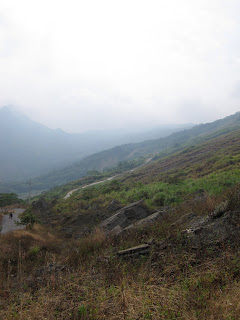
After a short climb there is a sign pointing left toward Jiufen Ershan right after the Xinfo Temple 心佛寺. This is the way to 18% grades. We stayed on this road and kept climbing. At some points I was way out of the saddle over my handlebars just to keep my front tire on the ground. It is a grueling assault on the quads.

The earthquake park is about 400 meters downhill from the crest. After a rest at the top we blasted down on a forearm bursting descent.


Traversing The Slide Zone

One of the strangest stretches of roads is the tooth-rattling descent across a debris field leftover from the earthquake. The road looks level, but it is an optical illusion and soon gravity takes over and you find yourself riding your brakes to retain control of the bike over the choppy pavement. It starts to dawn on you that you are rolling across a giant mudslide that could easily take off again at any time. Below there is a new lake that was formed after the quake. The geologic power of the earth is truly amazing.


Scars On The Earth

There is a small market at the bottom where you can pick up bananas and fuel for the ride back. Just behind the market is a house that is now sitting diagonally due to the tectonic forces of the earthquake. It brought back a lot of memories. There is one more hill climb up to a restaurant and a vantage point over the epicenter of the 921 earthquake. The entire landscape is turned ever which way. The striations of the earth point in all directions.
The House Is Gone

In the distance you can see a wrecked structure and check out the natural recovery of the local plant life. We hung out for a while and had some lunch amid locals who were making the most of the disaster by selling souvenir picture books and postcards. There is a desolate quiet about the whole area and the proximity to the center of such a powerful event was making me a bit nervous. I guess I am chickening out on discussing the impact of this ride, but I was really feeling unsettled by it.
Looking Back at 921


A Type of Orb Spider

The idea of going back up the mountain and, even worse, coming down the other side, made us reconsider our exit. We headed down the back side to the Nantou County Road #147. This road can go to the Highway 14 or out to Shui li. We decided to go to Shui li and took a right at the base.
A Formosan Deer Farm


Shui Gang's Ship... far from the sea.

After taking it easy on a long, flat road, we were soon climbing again. The climbs were shady and beautiful along gurgling creeks and through quiet valleys. Eventually we hit a fantastic descent to the Nantou Local Road # 131. I love the 131. The 131 makes me feel fast. It is wide, smooth... and mostly downhill. It empties out into Shui li, where we refreshed ourselves with passion fruit slushies before beating it back along the Highways 16 and 3 to Ming jian.


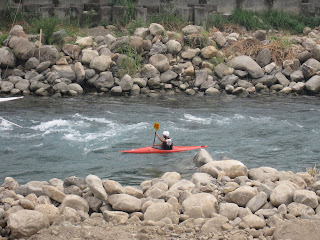
Kayaking in Shui Li


Links:


Thanks to Jason W. and Todd A. for the pictures and details for this post.


Bike route 348866 - powered by Bikemap 

Thursday, May 6, 2010

Support Taiwan


Taiwan is the center of my life and it is for all those who are living in this country. We are connected through an imagined community of experience and it is that experience of interacting within the frameworks of this society that gives us our sense of communion. Taiwan's culture(s) are and have always been in a state of dynamic change; adapting and transforming to conform to new realities and motivations. There is a social structure in Taiwan that is unique and each of us must come into contact with that structure in a different way, but it creates the structure of our lives and we learn how to negotiate it like a mouse learns to negotiate a maze. That is where our culture comes from.

Cycling in Taiwan is another way in which we can interact with our environment in Taiwan. Whether we are a Taiwanese, Foreigner or Alien, we are engaging and interacting with our environment. We are in contact with others. We make friends, chat with neighbors, visit the store, use the post office, cycle through rice fields and swear at passing cars. Everything that is going on within this structure is adding to the shared community. As an ethnic foreigner on Taiwan (yes, ethnic foreigner), I am often regarded as a hermetically sealed entity that can have no meaningful experience or impact on my community... or opinion for that matter. This is a false exclusion. I am part of the Taiwan experience and Taiwan is part of my experience. The way I interact with the structure of Taiwan is as a foreigner, which is different than a non-foreigner, but still an experience unique to Taiwan. Cycling simply allows me to engage in one more conversation with the land and people.

Through my experiences on the bike I add to my experience and my emotions attach to more parts of my world. I am a part of this space and I am not shy about standing up to protect MY HOME. I am proud of who we are on Taiwan and of the people we have become. I love my home and therefore I would like to pass along the following message:


On May 9th, FAPA-YPG would like to encourage all of you to change your Facebook Avatar to the image above.


======================
+++++++ THE CRISIS +++++++
======================

China claims that Taiwan is a "renegade province" that must be "reunified" at any cost. While threatening the people of Taiwan via 1400+ missiles aimed in their direction and refusing to renounce the use of military force, China has also isolated Taiwan internationally, blocking its membership in organizations such as the United Nations and World Health Organization. As a result of China's belligerence, many nations, including the United States, do not formally recognize Taiwan, instead adhering to a "One China" policy that fails to acknowledge the reality of "One China *and* One Taiwan."

======================
+++++++ THE TRUTH +++++++
======================

Taiwan is an independent, democratic, sovereign nation with its own government, its own territory, its own military, and its own people. China's campaign of "reunification" and "anti-secession" is nothing more than a propaganda effort to annex its democratic and prosperous neighbor.

===> Taiwan has been a part of China since...never. <=== Taiwan has been occupied by multiple powers (including the French and the Dutch) in the last four centuries. However, it has *never* been occupied by the People's Republic of China, a communist dictatorship whose rampant and systematic abuse of human rights are well-documented. ===> A casualty of World War II: Who asked the Taiwanese? <=== Prior to World War II, Taiwan was occupied by the Japanese for half a century. Upon Japan's surrender, Taiwan was occupied by the KMT (Kuomingtang), who had lost the Chinese Civil War *in China* to the Communists and fled to nearby Taiwan. The Allies appointed the KMT as temporary administrators over the island; however, the KMT promptly established martial law and ruled Taiwan with an iron first for the next 50 years. ===> The evolution of Taiwan's democracy: The Taiwanese people demand freedom. <=== Through the efforts of the Taiwanese people—many of whom sacrified their lives for the dream of democracy—martial law was finally lifted in 1987, which paved the way to a direct presidential election in 1996 and a peaceful transfer of power from the KMT to the Democratic Progressive Party (DPP) in 2000. In 2008, the KMT was re-elected into power. Through all this, Taiwan has never been part of the People's Republic of China. ====================== ++++ WHAT YOU CAN DO +++++======================

On SUNDAY, MAY 9th, 2010, which marks the beginning of Taiwanese-American Heritage Week, join the campaign: (1) Change your profile picture to the "Taiwan is Not Part of China" logo, the picture for this Facebook event. (2) Post the following message as your status and attach a link to this Facebook event: ++++++++++++++++++++++ ----------------------------

Taiwan is a free, independent and democratic country. Taiwan is NOT part of China. Help us tell the world by reposting this message as your status.

Giro Time: Giro d'Italia Saturday, May 8

The late Marco Pantani was a climber's climber and a thrilling rider to watch. In 1998 he won both the Giro and the Tour. That year he also won the Giro's Mountain Classification as well.

The Giro d'Italia (Tour of Italy) is already here. Three weeks of some superior cycling and daily rigors. The race has been won by Coppi, Merckx and Hinault, among other greats, and it serves as the preview for the Tour de France.

These grand tours are interesting to watch for the tactical aspect as teams rally around their star rider and try to safely escort him through the peloton while chasing down breaks and capping attacks. The pacing is much different than the Spring Classics and the variety of climbs, distance and Time Trials makes for great racing day after grueling day.

The leader wears the distinctive Maglia Rosa or "Pink Jersey" as opposed to the Malliot Jaune "Yellow Jersey" from the Tour de France...

Here are some links if you want to catch some of the action.

Happy Giro!!!


Wednesday, May 5, 2010

Ride Like A King Day


One final piece of Giant News to report:

No, the title of this post does not suggest riding an early 1990's Cannondale aluminum framed bike over potholed roads for 8 hours until you feel like you've been beaten by a half-dozen of L.A.'s finest. No, no...

May 7th will be the second annual "Ride Like A King Day", in honor of Giant founder and Taiwanese cycling spiritual leader King Liu. According to Bicycle Retailer Magazine, King Liu is still riding strong at a spry 76 years of age. If he is not too old to clip in and hit the road, nobody has an excuse. Three years ago Liu covered the 927km around Taiwan to help promote cycling in Taiwan. I absolutely hate hearing the "age" excuse for cycling. Nothing can make a person feel like a kid again than riding a bike.

Speaking of age:
Joe Freil has a great piece on age and diet.

My GIANT Night Out


Last night I had to pick up some replacement cleats for my Crank Brothers pedals. I love how the pedals function. They are easy to clip in and out of and I can clip-in from two directions. The mechanism doesn't get clogged with dirt. They're great... except for the cleat mounts.

The aluminum bolts are just too soft and mine started to strip the first week I owned them. The mounts would come loose and I would torque them down pretty hard and strip them out even more.

I finally found my "spot" and they haven't moved, but they've certainly worn down from me walking around on them and it was time to change them out. That is... if I could get them unseated from my shoes. The hex holes were too stripped to take a wrench and no amount of hammering could do it, so I headed around the corner to the Giant shop to see if they had more tools in their arsenal to deploy against my cleat. I think I may have made it more difficult by forgetting to lube a bolt or two when replacing them in a hurry. ALWAYS LUBE THE MOUNTS!

The Giant guys kindly took a hacksaw to the cleat and it was off in about 30 min. During my time in the store I stood there with a bemused look on my face as I watched the sales staff sell bikes.

A tall young woman nervously walked in an grabbed a big mountain bike with full shocks and disc brakes. She rode in a few circles around the store and then picked up a micro-bike with flat-bar and 20" wheels. She did a loop on that. By then a sales rep went over to assist and mainly stood there talking to the woman about the "feel" of the bike. The customer was riding bikes with seats that were 4-5cm too short and then being asked how it felt. At no time was the customer ever asked what purpose she intended for her bike; leisure, exercise, commuting, errands, group rides...etc. She was never sized. The sales staff just let the woman randomly guess what might be a good bike. After that they took her over to look at mountain bike helmets and biking jackets. Lots of people really don't know what options are available to them and what characteristics they should be looking for in a bike. A knowledgeable sales staff can guide a customer to make better choices. The bottom line is that only the rider knows what they want... but the sales staff can help the customer focus on what might better suit their needs and at least size them for a proper fit.

800 lb. GIANT Gorilla?


An interesting little article appeared in the Taiwan-based China Economic News Service aka Taiwan Economic News Service the other day.

According to the article, the Taiwanese bicycle mega-manufacturers Giant and Merida are poised to see substantial growth in the China market this year. The article states:

"Giant is now the No. 1 bike brand in terms of sales value and with the highest the average selling price in the Chinese market for bikes. To cash in on the growing demand for leisure bikes in the market, the brand has launched a new sub-brand, Momentum, this year, which, bolstered by Giant`s solid brand recognition among Chinese consumers, is expected to help to boost the brand`s overall share in the market in the future.

With the aforementioned marketing strategies, Giant confidently expects steady growth in its sales volume and value of own-brand bikes in the Chinese market in the coming years. Presently, the brand runs three manufacturing factories in China, which have totally achieved annual output of over 3.7 million bicycles, with a majority of which for sale in the domestic market."
It is no revelation that growing affluence in China is driving many sectors of Chinese society to consume on levels that may match and even outpace their global counterparts in terms of their desire for the prestige of consumer goods.

What really interests me about this article is what this trend means to the old Fei-Ge or "Flying Pigeon" brand of bicycle and even the Taiwanicization of Chinese culture.

In Taiwan we are used to understanding culturalization programs from the receiving end of different state centered programs to colonize and transform the people of Taiwan into something more desirable to the state. Over the past 60 years Taiwanese have been subjected to the Chinese Nationalist culturalization program that positioned Taiwanese people and cultures in terms of "inferiority", "backwardness" and "weakness" in consideration of the Taiwanese willingness to cooperate with the Japanese colonization program. Beginning in the 1950's the R.O.C. government on Taiwan instituted several items of culturalization legislation aimed at transforming Taiwanese people and cultures to conform to the ideals of the highly centralized state culture of the R.O.C. -- to transform Taiwanese into Chinese.

Taiwanese are used to seeing their cultures under assault from the "other" and Taiwanese have also sought out and adopted many new cultures into the dynamic discourse of "Taiwaneseness". It could be argued that The United States served as Taiwan's cultural center for much of the post WWII period as strong Americanization filled the gaps left by Japan. It is through the process of local interpretation that these symbols and meanings became "Taiwanese" culture rather than the mysteriously applied and poorly defined measurements of "mainly Chinese with Japanese and American influences". I would go so far as to argue that "Chinese culture" is a bogus term outside of the current nationalist construct. Still, there is a continuing battle between the constructed "sinicization" promoted by the Chinese Nationalist Party (KMT) and "localization/indigenization" of people who view Taiwan as the center of their world and their culture.

From Taiwan we still, and rightly so, see China as a potential hegemon. As China's economic power increases, the Chinese will be more able to project their interests beyond China's borders and attempt to draw the periphery closer to the center. Of course the periphery can never occupy the same space as the center and will always remain "peripheral". Still, the questions raised by the CENS article ask us to consider the possibility of and response to the "Taiwanicization" of China. It turns the equation on its head and begs us to examine the impact of Taiwanese culture on the Chinese.

Giant and Merida are Taiwan's two largest bicycle brands. Giant is the "kleenex" of bicycles in Taiwan. I do not know how often I am asked if my Salsa branded bicycle is a Giant. But beyond simple brand recognition there is a real sense of national pride in Giant. It represents the "Taiwan Miracle", it validates the sense of Taiwanese accomplishment and acceptance in the world to help counter the Taiwanese tragic lack of self-confidence that has been cultivated through a failed Chinese nationalization program and Taiwan's shameful diplomatic isolation (and the appeasement policies that have been promoted to avoid defacto Taiwanese nationalism). Giant has become an expression of Taiwanese economic and leisure cultures.

Now Giant is poised to take over the Chinese market, which has been dominated for decades by the ubiquitous Flying Pigeon. The Flying Pigeon is China's major domestic supplier of bicycles. Although it was originally founded in Tianjin by a Japanese businessman, the Flying Pigeon was taken over by the state following the Chinese Civil War and it essentially grew into China's national bicycle in much the same vein as Hitler's Volkswagen-- a cheap form of transportation for the masses.

The Flying Pigeon virtually became a part of daily life for Chinese. It pervaded Chinese cultural life as it transformed China by providing not just physical, but economic mobility for millions of citizens. Much like Giant in Taiwan, the Flying Pigeon symbolizes something greater than just the bicycle in the imaginations of the Chinese people. It is an icon of Chinese cultural life and of the Chinese experience that most people who live outside of China can not really understand. The Flying Pigeon is the type of shared symbol that breeds culture and now Giant is poised to replace it.

It makes me wonder at what point Chinese people will begin to develop a sense of nostalgia and start to seek to protect and retain the contemporary symbols of Chineseness rather than simply promoting the silly myth of "5000 years". Will they resent Taiwanese (and others for that matter) for their own cultural hegemony as Taiwanese bring their culture with them to China and inadvertently engage in replacing Chinese culture with Taiwanese ways of doing things? Will the Chinese cultural pendulum eventually swing back as they fight to hold on to the symbols of their unique and special experience?

It makes an interesting scenario.

Monday, May 3, 2010

Students Bike Around Taiwan

Taiwan Today reports on a group of 113 students from Hsin Dian who just completed a 12 day trip to circle the country by bicycle.

I think young people should be allowed to participate in more events like this to gain a greater understanding of their home and their environment. The bicycle allows people greater access to Taiwan and removes the natural beauty from the constant framing of a car window.

Here's the whole story:

A group of 113 students from the Kang Chiao Bilingual School in Xindian, Taipei County, recently circled Taiwan by bicycle in 12 days, covering some 1,000 kilometers and raising NT$170,000 (US$5,423) for charity.

They finished their trip May 1, being welcomed by their parents and classmates back in Xindian. Along the way, the students performed music and gave talent shows to raise money, which will be donated to the Taitung Bunun Cultural and Educational Development Foundation.

Principal Chang Chi-long said each student who participated in the tour did so in the spirit of overcoming difficulty and hardship, and every one of them completed the tour. Chang said he is very proud of them, and that the whole school is congratulating them on their achievement.

Chang said the tour was an arduous and lengthy trip, a real rite of passage for the students, who are all under 16 years of age. The school is going to publish a book to commemorate their efforts on the trip and chronicle the preparation and training they put in before departure.

Director of Academic Affairs Chuang Sheng-li accompanied the students for the whole trip. He said according to his close observation of the students, they matured a lot along the way. The trip was intended to build their endurance, interpersonal relationships and leadership—all things that are very difficult to teach from textbooks alone, Chuang added.

Chuang was most moved by the fact that although 12 students were injured or fell ill over the course of the trip, not one of them was left behind. With the support and encouragement of their classmates, the students managed to complete the entire course together with their friends.

Team leader Lu Cheng-hsiang said the trip tested more than simply physical stamina. The young people also had to work together to overcome difficulties, particularly in helping some of the less physically fit students. Doing so, and successfully avoiding leaving anyone behind, made a huge contribution to the cohesion of the group.