As I try to unsuccessfully shoehorn too much information into too little space, I will write a little history behind an amazing bike ride.
A few weeks ago we did a tour around Taiwan’s Heng Chun Peninsula, which was not only a marvelous scenic tour, but it also provided a very provocative backdrop for some much larger issues that continue to swirl around the current geopolitics of East Asia.
In the words of the historian, Paul Cohen, history can be divided into three basic pieces; event, experience and myth. The event makes its presence known through the simple act of recording an event to inform others. The experience is made up of the subjectivities of witnesses whose points of view and biases contribute to a full, layered understanding of the event, limited only by the perception of the senses. The myth is the third, and most controversial aspect of history, in which political actors deploy the event and experiential aspects of history in an attempt to subvert them into a narrative that serves to promote and extend the ideologies and political goals of a given power.
The implications of the events that took place between 1871 and 1874 in the Mudan area on the Heng Chun Peninsula would not only serve to shape Taiwan’s experience, but the effects would resonate throughout the 20th Century and echo deep into the framework of contemporary foreign policy, state ideology, ethnicity, political gamesmanship and conflicts of sovereignty or suzerainty.
The events sparked in 1871 by a passing typhoon and their later implication are again brought to the fore in light of the recent row between Japan, China, Taiwan and the United States over the disputed Senkaku islands. The intelligent and insightful academic and blogger, Michael Turton, who also joined us on our ride, has been keeping a detailed commentary on the recent Senkaku dust up here, here, here, here, here, here . I hope this piece will not only delve into Taiwan’s unique history as a Pacific society (which is too often framed by its relationship to China as opposed to other islands or political entities), but I also hope I can add a little depth to understanding the historical and future emphasis regional powers have placed on projecting their power into the Pacific.

Sign Along the 199
The Okniawa (Ryukyu) Island chain, which spans the sea between Kyushu and Taiwan, had been a dual tributary state of both the Ming, and Satsuma daimyo. Although the Ryukyus were governed as a separate kingdom, the powerful Satsuma Shogun invaded in 1609 to bring the Ryukyus under its sway. The Ryukyu kingdom existed simultaneously as a tributary state to the Satsuma, Tokugawa and the Ming. By the late 19th Century, the powerful shogun behind the emperor, were looking to expand their newly consolidated power beyond the traditional borders of Japan as the leaders of the “Yellow Race”. The Meiji Emperor placed the Ryukyus under the administrative control of Kagoshima prefecture.
One the eve of November 6, 1871, Taiwan was governed as a special frontier prefecture of Fujian Province. Most of Taiwan was regarded as existing “outside the realm” with the Qing only claiming to exercise tenuous control over specific areas delineated by a border, which was sporadically enforced by military colonies consisting of Plains Aborigines. The mountainous interior and the East coast lay “beyond the pale" and was characterized by Qing gazetteers as a savage and barbaric place, inhabited by a savage and barbaric people.

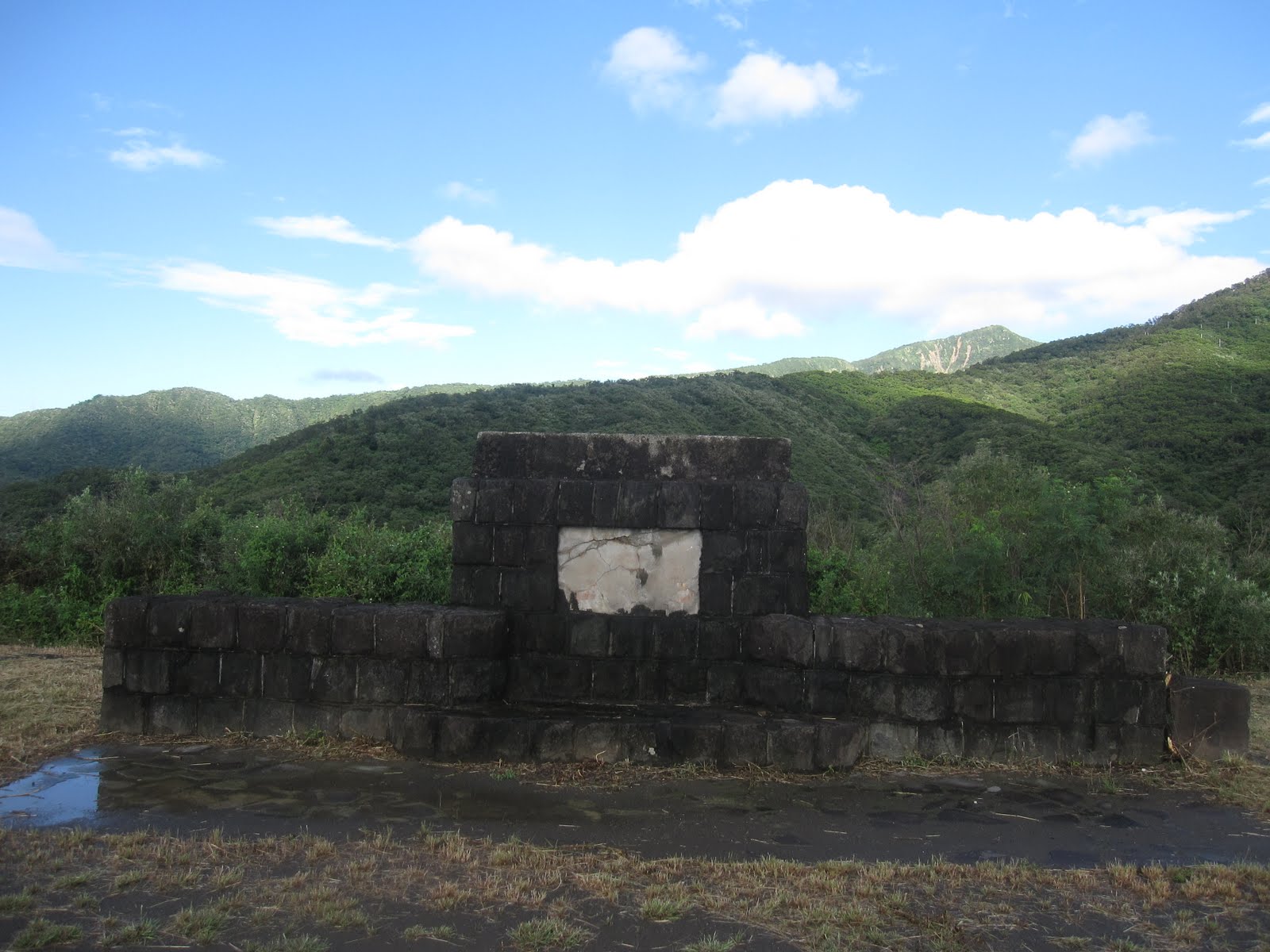
Original Grave Marker
The Wreck:
On October 18, 1871, a small flotilla of ships carrying Nintouzei taxes, sailed into the path of a late typhoon. One ship was thrown far off course and on November 6, wrecked on the eastern coast of Taiwan’s Hengchun Peninsula. The 66 survivors hiked into the mountains in search of salvation and soon came upon the village of Mudan.
Some stories of what transpired differ, but one popular telling is that the Mudan captured the Okinawans and brought them to some local Hakka businessmen and their Plains Aborigine interpreter to trade for valuable goods, such as bolts of cloth and metal.
When a deal could not be reached the Mudan became enraged and began killing the Okinawan sailors. When the carnage was over only 12 Okinawans remained alive and were shepherded out to safety. The Mudan collected the severed heads and returned to their village with plenty of skulls to fill a head shelf.
The businessmen and the interpreter collected the corpses and built a small tomb for the headless bodies and took it upon themselves to become the caretakers of the tomb.

Japanese Memorial Stele
The Taiwan Invasion:
Three years later Japan was eager to begin testing the waters for its future colonial ambitions and further sought to test the resolve of its powerful neighbors in the face of Japanese expansion.
In May 1874, Japan used the earlier murder of the Okinawan sailors to demand compensation from the Qing. In doing so, Japan ultimately asserted a retroactive sovereignty over Okinawa and further mounted a challenge to the Qing commitment to Taiwan.
Initially, the Qing refused, claiming that the sailors were killed outside Qing jurisdiction and thus the government could not be held responsible for their deaths. The rejection of Qing sovereignty over Taiwan’s interior paved the way for Japan to send an expeditionary force to Taiwan in a “punitive” campaign against the Mudan.
In May 1874, the expeditionary force numbering 3600 men, landed around Checheng to begin operations against the Mudan. The Japanese claimed the operation was a major success in the Battle of Stone Gate, with approximately 30 indigenes killed and 29 Japanese either killed or wounded in action. It has also been recorded that 561 Japanese soldiers died of malaria.
In the end the Qing relented and agreed to pay 500,000 taels of gold and a Japanese police force entered Okinawa to enforce a Japanese ban on trade with the Qing.

Mudan Villager
The Political Fallout:
Japan’s experience during the Mudan incident framed the relationship between the Japanese Empire and its future colonies in the Pacific. The events that transpired on the Heng Chun Peninsula between 1871 and 1874 further defined how the Japanese civilizing project would conduct its relationship with indigenous and colonized peoples in its push into “the south” and reconfigure the Japanese empire into a far reaching, multi-ethnic polity.
Following the trumped up indignation at having its Okinawan “barbarians” murdered on Taiwan, in which the newly reconfigured empire successfully projected military power overseas, Japan embarked on its first colonial venture in Hokkaido (1884) in which the Meiji government instituted an official policy to bring their plans for colonial expansion to fruition. The resulting Japanese policy on Taiwan, which Japan acquired in 1895, published twenty years before the onset of their rule on Taiwan, cast Taiwanese aborigines as "vicious, violent and cruel" and concluded "this is a pitfall of the world; we must get rid of them all"
The indigenous people on Taiwan and on other islands were regarded by the Japanese project as savage, bloodthirsty wildmen who needed to be exterminated or transformed through Japanese colonialism into “loyal subjects”.
Japan continued to assert itself in the Asia-Pacific region as capable civilizers and administrators of savage frontiers. Following its League of Nations trusteeship over large tracts of the Pacific, which it would later colonize, the Empire of Japan succeeded in joining the European powers on equal footing.
The Mudan Incident was viewed by the Japanese as such a pivotal event in its path to greatness, that it became the site of Japan’s first colonial monument. In the 1920’s a stele marker was placed at the Okinawan grave-site, which memorializes the grave of “Greater Japan’s Okinawan Barbarians.” The wording is novel in that it encapsulates the Japanese colonial view of “Greater Japan” or “大日本”. Moreover, it uses the common and arguably pejorative term, Okinawan Barbarians“琉球藩民“ to firmly place the Okinawans within the Japanese colonial framework as inferior and in need of Japan’s civilizing project. A larger monument and Shinto shrine was placed on a hill overlooking the Stone Gate battlefield.

Battlefield Monument: Faded Words "Formosan Race" before those words changed in meaning.
Transformation
With Japan’s defeat at the close of WWII, Taiwan was placed under the administration of Chiang Kai-sheck’s Republic of China pending a formal solution to the problem of Taiwan’s sovereignty after 50 years as a Japanese colony.
Due to several factors involving regional and global powers, Chiang’s ROC was forced to retreat from China to Taiwan, where the Chinese nationalists used their monopoly on power and US aid to remain as a single party authoritarian state that represented only the views of a very small minority of Taiwan’s population.
The ROC enforced its own form of colonization on Taiwan that mirrors the Japanese effort in many ways. Taiwanese were often excluded from joining the powerful mainlander elite for their inability to reconcile the Taiwanese experience as Japanese colonial subjects with the ROC; a government that viewed Taiwanese as Japanese collaborators.
For the ROC, the Mudan Incident and the surrounding historiography was reimagined by the central state apparatus to conform to the anti-Japanese undercurrent of Chinese nationalist ideology. Indigenous revolts against the Japanese were recast as being “pro-Chinese nationalist” in nature, and indigenous peoples were portrayed as “High Mountain Chinese Compatriots” loyal to the teachings of Sun Yat-sen, which, ironically, cast the indigenes as inferior.
As symbols and figureheads of the Japanese empire were replaced with symbols and figureheads of the ROC, the markers at Mudan were redeployed as expressions of “Greater China”. The monument overlooking the battlefield at Stone Gate was re-inscribed with the now faded characters for the “Taiwan/Formosan Race”—an attempt to draw the indigenes of Taiwan into the racialist construct espoused by Chinese nationalism which calls for Han race to rise up as the master race of Asia and lead the “degraded peoples” to glory against the European powers. Echoes of these views can still be heard in the rhetoric Taiwan’s president, Ma Ying-jiu uses on occasion when defining his goals or discussing indigenous peoples.
In a more curious move, during the 1970’s, at the height of the first clash between the governments of Taiwan, China and Japan over the Senkakus, the marker of the Okinawan grave was defaced to remove any reference to “Greater Japan”, and its claim to Okinawa. This move not only erased the Japanese from the story, but it also effectively treated Okinawa’s sovereignty with an undertone of ambiguity, with the inference that it could be read as “our” Okinawan barbarians… the “our” meaning “Chinese” and advancing territorial claims further into the Pacific – thus laying a retroactive territorial claim to a set of pacific islands.

Shi Men Battlefield
Conclusion:
With the new dispute over the Senkaku islets, in which Taiwan’s ROC government has again inserted itself on behalf of some imaginary traditional Chinese racial nation, the Chinese, with the help of Taiwan’s government, are beginning to resemble the early Japanese empire as they selectively historicize events to fit their political projects and make anachronous and selective claims to a set of Pacific islands that can become another prefabricated conflict with a view on unrelated political ends in a bid for resources and regional influence.
In the midst of a 21st century conflict the Mudan Incident stands as a historical backdrop to the events that are currently unfolding in the Asia-Pacific region.
Our bike trip through the Mudan battlefield could not have been more appropriate for these interesting times.
*Thanks to James Boyden of Sponge Bear for some advice on the proper Japanese nomenclature* 

 It was pretty easy going the entire way down to Zhushan, but the traffic on Highway 3 always sucks. You can just see the start of the 149 on a little road off one of the major intersections. The road is also where the 49投 empties out off the Sanlinxi, beyond Lugu. That is a climb for anther day.
 We passed the gate of the Deshan Temple (德山寺), which traces its genealogy to a temple constructed in 1765, has only been based in its current location within recent memory.
  At the base of the temple we noticed a strange set of Christian and Han style graves scattered about at odd angles adjacent to another odd collection of graves and memorials. These little discoveries make the long rides worth every long hour of pedaling. I will save my commentary for another post.
 What was really noticeable was the economy at work in the foothills. As we rode along the 149, the local economy shifted from rice farming, poultry and light industrial, to forestry products.
 By forestry products I mean tea, coffee, fern, palm, betel, timber and other products that can not be easily manufactured on the plain or through wet farming. I think this has as much to do with Taiwan's social history as it does with the natural environment. I might seed the thought a little bit with the question, "How did these people get here to do what they are doing?"