body{background-attachment: fixed ! important; }

Tuesday, December 28, 2010

2011 Giro Course Announced... and Looks AMAZING

I really enjoyed last year's Giro and ever since the 21st stage ended on the last go round, I have been looking forward to the next one. I was far more interested in the 2010 Giro than I was in the Tour de France.

This year it should be a treat for climbers and several of the obstacles will surely provide plenty of suspense and action. Check the Velonews report.

I guess following cycling is a lot like following golf. It really doesn't make a lot of sense until you do it yourself. Once you know how hard it is to climb and descend off a mountain do you really appreciate what these guys are doing in the pro ranks.

Bravo!

Sunday, December 26, 2010

Shimano Di2 Electric Boogaloo Ultegra: Do Cyclists Dream of Electric Shifts?


On the tech side of things it appears Shimano is looking to increase its lead over industry rivals in the realm of gruppo gadgetry. Last year Shimano successfully unveiled and tested its Di2 electronic shifting system for their flagship Dura Ace component set.

Aside from some very core philosophical prohibitions, the ride-by-wire system is also prohibitively expensive. The gruppo costs about $4000 USD, which is pretty steep to simply replace some very good systems for manual shifting. Review

Now comes word that Shimano is preparing its second wave against Campagnolo, which had been ready to push the innovation envelope to 11, with its Super Record 11 Speed gruppo.

Shimano is preparing to launch the Di2 Ultegra gruppo, which seems to be priced more reasonably at around MSRP $2700 USD.

This recent move would seem to put pressure on SRAM, which has seen a meteoric rise in popularity over the past few years with its "Double-Tap" system, marketing strategy and light components.

Campy had been caught a little off guard and is now hurrying to get their own electric group set to market. So far they are in advanced prototype testing, but have nothing ready for the market.

My question remains.... What do I need electric shifting for?

Would I use it if it fell into my lap...? Probably...

ADDED:

I couldn't help thinking about this a little more.

Although I hate to construct false dichotomies drawn along narrow and essentialist lines... but it seems there are amateur/recreational cyclists out there who are always looking for technology to give them a "boost" in performance.

For these cyclists, the manufacturers, and the newest technology they offer, will always be the elusive ticket to better cycling... and "elevating" their performance "above" their amateur skills. The key to better cycling is in the gear. Lighter and more aero composite frames, lateral stiffness matched to vertical compliance... a gram here and a gram there... and of course... electric shifting. In this case the margin for improvement is imagined to be greatly increased by the degree of new technology used on the bike. The technology in the bicycle makes the ride. There is often a bit of fantasy or a placebo effect going on, in which the rider will imagine greater gains when using the newest technology. The Di2 system is definitely for them.

On the other end of the spectrum is the person who takes a rider centered focus and views performance in terms of the human output, shifting the values from the technology to the rider. All but a handful of human beings have the training and genetics to become a professional rider where the new technology might actually mean a millisecond in a race where a place on the podium may mean the difference between a an ice bath and sponsorship deal and simply an ice bath. Riders who focus on the human aspect come to terms with the fact that they are human beings who, after a certain age, begin to slowly degrade until our bodies fail us and therefore have to make the most of the body and brain to keep in top form. There is not the misplaced belief that a manufacturer out there has all the answers to better riding and only a monetary sacrifice on the altar of free enterprise can bring about the desired results.

For the people who do not feel the ride is in the technology, the Di2 system is just another system trying to sell the faithful a little Harry Potter magic and pixie dust from the wings of a flying unicorn.

Taiwan Bike News:

Taiwan Narrowly Escapes Invasion. Man on bike steals from Taiwan.


Links:

Saturday, December 25, 2010

Bike Stuff Under The Tree?

This year we were a little restrained in using Christmas as an excuse to buy bike parts, but I saw some friends out there cleaning up with all kinds of droolworthy goodies.

James, from Sponge Bear, got his daughter off right with a new bike, and Virginia, the former blogger from Cycling Taiwan, found SRAM Red in her stocking.

I ended up having to buy a new bottom bracket for my bike. For at least a couple weeks I have been chugging along on a squishy, barely operational BB. After over 25,000km it finally had enough. The new one is spinning so smooth and stiff.... ahhhhh!


I also picked up a stronger pump for trips further afield. I just don't trust my CO2 very much when I am far from a trying my luck at a pump equipped 7-11. I bought this slim little LEZYNE frame pump for my mountain rides.

I hope all of you had a happy holiday, whether you celebrate Christmas or not. An excuse to get outfitted with more bike stuff should never be overlooked.

Anyone else get bike goodies?

Thursday, December 23, 2010

Taiwan's Unofficial KMT Mouthpiece Touts Cycling


The current issue of CommonWealth Magazine (天下) locates "The Six Lures Hooking Foreign Visitors". The introduction to the article identifies Taiwan's difficulties in competing with Europe and Japan for tourism dollars and then seeks to contrive emotive experiences for potential visitors.

Most of the article focuses on the mythologized "round island trip" and a character called "Frog", who has leveraged a sizable capital investemnt in bicycle tourism.

The whole article is really worth a read as it gives us a glimpse inside the dissonance between the actual cultural life in Taiwan and how that cultural life is imagined, constructed and promoted by a powerful minority of ideologues who seek to engage locals and visitors alike in the realm of wishful make-believe.

CommonWealth Magazine is a publication that founded in 1981, during a brief period of liberalization in the era of martial law, in the indirect aftermath of the Chung-li incident. CommonWealth has traditionally been aligned with the beliefs of the Chinese Nationalist Party (KMT) and, in earlier days, the Government Information Office, to promote a sinocentric outlook for Taiwan.
Taiwan's people seem more smitten with Europe's streetscapes and Japan's culture than their country's own beauty. But CommonWealth Magazine has identified six major lures that overseas visitors have come to appreciate.
It is in the context and juxtaposition of CommonWealth's traditional political alignment/ideology, and its current lamentation for promoting Taiwan to foreigners that I find this story very interesting.

For the entire period of KMT initiated martial law, beginning in 1949, until the end of Lee Teng-hui's first term as president following the death of Chiang Ching-kuo, Taiwan's late dictator, Taiwan's separate cultural and ethnic identity had been degraded within the framework of the ROC into an undesirable "local" flavor that was to be gradually replaced with the modernist state high "Chinese culture" invented and promoted by the KMT in China.

Chinese nationalist critics, like CommonWealth, have claimed for decades that Taiwanese had "no history" or culture. They have contended that Taiwanese were culturally "traditional Chinese" (as opposed to those modernist Chinese in the KMT who had jettisoned their "backward" traditions and thus making them fit for leadership), and that the concept of a separate Taiwanese identity and culture is merely the result of contemporary political careerists.

I would argue against this position as Taiwanese have not only followed a different socio-historical trajectory than other people around the world, including Chinese, they have also lived within a separate Taiwanese socio-political structure that delineated how the people on Taiwan would interact with their respective governments and with each other, across the lines of ethnicity, class and, later, political affiliation. Qing era Taiwanese were definitely aware, from as early as the 17th Century, that their experience was an exception within the Qing Empire. This is reinforced by the myriad of special laws and decrees issued specifically to manage Taiwan's unique ethnic and cultural landscapes.

I find sad irony that such a staunchly conservative publication, such as CommonWealth, would now seek to promote Taiwanese culture after being so aligned with the Chinese nationalist establishment that spent, and still spends, so much effort in fruitlessly trying to transform and align Taiwanese culture with the idealized "Chinese high culture" invented and distilled for the Republic of China in the 1930's.

In June 2007, after Yang and three friends circumnavigated Taiwan by bicycle, he decided to leave the online game company he was working for and devote himself to running his biking haven, the Frog Café. He was so enthralled by the spirit of adventure and feelings of attachment for his native land he experienced during his tour of Taiwan that he wanted to encourage young people to share the adventure.

Yang invested NT$200,000 in 15 bicycles kept at his Bali outlet that are available for people to rent or borrow. Those who submit a simple "Frog Round-Taiwan Bicycling Sponsorship Plan" online, pay a NT$500 maintenance fee and contribute NT$500 to a fund for sustainably promoting biking around the island can use the bikes in Yang's shop for an unlimited number of days.

"Surprisingly, the first person to submit an application was a woman from Hong Kong. She said she wanted to use the bicycle to get to know Taiwan's beautiful natural scenery," Yang says.

After that, many other ethnic Chinese, from Chinese exchange students to Malaysian office workers, took advantage of Yang's plan to tour Taiwan's mountains and coastline.


What really caught my eye was the repeated focus in the CommonWealth article on, "Ethnic Chinese".

This is a very loaded term and a contrivance that comes directly from the core of Sunism and its ambiguous friction between concepts of race, ethnicity and the nation.

Chinese nationalism seeks to construct a global net of "Overseas Chinese", who are forever bound to "the nation" by blood. Scholars like Dru Gladney and David Wu have done a marvelous job in unraveling the political construct we know as "Ethnic Chinese". This term is actually more an artifact from the old Sunist lexicon than representative of a non-political imagined community.

Contemporary Chinese nationalists have tried to come to grips with the post WWII world, in which the old Western colonial enterprises withdrew, Tibetan, Sichuanese, Uyghur, Yao and other nationalisms failed, the Japanese Empire withdrew... and yet the people remained were bound by their shared experiences and not by an imagined darwinian blood linkage. The Chinese nationalists coined the term "Greater Chinese" to lay some form of ownership over most of East Asia.

This CommonWealth article is rife with evocations of this imagined "Chinese culture".

Among other attraction they hope to promote Taiwan's "Rural Villages" because:
These destinations all showcase pastoral landscapes that are so poignant, they evoke deep emotions in many ethnic Chinese. Community-building efforts have generated a vitality similar to that of the spring planting season, when the soil is broken up and new seedlings germinate, yielding unique green sightseeing opportunities.
...further stating:

In recent years, Taiwan's leisure farms have even developed strong name recognition in Singapore and Malaysia, drawing many ethnic Chinese families from the two countries.

More than 140,000 foreign nationals have already visited Taiwan's recreational farms this year, according to statistics from the Taiwan Leisure Farming Development Association, signs that a 20-year campaign to build tourism around local agriculture is having some success. The initiative first positioned farms as tourist orchards, and then they slowly evolved into integrated recreational areas complete with restaurants, accommodation and DIY farming experiences.

In another passage CommonWealth attempts to highlight Taiwan's cultural particularism while failing to fully backtrack from the logical impossibility it asserts... that... somehow Taiwan is "more authentically Chinese than China".
In recent years, the country's dynamic and enterprising cultural creativity has generated many commercial festivals attractive to the ethnic Chinese community that bear little resemblance to traditional holiday celebrations.
The following quote emphasizes the Chinese nationalist view of their right to cultural hegemony in the face of cultural particularity.
"What we are selling is Taiwan's outstanding lifestyle, attitude and aesthetics. We examine our vision of life and hope to successfully communicate an interpretation of ‘life' with everybody, or at least with all ethnic Chinese,"
One of the most revealingly incongruous quotes from the CommonWealth article comes in the form of this little gem:

Preserving the Spirit of the Country Scholar

Because most guesthouses are situated in the countryside, they allow foreign tourists to experience the life of the traditional Chinese countryside scholar, as preserved in Taiwan. Pei Chin, the owner of the Riomont Penthouse in Yilan County, lived in California for 25 years before returning to Taiwan and was stunned to find traditional agrarian scenes everywhere.

"The forgotten practice in Chinese culture of pursuing learning while tilling the soil was somehow preserved really well in Yilan County," Chin says, and this was one of his inspirations for opening his own guesthouse.

The lesson from this article and others like it, that seek to promote cycling and leisure activities in Taiwan, is that much of what is being touted and sold is a figment of the imagination born in the minds of political actors intent on authenticating and framing Taiwanese cultures and experiences to fit a narrow trope and appeal to their own fantasies and the fantasies held by others. They simultaneously acknowledge Taiwan's separate, non-Chinese identity through the exoticizing lens of tourism, while trying to maintain congruity with their monocultural Chinese nationalist ideology. The apple cart upturned.

Also:

Wednesday, December 22, 2010

Death An Expected Part of Cycling?


It is the holiday season again, and this is the time of year when I conduct my annual White Elephant gift exchange. Every year there is at least one student who tries to fudge the rules and cheat just a little bit by giving a second hand gift, or having mom go out and choose something stupid.

The rules are very clear: 1) Buy a gift valued between NTxxxx and NTxxxx. 2) Choose the gift yourself. 3) Choose a gift you wouldn't mind getting yourself.

These simple rules outline a sort of Rawlsian idea of Justice as Fairness and I can often use it as an example to teach some very basic ideas about justice, law and following even the little rules.

I will choose some examples in society where people try to "cheat" just a little bit and decide to break a small rule, that can have dire consequences. I usually choose construction codes and traffic.

Yesterday, a couple days after this explanation, one of my students returned from a one-day absence and I asked where she had been. She had been at her aunt's funeral. Her aunt was only 38 years old and had been riding an old bike to one of the markets.

Someone had decided to blow a red light, because they were in a hurry, and killed her aunty.

As a cyclist this really strikes a nerve. I am even more upset when I think about how the government spends money on cycling tourism over making an overall riding environment that is safer by enforcing the laws and managing safe bikeways.

I am sure this is "bad voodoo", but here is a sample of just some of the stories that have been circulating over the past month or so from the English speaking press.

Taiwan's traffic situation is much worse.


Sunday, December 19, 2010

Hill Tour of Nantou County:183km and 2268m of climbing

Taichung From On High

After an uncharacteristic week of cold and rain, the weather looked promising for a long weekend ride. I really felt like I needed get a punishing single day ride under my belt if I was truly going to climb back into form... and climb I did.

The plan was for a solo-ride over five or six good hills between Taichung and Nantou counties. I really preferred to solo this ride as there was a high possibility of failure and I didn't want to drag someone down with me. Only I could answer the age old question: When a cyclist fails in the forest, does he make a sound?

Friendly Riders

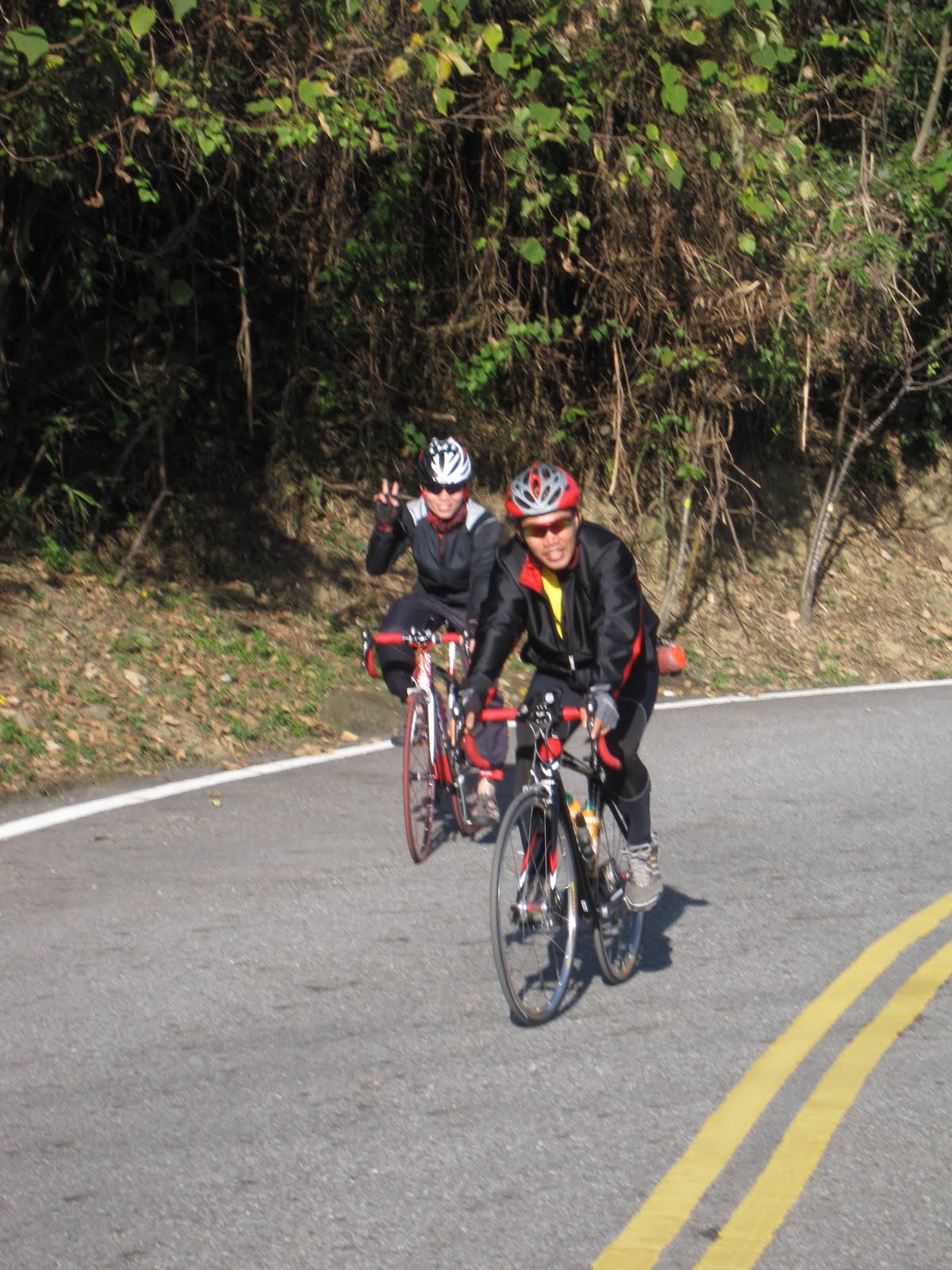
I started by climbing out of Taichung City up the notorious 129 from Dakeng. The death-spiral takes you up to a plateau overlooking Taichung and Fengyuan cities. The weather was cold, but relatively clear and sunny. I had a bit of a sore throat and post nasal drip that just made the first hour a pain. I decided to carry the Camelbak on this trip to reduce water stops and to have a little extra space to stuff food and clothing.

My plan had been all about pacing and thinking about the ride in parts rather than as a whole.

I easily spun up the 129 and practiced carving into deep corners on my way out to the Highway 21 between Taichung and Nantou counties. I have always been a bit of a puss with corners, but a little practice had gone a long way in giving me the confidence to attack them with a little more grit.

View From the Top of Highway 21

By the time I hit the Highway 21, I knew I had been taking things relatively easy and had done it much better in the past. I tried to convince myself it was a controlled speed, but I also feared it was all I had. I felt better as I passed a small group of riders who were climbing the 21 with fury. I hung back and chatted them up and then finished my ascent. I ticked another peak of the day's menu and was still feeling good. The mountains looked like a multi-layered, translucent stage backdrop, with each set of mountains floating behind the rest to give the illusion of depth.

View Toward Mountains

The descent down the Highway 21 is always a thrill. I didn't push too hard and continued my work on corners. I tried to pick a line and stick to it.

As I was coming out of the village of Guoxing, I was just cresting a steep, little hill before the junction with the Highway 14, and I noticed a couple uniformed men with reflective stripes on their jackets and a few people milling around on the side of the road.

I immediately assumed a temple procession would be coming by as there were placards of faux garlands posted up around the adjacent school. I stayed alert for the train of tour busses packed with pilgrims or for the palanquin parade to weave down the street.

It is truly amazing how life can pass so quickly and we can hardly remember most of it. At the same time there are some images that may pass in just a second and we can recall every stirring detail.

As I approached the uniformed men, they looked listless and ill. There was frantic commotion in the betel nut field below the road as a half-dozen people were bent over the flames of a blue-smokey fire as they frantically flipped spirit money into the heap of burning paper..

I passed at 30kph, but I could clearly see the shape of a body lying under a pristine white sheet about 5 meters away, amid a hundred thin trunks of betel nut trees.

The sheet covered most of the body except for the a pair of booted feet and two ashen yellow hands, palms upturned with fingers half-curled. The image reminded me of the old Frankenstine movies with the monster under the sheet waiting for the reanimating jolt of electricity.

He may have been hit by a car or had a heart attack in his field. Maybe he fell into the fields in a drunken stupor and the cold night air got too him. I will probably never know.

Just as that man's life had so quickly passed... as did I.

Valley

Despite the unexpected dead body at the side of the road, I continued along my route on the Highway 21. There is a short climb that offers the most magnificent views of a tight river valley that seems to sit at the bottom of a punchbowl. I always enjoy riding through this valley, but I can do without the climb out to another plateau above Puli. I was feeling a little tight in the legs by this point and the road that bombs into Puli is worth any climb. I made it to tick the third peak off my itinerary.

Sprouts

The plateau overlooking Puli is a bounty of agricultural beauty. The red soil and symmetry of the crops is a sight to behold. After a good climb the flats were just what the legs asked for.
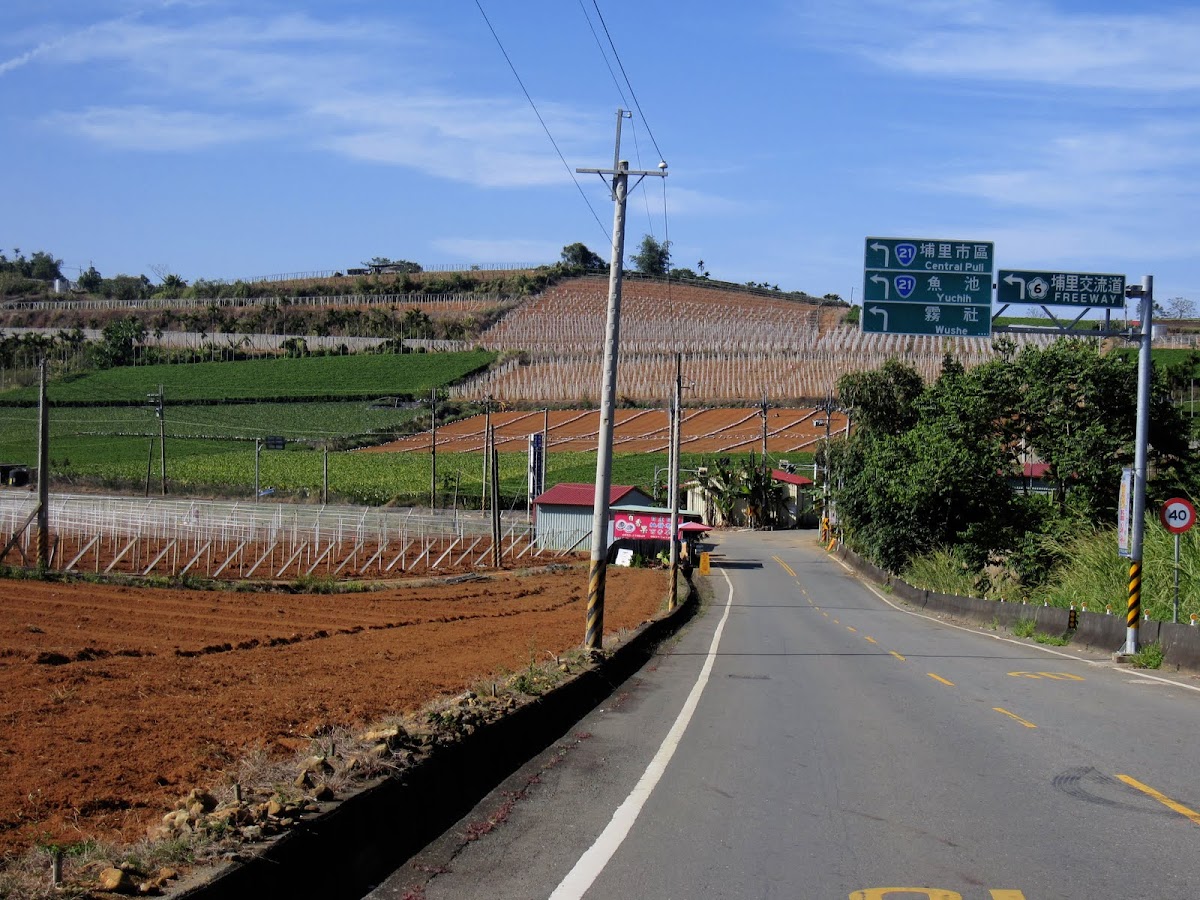
Plateau Above Puli

All too soon I came screaming down the mountain to Puli, where I restocked and had a quick coffee.

Sun Moon Lake

From Puli the Highway 21 starts a long, steady ascent toward Sun Moon Lake. That stretch of road sucks. Cyclists are pushed off to the sides of the road, which are littered with rocks, sand and glass.

Just as I was getting to the point where the great 131 splits off to Shuili, I felt my back end getting soft.

Argh! A flat. A piece of Taiwan Beer bottle was lodged in my tire. Luckily I was right in front of a 7-11 and quickly set out to change tubes. In a matter of seconds I was another tourist attraction. About 6 or 7 people had gathered to watch me change an inner tube, each offering their own commentary. Come one, come all... watch the white man fix a flat. it is Sun Moon Lake after all. It and everything was put on this Earth for YOU!

That 7-11 didn't have a pump, so I had to use my CO2, which I don't trust very much. I had one misfire and the other worked. I think this incident turned the tide a little as it threw off my rhythm and cost me some valuable time.

Posing

Sun Moon Lake is a Tourism Mecca in Taiwan. This is not in doubt as the caravans of tour busses make an endless loop around this Japanese era reservoir, that was once a much smaller lake.

Chiang Tower

In the distance I could see the tower that popular mythology claims was constructed by Chiang kai-sheck in honor of his mother. In reality, it had less to do with the love for a mother than a rabid hatred Chiang harbored for the Japanese. The tower occupies the space that once housed Sun Moon Lake's shinto shrine.

Just What We Need... More Cable Cars

I took the East side of the lake, as it has fewer attractions and trinket shops. There was more climbing around the lake than I had anticipated. It seemed it would be a loop of gentle rollers, which were beginning to feel like mountains on my legs.

Just Pave It

Above The Lake

Finally, after battling traffic and rubberneckers for half the lake, I made my way to the Tsao/Ngan village, which actually resembles the flavor of a Native American casino. Years ago I had lunch with the "head family" of the village which was a position the KMT government invented to gain some greater influence over the area. The "chief" and "princess" talked to me for some time about their influence over the tribe. The "princess" still recalled her glory days of dancing for Chiang Kai-sheck. Not all the Tsao think so fondly of the former dictator or their local patrons.

Nantou 63

From the Tsao village the 投63 climbs up above the lake and the quiet, treelined road is a welcome respite from Disneyland below. Now, between the 131 and the 63, there is absolutely no reason to take the Highway 14 to Sun Moon lake.

Xinyi Township

Coming down the 63 is a simple thrill. There is nobody there. It is just you and some hulking mountain peaks.

An Odd House

I followed the 63 all the way down to the Highway 16 in Xinyi Township. There were a few minor climbs. I made my way out to Shuili and not much further beyond that my energy started to wane. It seemed I was pedaling squares all the way back home.

Choushui River

The cramping hit at Mingjian and it was all I could do to push forward. My original plan had called for me finishing over the 136 if I had had the time, but I was glad I didn't attempt it. It would have been a disaster. I need a few more of these long, punishing rides before I can do all six peaks on a loop through Taichung and Nantou counties. I have ridden better and plan to get back to that point.

Chasing Skirt

Final Score:

Distance: 114mi/183km
Elevation: 7438 ft. 2268m
Time: 8hr 22min.
Calories Burned: 6443

Friday, December 17, 2010

Duchamp, Modern Art and The Bicycle Wheel


I was just having a little discussion about art and Marcel Duchamp, the French avant-garde artist who was highly instrumental in ushering in the modern era of art, which transitioned art in all forms from an emphasis on technical artistic creation and production-- the artist's skill at painting, sculpture, drawing-- to the conceptual with an emphasis on the artist's framing.

"The creative act is not performed by the artist alone; the spectator brings the work in contact with the external world by deciphering and interpreting its inner qualifications and thus adds his contribution to the creative act."--Marcel Duchamp

This shift opened the doors for pop artists like Andy Warhol to explore concepts of mass production and cinema, especially exemplified by Warhol's 1964 film Empire, which consisted of 8 hours of still footage focused on the Empire State Building (I am sure the concept of thousands of individual frames passing one after the other on an unmoving object at 24 frames per second was especially titillating to Warhol's fixation with the "factory").

I was thinking of Duchamp's earlier works and came upon his 1913 work, The Bicycle Wheel from his Readymade Series, which brings this discussion into the realm of my blogging and thinking about the bicycle.

"The Bicycle Wheel is my first Readymade, so much so that at first it wasn't even called a Readymade. It still had little to do with the idea of the Readymade. Rather it had more to do with the idea of chance. In a way, it was simply letting things go by themselves and having a sort of created atmosphere in a studio, an apartment where you live. Probably, to help your ideas come out of your head. To set the wheel turning was very soothing, very comforting, a sort of opening of avenues on other things than material life of every day. I liked the idea of having a bicycle wheel in my studio. I enjoyed looking at it, just as I enjoyed looking at the flames dancing in a fireplace. It was like having a fireplace in my studio, the movement of the wheel reminded me of the movement of flames" --Marcel Duchamp

My friend Matthew sent this wonderful piece from his iPhone:
I'm at lunch reading about the re-alignment of West German art during the first ten years after 1945; the year considered the zero hour of the new german history for obvious reasons. German art houses and museums, for a time, displayed modernist art (or as it was known ten years prior: degererate) and quietly put away the neoclassic paintings previously sanctioned by the Nazi party.

This lead me to think about something that Dennis (an illustrator friend) used to always say about Duchamp ruining art for illistrators by re-aligning the art 'argument' to the artist's choice and intellect rather than the produced painting and skill of the hand.

I'm lead to wonder if in reality the change from illustrative/representative art was primarily caused by a need to disassociate from the Nazi party (read here any previous powerful state party that had a hand in the disaster of the world wars) and it's past representative icons of its ideals and a need to show acceptance for the dissenting art, which was primarily abstracted, and the ideals for which that art stood.

Duchamp, it seems, may have been the one to define and announce a trend that was already coming to be the world over.

Abstraction was a step in a process already heading Duchamp's direction.
The more I think of Duchamp the less I think of him as a catalyst. Now I think the emperor was already struting nude in front of his citizenry, Duchamp just revelled in being the first to point it out.
In essence, Duchamp was simply doing what he was best at; supplying the frame to a movement that was readymade by the process of experience.