body{background-attachment: fixed ! important; }

Wednesday, January 5, 2011

(PART 1) Starting Over: My Next Bike For Taiwan


I recently received an email from Salsa Cycles about my fractured HT and they, so far, seem very willing to see what they can do about this problem. One of the things I considered in buying my Las Cruces was the 5 year warrantee and Salsa's frame replacement policy. They have a very good reputation in this department.

So I am now, again, in the position of building up my "Taiwan Bike".

I have dispensed a lot of advise to other people looking for theirs... and now it is my turn to ask myself the usual questions about my riding and my my purpose.

My riding profile might look like this:

1) Long Distance: I typically do at least one... if not five 160-200km rides in a month.
2) Climbing: I love the challenge of a good day of climbs and with Taiwan's topography it can hardly be avoided... unless I want to dedicate myself to triathlon.
3) Hard/Fast Solo Training Rides. Race against time and traffic.
4) Casual Friendlies: I love spending the day in the saddle enjoying a ride with friends.
5) Light Touring with only a change of clothes.
6) The Occasional Race.

I imagined my last bike to be a bit like a Paris - Roubaix bike with a little more room for messy roads.

I haven't done nearly enough dirty riding, so I will focus on how I see my riding. I like long adventurous road riding on all types of roads with bumps and some dirt. I like climbs and descents. I like to push myself physically. I like speed as well.

I am looking for something I might term... a Giro bike. I was greatly inspired by the last Giro d'Italia and they covered most of the riding I do, but I am nowhere near that good. I don't worry about the touring part.

As I start sketching what I want in a bike, the image is getting clearer.

Now I need to find it.

Any ideas?

Tuesday, January 4, 2011

Caffeinated Goodness: Cycling Through Taiwan's Tea Districts

Tea Farmer Friends

Yesterday, The Hungry Cyclist posted a photo and ran a short story on Taiwanese teas and his experience cycling through the northern tea hub of Ping Lin in 2009.

His post aptly explains:
Cutting through the steep hillsides and verdant tea plantations of PingLin is hot, hard work. The undulating coutryside and searing heat make for challenging cycling but also ensure that PingLin grows some of the best tea in the world.

Mei Shan Tea

Taiwan is one of the world's leading producers of high quality Oolong teas as well as other varieties. Beyond offering simply the leaves for a hot beverage, Taiwan's tea districts make up some of the nation's best cycling routes.

Many tea growing areas offer occasional food and lodging that can make light touring a real possibility all around Taiwan. Furthermore, the best tea growing areas are high in the foothills and mountains of central Taiwan, which provide spectacular views along roads that are maintained fairly well.

Despite the assumption that tea has been a long and traditional part of local culture, tea cultivation and consumption are relatively new to Taiwanese culture.
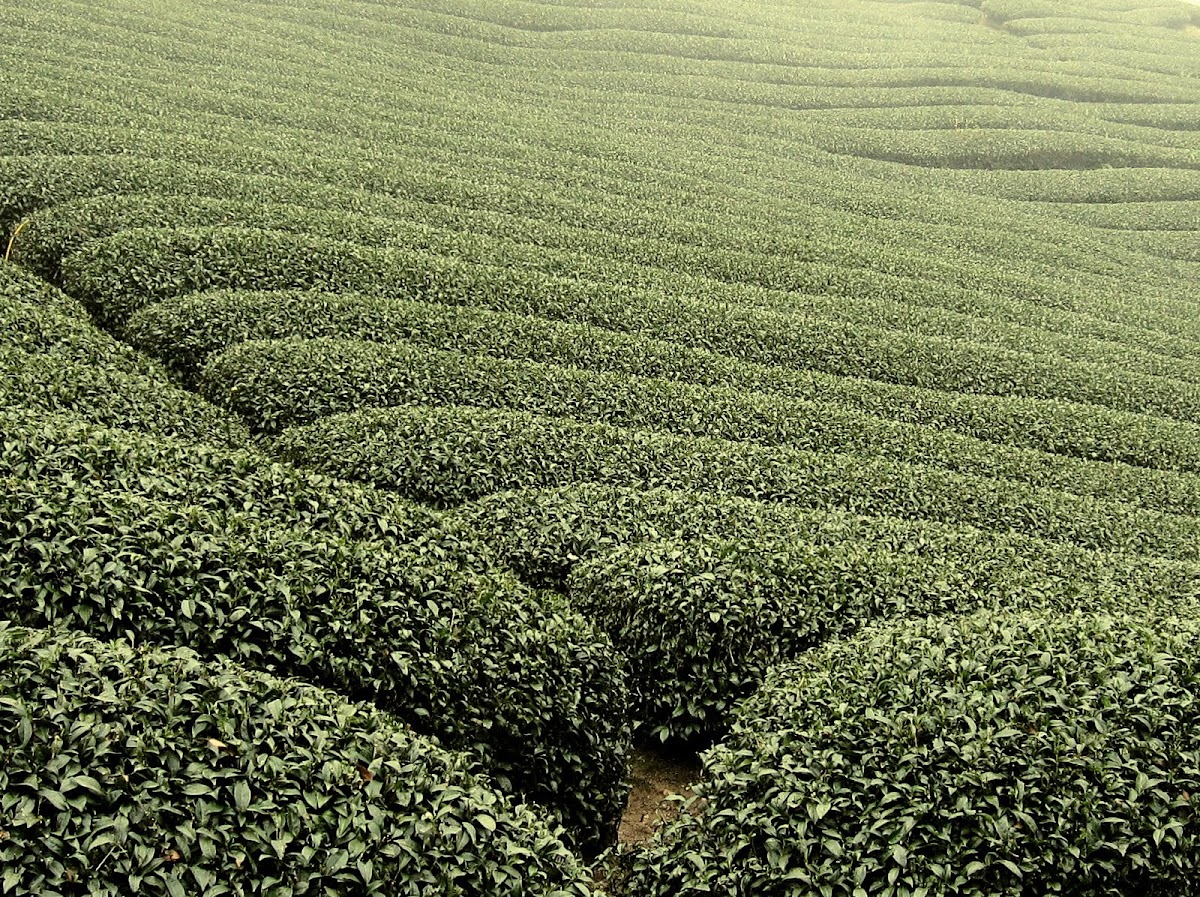
Lugu Tea District

Tea drinking culture in Taiwan has really only arisen within living memory as most Taiwanese were traditionally too poor to afford tea. The ubiquitous tea set and table that occupies so many Taiwanese living rooms is more a recent expression of wealth and status than a long held tradition.

Leaf Testing

Tea production in Taiwan really only started to develop during the final decades of Qing imperial rule and was more directly related to Taiwan's place in the 19th Century global marketplace as an agrarian center.

Between 1860 and 1895 the American demand for Oolong teas provided the spark that led to the expansion of Taiwanese tea cultivation into a multi-billion dollar a year industry.

Tea Baskets

By the 1860's large swaths and pockets of Taiwan's western plain had been opened for cultivation and the local plains dwelling austronesian indigenous peoples had been incorporated into the Qing administrative structure. Even the sub groups of indigenes who had withdrawn into the foothills had relented and come under some form of Qing governance. Hoklo and Hakka speaking immigrant farmers from Fujian had established a strong economic culture on the plains an Hoklo became the dominant language of the marketplace. Still, most of Taiwan remained "beyond the pale" and ungoverned by the Qing imperial state. Highland indigenous peoples still resided outside the reach of a foreign government.
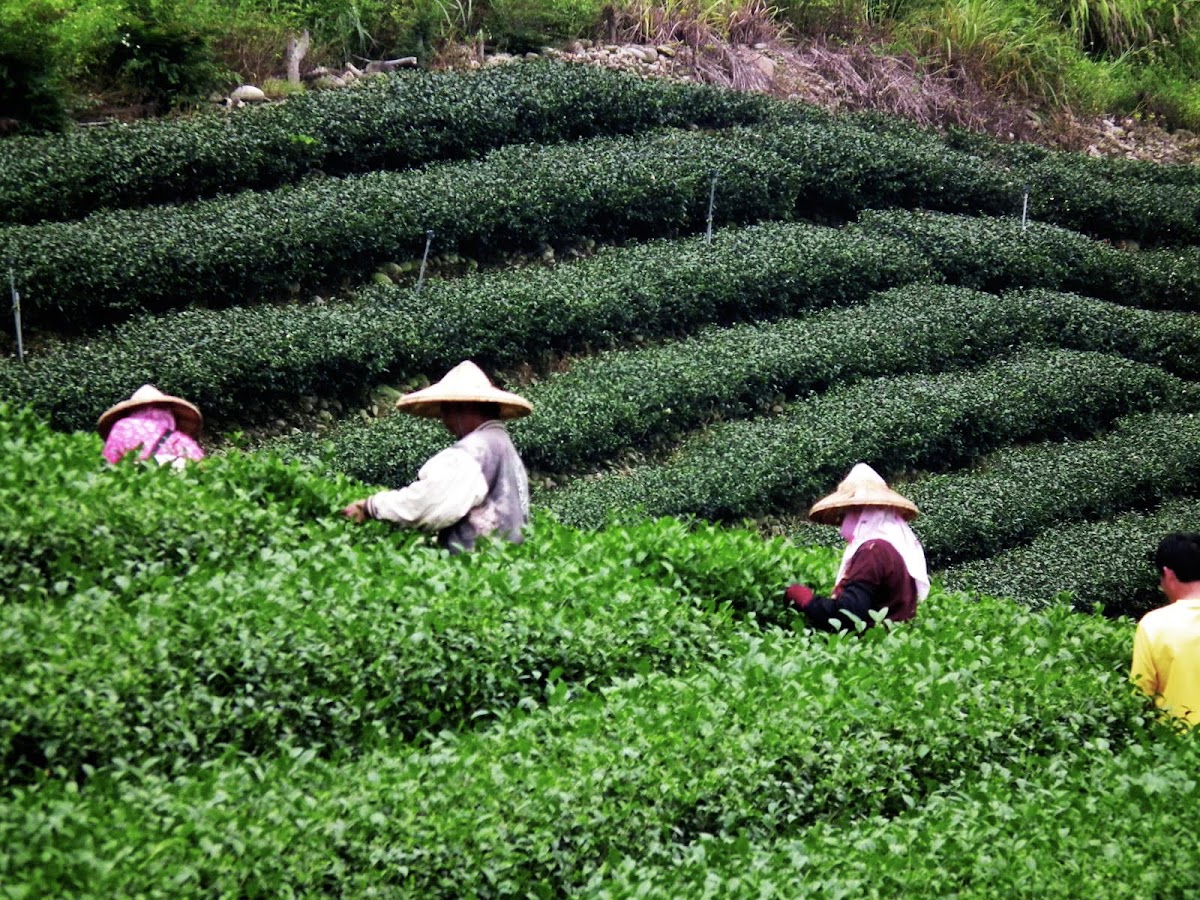
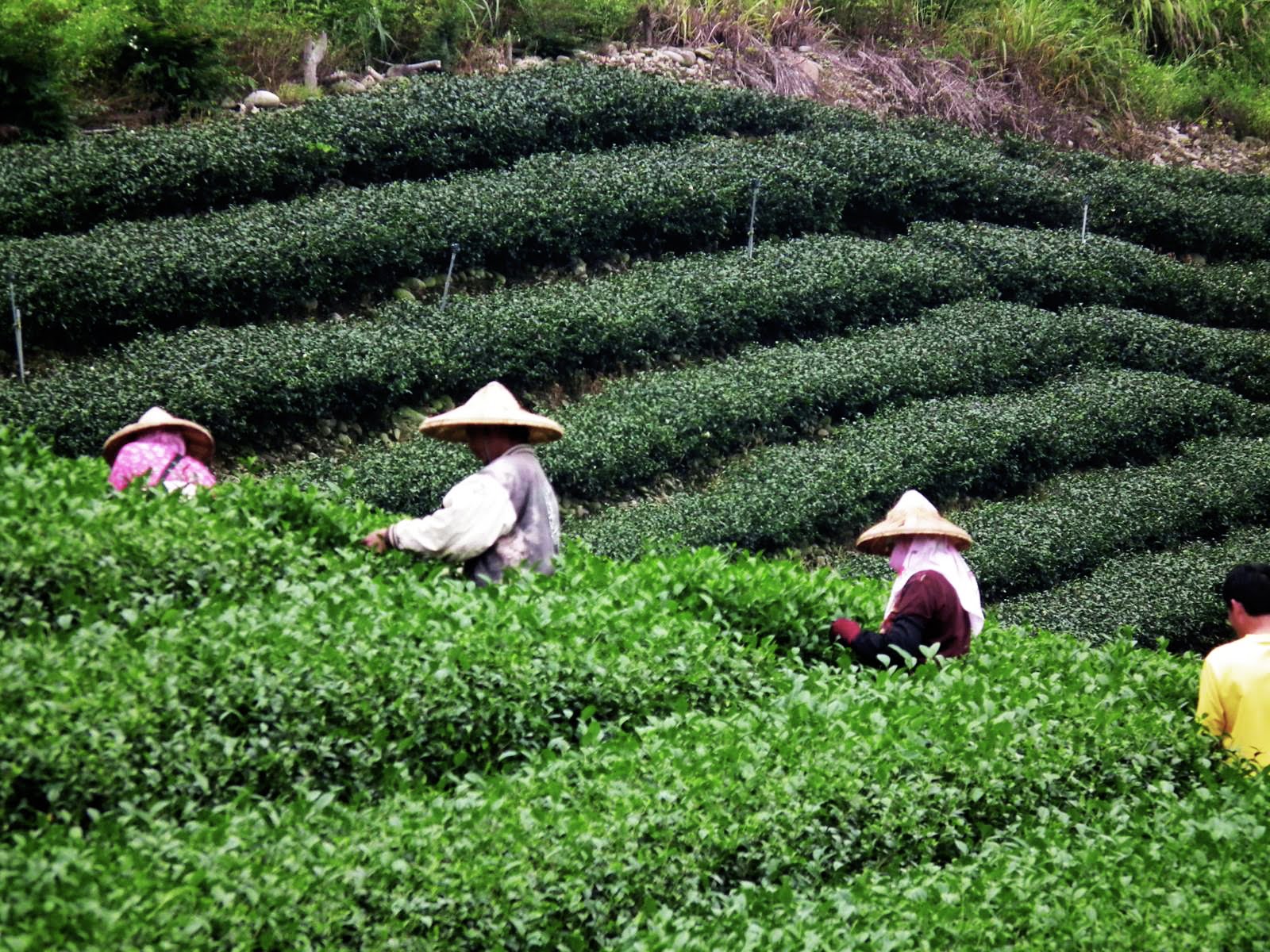
Pickers

During this period Taiwan's political economy was also greatly influenced by the geopolitical projects of European and American colonial interests. The Opium wars and their indemnities expanded foreign influence over the regional economy as Taiwan's agricultural production shifted from sustenance farming to feeding the voracious appetite of the West. The value of tea exports rapidly grew from 9.4% in 1864 to 58.4% in 1891.


Fresh Tea Leaves

The tea boom at the end of the 19th century turned the tiny tea plant into a virtual money machine for minting what was termed "green gold". Many Hakkas and lowland indigenes or ex-Aborigines used their experience as dry farmers (as opposed to wet rice farming), as well as their locations in the foothills, to transform their land into centers of tea cultivation. Much of the farming was done by tenant farmers who were required to cultivate the land and pay tax on the tea bushes. The taxation of production was perceived to be more fair than the head tax paid by some indigenous peoples and may have led to a gradual change of ethnic identity in the mountain regions.


I am not only a cyclist, but I am also a tea lover. I have been drinking tea since I was 10 years old, drinking Red Rose black teas... until I scalded myself after grabbing a superheated mug out of the microwave, which resulted in a scar that stuck with me for 3 years.

I have been interested in Taiwanese teas for over 15 years, when I would sit around drinking tea with my Taiwanese language exchange buddies in college. Ever since then I have been developing my palette for tea.

As I cyclist it is even more exciting to go off on some mountain climb to see the fields where some of your tea was actually grown and picked.

Many of the teas I sample and source end up at Miro Tea in Seattle, so if you are lucky enough to visit, Miro will have some excellent Taiwanese tea.

One of my favorite rides is through the tea district of Lugu. I have ridden this area numerous times and I am always impressed by the scenery and the quality of many of the local teas.

Runner Up

This past weekend, the day before my bike broke, we took a non-cycling trip up there again to visit some friends.

My friend and supplier of some excellent Dong-ding Oolongs, Jacky, was on hand to receive his award for the best tea in the Lugu Tea Farmers Association Winter Tea Contest.

The contest took 21 samples from over 5000 farmers and subjected them to repeated, anonymous testing. This ensures greater fairness in the competition, which costs each farmer NT6000 to enter and is extremely labor intensive.

Other contests in Taiwan are subject to manipulation by speculators in organized crime who buy up the winning tea before it is judged and then sell it for the inflated price.

Jacky was able to sell his 21 jin (600g) to a collector for NT2.2 million.

Winner's Dad

We have visited Jacky's farm and hostel on several bike trips to Lugu, and Jacky is also the one who rescued me when I could not fix my tire high up on the Highway 16. We also bought some of his winning tea before Jacky was awarded the title of "King of Teas".

A Boy and His Teas

Aside from congratulating our friend, we also used the opportunity to test different teas and network with other farmers who were on hand to hawk their teas. For many farmers their chief concern was the dilution of Taiwanese teas with inferior and potentially tainted Chinese and Vietnamese varieties.

The demand for Taiwanese teas far outstrips the supply, so many wholesalers are mixing their teas. Although Taiwan has very strict standards to limit pesticides and pollution levels in the teas, Chinese and Vietnamese growers are not subject to the same restrictions.

The recent lowering of tariffs on Chinese agricultural products has made this practice even more of a threat to Taiwanese farmers.

Award Ceremony

For regular tea drinkers it is best to buy directly from a trusted farmer rather than a wholesaler. I am happy to have built some great relationships with local farmers and even biked out to check their fields.

I am glad I am not on the other end of that

If you are going to ride up to Lugu, I highly recommend taking the 131 to the 151. It is a nicer and quieter road. From there you can take several smaller roads all over the mountains.

Big Business



Lunch Time Sport


San Lin Xi Field

Hong Pei Tea

On this particular trip we were interested in checking out some hong-pei, or charcoal roasted tea. We saw one farmer on the side of the road doing a roast.

He was roasting the tea under burning rice husks.

I love Taiwanese hospitality.

This farmer not only answered our questions, but also took us on a full tour of his facility and an impromptu tasting of a batch he had finished that morning.

Drying Baskets

A Dime Bag

We had to leave with some freshly roasted tea leaves. They need to sit a while, but they wee very good.
Mr. Liu and I
Subtropical Oolong from Songboling

One wonderful ride I would love to do, is a tour of Taiwan's tea country.

Tea country actually starts on the southern side of Alishan, where some farmers around meinong produce Oriental Beauty tea, which is oxidized as it is digested by the larvae of the Tea Green Leafhopper insect. The digestive juices of the Leafhopper give the tea a distinct sweetness. It also ensures the tea is free of pesticides.

A trip up the Highway 20 to connect with the 159甲 over Alishan past the Gaoshan tea farms. Since Typhoon Morikot gave the government a pretext to relocate indigenous peoples from their traditional lands, many tea farmers are pushing for those areas to be opened up for tea farming.

The 149 to Shuili goes right past the Taiho farms. Then a trip up the 14 to the top of Hehuan Shan to get to the back side of Lishan, where some of the best Gaoshan teas are grown.

The Highway 7 gos from Lishan out to Taiping Shan and Iilan, where I like to buy some balanced Baozhong teas. Pinglin, which is famous for Baozhong teas, is right above Iilan.

Baozhongs are often mildly oxidized, unrolled teas.

The highway 7 also goes near Haishan and San Hsia and lets out by Ying ge, near Taipei. Yin ge is famous for its kilns and tea pots. This might be a great biking adventure through some beautiful country amid some of the best teas in the world.

Lugu

Monday, January 3, 2011

Cycling and Taiwan's Tourism Trade Imbalance

Taiwan Insights has a cheery little set of Ma administration talking points regarding Taiwan's expanding role as a tourism center in Asia. And again, the bicycle appears as one of Taiwan's major draws.

Despite the sunny spin this article puts on expanding Taiwan's tourism and the role cycling plays in the government's scheme, there some dark clouds just on the horizon.

At a time when many industries in Taiwan have been hit hard by the worldwide economic slump, Taiwan’s tourism industry has continued to experience double-digit growth and is projected to do even better in the coming year. In 2009, there were 4.4 million foreign tourists visiting Taiwan, a 14.3 percent growth over the number in 2008, ranking No.1 in the Asia-Pacific region.

Currently, Chinese tourists are the largest group of visitors to Taiwan. The steady increase in tourism from China has meant that over 2.01 million Chinese visitors have come to Taiwan, bringing in foreign exchange earnings of close to US$2.10 billion. This is welcome income as Taiwan’s industrial and agriculture sectors decline. In fact, one of the six new industries the government is promoting is tourism since the industry has become an important part of the service sector, accounting for 73 percent of Taiwan’s GDP.

If that figure is correct we can mark 2010 as the year Taiwan gave up its position as an economic center in Asia and became a Chinese periphery... a playground for China's wealthy.

When I first arrived in Taiwan over a decade ago, Taiwan's industrial sector was going strong as the economy shifted from machine tools to information technology. I remember earlier in the 2000's there was heated debate over the matriculation of 12" wafer technology to the Chinese.

The former president Chen Shui-bian touted Taiwan as a "Green Silicon Island".

Those days are over. Taiwan has decided to allow China to be the technology hub of Asia and with ECFA the agricultural sector is nervous.

But at least we have the bicycle... right?

Also, as an island and in keeping with the popularity of a greener way of traveling, Taiwan is promoting “Let’s Bike Taiwan” as another way to experience Taiwan’s magnificent scenery and interact with local people. At a recent “Let’s Bike Taiwan” event, 500 cyclists from Hong Kong, Singapore, Malaysia, Japan, Korea, throughout Europe and the United States, cycled five routes around Taiwan. Besides being a popular leisure activity, Taiwan is also home to many bicycle manufacturers, including Giant Bicycles, the largest quality bicycle manufacturer in the world.


Top two Taiwanese bicycle makers – Giant Manufacturing and Merida Industry – have reportedly been boosting output at their factories across the Taiwan Straits.

According to a report in the Taiwan Economic News, this is in order to ‘cash in on the recovering demand for high-end bicycles worldwide.’

Giant has recently spent US$36 million building its ninth bicycle factory in China, in Kunshan City. This is scheduled to be operational in the third quarter of 2011 and should produce around 1 million to 1.5 million bicycles two years later.

One focus of the Kunshan plant will be electric bicycle manufacturing. Although, the new Kunshan site will also produce bicycle frames and carbon fibre.

A production line for high-end bikes should become operational the second quarter of 2011, with annual output of around 200,000 units in the next three years.

Giant currently produces around 100,000 units of higher-end bikes in Taiwan each year.

Meanwhile, since August 2010, Merida has invested NT$250 million (US$8 million) in expanding its production capacity. At its factories in Taiwan and China, Merida has procured new processing and production equipment and has made improvements to existing production lines.

The latest expansion from Merida is scheduled to be completed in April 2011.

Merida just reported its sales revenue of NT$1.285 billion for November 2010, up 26.27% year on year. This boosted total revenue for the 11 months of 2010 to NT$11.074 billion, up 8.94% year on year.


Taiwan Insights continues with:
Taiwan’s tourism will receive an additional boost when the government increases the daily quota of Chinese tourists to 4,000 per day, with independent Chinese tourists allowed to visit Taiwan by the end of June 2011. Since the lifting of the ban on Chinese tourism in July 2008, the average daily number of visitors from China has steadily increased. In 2009, visitors from China averaged 1,661 per day, but, by the first half of 2010, it jumped to 3,440 per day.
I am sure this is just a figment of my paranoia, but when Taiwan has nothing anyone really wants, the trade imbalance can have far reaching economic and political consequences. Is this part of a greater political plan to integrate Taiwan into China?

What if China gets angry and turns off the tap?

They stand nothing to lose and Taiwan loses everything.

UPDATE:

I have been made aware that China is, in fact, using its economy as a political cudgel. This should be no surprise, but what IS surprising is how deep, far reaching, and orchestrated this effort is.

The CCP/Chinese state is creating an artificial demand for Taiwanese goods and tourism to gain greater leverage over Taiwan's local economies and over local politics. This has gotten to the point where Chinese delegations will purchase goods and even provide services to promote annexation policies.

Sunday, January 2, 2011

Da Xue Shan Climb (大雪山): My Last Ride on My Beloved Steed


For this chilly beginning of the New Year, I thought I would not stray too far in case I got too cold or something. I knew I wanted to do a bit of climbing after a two week lay off from any real riding.

I figured the 5000ft. of Daxue Shan would be perfect. Still, I wasn't sure how cold it would get up on the mountain.


I have done this ride a few times, so it was fun to see the change between seasons.

My first order of business was making sure I'd be warm enough. I bundled up in my cold weather gear and about 10 minutes out the door I was plenty warm.

By the time I got to Dong Shih, where I planned to really start my effort, I was even a bit toasty.
I started up at a pretty good clip, but I tried not to get too enthusiastic. I didn't know how long my legs would hold up.


All my landmarks just buzzed along in no time and I was feeling pretty happy with myself... especially after a period on not riding.


In no time my arm and leg warmers were in my jersey pockets. My long-finger gloves were replaced with my worn short-finger gloves. My jacket came off and I was rolling up my base-layer sleeves.


As I made it up to the 4000ft level I was feeling the climb in my legs, but had plenty left. I still heard a pit of noise coming from my bike and stopped to check out the source.

That is when I noticed a hairline fracture in my Head Tube.

That was the end of my ride. I gingerly paced my descent to avoid any surprise potholes, while I rehearsed breaking the news to my wife and friends.

I was also conscious of the fact that it would be our last ride together and did my best to enjoy it. She has been the perfect steed and it is sad to have ridden our final road together.

For our last 1/2 km home I attempted one more full sprint to the front door.

Salsa Las Cruces R.I.P. (October 22, 2007-January 2, 2011)


Friends, it is a sad day here in my family as my beloved Salsa Las Cruces has developed a hairline fracture in her head tube and will be retired immediately. I don't know how the fracture developed, but there it is. I guess it is all a part of owning and enjoying a good bike. Sometimes this stuff happens.

I bought this bike in October 2007 as my "Taiwan bike", and after a 6 month wait for parts in the midst of a cycling boom, she was ready to go by late April 2008.

This bike has taken me to so many places and been a major part of shaping my life over the past three years. I have logged 20,419km on her and beyond the distance she regularly helped put me in touch with all the things I love about Taiwan.

She has been a good friend and will be sorely missed.

Here is a little retrospective in honor of my favorite bike: