body{background-attachment: fixed ! important; }

Friday, December 9, 2011

Best Taiwan Blogs: Vote And Discover Taiwan


It is election time, so once again Taiwanderful has launched its annual campaign to select the best blogs in Taiwan.

Although blogging may seem a bit narcissistic, but it actually brings thousands of eyes and thoughts together to better flesh out a place and all the connections that help us perceive where we are and what makes our communities.

Too often all that is Taiwan is reduced to a single pithy line in the Associated Press. Blogging gives us the depth of experience that is often missing from the lines of the formal press, lines that are often lazily regurgitated to satisfy a deadline or make exciting copy.

The blogging community does not provide any singular, uniform narrative, but it weaves together thousands of incongruous and oft conflicting narratives that result in better representing the reality and complexity of our shared Taiwanese community.

Go to Taiwanderful and browse the blogs. Vote on the good ones if you feel like it, and discover something new about Taiwan.

Browse and Vote HERE

Wednesday, December 7, 2011

Blog Posts and Travel Notes


Here are a few interesting travel posts:

Personally, I love the highways in the interior: the northern cross-island highway, the central cross-island highway, and the southern cross-island highway (they’re more roads than highways). The scenery along these roads is wonderful, and you can check out places like the Alishan region. The mountains of Taiwan are, in fact, riddled with narrow and fascinating roads that seem to go everywhere and nowhere. My favorite thing by far in Taiwan is just to hop on my scooter and go driving around the mountains. Most of the roads aren’t even on any maps, and you can just pick a road and see where it goes. You end up having all kinds of adventures.
  • Ronin on a Bike recently visited from Japan and blogged a bit about the experience.
Dropped off my hardhat then started on my journey south. Could quickly get on to Route 193 towards Hualien. Nice empty coastal road, including through a graveyard the size of a small town, with a strong tailwind and speeds up to nearly 60 kph. Just a couple of busy kilometers through Hualien centre, then a couple of punctures before getting back onto Route 193 alongside the River Siouguluan. Almost no cars on this route on this Sunday, but fairly good road quality and frequent "cycle rest stops" where you can fill up with water and use the bike pumps.

Fulong Station marks the start of the Old Caoling Bikeway and as you can see is quite busy.

On the right there you’ve got lunchbox places to eat at and there are numerous bike rental places scattered throughout the immediate vicinity of the station.

If you are riding down to Fulong Station or come by car down Route number 2 along the coast, this is the intersection you want to stop at to turn right;

_____________________________

Other Links:
  • Red Kite Prayer on accumulating equipment.
  • VeloNews with a look at the impact Highroad had on cycling. Without Taiwanese sponsor HTC, the team folded at the close of the 2011 season.

Tuesday, December 6, 2011

Ride With Rapha: Join Cycling's Top Gear Touring Taiwan


A reader forwarded this tidbit of information my way regarding Rapha, the fine bicycle equipment maker and clothier, and the company's enthusiastic entry into the Taiwan market.

Rapha makes some pretty sharp, albeit pricy duds, but Taiwanese cycling is now at a stage where riders are becoming more brand savvy and looking for bikes and equipment to reflect a more discriminating taste.

----------------------------------

INVITATION

MORNING RIDES WITH RAPHA

We cordially invite you to a series of rides with Rapha in Taiwan.

Rapha’s Adam Horler will host a number of rides in and around Taichung and Taipei on the 14th, 15th and 16th December.

On Wednesday 14th December, Adam will host a two part ride to Sun Moon Lake from Taichung, meeting at 6.30am at No.499, Huiwen Rd., Nantun Dist., Taichung City 台中市南屯區惠文路499號 (文心森林公園後7-ELEVEN), where we will then ride 40km to Chungshin New Village, have breakfast and then those who are able can continue on to Sun Moon Lake.

On Thursday 15th December, we will ride from Taipei to Wulai, a ride to the mountains. We will meet at 6.30am at Xindian Station.

Then, on Friday 16th December, we will meet at 6.30am at Taipei Zoo Park for a 40km city ride, followed by breakfast at Helen Coffee.

We’ll talk all things Rapha, road racing, bikes and more. Please wear your best road attire, we want to represent the sharpest riders in Taiwan.

Please send an e-mail to adam.horler@rapha.cc to book your place on the ride and breakfast, indicating the dates of the ride/s you wish to join.

There will be a cap of 40 riders for each ride. We will take the time of e-mail sent to make any cut off.

Thanks for your understanding.


Direct Links: Cyclist Cruises from China to Taiwan


With the recent tourism links between Taiwan and China, several cyclists have taken advantage of the direct cruise ship links between Taichung and China's port city of Xiamen.

World Biking, a site dedicated to riders hoping to ride through every country on the planet, has written a review of the experience.
The place was a madhouse of tour groups in funny hats queuing up to board the boat. Our bicycles were our ticket to first class service and we were whisked to the font of the line to board the ship first. The crew bustled around stowing our bikes and bags, then lead us up to a comfy cabin complete with dazzling lilly- white bed sheets and a fluffy pillow. After setting sail, I wandered around the ship and discovered not only karaoke and a dining room, but a sauna and Japanese-style bath house.
The writer does a fair job describing what it means to tour Taiwan. I am also grateful for WT recognizing Taiwan as a country rather than trying to find some cute way of degrading Taiwan and its relationship with China.

ADDED: *Cringe!*

Here is how this trip is being spun by China Cenral Television for the Chinese audience:

The first high-speed roll-on roll-off vessel has returned from Taichung to Pingtan of Fujian Province at 16:10 on December 1 (local time) along the second sea routes opened between the Chinese mainland and its island province of Taiwan.

The vessel carried 181 Taiwan compatriots in its return trip. The arrival time was an hour behind due to a strong gale-force wind on the way.

The vessel "Haixia" (Strait) made its maiden voyage along the new route on November 30, carrying more than 500 tourists on the two sides of the Taiwan Straits. Some of the passengers have also brought their bicycles along for a bicycle trip on the mainland.

"It's great. The ship is so fast and the trip is so economical. It would greatly facilitate tourism and trade between the mainland and the island,"said Yi Jiansheng (pinyin), passenger from Taichung.

"It's a pioneering undertaking, an undertaking pioneered by the Taiwan Bicycle Friendship Association by taking advantage of this platform provided by the new sea route. We hope that the people on both sides of the Straits would have more of such opportunities of exchanging bicycle tours," said Xie Jianguo (pinyin), a passenger from Taichung.

Monday, December 5, 2011

Problems Over-Developing A Bicycle Paradise

Map of New Development in the Rift Valley

A couple pieces have caught my eye over at The View From Taiwan, and I thought I could weave cycling into the discussion.

Two articles in particular stand out. The first involves the rapidly expanding development of Taiwan's East Coast. And the other highlights recent criticism of a bill that would critically impinge on the rights of Taiwan's First Peoples.

Michael does such an excellent job with many of the details, so I will simply expand upon the ideas here to better demonstrate how these initiatives impact and will be impacted by cycling and bicycle tourism.

Much of the hoopla surrounding the recent Taiwan Cup and Taiwan's International Bike Festival involved showcasing Taiwan as a cyclist's paradise. Although we each have our own idea of what cycling paradise entails, the thrust of the Taiwan Tourism Bureau's presentation revolved around the amenities and activities specifically constructed to cater to the bicycle tourist. Many of the projects put on display were the result of a tourism building boom that had given the Ma administration plenty to crow about, and moreover, these projects have provided construction and development companies a fertile playground to capitalize on the deliberate transformation of Taiwan from a leader in technology and industry into a tourist Mecca.

Although I support expanding rider support all over Taiwan, the country's penchant for unchecked development, illegal construction, kickbacks , payoffs and creative zoning threatens to not only discourage visitors who are looking to enjoy Taiwan's rugged wildernesses, but it also threatens the collective rights of Taiwan's indigenous inhabitants, many of whom own the lands along the Rift Valley between Hualien and Taidong.

Amis representative Konon Panay (古孟巴奈) said the central government did not define and grant Aboriginal lands, but it has been depriving Aborigines of their lands in the name of development.
Under the government of the Republic of China (ROC), the often correlative concepts of "development" and "eco-tourism" can be viewed as demonstrative of Taiwan's problematic postcoloniality.

When the Republic of China (ROC) arrived on Taiwan in 1945, the government instituted a program which located Taiwan's Hakka, Hoklo, Pingpu* and Aboriginal communities as "backward" in need of the modernity the ROC claimed to possess. The authoritarian government of the ROC used development programs in an attempt to "modernize" and transform the people of Taiwan into something subjectively better and "improved". Non-Taiwanese were located closest to the civilizing center and Aborigines at the furthest points.

In many ways the ROC scheme reflected pre-existing beliefs of Qing era transformationalism, or the belief that "savages" could be improved if they could learn to act like "humans", as well as the social darwinism that was popular with Sun Yat-sen and his cohorts. Taiwan's Aborigines were believed to be a degraded people who could be improved through the ROC civilizing program.

Many Aborigines were asked to move from traditional villages into "modern" concrete houses. Not only was the move away from traditional homes an attempt to modernize them, but the act can be viewed through the Confucianist lens as an act of taming; of transporting indigenous people through time to near the present and away from the "wilderness", which has been traditionally viewed by Han people as both savage and degraded. Even during the Qing colonial era, farmers along Taiwan's western plain were implored by official decree to "tame/open the wasteland" through farming. These believes reflect the deep connection between traditional Confucian views and official ROC ideology. Emma Teng's book Taiwan's Imagined Geography provides a great read on how these beliefs manifest themselves in official writing on Taiwan's indigenous peoples.

I think these beliefs can be seen from 2008, when Taiwan's current president and Chinese Nationalist standard bearer Ma Ying-jiu addressed a group of Aborigines.

Ma was quoted as saying:
"I see you as humans and as citizens of this city. I'm going to educate you well and do a good job of providing you with opportunities. That's the place from which the attitude of aborigines needs to be adjusted...now that you've come here, you need to play by the rules here..."
The pejorative distance between city and country, savage and non-savage, degraded and elevated are on full display with Ma clearly envisioning himself in the position of the civilizer.

The moves for development groups to go in and develop the indigenous lands along the Rift Valley while stripping or weakening the rights of indigenes to manage their own development creates a system of patronage, where the indigenous peoples must rely on the development groups and their political benefactors for economic support. Many of Taiwan's development schemes are not only owned by outside investors, but often many of the only jobs created are in service or entertainment where indigenous people are requited to perform quasi-traditional performances for the pleasure of tourists thus becoming the exotic object of desire on their own ancestral land while most of the profits go elsewhere. I recall "Aboriginal dancing" being one of the "highlights" promoted to visiting journalists for the Taiwan International Bike Festival.

The prospect of cycling tourism has become one of the driving forces behind much of this development; development that is neither sustainable, tenable, ethical or just.

For these reasons I would recommend cyclists ask for cycling development in Taiwan with a lighter touch to best enjoy Taiwan. I hope those people who arrive in Taiwan on a government paid junket or for cycling tourism can covey the belief that often less is more and we care about more than simply bike trails or hot springs. We care about the entire cycling environment including how the land was acquired and how much local involvement goes into planning cycling infrastructure. For now many of the decisions on bicycle infrastructure and development are made by politicians, developers and their corporate backers.

* Pingpu existed under the Japanese, but were incorporated into Hakka and Hoklo groups under the ROC by 1953.

ADDED:
Food For Thought: Two thoughtful articles about tourism from Ryan at Savage Minds. Article 1 and Article 2

Sunday, December 4, 2011

Steeling Away On A Light Tourer: Some Great Steel Bikes For Touring Taiwan


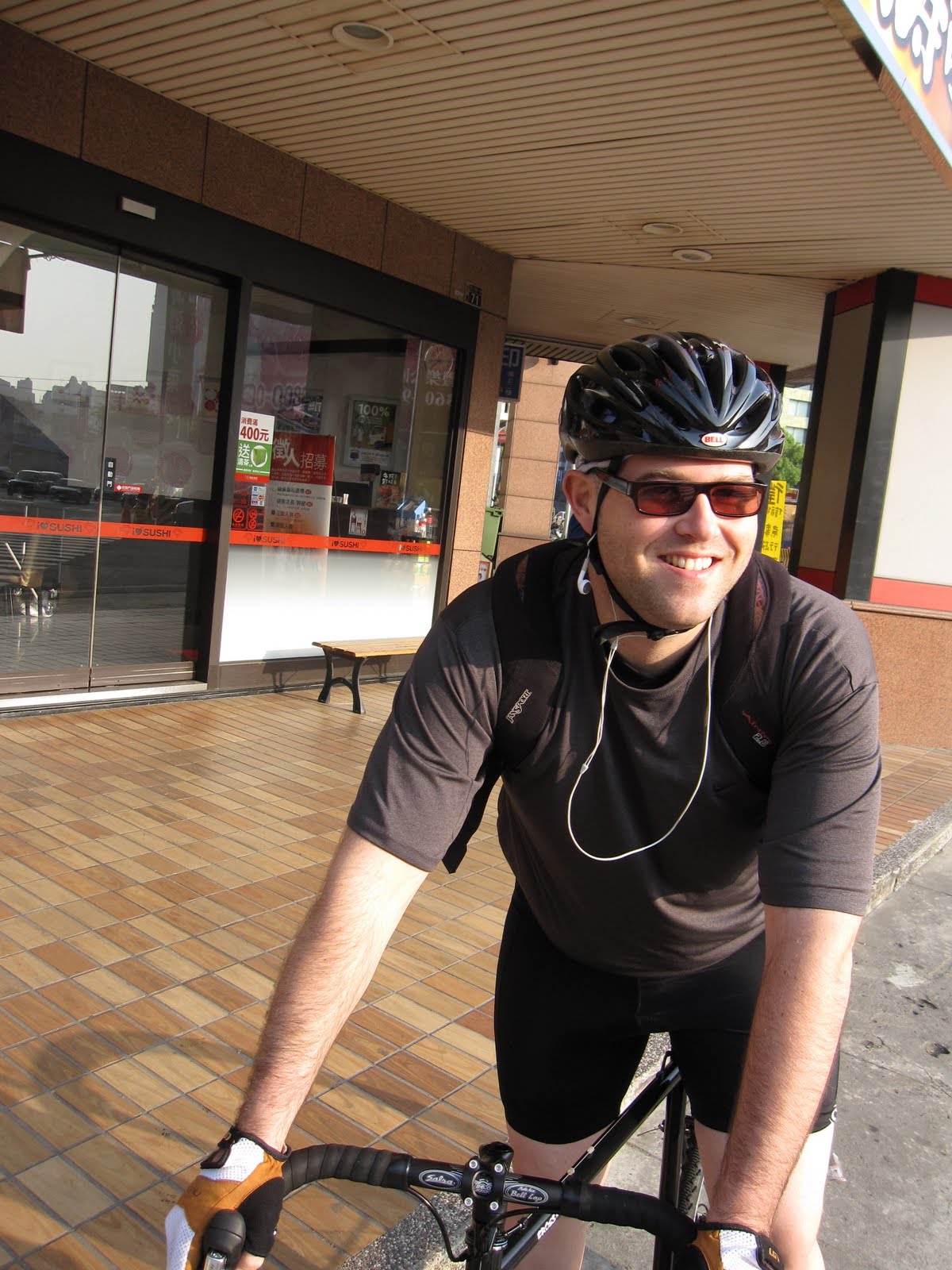
This weekend Chris B (pictured below) toured around on his brand new Surly Cross Check. The Cross Check is one of my most recommended bikes when riders or prospective riders email me to find out what kind of bike they should ride in Taiwan for a little of this and a little of that.

Although carbon fiber race bikes are all the rage, the aggressive geometry and lack of expansion is really limiting to most riders who are not interested in racing.

A better choice for a multipurpose bike for Taiwan's roads is the Cross Check or other similar bikes. Unfortunately, the margins on steel are lower than carbon or aluminum, and thus the big retailer/manufacturers really don't want to put their customers on a great steel bike, and would rather offer race bikes or flatbar aluminum XC bikes.

The Surly Cross Check is technically a bike designed for cyclocross racing, but its designers understand that racers are in the minority and keep the design to the loosest affiliation with the muddy sport.

What the engineers have done a great job of, is isolating the aspects of cyclocross racing that enter our daily lives, and concentrated on putting those qualities into a frame that can be the jack-of-all-trades.

The Cross Check can be a commuter, a light tourer, cyclocross racer, drop-bar, flat-bar, city, country beast of burden.... You can beat it all to hell and the 4130 CroMo steel frame will buck up and take the abuse.

Chris was looking for a bike to do it all from a loaded commuter to weekend recreation... from sunny day touring to muddy day single track.

Also, Chris is a really big guy.


The frame is 4130 CroMo steel. It is not a featherlight bike and comes in at about 5lbs heaver than my titanium Seven. Still, it is better to take the weight off the ass, than pay out the ass for just a few grams. As a non professional racer Chris could care less.

The steel frame with long chainstays gives a stable, supple ride to take the bite out of the asphalt. The bike is a bit of a truck, but it can easily crank up to speed. I found the handling to be very stable and forgiving. You can look away to chat with friends without worrying about rocketing into a ditch.

The relaxed geometry suits Chris very well. He has some weight to lose and it puts less pull on his lower back to stay in position. He can also be more upright to enjoy the views or keep an eye on traffic and not just the wheel in front of him.


The Cross Check, like other cyclocross or touring bikes, comes with cantilever brakes to accommodate fatter tires (up to 45mm), which means Chris can switch out tires from skinny road slicks for asphalt, to fat, knobbies for the dirt. The Cross Check comes with Ritchey Speedmax tires that are ok for the road, but wear out after a couple months. They stick well on hardpack or sandy roadways.


One downside about the cantilever brakes is that they don't have the stopping power of a good set of discs or caliper brakes. A change to Swiss Stop or Kool Stop pads will get them a bit closer.


The cable routing along the top of the top tube allows for shouldering the bike up stairs or over obstacles. When I was riding my old Salsa around Taiwan I found this cable routing to be optimal.


The bottom bracket is finely TIG welded and felt stiff enough. The ride was compliant more like a tourer, but over rough terrain it will save your ass.


The stock Cross Check comes with a wide array of Shimano and Tektro parts to bring the cost down. These can all be upgraded or changed out if the rider feels they can do better. The important factor here is that the bike can be adapted to grow with the rider.

Another feature that is lacking on so many other road bikes in Taiwan, is the use of both rack and fender mounts. You can throw a rack on the back, add a pannier and load up on supplies for work or a camping trip.

The rear cog is a 9spd 11-32 cassette that, when combined with the 48/36 tooth chainrings, should be perfect for most rides and climbs, as long as you are willing to train for it. This avoids the need for a road triple.


The front derailleur is Shimano Sora and the rear uses Deore... again... it can always be changed and should be fine for Chris... for the moment.


One thing that is a bit different about the Cross Check is the bar-end shifters. These are often preferred for touring rather than racing. The Bar-end shifters are great when you are in a more upright position, hands on the bar-tops and you want to shift as opposed to the more aggressive road positions optimal for speed. Personally, I like STI shifters, but I think this is great for where Chris is now, and I don't see anything wrong with them.


The fork is an all steel fork, so it should be strong and also soak up the road chatter.

This is really a bike that can be configured to do it all and last a long time. With a little frame saver sprayed inside the tubes this bike should last Chris as long as he wants the bike.

This is really the bike so many people are asking for, but not enough people know they want it or that it exists.


Chris paid NT34600 at:

Famous Bikes
Manager: Tom Jian
No.5 Xitun Rd. Sec.2
Taichung City, Taiwan
Tel: 0933239055
email: famous.bikes@msa.hinet.net

Famous also carries other brands of similar, steel-framed light tourers.

Dom A. bought a nice Louis Garneau steel touring bike from Famous with a similar configuration of Shimano and Tektro. Dom has taken his bike around Taiwan and abused it very well over the past year and a half.


Famous Bikes is a Salsa dealer as well. Salsa sells several great light and heavy steel and titanium touring frames that are well speced and don't cost a fortune.

If you are seriously considering a frame like these, go contact Tom at Famous and be prepared to wait. Many of the frames over 54cm have to be imported back to Taiwan and it can take a couple months to receive a shipment.


Taiwan in Cycles Shill policy: HERE

Feeling Like A Kid Again: Chris Enjoys First Adult Ride Through Gaomei Wetlands

Saving A Fallen Comrade

This Sunday I had the pleasure of taking a friend out for his first real ride since childhood.

What is really special with this ride, is that it marks a new stage of his commitment to himself, his family and his life.

When I first met Chris last year he was-- well-- shall we say... fat. He was 6'1" and 348lbs (158kg). The only numbers he was putting up were some pretty scary ones at the doctor's office.

What it all really boiled down to was that he had to make some radical changes in his life if we wanted to have any chance at enjoying a long, healthy future. Moreover, he felt the need to better educate his little boy on the lessons of leading a healthy lifestyle. Chris saw no other way than leading by example.

Chris has since become a strict vegetarian. He made the time in his schedule to start running and swimming.

Then, about 6 months ago, he approached me for advice on buying a bicycle for commuting, exercise and general transportation. He was looking for every possible way to get and keep fit.

After 6 long months the bicycle arrived, and it is a beauty. He bought a Surly Cross-Check (detailed in another post) to suit all his needs, and he has been gradually building up his strength.

With the bike as a carrot, he dropped to 242lbs. (110kg) and has strengthened his cardiovascular system to better support harder efforts.

By Sunday he seemed about ready for a group ride.

Chris

We met with Dom, Jeff, and the indomitable Michael Turton for a morning of pedaling through the flats around the Gaomei Wetlands and back to Taichung. It was steel bike day, so I brought out my La Cruz for a lazy spin to join the theme of the day.

Jeff and Michael

It is always great riding with these guys. The atmosphere is always friendly and the saddle talk is laddishly jovial, but also slyly intelligent.

The first part of the ride was "the hook", where we roll very fast down a hill to introduced Chris to the addictive sensation of velocity before an easy roll through the flats to the Taichung Harbor Port.

Chris and Dom
Wolfman Jack


We hit one of the local bike trails and rumbled up toward the Gaomei Wetlands.


Just as we coasted through the narrow lanes of Gaomei, we ran smack into the blue smoke and commotion of a religious procession.


The wetlands were filled with people wading out onto the mud flats and scouting wildlife through expensive optics. Some of the local ragamuffins showed up to flip a little sass our way before we cruised up the sea wall in search of food.


The trails back to the Highway 1 are quiet and, if you look closely, you can spot some rare vegetation, mud skippers and swarms of crabs.


Just at the Dajia end of the Dajia Bridge (by the Bridgestone Tire Center), there is a lane that goes wending off into the fields. If you have the time for a little adventure, the roads play out like a child's maze. Michael knows the route better than anyone, so we followed his guidance past the burning stalks of rice, up to Houli.


With only one minor hill, we all charged up above Taichung and happily spun into town.
Chris was full of energy and managed to keep up without any problems. It was awesome to see him out there with a smile on his face astride his first new bike since childhood.

There is just something about riding bikes with your friends that brings back the joys of childhood and makes a person wonder why they ever stopped.

I am looking forward to more rides with Chris and the rest of the guys. I will probably be taking a few weeks off, but I will be back... and in greater numbers.

Well done Chris, and thanks!