
Showing posts with label Dangerous cycling. Show all posts
Showing posts with label Dangerous cycling. Show all posts
Saturday, March 12, 2016
Paved With Good Intentions: More Trouble for Taipei Bicycle Lanes
According to this report from SETN.com, Taipei has taken two steps forward and one step back in implementing a grid of bicycle lanes throughout the city.
The project, which was initiated by Mayor Ko Wen-je, an avid cyclist and former bike commuter, sought to better incorporate the bicycle into the urban transportation network. One major problem with Taipei's YouBike program-- a system of bike rentals through the city-- is that there are realistically few dedicated places to ride. Cyclists and bicycle commuters have had to fight both traffic and pedestrians in their battle for space in Taipei.
Of all the plans proposed thus far, Mayor Ko seems to have the right idea. But as a fortune cookie warned me a long time ago, "The road to hell is paved wit good intentions." (True story...and it was then that I realized that all fortune cookies were not positively ambiguous.)
It now seems that after spending NT180 million, the contractors responsible for the bike lane construction had precious little experience in actually designing bike lanes, resulting in some potentially hazardous, expensive and avoidable boo boos.
According to the Chinese language report, the city contractors used thick construction grade paint for path markings. The paint is a known hazard to cyclists as it produces an extremely slick surface in wet weather. The contractors also used porous asphalt and left metal utility covers exposed and with wide gaps. All of which pose a potential danger to cyclists and have been designed out of existing networks in Japan and other countries.
Here's to hoping Taipei gets its bike lanes squared away to be held up as an example for the rest of Taiwan to follow.

Monday, October 15, 2012
One Killed and 26 Injured in Tour of Changhua Bike Event
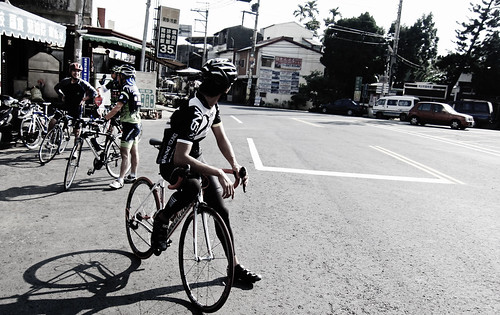
As riders were still filtering in to the finish line at the Tour of Changhua, word around the reception area spread that several riders had been injured, and some critically, somewhere along the course.
This morning it was confirmed that there had been 26 injuries and, sadly, one fatality.
This seems to be an awfully high price for an event that is organized in the name of "fun". Immediately questions arose as to who or what was to blame.
The Merida sponsored Tour of Changhua has become one of the largest biking events in Taiwan. Over its three-year run, the ToC has annually drawn in excess of 7000 cyclists as participants or non-registered followers. This is both a testament to the event's popularity as an open event, as well as a testament to the growth of road cycling as an activity for sport and leisure in Taiwan.
Cycling is a dangerous sport. There are certain risks involved in propelling oneself at high speeds down public roadways. Lots of things can happen. The risk is acknowledged as soon as we clip the chinstraps of our helmets. Automobiles often pose the greatest threat to cyclists, but even in the guarded confines of a professional race there is still room for tragedy to strike.
This was by no means a professional race by any stretch of the imagination.
What's Wrong with the Tour of Changhua:
1: Numbers
Unlike professional cycling, few of the 7000 participants in the Tour of Changhua are generating the watts that put them on the razor's edge between life and death.
For Tour of Changhua organizers, but I have seen this for other races as well, the number of participants signifies the success of the race. With more entry fees paid there are more eyes on the sponsors. With any large gathering in Taiwan there seems to be a lot of weight placed on the numbers and 7000 makes for an impressive figure to show the public.
The sheer number of riders is the race plays the greatest role in increasing the chances for injury. With 7000 riders all trying to snake through the same stretches of roadway, it becomes a problem of fluid dynamics. It may be wise to curtail the number of riders.
2: Organization
The second problem is in the disparity between skilled and unskilled riders.
The Tour of Changhua starts all riders on a first come, first serve basis. Fast and slow, skill and unskilled riders are all packed cheek by jowl in the starting area leaving the faster riders to pick through the unstable group to advance up the road in decent time. Many of the novice riders lack the strength and basic skills to safely ride a bicycle in close proximity to other riders. On Sunday I had a few riders steer into me while muscling up the initial climbs.
Anyone can go to the store and pick up the latest, highest tech racing bike on the market in exchange for cash. There are no skill tests to pass. Therefore, there are lots of riders out there with twitchy race bikes and not a clue how to handle them safely in a group.
Group riding takes practice and some training. I can't begin to tell how many times I dropped onto someone's wheel, only to have them constantly oscillating their speed. Dangerous.
The Tour of Changhua organizers might consider dividing the field into a competitive group and a recreation group. This might smooth out the action and keep it a bit safer on the course.
3: Route
One of the key factors was the route. After announcing the official route, the organizers reversed the route in the name of safety. They did not want novice riders to face a hill climb 50km from the start. They feared riders would collapse from exhaustion.
Instead, riders were making high speed descents into sections of poorly patched blacktop from a recent construction project. The bumps and seams in the road surface would have ruled it out of any professional event. It was at that spot I saw my first ambulance of the day.
The route was also not closed to cars. On Bagua Shan I was surprised to see oncoming traffic with no separation between cars and riders. Occasionally the call, "che!" or , "car" came echoing down the pack.
The section that had the fatality and another serious injury was along the creek near the finish. It was narrow, with one low barrier between the rider and a deep creek bed. Several riders lost control and crashed there.
It may be that the Tour of Changhua needs more experienced cyclists to plot the route with time for the government to ensure it will be safe by the time riders leave the starting gate. In many cases the choice to send riders on those roads was a simple act of negligence.
Conclusion:
The Tour of Changhua is still a relatively safe race. Still, the organizers failed to learn from prior mistakes and, in the name of spectacle, put a lot of lives at risk. There are still several things the Changhua government and race organizers can do to make this a better and safer race for everyone. It is something Taiwan's race organizers can all learn from.
It is sad when it takes a death to force change.
WebRep
currentVote
noRating
noWeight
Subscribe to:
Posts (Atom)