body{background-attachment: fixed ! important; }
Showing posts with label Taiwan bike infrastructure. Show all posts

Monday, January 12, 2015

Taiwan's Fascination with Black Box Cycling Infrastructure Schemes

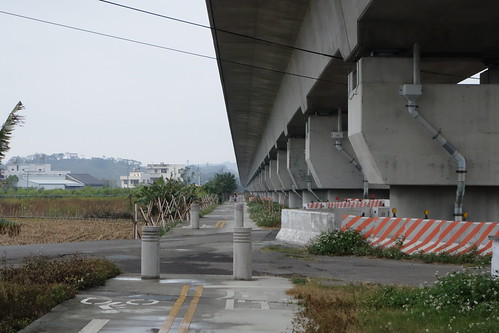
DSC03693
Another bike path to nowhere. This beautiful path has no destination. Photo courtesy of Michael Turton


So, from what they say, 2015 will be the year of the bike path. Taiwan's central government is planning to connect several existing bike systems together into a complete cycling transportation network by the end of the year. 

The executive Yuan explains
As for promoting cycling as a sport, Premier Jiang emphasized that ministries should build up a cycling atmosphere around the more popular routes and attract more foreign tourists for biking in Taiwan. Since this effort involves infrastructure construction, software management, promotion and marketing....
and further 
MOTC said it is planning to integrate bike paths with railways, buses, scenic spots, restaurants, accommodations and tours to provide a quality, safe and green cycling environment. Meanwhile, it will team up with the Sports Administration to assist local authorities to install bike path signs and mileage markers. It will also work with the MOI and MOE to include bike paths into land development and tourism plans, helping to create jobs, serve the physically active population and spur local industries.
An old report from Taiwan Today:


Under the NT$1.2 billion (US$40.2 million) government-funded project, 60 in-place paths are to be linked. Comprising paths, provincial highways and rail connections, the network will enable cyclists to complete a round-island-tour of 1,000 kilometers in nine days.
“Since I took office in May 2008, Taiwan’s bikeways have grown from 720 kilometers to 4,017 kilometers, President Ma Ying-jeou said at a Ministry of Education-hosted meeting with the nation’s youth Aug. 31 in Taipei City. “I have instructed the Ministry of Transportation and Communications to prioritize mapping the network and promoting it abroad.”

I would and should be ecstatic over this. As a cyclist I should feel like pogoing with pom poms a blazing in support of a bold government initiative to promote and develop a greater cycling infrastructure. I should. I really should. 

But I can't. 


On its surface it looks great. Upon closer examination this looks like another publicly funded black box program that diverts valuable resources away from where they would be most beneficial and locks them up in a mysterious scheme that serves as resume padding for elected officials in the lead up to an election year. No maps or plans are available for public scrutiny. The plans are left to localities to implement and the number of people served is greatly reduced by only focusing on cycling tourism. The government even had the gall to blow a bunch of smoke in regard to "reducing traffic-related pollution while boosting Taiwan’s tourism appeal." The cynicism hurts to the point of laughter. Not only is it unclear which businesses would benefit, nor does the plan specify an exact route, but is typical Taiwan fashion, the plan also does not allocate any funds for regular maintenance or safety. 

Well done!  


The fact of the matter remains that focusing on weekend and leisure cyclists as well as niche tourism, takes NT$1.2 billion dollars and throws it into putting garlands on an ass. 

This is a symptom that is rampant with Taiwan's cycling infrastructure. 

The majority of Taiwan is impeccable for cycling. The gaps between cities host dozens of excellent routes a cyclist can choose from. There are lovely roads that parallel other lovely roads. To narrow them down would be a disservice to the traveller. The problem is not in the gaps between cities where it appears much of this fund will be spent. 


The central government needs to quit throwing money into the black holes of local construction contractors and their political patrons. 

The greatest need for NT$1.2 billion in cycling infrastructure is in the cities once a cyclist has covered the gaps. Once a cyclist navigates through the countryside and arrives in Hsinchu, Chiayi, Taichung or Changhua... what then? There is nothing. The cities are not designed to accommodate the bicycle as a regular part of the transportation system and there have been no serious moves to actually move toward the bicycle's integration. 

Various cities have gone as far as public bicycle rental schemes, which are actually quite handsome and conspicuous, but the bicycles really have nowhere to safely go. I often see these orange, slow moving bikes weaving in and out of traffic and uneasily along sidewalks. There will be no reduction of emissions when inviting foreign visitors to ride their bikes around Taiwan. 

We hear of fancy bike trails like the congested Hou-Feng and Sun Moon Lake trails, but these are completely purposed for occasional entertainment. They benefit a few tourism interests and rental stations, but mean nothing to the majority of Taiwanese. 

Taiwan can do without overdeveloping the rural cycling atmosphere... but Taiwan can not continue to ignore the need for a serious and public approach to integrating the bicycle into the daily lives of its urban majority. 

I hope the new local heads can look beyond the cash rewards of a vague government program, and decide to use the cash in areas that may actually impact the lives of their constituents. 

Tuesday, August 14, 2012

Elephant In The Room: Growing Criticism Over Taiwan's Corporate Model For Cycling Infrastructure

Mist

Taiwan Insights has an excellent article examining the trouble Taiwan, and Taipei especially, is having with integrating its leisure and utility cycling infrastructure to promote cycling as a viable mode of transportation. 

The article points to several of the causes this blogger has identified (here and here), namely that the bicycle infrastructure model adopted by Taipei and the central government is driven by the interests of large corporations whose main commitment is to their board and shareholders rather than the interest of public good. 

This model leads to an ultimate conflict of interest and misguided policy. Just look at how the government effectively relied on corporate advisors to solve the problem of cars crashing into cyclists

The article states:

With two leading bicycle manufacturing companies on Taiwan, the island is known as the “bicycle kingdom.” Nevertheless, despite Giant and Merida’s presence, it is very difficult to commute by bike in Taiwan’s cities. Taipei City Councilman Chen Yan-bo pointed out, “Frankly speaking, Taipei has yet to provide an environment for cyclists to bike to work.” However, municipalities, non-profits and Taiwan’s bike manufacturers are working hard to make its cities more bike-friendly. 
Lin Yin-hong, the author of A Bike City, is a well-known cyclist and writer in Taiwan. He used to cycle to school daily as he pursued his PhD in Germany. But, upon returning to Taiwan he put his bike into storage, saying “All Taipei residents know how difficult it is to commute to work by bike.”

The article goes on to contrast the bike schemes developed by both Taipei and Kaohsiung, Taiwan's two largest metropoles. This is the second time this year a ruling party politician has come out against the government's efforts to expand the cycling plan to include commuters. 

Both the southern city of Kaohsiung and the capital Taipei unveiled public commuter bike rental schemes in 2009 in the hope of creating “Bike Cities.” The public bike rental system called “YouBike,” is sponsored by the Transportation Department of the Taipei City Government in partnership with Giant to provide 500 rental bikes at 11 locations in Taipei’s Xinyi District, the city’s most vibrant commercial area. 
Commonwealth reported that the rental usage of the YouBike has been underwhelming since its founding three years ago. For example, average daily rental numbers were only 178 bicycles from January to August last year, which means 64 percent of the bikes were not in use.
As long as Taiwan's roads remain largely unregulated and laws unenforced, there is no reason for Taiwanese to hop on bikes to commute. 

But either way this is a boon for Giant as they have already procured the meaty government contract with the Taipei government pledging to throw more taxpayer's money at a problem that Giant will undoubtedly be happy to help them fix. 
Commonwealth reported that the Taipei City Government announced in July that it was going to invest NT$228 million (US$7.6 million) to turn YouBike around with the expectancy of expanding to nine areas in Taipei City, adding 5,000 bikes and an extra 162 rental stations over three years. The main goal is to help Taipei reduce its 5,021 metric tons of carbon emissions by 2018. 
However, Councilman Chen is worried that this new investment is too much of a gamble. Lin concurs, “Who will spend money on bike rental? Even those who are Taipei residents owning bikes do not commute by bike.”
The article concludes with a very poignant and obvious observation:
"It seems that Taiwan is doing things backwards by building a public bike system first before improving the traffic environment. It is also very difficult to allocate new bike lanes on existing city roads. The only way for Taiwan to build a bicycle-friendly traffic environment is through legislation and educational advocacy to promote shared traffic rights for pedestrians, motorists, motorcyclists, and cyclists..."

Pretty bold for a blog run by the Government Information Office.
_____________________________________________

Also:


  • Oh my! My friend and former co-worker, Albert Chen, has arrived in Belgium on one of the final legs of his cycling mission. Yes, Mormons are not the only missionaries to travel by bike. Albert, a devout Catholic and avid cyclist, has taken it upon himself to cycle the world in the hopes of sharing the world vision of the Holy See. Although I do not agree with the idea of missionary work, I wish him a safe journey. We had spent quite a lot of time discussing cycling routes and Albert was very keen on pedaling through some places that are often not entirely friendly to the Christian cause. I am happy he has arrived in Europe safely. Like a two wheeled Godfrey de Bouillion, Albert's next stop... Israel. 

Monday, November 21, 2011

Lack Of Bike Infrastructure Builds Frustration: China Post Commentary


In today's China Post, Ian Gilchrist calls out Taipei for the city's failure to integrate cycling into the transportation grid.

Gilchrist adroitly spots some of the problems in this section of his commentary:

Politicians can point with some pride to the riverside rides which work well on weekends, but if a survey could be carried out for weekday commuting, they would almost certainly be deemed greatly under-used. And they're still far from being a sanctuary. While riding on a riverside cyclepath I was hit by a woman riding a motor-scooter who then screamed that it was my fault. The attending police officer was rather non-committal.
This blog has not been shy of highlighting many of the problems Gilchrist describes. What it really boils down to are the politics and economics of Taiwan's bicycle infrastructure.

For cities like Taipei and Taichung, the emphasis of bicycle infrastructure (or the lack thereof) is purely a profit motivated initiative. Government funds are being spent to ensure a select number of businesses can profit from bicycle infrastructure. This includes connected contractors, retailers and service providers. If bicycles were used freely around the city it would be harder to corral cyclists and direct them to those who will profit most from their presence. Leisure bike trails which have become so popular in Taipei, Taichung and Miaoli can be constructed to control and direct flows of customers to political patrons.

Some very powerful interests see more profit in this model than one that encourages making every street into a bike trail. Ever wonder why Taiwan's big bike retailers do not promote steel commuting bikes? They are not as profitable as aluminum or carbon fiber leisure and racing bikes.

The politicians are simply feeding their backers and giving the public a token symbol of "progress".

The other side of Gilchrist's frustration is that there is no political will to transform Taiwan's roadways into shared spaces for cars, scooters, bikes and pedestrians. This is not impossible, but it would take a commitment from both the central and local governments to carry out.

The cynic in me says Taiwanese drivers will not change. Then I remember when the law went into effect to mandate all scooter and motorcycle riders wear helmets. The law was first met with resistance as regular enforcement was brought to bear against violators. I recall seeing an old man with a cooking pot on his head in an attempt to both comply with... and circumvent the law. Helmet theft was rampant. You couldn't leave your helmet unattended outside without the risk of having it stolen by a rider in a pinch. Now, everyone (at least in the cities) rides with a certified helmet.

The same could be done for traffic. But it takes the political will to make it happen. So far, of the major cities in Taiwan, only the southern city of Kaohsiung has started taking the difficult steps toward crafting shared roadways. Of course, the police need to complete their transformation from a mediation force to a full police force committed to the rule of law.

Taiwan's road to becoming a bicycle paradise will be long and hard, but with a commitment to transforming Taiwan into a real bicycle island, it is not impossible. What the public doesn't need are more tourist trails that go nowhere.

___________________

In Other News: Frontier Sports put together this great video from the Taiwan Cup.

Saturday, July 9, 2011

An Analysis Of Taiwan's Cycling Infrastructure

A couple weeks ago Taiwan was visited by Jack Becker, a Canadian cycling advocate and director of the 2012 Velo-Cities conference. Mr. Becker presented a paper relating to creating lasting and meaningful infrastructure for cycling. He spent five days in Taiwan feted by local political actors looking for an evaluation of their efforts to transform Taiwan into a "bicycle island".

Becker walked away with a very clear impression: Taiwan can not foster a bicycle friendly environment until action is taken to regularly and evenly enforce traffic laws and to take cycling seriously enough to provide separate space for riders to survive amid chaotic traffic conditions.

Please read his brief evaluation HERE and I would encourage readers to leave a comment.

I think Becker makes some great points about Taiwan's softball approach to cycling infrastructure.

I call it a "softball" approach because rather than addressing real problems with our cycling infrastructure the central and local governments either look for solutions in search of their problems, or initiate a half-baked "solution" that looks good when framed by bullet points in a Power Point presentation, but lack any reasonable followthrough.

Two examples might be the kilometers of leisure trails being constructed that start at and lead to nowhere. In cases like these the proposition is to promote tourism, where there was no real need before (especially now that Chinese tourism has dropped 30% in the past year).

A second example might be the "Bike Trains". They look great on paper and the government can proudly announce an increasing number of these trains. What a bike train means is that a rider may be allowed to bring their bike into a train car, which will be shared with other, non cycling, passengers. There are no racks, there are no hooks or nets or any special devices to make carrying a bike easier. One simply must hold their bike as the car fills with passengers who are annoyed that they have to rest their bags of fruit on your handlebars or get chain grease on their clothes. Michel Turton reported to me that his train car was so full last weekend that one rider had to pass his bike over the heads of passengers packed seven or eight deep into the car. This is hardly a viable solution to encourage riders to use the railway system.

These are just a couple examples, but for a program that has had so much fanfare, there is sure a lack of results in many key areas the government should be focusing on.

Friday, May 6, 2011

Linked To The Future?: Taiwan's Bicycle Master Plan


According to a brief report from the Council For Economic Planning and Development (CEPD), an economic advisory council to the Executive Yuan, Taiwan's government has earmarked increased spending aimed at expanding the current bicycle transportation network.

The plan allocates NT$ 4 billion with the goal of laying 3823km of bicycle lanes and related infrastructure.

Part of this plan allocates NT$870 million for 2011 intended speed the completion of the "Integrated Bikeway Network Construction Plan", which aims to link existing bicycle networks and create bicycle transportation corridors between urban and rural communities, and between business and residential districts.

The plan also seeks to invest in other centers for bicycle culture, including velodromes and recreational resources.

I. The Good:

It is refreshing to see Taiwan's government taking the initiative and pledging funds for wider bicycle networks beyond simply recreation, which has, thus far, been the major recipient of public funding.

The report highlights the importance of building bikeways between districts and localities. It speaks to the diversity of Taiwan's bicycle cultures, and it imagines the bicycle as a means to seek economic revitalization of some areas; this could potentially include areas that have seen economic decline due to alternative transportation routes, or other demographic changes that have had a negative impact on the local economies.

II. The Bad:

A project like this will also encounter many potential pitfalls, which include:

a) Planning:

The central government will have to resist special interests and take this plan directly to the localities to see what riders and potential riders might require to become interested in such a network. This plan can not be directed from the board rooms of the bicycle manufacturers or in a paternalistic top-down approach directed from a politician's personal viewpoint. This network needs to be built from the ground up if it is to serve the public with open public debate.

It is not just the bicycle interests that pose a threat to an effective bicycle network, it is also politics at the national and local level. There will undoubtedly be local politicians, factions, organized crime groups, business leaders and a muddy mixture of all of them fighting to pull and manipulate these routes for their own benefit, which may run counter to the interests of the rider. We have seen this with other transportation systems (bussing), where a powerful local interest shifts public transportation routes to benefit their own businesses.

Another problem is graft. It is not inconceivable for local representatives to be allocated a budget reserved for bicycle trails. The local representatives *may* simply purchase several dozen "bicycle" tiles to embed in existing sidewalks and designate it a "bike trail", and thus pocketing the difference. This process, much like any other public construction project, is ripe for organized bid rigging as well. It is not unheard of for organized crime groups to collude on rigging bids for construction projects and inflate a bid two or three times the competitive rate. In many cases local representatives are linked closely to these construction companies and interest groups. It will take dedicated oversight to ensure the public is benefitting from this investment and it is not just a scheme to buy votes and influence elections.

b) Management

This system can not work if it is not regularly managed, supported and enforced. The government must allocated annual funding for maintenance, public safety and law enforcement to ensure these bikeways remain safe and unobstructed at all times. The trouble with many of the current systems is that they are made useless by unauthorized obstructions like parked cars, scooters, private vendors and pedestrian traffic. The purpose of any transportation system is to ensure flow. I can also imagine some locations being ripe for both petty and violent crime if not regularly enforced. Regular, fair and predictable enforcement is one of the key necessities for any transportation system to work well. Riders need to feel comfortable riding these systems.

c) Balance

Although thus system pays lip service to balancing the interests of Taiwan's different types of riders, there has been far too much emphasis on bicycle tourism. The government has made very much noise over the past 3 years about boosting tourism and its economic agreements with China, but it risks a) over emphasizing one area and b) replacing good, high earning jobs in competitive industries with low earning
service jobs in tourism. Although the government can boast some success in job creation through tourism, the type of jobs being created are not on par with those being exported. Moreover, these jobs do not require the the type of competitive skills educated Taiwanese hope to leverage with their college degrees. Tourism is a superfluous industry of leisure. It is open to manipulation and political interference. Putting too much emphasis on Chinese tourists is especially risky for this reason.

Taiwan's bikeways should focus on bringing people to their jobs and not simply be the job.

I am glad to see an enhanced vision coming from such a conservative body. I am also glad the CEPD envisions bicycles as a part of Taiwan's future economic development beyond export and tourism. Now we need to see lip service transformed into public service.

I will be watching these developments closely.

Saturday, March 26, 2011

Connecting The Dots: Taipei Completes Major Bike Project

Taipei Urban Bike Path (Green)

The Taipei Times is reporting that Taipei has just completed the Jingmei section of bike trails to finally connect 111km of trails around the city. This is an admirable achievement by any measure as it works to create and expand the available space allocated for cycling, but I would temper my enthusiasm in light of how other global metropoles have better allocated their financial resources to integrate cycling into the urban environment.

With the completion of the 1km bike trail on the right bank of the Jingmei River in front of Shih Hsin University, cyclists can take a ride along the Tamsui, Keelung, Xindian and Jingmei rivers that connect the Muzha (木柵), Neihu (內湖) and Beitou (北投) areas.

Taipei Mayor Hau Lung-bin (郝龍斌) joined hundreds of cyclists yesterday morning at Jinmei Bridge to celebrate the completion of the “last mile” of the city’s riverside bicycle trails, and promised to keep the trails safe and eco-friendly for city residents.

“After we complete the last mile of the trails, city residents can take a ride from Taipei Zoo to Tamsui, or to Bitan Lake in Xindian without having to compete for space with cars and scooters. Riverside parks and recreational areas are also more approachable,” he said.


It is clear that, despite the "green" label, the concept behind the NT 1.86 billion dollars spent on bicycle transportation grids is almost completely fixated on sports and leisure, and divorced from the idea of the bicycle as an alternative form of urban transportation. Taipei's bicycle infrastructure is entirely focused on traversing Taipei's different outlying tourism areas.

In related news, the Council for Economic Planning and Development said yesterday that with the cycling craze continuing unabated, Taiwan has already built 1,323km of bike paths and has connected all the paths in the northern region.

The council estimated this total would increase to 3,823km of paths by 2012.

The council said it started to plan for a bicycle path network in 2002 with the aim of building a healthy and superior sports and leisure environment. The council invested NT$1.86 billion (US$63.2 million) on the planning and construction of the bike paths.


I have previously drawn comparisons to other major metropoles and their bicycle plans, and I have speculated on who benefits from the drive for more tourism and tourism infrastructure.

Michael Turton from The View From Taiwan provides an excellent and timely commentary on ECFA and the recent importance of tourism to offset Taiwan's choice to forfeit its most competitive industries. The bicycle is set to play a major role in expanding Taiwan's future as a tourism and entertainment provider.

With so many of these projects funded by the taxpayer; projects which will eventually benefit big business, politicians and those who feed off politicians (someone's big brother), there is surely a need for cyclists to take a closer, and more critical look at these projects, their aims and also their liabilities. Bike are fun, but they are also big business and big politics. I hope Taiwan's riders are paying close attention.

Can there be better, more effective ways to spend tax dollars that can benefit more people and actually contribute to reducing pollution? Is big business too involved in driving these projects that use public funding? Who are the biggest beneficiaries of these projects?

Food for thought.

Thursday, March 17, 2011

Bikes Are Fun... and More. Incorporating the Bike Into Our Lives


I have been told a few times to quit over thinking the bike. "Bikes are fun".

This is true... Bikes are fun! But I think if we simply focus on one single aspect of riding a bicycle, in this case "fun", we lose track of so many of the other opportunities and challenges bicycles provide.

Yes, bicycles are fun. They are also a multi-billion dollar industry. They are tools. They are recreational. They are utilitarian and political in how they are used by political actors and activists to promote change. Bicycles, at their most basic, allow for all types of physical and social mobility to occur. They are transformative.

Bikes can be a lot of things.

In Taiwan we have seen private companies and the government put a growing focus on recreation and leisure, which is fine, but it is often at the expense of all the other qualities a bicycle can provide. I have seen a growing emphasis on leisure over transportation infrastructure. There is money to be made in leisure and tourism... and so I can understand why there is such an emphasis on simply recreation.

Luckily, some urban areas like Kaohsiung are working hard to ensure the bike can become more than just a toy for use in "other" places. Bicycles need to be localized and incorporated into a part of the transportation grid and as a way of life. This can not happen without metropoles that are willing to facilitate the bike and make space for its use, and bike companies willing to produce bikes for the way people live. This is where we need to see greater commitment.

Then I come across this.

Here is an excellent piece from The City Fix on what Kaohsiung has been up to.

In a country where there is nearly one motorbike for every two people, Kaohsiung has 766 motorbikes for every 1,000 city residents. To get citizens off their motorcycles and scooters, Kaohsiung instituted Taiwan’s first urban bicycle rental program. Kaohsiung’s City Public Bike (C-Bike) program includes 4,500 bikes at 50 rental locations. Bike rentals through the program aren’t free, but the government offers subsidies to encourage citizens to use the city’s more than 150 kilometers of bike paths (the first-of-their-kind in Taiwan.) Kaohsiung’s efforts have led CNN to name it the third most bike-friendly city in Asia.