body{background-attachment: fixed ! important; }

Saturday, March 13, 2010

Ching Shui

A Pillar of Empire

Saturday was supposed to be a busy riding day. I woke up at 6:00am to join a ride with some local triathletes and then I was going to split off after a couple hours to do hills with Michael T. The sound of thunder and rain made the idea of a hard, fast ride at early o' clock in the morning sound un-fun, so I went back to bed with the hope that the rain would piss itself out by mid morning and I could still catch the afternoon session.

I was paranoid I'd be late and rode way too fast for a warm-up from Taichung to Tanzi. I met Michael and off we went to the mountains. Just before starting the climb, the clouds opened up and we retreated to Feng Yuan City for coffee.

When the rain stopped we headed out to the coastal town of Ching Shui instead. We took the Highway 10 out of northern Taichung County down a fast and fun descent into Ching Shui and took it from there.


Ching Shui Elementary

The Ching Shui area was formerly the home to the Papora speaking Austronesian cultural-linguistic group of indigenes. Prehistoric evidence of the Pre and Proto-Papora has been found in several parts of Taichung County. There are archaeological sites around Dadu Shan and one adjacent to the Tiger City mall. Taichung Mayor, Jason Hu, a Han-chauvinist at heart, once declared that he would move to continue development at the Tiger City site as the find was "not as significant as terra cotta warriors". Much of the site had been destroyed before scholars could file an injunction.

The Papora cultures were documented in Dutch records and Ching Shui is routinely mentioned in Dutch sources as, "Gommach", which is believed to have originally been located near Ching Shui Elementary School. Neighboring Shalu was another major village called "Salach". Each village was surrounded by several satellite villages that made for more balanced trade and resource management in the era before the Dutch organized the deer trade, which helped trigger a collapse of the traditional political economy on the indigenous Taiwan plain. Later effects of this policy would culminate in pressure for indigenes to acculturate into mainstream Taiwanese/market culture.

During the Cheng siege of Fort Zeelandia, in 1661, a Cheng garrison was stationed near Ching Shui. Soldiers from Cheng's forces started interfering in village life and molesting the local women, thus antagonizing the Papora villages, this and other forms of social tension led to several large revolts. In 1670, another revolt in the area led to the destruction of one satellite village and the wholesale slaughter of its inhabitants.

Later, in 1722, during the Qing administration over Taiwan's western frontier, Papora revolt leads Cheng commander Luo Guo Hsuan to destroy the village of Sha lu. In response, Governor Man pao ordered a boundary line constructed running North to South delineating the non-tax paying aborigines from the Han and Aborigines loyal to the Qing. The boundary of trenches and hills was meant to prohibit settlers from occupying land beyond the markers that may result in any more destabilizing Aboriginal violence.

Corridors of Imagined Communities

During the initial phases of Japanese colonial administration on Taiwan, Ching shui was one of the earliest towns in central Taiwan to be integrated into the greater imperial economy. Ching Shui is a fantastic example of the early Japanese infrastructure project as the town became a hub for moving produce and goods along the coast. Ching Shui also became one of the earliest manufacturing hubs in central Taiwan. Local weavers were recruited to produce hats and textiles in Ching Shui's industrial district. At one point Ching Shui was the largest producer of the popular straw hats the Japanese were fond of in the early 20th century. The industrial infrastructure laid by the straw hat producers provided fertile ground for other industries seeking skilled weavers; namely the sporting goods industry. Straw hats led to footwear, tennis racquets and later, in cooperation with the machine tool training many Taiwanese received during and after WWII... bicycles.

On our ride, Michael and I stopped at Ching Shui Elementary School on Guang hua and Zheng Nan roads, which was one of the earliest elementary schools in central Taiwan. It was founded in 1907, primarily for the children of Japanese industrialists, but later the children of the Taiwanese gentry were allowed to attend. This had a major impact on society asTaiwanese were, for the first time, able to be educated with the mission in mind, to help them read about and imagine their community.

Pedaling Pilgrims

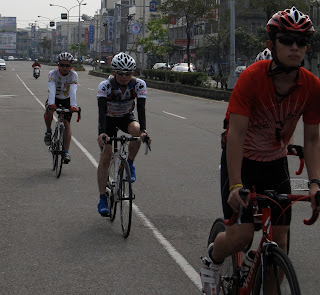
We ran into the Hsin Kang to Dajia cycling event. The even is a 110km ride to follow the route the Dajia Mazu will take on her annual pilgrimage from her home in the Cheng Lang Temple in Dajia. The Mazu festival marks the traditional arrival of Spring. Although Mazu pilgrimage in nothing new to Taiwan, I have heard... ahem!... the Dajia event has become mainly a tourism juggernaut run by organized crime and local politicians to fulfill their political fortunes and fortify their local fiefdoms of gravel, construction, bid rigging, sex, drugs, weapons and betel nut. I have also been told that some of the revenue generated from these events, eventually makes its way into the coffers of a particular political party with roots in China... ahem!

Making for Mazu

We made our way out of Ching Shui back along the villages along the base of Dadu Shan. I noticed that the villages had a strange layout, like a soldier village, and Michael suggested they were more recent plains Aborigine villages. The names suggested as much. Much of the Taiwan plain is dotted with this type of village and EVERY major town was once a center of indigenous life. The villages we passed through on our way up the hill are in an area known as Fan Cheng, or "Barbarian City". These areas were probably considered indigenous until the Japanese colonial period when the ethnic markers that once delineated Aborigine from Han were eliminated only by official caveat.

We rode back to Tanzi and I sped the 8 miles home at speeds between 23(37kph) and 29mph (46kph). Another great little ride complete. For the day I only logged 50 miles (80km), but it was a really nice ride.

Rocky Huang: Cycling Taiwan Video

Support Your LBS:

Final Build

Here is a great video posted by my friend and builder Rocky Huang from T-Mosaic Cycles in Taichung.

When Rocky is not preparing for a race he usually reserves his weekends for taking customers on rides. They usually offer different rides for different levels of fitness, so nobody is excluded.

Although the big box stores like Giant and Merida offer some good deals, you don't get the same level of expertise you get when dealing with a good local bike shop. At an LBS like Rocky's, you might pay a little more, but you get service from a guy who actually knows what it is like to seriously ride a bike and shares the same passion for the sport. Often, the big corporate stores do just enough to move merchandise, but the employees do not have the saddle time it takes to understand the customer's needs. Sometimes with large corporations, excessive overhead drives the sales rather than ensuring the customer has the bike they want and need. In my own experience I have found Giant and Merida stores are great for a quick repair, but generally they are technicians of limited ability. The employees go through a short training course, like McDonalds, and then hit the sales floor. Rarely are the Giant derailleurs ever indexed properly. Visiting Rocky is more like going to a cycling councilor. I can discuss training technique, different component options, geometry, routes and resources. This is a huge advantage of the LBS.

Furthermore, supporting your LBS is a great way to support your cycling community and I hope more cyclists will go out of their way to lend these places their support. The LBS forms a center where local cyclists can meet, ride and build community awareness. They need your patronage to remain a part of your community. To favor the corporate stores is simply penny wise and pound foolish.

I would again like to thank Rocky for his expertise and help with prepping by bike on short notice when I need to ride. Best bike shop in central Taiwan.


Friday, March 12, 2010

Clipless Pedals


Time to go CLIPLESS... please!

I have seen too many riders out there who are still using grubby old athletic shoes and pushing away at old platform pedals.

Platform pedals were great when I was when I was a kid and I would just leap off my bike and let it coast down the hill into Mr. Anderson's new Berlinetta.

Time Atac

Now that cycling has become, for me, both recreation and serious exercise, the pedal becomes a serious and essential piece of equipment to get right.

I am not just bringing this up to dump on people for not looking "pro", but rather, with clipless pedals (pedals you clip a cleat into) you can deploy more muscles and take advantage of your entire stroke to get better, more efficient performance.


The perfect stroke

The most efficient pedal stroke should be, as it has been described to me, like scraping dog shit off your shoes. Nice even strokes with the foot being generally flat at the bottom stroke (or pointed up for climbing). I have seen some guys who have pointed their toes down for years, so much so, that it has changed their frame size requirements. Old habits die hard. I could only imagine how awesome they would ride with a corrected stroke.

A lot of people are afraid of being locked to the bike, but the clipless pedals essentially turn the show into the pedal. It isn't so scary with a little practice and becomes second nature. (I fell down my first time out... in front of some cute girls who happen to be there whenever I look like a total boob.)

Speedplay Zeros

For shoes in Taiwan, I made a fashion faux pas and bought SIDI mountain bike shoes for NT8000. Mountain bike shoes have a bit more tread and you can pretty much walk on the street as if you are wearing regular shoes.

Look Keo

I paired the shoed up with Crank Bros. Candy SL pedals because they have a small platform and are easy to hook in and out. They use the CB SPD style cleat. They are small and pretty universal. For roadies, a lot of guys like Speedplay Zeros, which have a huge clip that attaches to the shoe. Look Keo and Time Atac are also great pedals.

Crank Bros. Candy

No argument.... If you don't have 'em... get 'em!!!

Thursday, March 11, 2010

Cross-ing Taichung County


Exploring Farm Roads Off The #136

One reason I sought out and went through all the pain and expense of building up a CX bike was to better explore the little betel nut roads and farm trails that litter Taiwan's counties. Unfortunately, I don't get to do enough of this. For the cost of several minutes to change tires and tubes, I can go from a road bike to an off-road bike and hit the trails. This would be better if my car hadn't been stolen and I could drive out to where the trails start... rather than bike 30 miles before the ride even starts. That's the down side. Knobbies tend to be a bit softer and a couple months on the road wears them down pretty bad. For this ride I went out the Local Taichung #136 past the Bat Cave (now unfortunately called "The Bat Hole") in Taiping. Just past the gaudy, gold-painted monastery I took a left over the bridge and off into the hills to the Fairy Falls. I used to go out there to jump into the waterfall before anyone really knew about it... but word leaked out and it has since become a party spot for foreigners and Taiwanese alike. Every so often someone drowns out there and the authorities discourage jumping into the falls.


I chose my 32c Michelin Mud 2 for the front and Michelin Cyclocross Jet for the rear. These are hard to find in Taiwan and I use them sparingly. Otherwise good tires. I do wish I had switched them around for the day or went all Mud2.
The whole area is much different from when I first visited a decade ago. The through road collapsed in a mudslide and now there is no access from the other side. Huge boulders are strewn about and a giant swath of hillside is noticeably missing. The area has become a kind of defacto nature preserve. I have seen pheasant and large herons back there as well as other animals.

I surveyed the terrain and made my way in. The path was partially paved and some parts overgrown and muddy. It was glorious.


Some parts of the road had been washed out and some half-assed construction was going on to make the road passable. It wasn't so bad.


As I got further down the road the conditions got more and more iffy. huge sections were overgrown and I took a little refuge under some banana trees as it started to rain.

In some parts the road was just a narrow track of dried mud. I glided over smoothly as if it were asphalt. I could look down at the stream below and at all the waterfalls. I love river tracing, so I had to imagine how to negotiate the stream bed below.

The whole valley was pretty peaceful and quiet. The only noise came from a distant construction project and the occasional roll of thunder.


I got a pinch flat on my way out. I didn't even notice for a while. As I stopped to change my flat, I heard the sound of grunting from the bushed. As a former paperboy I immediately feared a large dog or something would burst out of the bushes. I hate big dogs like Indiana Jones hates snakes. Finally, I looked up and saw a troop of monkeys looking down at me as if they were laughing at my folly. I patched up and went home before the rains picked up again.


Night Stats


I just got back from my night loop. Not a personal best, but I'll take it. Traffic was a little heavy tonight, but I love the feeling of fighting through the scooters. My bike, as a cyclocross race bike, excels in these situations. It is almost like criterium racing. I think I was a little tired for the intervals at the end. This is also the third time I have opted to just hold my gearing to the 50 tooth chainring and limit my cogs between 12 and 26.

Time for some chocolate milk!

Wednesday, March 10, 2010

Passing Geometry


Understanding Bike Geometry When Choosing A Bike:

I know the word, but what does it mean?


Size:

ST (ct) Seat Tube.

The seat tube determines the height of the bike or your frame size. This is generally measured from the center of the bottom bracket to the top of the top tube.

TT (cc) Top Tube Center to Center.

This is also known as the “effective top tube”. This measurement ranges from the center of the seat post to the center of the steering tube. This measurement determines the rider’s cockpit size and reach. The TT (cc) measurement is important to understand so that the rider will not be too stretched out or scrunched up. Most riders can feel when they are too stretched, but often make the mistake of getting too scrunched and not allowing a good position for proper breathing. Good breathing technique is vital for climbing and hard rides.

TT (hz) Horizontal Top Tube.

This is the actual length of the top tube. On compact frames this measurement may be longer than the effective top tube.

ST angle: Seat Tube Angle.

The angle of the seat tube is measured in relation to the ground, and tends to fall somewhere between 68 and 75 degrees.

A frame's seat tube angle determines the position of a bike's saddle related to its bottom bracket. Since the bottom bracket is the axis around which the bike's cranks and pedal rotate, this affects the orientation of the rider's legs and body in relation to the bike. Seat tube angle also influences how the rider's weight is distributed between saddle and handlebar.

A steeper seat tube brings the bike's saddle more into a vertical line with the bottom bracket, thrusts the rider forward into a more aerodynamic position, situates more of the rider's weight on the handlebars, and so the rider employs more of the hamstring muscles. Triathlon bikes often have steep seat tubes, because they're built exclusively for speed and tend to be ridden by people who are strong runners (and therefore have well-developed hamstring muscles).

The shallower the seat tube, the further the bike's seat is pushed behind its bottom bracket. This is a less aerodynamic position, but it also puts more demand on the thighs and glutes (which tend to be well developed in cyclists), and places more of the rider's weight on the saddle, to increase rider comfort.

A steeper seat tube makes a shorter seat tube for a frame of a given size, and making for a stiffer, more responsive feel. A shallower seat tube requires longer chain stays which can allow for grater comfort over rough terrain.

The steeper seat tube enables a more direct transfer of power through the rider's legs, although a shallow seat tube angle puts the rider in a better position to exert power during low cadence riding, such as seated climbing.

HT Angle: Head Tube Angle

Most head tube angles vary from about 69 degrees (when 90 degrees is perpendicular to the ground) to 75 degrees. In general, the steeper your head angle (closer to 75 degrees) yields quicker and more responsive the steering. Responsiveness can be explained by the following:

a) - A steeper head angle allows for a more weight-forward riding position, placing the body and head closer to the front of the bike, allowing the rider to see the road ahead sooner.

b) - A more upright head angle allows the front wheel to be tucked down under the rider, thus easier to steer.

c) - With the rider's weight more aligned with the turning angle, the bike will turn with more subtle weight and shoulder shifts rather than large arm movements.

You Gotta Have An Angle:

ROAD BIKES

Bikes with the steepest angles are the dedicated road racing bikes, which have angles averaging 74 degrees for both the head and seat tube. Racers want quick, agile and efficient machines, geared towards speed with comfort being a bonus if you get it. A steep head tube angle means that most of the rider's weight will be evenly distributed between legs and shoulders. A racer has to be in good shape to ride with more weight on the shoulders with eyes focused directly on the road in front rather than the trees and mountains.

Touring / Sportive/Recreational Road Bikes:

Steep angles allow for a very efficient ride. You can get racing angles to fit this category as well. In this category however, you get the luxury of having a slightly slacker HT angle for a more upright position, better for taking in the scenery, watching for cars ahead, and a little less interest in controlling the bike. In a more upright position, more weight gets transferred to the sit bones, which is usually more comfortable.

BB drop: Bottom Bracket Drop

If you were to draw a line horizontally between the front and rear dropouts and a perpendicular line through the center of the bottom bracket. The distance between the center of the bottom bracket and the first line, measured along the second is what is known as he "BB drop, which measures how far below the axles the bottom bracket sits.

Mountain, cyclocross, and track frames bottom brackets tend to be quite high (mine is 65mm). The reason is to keep stones, dips, roots or a severely sloping track from causing a pedal strike, hitting the chain rings or frame. The bottom bracket in these bikes is built up and way from these dangers which could end a ride or a season in a hurry. A higher bottom bracket also shortens the chain stays and down tube of a frame, which are put under the greatest stress under riding conditions, which translates into a stiffer, more responsive feel.

The advantage of stiffness and safety come at the cost of stability; the lower the bottom bracket, the lower the bike's center of gravity, for a more stable ride. Touring and commuter frames often have a lot of drop, to be more practical than concerned about winning a sprint. Many good road bikes tend to have medium BB drop for the best of both worlds.

CS: Chain Stays. The chain stays run from the bottom bracket to the rear dropouts. This can be measured as "actual" or "effective" length due to the fact that the bottom bracket drop will increase or decrease the length of a frame's chain stays without changing the position of the wheel.

Most models tend towards shorter chain stays. Short stays makes them stiffer and minimize the flex and therefore adds greater power transfer from the pedal stroke. This shortens the wheelbase for a snappier feel and low speed turning. It also puts more of the rider's weight over the rear wheel for optimized traction. Mountain bikes use short chain stays to better dig in to fight up loose climbs.

A longer wheelbase with longer chain stays makes a more stable bike at higher speed. The long chain stays add more flex. They push the rider forward off the rear wheel to add to the comfort of the ride. These bikes will often have a more shallow seat tube angle; great for seated climbs and women's bodies. The longer stays also allow greater tire clearance for larger tires to be used and making it easier to remove the wheel. Another added benefit of longer chain stays is that they will keep the rider's heels from hitting a rear pannier rack. This is generally why you see commuter and touring bikes with longer chain stays.

SO: Standover.

This is how high the top tube will be from the ground. This measurement may vary based on tire size. Some companies measure this differently, so it is good to double check before ordering.

HT Length: Head Tube Length

This may vary to allow for greater aero position.

WB: One fundamental measurement is wheelbase. The WB is calculated either by measuring the center of the hubs or the center of the spot where the wheels meet the ground; these distances must be equal (assuming the wheels are round!). A longer wheelbase should make a bike more stable in a straight line but less agile in turns. It may make a bike feel more comfortable or smoother due, in part, to the flexy stays.

Stem: Stem length is a completely adjustable parameter to adjust the feel of a bike. Most stem lengths are selected based on fit, but a rider can opt for a longer stem with a forward seat position to create slower, more stable steering, or the opposite effect with a shorter stem. Stems may vary from 130mm to under 90mm.

Taipei CYCLE 2010

Taipei CYCLE 2010 (The 2010 Taipei International Cycle Show) is warming up to present its biggest show in its two-decade-plus history. Taipei CYCLE, Asia's leading bicycle trade show hosts 2,900 booths at the TWTC NANGANG Exhibition Hall in Taipei from March 17 to 20, 2010.