I spent the last full day of my trip to Seattle with family. I took my brother to a cyclocross race to watch my cousin compete in the Cat 3 race before the Single Speed Cyclocross World Championships in Kent, Washington.
Pits
The weather had been rainy, but cleared up just in time for racing to start.
Junior Racing
The first to race were the kids. I love seeing kids out there racing around on drop bars. Some kids has some pretty expensive rigs.
A competitor with her LaCruz
Most of the competitors were men, but several women were in the field. The women race at the same time the men do, but their placing is calculated separately.
With the recent unstable afternoon weather and the biblical amount of rain that fell on Saturday, my plans for a Sunday Century were put on hold. I just didn't want to get out to Miaoli and have the skies open up for three hours.
Instead, I decided with all that rain there had to be some mud out there somewhere.
Furthermore, in many places around the world, this weekend is the beginning of cyclocross season. Cyclocross is a discipline in bicycle racing that has riders race drop-bar bikes around a course of mud, grass, sand and clay. The courses usually have sections of barriers the riders must dismount and jump over. Other sections require the riders to dismount and shoulder the bike up steep inclines. Basically, it's a lot of fun.
So, I took off my slicks and slapped on a pair of Mavic Locust CX knobby tires for a ride up into the trails around Taichung County.
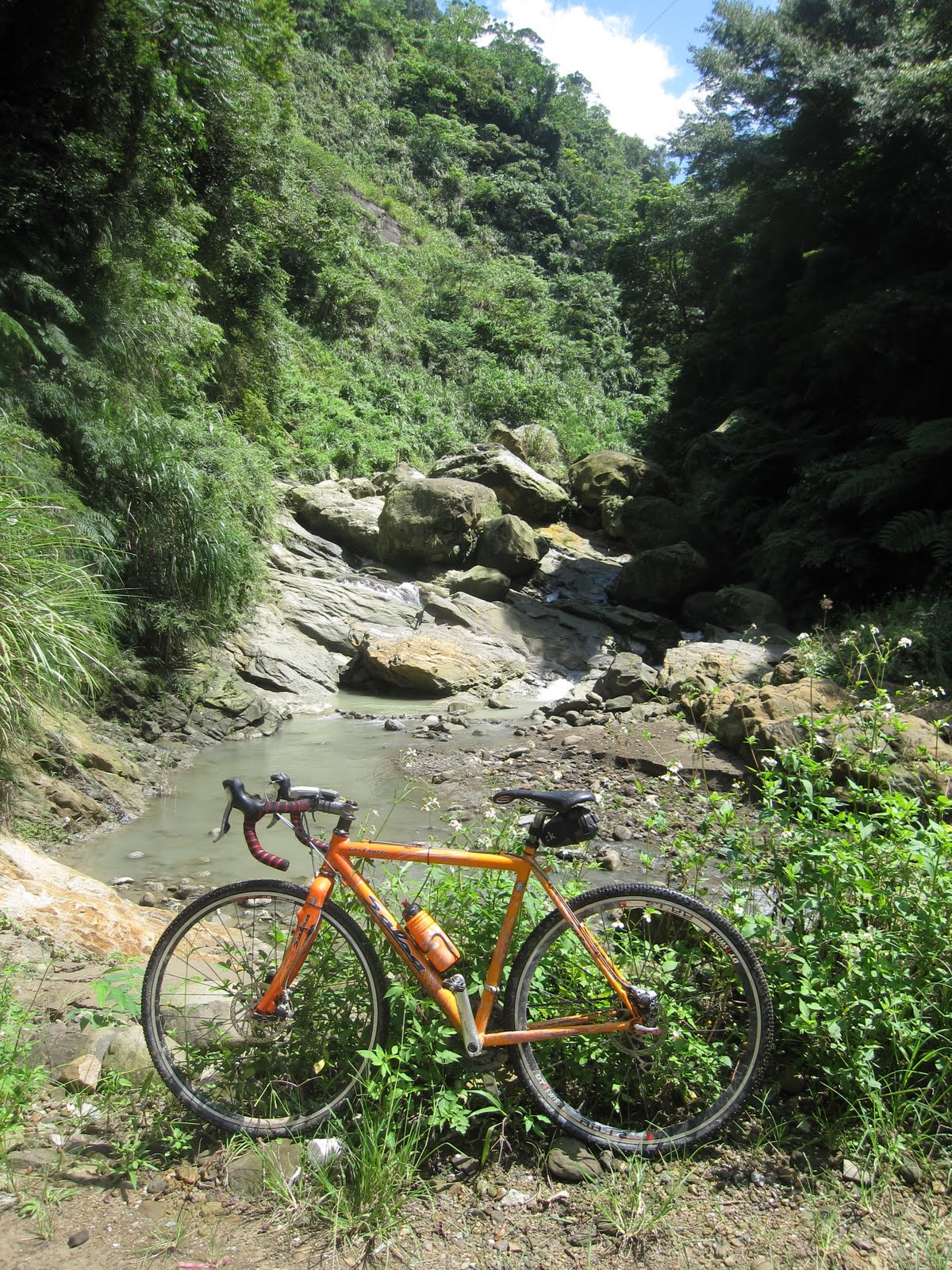
A small stream near the Taichung Local #100
When I first arrived in Taiwan over a decade ago, this route was one of my earliest trips after buying a second-hand motorcycle registered to some other foreigner who no longer lived in Taiwan. That is just how we did things back then. Anyhow, I got lost and found this glorious river valley with deep pools and nature abound. There had once been a back way in, but it has since been blocked by a landslide following an earthquake. Now, only part of the river is really accessible. There are plenty of waterfalls to soak in, and one you can dive into, though several people have drown in it. It had once been a little secret, but has since become popular with local expats as a place to BBQ and drink cheap beer.
With so little access, the valley has become more overgrown and the dirt road that follows the river has become less knowable.
The Road To The Falls
I planned to head back by noon to avoid any trouble with the weather, so I got out early and maybe a little too fast.
When I left, I filled my tires up to their maximum 75psi for better riding on the road. The knobbies take a lot of roll out of a set of tires and I am not sure how or why so many people ride mountain bikes with knobs on the road.
I also forgot my multi-tool and my mini-pump. I only had one CO2 cartridge in my bag, and so I would have to leave my tires inflated to 75psi to avoid pinch flats. Suddenly I was on a "one flat and out" rule for the day. I didn't want to get stranded out there.
The valleys are amazing
I arrived at the trailhead to find it was in much worse condition that I had remembered. The path had deep ruts carved into the clay from the heavy rains and large stones had been scattered all over the place from landslides. There were short sections of slick pavement divided by longer sections of slick clay, dirt and debris.
My chosen route
One thing I noticed was that my bike handling skills have greatly improved. I was able to spin out, un-clip, and hop off when the traction failed me. The best tactic was to aim for the center line where there a 2ft crop of crass had grown up. The grass offered better traction, but the centerline hid some major stones. Many sections had become so overgrown that I felt like I was riding through the undergrowth with no trail at all.
The easiest part
A major part of the cyclocross experience is the portaging and running with a bike. I had several of these moments when the hills became too steep or too rough to ride over. Some of it became a game of shifting weight to apply traction or to improve control. I blasted through little streams that divided the sections of track.
Miles from nowhere
This route is probably at about the limit of my skills and equipment. It is one gnarly path. Despite the difficulty, the area is filled with wildlife. Aside from the large butterflies and egrets, I managed to see a pheasant. I also heard a troop of macaques off somewhere in the distance. Furthermore, I was alone. There would be nobody coming up or going down that hill.
Local Flora
I continued to fight my way up over some dicey "single track" and through some nasty elephant grass, but the hill was just getting nastier and nastier. Every movement was a negotiation with terra firma.
Singletrack
She needed a rest
I finally entered a clearing where someone had a small cluster of banana trees, about two dozen Loquat trees and a shack. I was at about 2000ft and wanted to keep going, but I noticed a half dozen puppies hiding under a tree and did not want to meet a protective mama dog. My ascent was over. I could see a thick bank of clouds rolling in from the ocean and figured the rain was on its way.
Looking at the descent
It was time for the dangerous descent.
Descending is much harder as gravity becomes your enemy. You need to just stand and hang your ass over the rear wheel to stop from going over the handlebars. The entire descent was completely a technical adventure. I was pulled into deep ruts and toward melon-sized stones. Control becomes a very loose definition of downward progress.
What a nice stretch
I managed to ONLY take two spills with minor damage, just a few cuts and some burns from the sharp grass.
Posing
Lower down I picked up some speed and managed to negotiate the deep mud puddles and other surprises with ease. I am very glad to have 32 spokes on each wheel. I know I meted out some pounding on them coming down.
Falls
I finally made my final run back to the falls where I surprised a father and his children who were going to play in the water or catch insects.
"Talk about mud flaps, my girl's got'em"
The bike looked beautiful. Mud and filth caked all over the frame and components.
Splatter
The discs performed flawlessly, save for a squeak in the rear brake.
Salsa's next CX bike could be the Sanchez (dirty)
Caution: This route and this kind of riding can be dangerous and expensive. It is easy to take a fall or lose traction. The bike takes a lot of the abuse, so the rider doesn't have to, and that means it is very easy to have a catastrophic failure out in the middle of nowhere. Do not do this unless you are prepared to replace parts or buy a new bike.
On the way out
Here is a little video of my adventure to give you all a look at how we do Jungle Cross in Taiwan.
I think just from looking at my bike, anyone can tell that it is really not fish nor fowl... of course not... it is a friggin' bike. But besides the poor comparisons, it is, if anything else, a fine example of a brief period of time when bicycle manufacturers were playing with the concept of the cyclocross bike.
I have CX geometry, cable routing, and clearance. I have extra-light scandium tubing similar to some road bikes a few years ago. I then built up the bike to handle mostly road conditions, but with stronger (heavier) wheels. For the most part my bike can pass as a road bike at first glance. The most glaringly obvious difference is my choice in brakes: Shimano BR 505R Mechanical Discs.
For a period in the early to mid 2000s, CX bikes, which traditionally run cantilever brakes, were being outfitted with disc tabs. Manufacturers hoped the popularity of disc brakes in mountain bike racing might, pardon the pun, CROSS over to cyclocross. The biggest problem with cantilever brakes is that they are just not very powerful with poor modulation. Well... they can be made acceptably powerful, but it takes some rigging. Anyways, some companies led by Avid (BB7/BB5) decided to market disc brakes to work with STI levers as a better stopping brake that could be lighter than their hydraulic counterparts in the mountain bike world, and used in CX racing. Between about 2003 and 2006 a few companies produced frames and forks with CX in mind. The light disc crosser made several appearances on the websites of well known builders, but in the end the trend tapered off.
Salsa, the manufacturer of my bike, ended up taking all the elements behind my bike's "purpose" and diverting them into three other bikes; the cyclocross racer in the Chili Con Crosso, the utility-cross bike in the La Cruz, and the dirt road bike in the Vaya... but the all in one, race/dirt road/disc equipped multi-bike was gone.
There are several reasons for why disc brakes have not become more commonplace on more types of bicycles. Most critics of disc brakes cite "weight" as the predominant issue, with the average set of mechanical discs adding approximately one lb. to a bike's weight. Another issue has been safety. There are some riders who fear a white-hot rotor searing off a limb in a pile-up. The third major issue is that disc brakes are "overkill" for cyclocross racing and therefore are unnecessary for CX bikes.
In my own opinion I think the criticism stems from two primary sources.
The first is from the corner of the "cyclocross essentialists" (now watch as I essentialize), who revel in promoting and preserving a romantic view of olde time racing like in the golden age of European cyclocross racing. These are the types who are keen to determine how "real" a cyclocross rig can be base on its material composition and on the austerity of the component group. This is the "steel is real" crowd who believe the term "cyclocross" is reserved for racing cyclocross only. If the bike is not raced then it is not a CX bike. This would mean there are no cyclocross bikes sitting in bike shops as they have not been christened in a race. The same logic would make a steak knife only a knife until it cuts a steak, or a running shoe just a shoe, until you have run in it. I figure the geometry is for CX, which is also good geometry for other things, and therefore a CX bike. The cyclocross essentialists view the disc brake as sacrilege. Let's face it, a lot of people care what others think about their bikes and don't want to be perceived as a Fred. Disc brakes are like wearing scuba flippers to a state dinner.
The second point shares some sentiments with the first, but it more focused and concrete, beyond conjecture and my own perceptions of how others perceive they are being perceived.
Until this year the UCI (Union Cycliste Internationale), the world governing body for organized bicycle racing, did not sanction the use of disc brakes in cyclocross racing. The effect of such a rule might seem minor as few of the races that are conducted each season are actually sanctioned races under the UCI guidelines. Although there had been talk of allowing disc brakes in UCI races for years, it seemed like the annual appeal of the issue would forever remain D.O.A. The UCI has a reputation for being a stickler for tradition and a wrecking ground for many innovations. The UCI's ban on the ultra-aero Specialized Shiv TT bike, which had formerly been allowed to race, has become somewhat of a warning to all, of the volatile and seemingly arbitrary sentiments of the Council of Grand Old Men at the UCI. The whim of the UCI can translate into a multimillion dollar fiasco as manufacturers must change their designs to placate the official rule makers. Companies who would like to market a cyclocross bike want to see it doing its advertising out on the course and adhering to UCI rules is a major part of that ability to advertise. Isn't that what a lot of racing is about anyways... advertising!
The race is where the street cred comes into play, which sells the bikes. If Lance Armstrong won a the TdF with ape hangars and foxtails, there would be a slew of manufactures producing a cavalcade of Schwinn Stingrays for an eager public. The race provides a symbol of authenticity for the buyer, a security blanket, and plays on the fantasy side of cycling. We would all love to ride like the greats and as athletes we keep pushing ourselves to get better. We often rely on our equipment to make up for what we don't have in our legs, and sporting a bike that looks "professional" is one way to outwardly project one's aspirations (and insecurities). "You don't know me. I have exactly what Sven Nys is riding. I could be pro and you'd have no idea." The disc tab was just a very obvious symbol that the rider is not racing in UCI races and their legitimacy/authenticity could be called into question. The important factor is to "appear" to be legit. With so many people hoping to buy the aura of legitimacy and authenticity, it is no wonder the disc never caught on and manufacturers had little incentive to devote resources to engineer smaller, lighter and better disc brakes.
Even after the ruling there was still some shoulder shrugging and debate over whether the industry would make any moves back toward the disc brake, or if the ruling would be an arbitrary footnote.
Stevens Disc Crosser
The answer came sooner than expected.
Stevens has been showing a disc equipped prototype of their cyclocross bike at this year's Eurobike expo and the company seems ready to move forward with development for a 2012 launch. There may be other brands to follow with their own disc equipped rigs. Now, if the companies would like to sell disc equipped rigs, all they have to do is put a few under the buns of their sponsored riders. It is rarely about what the riders like, but rather what they are given to promote. There is nothing preventing discs to appear at the WCC.
I hope this latest swing toward disc brakes sparks some more innovation from the component companies to better refine the technology and bring better products to the consumer.
One reason I sought out and went through all the pain and expense of building up a CX bike was to better explore the little betel nut roads and farm trails that litter Taiwan's counties. Unfortunately, I don't get to do enough of this. For the cost of several minutes to change tires and tubes, I can go from a road bike to an off-road bike and hit the trails. This would be better if my car hadn't been stolen and I could drive out to where the trails start... rather than bike 30 miles before the ride even starts. That's the down side. Knobbies tend to be a bit softer and a couple months on the road wears them down pretty bad. For this ride I went out the Local Taichung #136 past the Bat Cave (now unfortunately called "The Bat Hole") in Taiping. Just past the gaudy, gold-painted monastery I took a left over the bridge and off into the hills to the Fairy Falls. I used to go out there to jump into the waterfall before anyone really knew about it... but word leaked out and it has since become a party spot for foreigners and Taiwanese alike. Every so often someone drowns out there and the authorities discourage jumping into the falls.
I chose my 32c Michelin Mud 2 for the front and Michelin Cyclocross Jet for the rear. These are hard to find in Taiwan and I use them sparingly. Otherwise good tires. I do wish I had switched them around for the day or went all Mud2.
The whole area is much different from when I first visited a decade ago. The through road collapsed in a mudslide and now there is no access from the other side. Huge boulders are strewn about and a giant swath of hillside is noticeably missing. The area has become a kind of defacto nature preserve. I have seen pheasant and large herons back there as well as other animals.
I surveyed the terrain and made my way in. The path was partially paved and some parts overgrown and muddy. It was glorious.
Some parts of the road had been washed out and some half-assed construction was going on to make the road passable. It wasn't so bad.
As I got further down the road the conditions got more and more iffy. huge sections were overgrown and I took a little refuge under some banana trees as it started to rain. In some parts the road was just a narrow track of dried mud. I glided over smoothly as if it were asphalt. I could look down at the stream below and at all the waterfalls. I love river tracing, so I had to imagine how to negotiate the stream bed below.
The whole valley was pretty peaceful and quiet. The only noise came from a distant construction project and the occasional roll of thunder.
I got a pinch flat on my way out. I didn't even notice for a while. As I stopped to change my flat, I heard the sound of grunting from the bushed. As a former paperboy I immediately feared a large dog or something would burst out of the bushes. I hate big dogs like Indiana Jones hates snakes. Finally, I looked up and saw a troop of monkeys looking down at me as if they were laughing at my folly. I patched up and went home before the rains picked up again.