body{background-attachment: fixed ! important; }
Showing posts with label disc brakes. Show all posts

Friday, May 6, 2016

Short Rides: Friday Links

Untitled Ebikes: 

Beginning July 1, Taiwan's Ministry of Transportation will be tightening regulations on Ebikes requiring riders to be licensed and the vehicles to be registered with the MoT. The new regulations will view the Ebike as a light motor vehicle as opposed to a bicycle. The move was due to the sharp rise in collisions between Ebike riders and pedestrians. Taiwan's strategy is a bit more subtle than the heavy-handed approach China has taken to address the problem by banning the vehicles in several major cities. 

Travel and Politics: 

A traveller from Hong Kong uses the bike to take a gentle dig at Beijing by contrasting Taiwan's urban development to Hong Kong's recent trajectory. 
On our first stop in Taipei what struck me was the freedom of movement; there are bikes everywhere. 
It’s similar to the mainland in that regard, but you soon notice how the government has been responsive to the needs of its citizens. 
Everywhere you go in Taiwan there are bike paths, sloped shoulders to drive on and off the pavement, and even lights specifically set up for cyclists to bike diagonally at crossing. 
As a tourist I felt I could travel anywhere with little concern for practicality.
 Pollution and Commuting: 

The Guardian has put out a piece that claims the benefits of cycling outweigh the harm caused by inhaling exhaust fumes in traffic.
The researchers modelled the effects of cycling and walking at different levels of air pollution and established a tipping point – the length of time after which there was no further health benefit, and a break-even point, when the harm from air pollution began to outweigh the health benefit.  
For Delhi, the most polluted city on the World Health Organisation’s database, the tipping and break-even points for cycling were 30 and 45 minutes per day respectively, while for walking they were 90 minutes and six hours and 15 minutes respectively.
While the researchers looked at the levels of particulates – PM2.5 – in the air and not NO2, which has also been established as harming health, “we did lots of sensitivity analyses and the message would have been the same”, said De Nazelle.
Personally, I don't feel braving PM2.5 levels over 150 is enough to convince me to test the researchers hypothesis. I do know that my asthma will flare up after riding in that shit and we should all be lobbying to not have to make the choice to bike in it at all. I guess they are trying to get us all to feel better about the realities. 

Disc Brakes: 

Don't throw away that disc brake equipped bike just yet... it appears the UCI has decided to give limited testing another go this June.  

Monday, May 2, 2016

What's Wrong With The Bicycles?

IMG_8380 

  “Our future lies in China and one of our goals is to develop this rapidly expanding market”--Giant CEO, Anthony Lo (2011)


Despite all the glad handing and praise the bicycle industry is facing some serious challenges in the short to medium term. There are increasing signs that things are not all well in paradise despite the passage of the Economic Cooperation Framework Agreement (ECFA), which was rapidly pushed through Taiwan's legislature and signed by Taiwanese and Chinese representatives in 2010.

“The markets are changing so fast that the rules have been reset, and if we don’t catch up, it is going to be harder for us to hold our own in the global market,”--Giant CEO, Anthony Lo (2013)
Aside from the chemical and mechanical doping scandals that have plagued the professional peloton--bicycling's advertising juggernaut--and possibly squelched interest in the sport, brands have been looking toward new technologies to buoy the industry and churn profits in a sluggish year. Shimano had been a major proponent of disc brakes in the pro ranks for some time and had been expecting reap the benefits. Now with both the UCI and the French Cycling Federation banning the components, a major source of market stimulation has been destabilized. 

Shimano profits are down 20% in the first quarter of 2016, and SRAM is tightening its belt with layoffs due to flagging sales. SRAM's plan to layoff 40 employees deemed "redundant" by the company will be spread over the company's global business, including the United States, Europe and Asia. 
“No one ever wants to be in position to request that people leave an organization, but sometimes it has to happen. I am confident that this restructuring positions us where we need to be and puts us on a firm foundation to drive forward into an evolving bike market.”--SRAM President, Stan Day
Wholesalers carry too much inventory into the first quarter, with the new product year looming (what is it now, May?). 
The lack of sales growth over last year is worrying in light of better weather conditions in much of the country this year. The Upper Midwest and Northeast were slammed with heavy snows in early 2015 but saw better conditions this year. However, the BPSA figures show that sales to retailers in January and February still lagged, though March wholesale sales showed a 6 percent improvement over 2015. 
Suppliers are seeing slow road and cruiser shipments at the start of the year, with road bike sales falling 9 percent overall. But mountain bike shipments are up 13 percent, and hybrid and commuter are up 16 percent.
The trouble coming from the two largest suppliers of drivetrain components is especially ominous, especially as Shimano does not simply supply the high-end, but supplies drivetrain components for everything from Walmart children's bikes to the Tour de France. A sizeable dip says a lot about demand in all sectors and that may have some serious repercussions in Taiwan. But hey, China is where its at, anyway. It is the world's largest emerging market and Taiwan has a free pass, right. 
Now, as a little reminder, ECFA was supposed to stimulate trade between Taiwan and China, opening up China to imports from Taiwan, with the bicycle leading the way on Early Harvest list set for an immediate and lasting impact. In a report from 2010:
Giant Global Group plans to increase its investment to build a bicycle plant in Kunshan, which has gained great support from the mayor of Kunshan Guan Aiguo. The 40-hectare new plant will consist of plants for bicycles, frames, carbon fiber and electrical vehicles. Besides, the cycle track & bicycle theme park plan will also be pushed forward. The investment in the initial stage amounts to USD 36 million (NTD 1.16 billion). 
Sources revealed Giant Global Group currently possesses a bicycle plant in Kunshan with an annual output of 2.5 million. As the Group's largest manufacturing base in the mainland, the plant boasts about 50% of the products meeting the domestic market demands. After being put into operation, the new plant will meet the market demands for both GIANT and MOMENTUM and the plant will trade with Taiwan bicycle plants after the signing of ECFA.
So, how are things looking in the post-ECFA world
Taiwan’s economy contracted on a yearly basis for a second straight quarter as China’s economic slowdown dragged on the island’s exports. 
Gross domestic product fell 0.28 percent in the three months through December from a year earlier, according to preliminary data released by the statistics bureau Friday. That compares with a 0.6 percent drop projected by the median estimate in a Bloomberg survey of economists and the 0.63 percent decline in the third quarter. The economy grew 0.85 percent in 2015. 
Taiwan’s exports shrank last year as local manufacturers grappled with the double whammy of slower economic growth in their top market China and tougher competition from mainland rivals. It wasn’t all bad news though: The economy grew 3.22 percent at a seasonally adjusted annualized rate, the most since the third quarter of 2014, as lower crude prices helped consumers.
Exports totalled USD 22.2 billion in January, which represented a notable 13.0% contraction in year-on-year terms. January’s result represents a slight improvement over December’s 13.7% drop. Imports tallied a total of USD 18.7 billion in January, which was a sharp 11.7% fall over the same month of last year. The figure came in above to December’s 14.8% decline. 
FocusEconomics Consensus Forecast panelists expect exports to fall 0.6% in 2016 and to rise 3.9% in 2017.
But at least we have the growing demand for E-Bikes in China to make up for the dip in high-end/high-margin leisure bicycle consumption, right? The E-Bike is the fastest growing market segment for bicycle manufacturers and China is leading the way

Following legislation in Beijing, Shanghai and Guangzhou, it has been reported that Shenzhen may also start to limit the use of electric bikes. Chinese people are getting wealthier and buying more and more cars, which as we know has caused many problems, such as heavy traffic, serious air pollution and poor physical health in big cities. In fact a highly viable alternative to fossil fuel powered vehicles is already available; bicycles and e-bicycles together with public transit form a good system and a true solution to the problem.
The Chinese market for Taiwanese bicycles declined by 33% to 79,000 units. Though not yet that large, the Chinese market was seen as a main growth market for several years. This development has now stopped due to the economic decline in China.

Wednesday, April 13, 2016

Death To Discs? : UCI Suspends Disc Brakes from Pro Peloton Following Paris-Roubaix Crash UPDATE

DSCN8651


It is now official. Disc brakes on your road bike will again make you look like a Fred--an asphalt amateur without the aura of potentially being mistaken for a pro with pro equipment. 

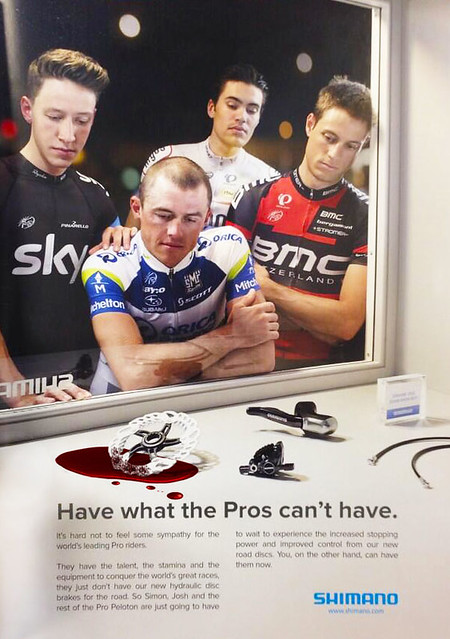
In the wake of the crash during last Sunday's Paris-Roubaix, in which Fran Ventoso from team Movistar suffered a sever tibial laceration in a crash as the alleged result of landing on an exposed disc rotor, the UCI has suspended the use of all disc brakes in future racing pending an investigation. The culprit is said to be a bike from the Italy/Taiwan sponsored Lampre-Merida squad, which brought their Scultura Disc bikes to the cobbles.


It is rare that the hyperbolic premonitions of technological dangers actually come to fruition. I have been a proponent of disc brakes for a very long time, and it is still early in the investigation. 


Disc brakes have been promoted by manufacturers as both an innovation in cycling technology, and as a means to stimulate sales in a sluggish market. Disc brakes can, but not always, offer superior modulation for better stopping power in less than ideal conditions. Moreover, disc brakes can also help drive the sale of carbon wheels, which are notoriously slick in wet, muddy conditions similar to those faced in the Paris-Roubaix


While manufacturers have been bullish on disc brakes, the luddite professional riders have been far more mixed in accepting the use of discs in the pro peloton. 


2012: Cycling News


At German bike brand Canyon, sponsor of professional teams Movistar and Katusha, the brand's team liaison manager, Andreas Walzer had his own, more rider-orientated concerns over RDBs: a longstanding worry over the mixing of disc and rim brake systems in a single peloton. 
"If you start, everybody has to use disc brakes otherwise its very dangerous," he pointed out. "You have two kinds of standard in braking if it's wet and downhill. Imagine what would happen in the downhill in the Tour or Giro?" 
Walzer also voiced concerns about races where RDB-equipped pros mix with young riders and amateurs. 
Currently only Shimano offer a user-ready system, though SRAM is close and Campagnolo should announce details of a system soon. That will partially mitigate concern over all pros having availability – a key concern of Katsanis – but doesn't resolve the thorny issue of the pro/amateur split. 
Carsten Jeppesen, Team Sky's head of technical operations, brought up another potential issue with disc brakes — pile-ups involving hot rotors. 
"The disc gets warm and in crash could you protect the rotor somehow?" Jeppesen said. "You have to look at that because if it's warm and sharp as a knife it's dangerous."
However Jeppesen doesn't believe current reservations about RDBs will hold up the system entirely. "You can't stop moving forward, you can't stop the industry and the fans – that's what they want and it's what we want," Jeppesen concluded.
2014: RKP
I was on a ride recently where I heard a rider saying he’d never ride a road bike with disc brakes because he didn’t want to get sliced up by the rotor in a crash. That’s not the first time I’ve heard that concern. While it’s true that I’ve heard of people cut by rotors, the injuries in the vast majority mountain bike crashes don’t include damage done by a rotor Ginsu-ing its way into flesh. Most crashes simply don’t involve body parts going into the wheels. Consider how often people are injured by chainrings in crashes; they occupy a far more exposed space than rotors do. RKP contributor JP Partland told me he knows a rider—exactly one rider—who lost a finger when it went into the spokes of a spinning wheel during a crash. Let’s call that an exception. Odds are, should you crash in the future, you’re much more likely to lose skin or break a collarbone than suffer a burn or cut due to tangling with a rotor.
2014: VeloNews


Geoff Brown (Garmin-Sharp mechanic): Now we’re already knackered with the front wheels anyways, because of the fork tabs. So it will add a bit more time, whatever, OK, fair enough. But more it’s just what it’ll do to the guys riding the bike, or the guy next to him. I personally have real fears about it. I don’t want to jump out of the car and see a guy with his femoral artery sliced. If there’s 25-30 guys on the floor, there’s not enough medical staff there to deal with the mess. It’s first come, first serve, the guy could bleed out right there.

2015: The Roar
But let’s step back here before we dismiss the idea of disc brakes on the grounds of safety because of the potential of an innocuous looking disc transforming into a ninja throwing star of death. 
A crash in the peloton is rarely a pretty thing when you consider riders only have a millimetre of breathable fabric and a foam esky with a polycarbonate shell on their head for protection. In a crash, there are many different elements that can cause bodily damage, so if we want to get serious about safety perhaps we should eliminate forks, spokes, derailleurs, handle bars, chain rings, other riders, and the road. 
After all that the safety risk posed by brake discs is small beer in comparison.
2015: Cycling Weekly
Against: Philippe Gilbert – pro rider, BMC Racing Team: 
“For me it is a question of safety. I know in cyclo-cross they use disc brakes, but when we crash we can land on 10 bikes. If you crash and land on a disc, which is warm having braked before the crash, it can open you. Then, if you get it in a vein somewhere…
“You will never have every team on discs, but you couldn’t have some with and some without because that would cause crashes. The ones with discs will brake in 10 metres and the ones without 20 metres.”
It will be interesting to see where this investigation leads. Clearly, the brands and manufacturers that have spent fortunes on adapting will be in full damage control mode. This probably means nothing to the amateur cyclist, except a little deflation of the ego if looking "pro" is important,  and will only have an impact if the pro ranks quit using discs at the competitive level for an extended period of time while the amateurs follow the pros (imagine the hit to retailers). Most amateurs don't regularly end up tangling with other cyclists in mass pile-ups. If this decision has an impact on the availability of disc related equipment (which is why I chose not to go disc with my current bike), then there will surely be an impact... maybe it could spur sales as everyone switches back...who knows. 

I rode a set of Shimano mechanical road disc brakes 2007-2011 and I enjoyed them for the varied riding Taiwan has to offer. Now that I am on a well balanced bike, I have never felt going back to rim brakes have ever been a hinderance, even at very...bold...descending speeds. I also don't use composite wheels, so I don't know what I am missing. I can surely see them as valuable on Taiwan's steep, narrow descents.


It will be interesting to see where this leads in the short to medium term as the cycling industry is really looking to invigorate sales in high-end machines. 


Update: 

The legendary Eddy Merckx prophetically commented on discs two days before the Paris-Roubaix.
“They work for [consumers], but in racing I think they’re too dangerous in crashes,” Merckx said. “If you crash, the brake can be hot, and if you take it in a leg, you can slice a tendon. In mountain bikes and cyclocross, it’s OK. But in a peloton, with 200 riders, I think it’s dangerous.”
Here is a rebuttal from Schooler's Cycling Stuff.

Update 2:

Meanwhile, the manufacturers have adroitly kept their distance from the events of the Paris-Roubaix and the UCI's official response by treating the allegations as a minor political  annoyance in the niche world of professional cycling, far from the realities of cycling enthusiasts. This is probably a very wise course of action from the industry as an anachronous echo of an earlier message:

Untitled

It seems, for the time being, the bicycle industry will continue business as usual with their plans to integrate disc brakes into a wider range of frames, forks and wheelsets. 

But it doesn't matter so much what happened to Fran Ventoso in the midst of Hell last Sunday. What matters more is what people think happened to Fran Ventoso. If both pros and consumers feel that disc brakes are somehow a legitimate danger, wrongly or not, the invisible hand will remove them from road cycling despite how badly the bicycle industry wants to promote them. 

On social media, one friend observed that the UCI had taken such a hard line on disc brakes, but had done little to nothing in regard to the motorcycles that dog the peloton after a crash between a moto and a rider resulted in the rider's death just a few weeks ago.  

The greatest impact may very well be a UCI that is even more resistant to introducing "new" technologies. We may have to endure another round of bottom bracket standards as a solution in search of a problem to sell bicycles. 

Stay tuned....  


Friday, March 11, 2016

Bullish or Bullsh*t: Is More Uncertainty Ahead for Taiwan's Bicycle Makers?

Untitled
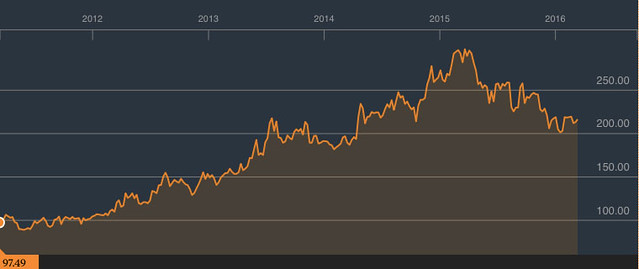
Giant Stock Price--Bloomberg

Every year the opening of the Taipei Cycle trade exhibition begins with an optimistic litany of industry figures and projections that seem to forecast sunny and clear with blue skies over the bicycle industry. This year we were treated to more of the same.

The latest statistics released by the Taiwan Bicycle Association (TBA) show that Taiwan’s bicycle export increased by 10.04% in 2015. Total export value reached 1.74 billion euro, compared to 1.58 billion euro in 2014. Also Taiwan’s bicycle parts export rose last year by 5.45%, with total value reaching just over 1 billion euro.

Despite the boilerplate assurances that the show was lights-out from the perspective of the exhibitors,  in private, and by proxy, there seemed to be more than just a general concern for the state of the entire industry in the short and medium term depending upon a company's position along the food chain from OEM/ODM, supply chain, subcontractor, brand, distributor and retailer. Even as TBA Chairman, Tony Lo, issued his report stylized as the industry's Auda Abu Tayi, from Lawrence of Arabia, declaring himself to be " a river to my people", there was an overall echo of anxiety in the relative quiet of the Nangang exhibition hall last week that did not resound with such confidence.

The greatest concern was the fact that the high-end bicycle market, which enjoys some of the highest profit margins, has been affected by multiple factors, including a sluggish European and American markets resulting in higher than normal inventory, aberrant weather patterns in the northern hemisphere, falling oil prices, the failure of the Chinese market to materialize as predicted due to unsustainable economic growth and oppressive air pollution.

Bike Europe reports
The market for Taiwanese bicycles in China declined by 33% to 79,000 units. Though not yet that big, the Chinese market was seen as a main growth market for several years. That development has come to a full stop thanks to the economic decline in China. 
The US is still the biggest single market for Taiwan made bicycles with 570,000 units between January and September this year, an increase of 26.3%. Export to the UK surged by 26.8% to 552,000 units and to the Netherlands by 17.3% to 316,000 bicycles. 
Next to bicycles, also total bicycle components export expanded by 7.01% reaching a value of 723 million euro.
Remember, the ECFA agreement was supposed to increase exports to China, and bicycles were part of the "early harvest" products upon the implementation of ECFA

Shimano, the groupset and component manufacturer that supplies components across several retail segments echoes this sentiment and has issued a cautious projection for 2016.
Shimano is taking a very careful position for 2016 and expects a decrease of its net sales (-7.6%) as well as an its net income (-23.9%). This will be the result of the strategy to bring forward the production scheduled for the first half of the fiscal year 2016 to the second half of 2015. Though the moderate growth of the European economies is expected to continue Shimano also expresses its concern over the possibility that the influx of refugees and the slowdown of the Chinese economy may lead to deterioration of the economic sentiment in Europe.
Despite all the bullish talk, Giant, Taiwan's largest bicycle manufacturer, has seen its stock price drop over 25% over the past year and the Financial Times forecasts advises investors to either hold or expect the stock to under perform.  

Another concern from some vendors was the increasing shift of Chinese companies competing for more of the high-end bicycle market. 

Many Taiwanese subcontractors and links in the supply chain have their start in the small to medium sized enterprises (SME) that served as the engines of the Taiwan economic miracle during the second half of the 20th century. Many of these companies were founded as joint family ventures where a day's work meant a seat at the dinner table. These companies thrived on the networks of personal relationships and upon the backs of brothers, sisters, aunts, uncles and children. 

Although the SMEs rapidly grew, many of them are still running on the narrowest of margins where the salaries are nowhere near competitive in the global workforce. It is no secret that Chinese headhunters are keen to exploit this weakness to woo knowledgeable employees into the service of China's competing enterprises. This is true in all of the sectors Taiwan has held the advantage of technical experience.

So, what will come of it?

For a few years we have seen bicycle events, a bicycle festival and the integration of the bike into tourism and city transportation. The idealist in me would like to think that good people want to make the wold a better place and simply want to promote cycling as a way to end our reliance on fossil fuels and save the planet.The pessimist in me knows that all of these events and programs are, at their cynical best, part of a greater plan to help sell more bicycles for the purpose of rewarding shareholders and satisfy a board of directors and make them rich.

Bike-Europe:
“We see a significant increase in the number of people and countries where people start cycling for sports, leisure and to commute,” said TBA chairman and Giant Global Group CEO Anthony Lo at the presentation of the industry sales statistics. “The average unit price of Taiwan made bicycles went down only slightly by 0.8% to 411 euro. The average export price for MTBs is now 618 euro and for road race 628 euro." 
Anthony Lo pointed out the importance of the cycling experience to get more people cycling. 
But I really think we have already seen the first, best, adjustment to drive sales with last year being the year of the disc brake. 

Disc brakes were actually quite a brilliant first step in trying to drive industry sales, and may prove to be far more effective that earlier attempts of a solution in search of a problem as we saw with the bottom bracket wars a few years ago. Disc brakes represent a radical change in form factor that currently requires the indispensable reengineering of almost every part of the bicycle to accommodate disc technology. Disc brakes require reinforced frames and forks with disc mounts. They require reinforced rims and wider hubs. They require groupsets to be redesigned for integrated hydraulic fluid units. They require the buyer to start anew and leave "yesterday's tech" behind. For someone with years of accumulated components and wheels, this is no small investment. 

The second initiative to reinvigorate sales has just gotten underway and I am pretty sure we'll be seeing a lot more of it-- Direct Online Sales. 

In the past, cheap brands like Motobecane were making gentle waves by selling bicycles online directly to the consumer without the typical retail markup. 

Then along came the German brand, Canyon, to completely upset the apple cart for the digital age by efficiently selling high-end racing bicycles exclusively through online sales. 

This approach drastically reduced overhead costs and served as a means to control the consumer's experience in an environment that is free from the typical competition in a standard retail store. 

Canyon has been going gangbusters in Europe, and now the big boys want to muscle in on the action by doing the same. 

First, Trek announced plans to sell online-direct to the consumer through its network of retail stores. Now Giant has entered the arena and the fight looks like it will only continue to get uglier with companies scrambling to offer similar services within a narrow time frame or risk being undercut by whoever gets there first.

Of course, the online-direct scheme throws decades of carefully groomed relationships between manufacturers, brands, distributors and retailers into chaos and the casualties are sure to mount, especially for the smaller brands that do not have the corporate backing to offer either a similar service, or a similar price point. Another casualty may be the choice a consumer has for components as each company will corral online customers into their own house brands as opposed to leaving it to the whim of the consumer. Lastly, it will be interesting to see how much of an effect this has on cycling culture as it is bound to change the traditional purpose of the bike shop. 

Lastly, the bicycle is going home. To better compete within the lucrative EU market, Taiwanese OEMs, assemblers and finishing houses are looking to move assembly to Europe in a move that will satisfy EU requirements for status as a domestic product. The Taichung based Fritz Jou Manufacturing (a loose term) just recently declared plans to move some "production" to Portugal. 
“We are joining Bike Valley Portugal as this is the ultimate project where the industry can take control over the supply chain again,” says President Fritz Jou of Fritz Jou Manufacturing. “In the past decades I have seen many production shifts based on GSP+, anti-dumping duties, and other tax incentives. These aspects are difficult to control by the industry. In the Bike Valley project we can finally produce where the market is, reduce the time to market and improve our flexibility. That is our ultimate goal.”
In short, it looks like there will be changes afoot in the coming years and Taiwanese companies had better be prepared for change.        


Saturday, March 19, 2011

New Bike Plan B: La Steel, La Disc, La Cross... La Cruz!!!

And That Means Its Good!

I started out my year on a bit of a sour note. The bike I had been riding for three years, the bike which had defined so much of my riding experience in Taiwan, had developed a fractured head tube. When I saw that hairline crack in the lower lefthand corner of the tube, my heart cracked as well. I loved that bike. It could do so much so well, and we'd been so far. Still, a defect like that could have led to a serious injury.

I could have been upset and made a gripe about the quality and design of Salsa bikes, but I don't think that would have been right or responsible. I don't blame the company, the design or the manufacturer.

A long time ago when I was a flustered teen trying to cope with a Murphy's Law moment in a fast food drive-thru-- which is sort of like taking the Bar exam for Murphy's Law-- a customer imparted on me some words of wisdom that have stuck with me since. As I continued to get worked up over a hamburger, he calmly called through the window, "Shit happens... and when it is not happening to you it is happening to me or to someone else."

This is sooth.

I think it was just shit that happened. No need to assign blame.

I also feel Salsa's 5 year warranty backs up their own confidence in the engineering and manufacture of their frames.

When people ask me to suggest some bikes for riding around Taiwan, Salsa is at the top of my list and I think, even after the broken head tube, I still wouldn't hesitate to put Salsa at the top of the list.

Unfortunately, I picked up one of the last of the Las Cruces framesets before they divided the bike into two different bikes designed with diverging purposes.

What really attracted me to the Las Cruces frameset was its versatility. It was light and responsive like a cyclocross racer, but it had disc brakes and could easily do double duty as a dirty roader or even a light tourer. It was made from scandium alloy tubing and the frame itself weighed in at only 2.5 lbs.

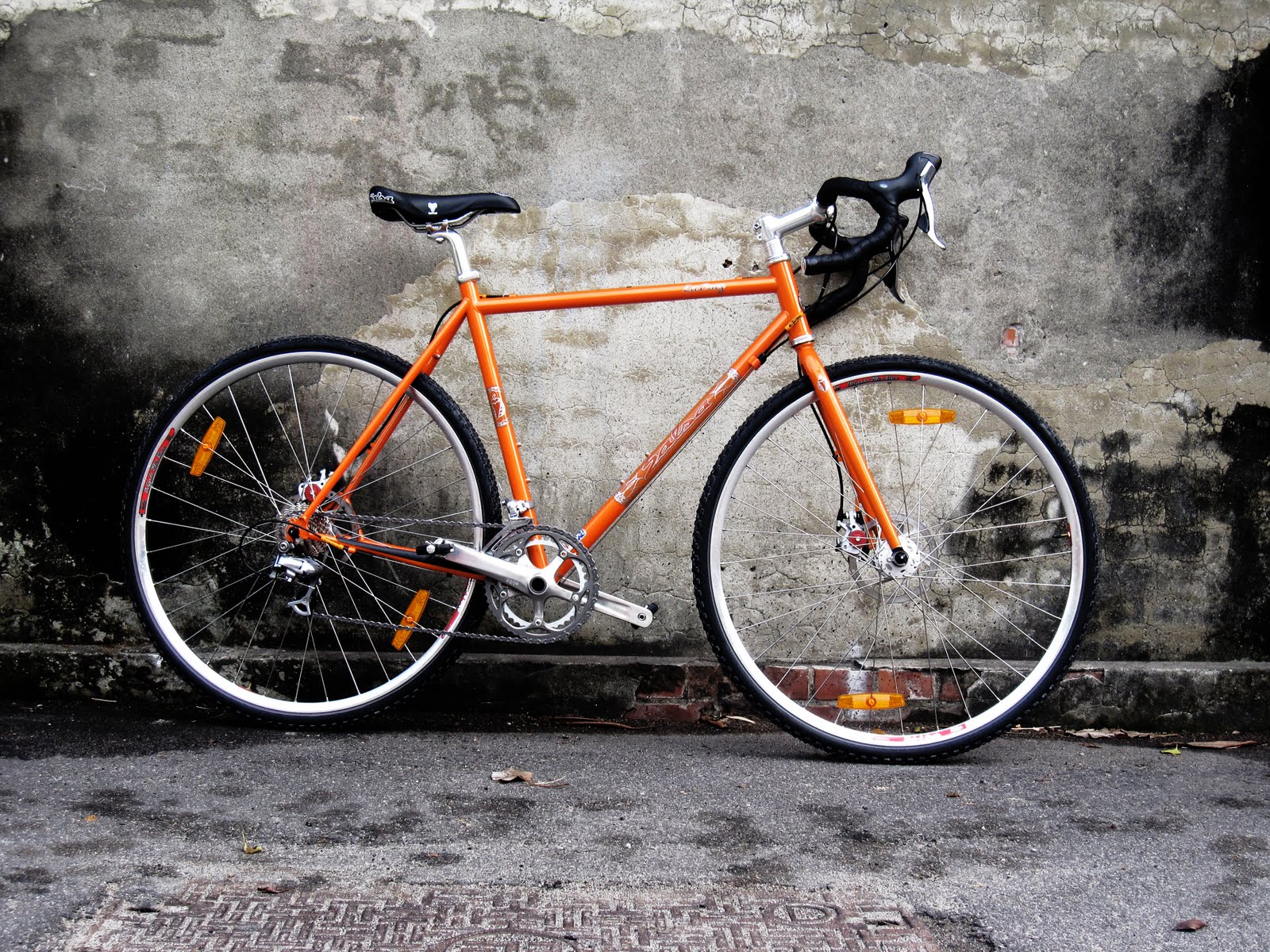
Still, the UCI had balked at sanctioning disc brakes and riders want to look pro, so the Las Cruces was discontinued and replaced by the Chili Con Crosso cyclocross race bike-- a lean, mean, racing machine focused purely on racing on a circuit of mud. It was also replaced by the La Cruz, a steel framed bike with relaxed cyclocross style geometry, but with disc brake exclusivity, eyelets and a steel fork. With a frame weight of over 4 lbs, it was not a lean racer, but it was ideal for almost everything else.

The La Cruz could be built up as a cyclocrosser, a light tourer, a commuter, a flatbar singletrack splitter, a smooth longhauler and a gravel roader. As a steel framed wonder, riders found a way to mold it into whatever they needed. It was such an expandable frame, it quickly became legendary in the same way its QBP stablemate, the Surly Crosscheck, has become an everything bike. The allure of shiny disc brakes made it even better.

And it was orange.

I have recommended the La Cruz to numerous people and brought them to Famous Bikes in Taichung to have a look in person.

This is the bike so many riders in Taiwan should be riding right now. It is made for the way real people ride.


After a rough start in trying to figure out how to replace my frame due to my location in Taiwan, Salsa was incredibly helpful in offering a solution. Since Salsa's Taiwan distributor does not have the 2011 models in stock, and will not have them for a while longer, I was offered a 2009 Salsa La Cruz as a replacement. I thought that seemed fair and accepted the offer.


The La Cruz is made from True Temper OX Platinum steel tubing, which is a very hard, durable alloyed steel tubing, allowing strength with lighter weight. It also lends itself to TIG welding, which is how the La Cruz is welded. Actually, I have been really impressed with the quality of the welds on the La Cruz. And that is coming from a Seven owner.


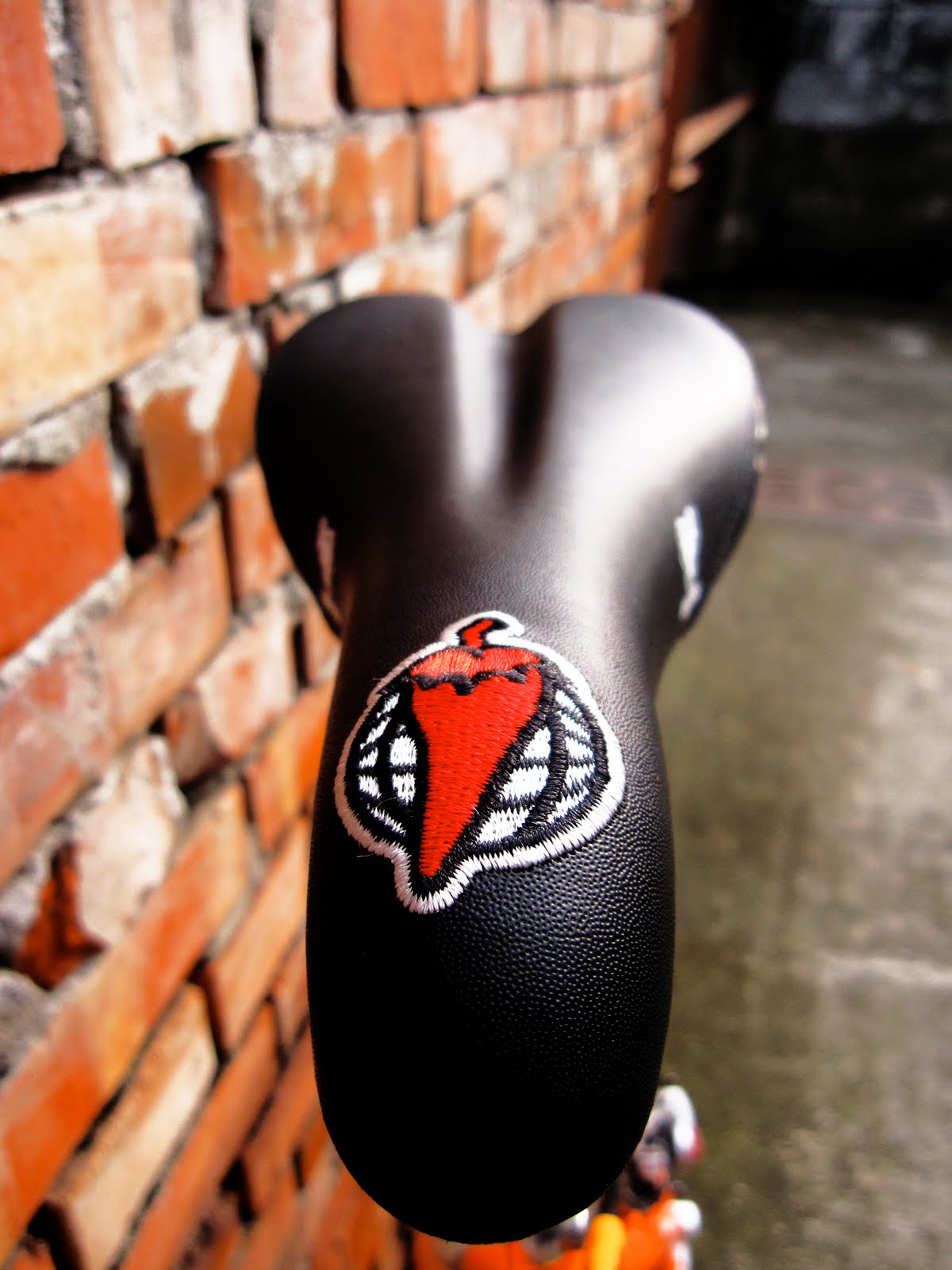
The complete La Cruz comes with a lot of Salsa branded extras, like the Salsa embroidered WTB saddle, which is soft and seems easily comfortable enough to keep the backside cool from Taichung to Kaohsiung.


The bike also came stocked with a shiny Cane Creek headset to highlight the "orange pop" paint job. The paint is sort of tricky to photograph. It has a satin sheen to it and a little sparkle. Really nice.


I was happy to get another set of off-road tires with the Panaracer Cross Max, but they were a little softer and slower than what I would normally have on the road. I will probably switch them out for a set of Continental 4000GP 25c road tires and possibly a commuting tire as well.


The 430mm chainstays can accommodate a 42mm dirt tire, so this bike could conceivably be used for some more heroic dirty riding than I have done so far. I might try to ride the entire length of the Highway 16 to the helicopter pad on this beast.


The drivetrain uses Shimano's trusty 105 group set with a Truvativ compact crank (50t/34t) and a 12-27 rear cassette. This is pretty much what I had been using before.


The La Cruz also uses Shimano's XT mountain bike hubs laced to some sturdy Salsa Delgado Race 29er Rims. These should make for some bomb proof wheels to handle anything from potholes on Taichung Harbor Road to the stony betel nut tracks of Taichung county.


With rear eyelets, I hope to strap a rear rack to the back and make this machine a regular commuter. I had been overstuffing a backpack, but it was too cumbersome and a rack set-up would really give me more of a utility angle than what I can currently do. What makes the La Cruz so awesome is that it can easily go from a quick road bike to a hauler with the snap of a rack. So many of the bikes sold in Taiwan for this purpose are ill suited for actual use. There are far too many flatbar aluminum bikes with panniers hanging off their seat posts.


The La Cruz sports some relaxed angles, which are great for comfort, touring and easygoing in traffic. The seat tube and head tube angles are each about a degree back from my Axiom. This would be perfect for riders with reach or back problems. It brings the bars closer in a more upright position as opposed to stretching way out over the top tube to reach the handlebars.


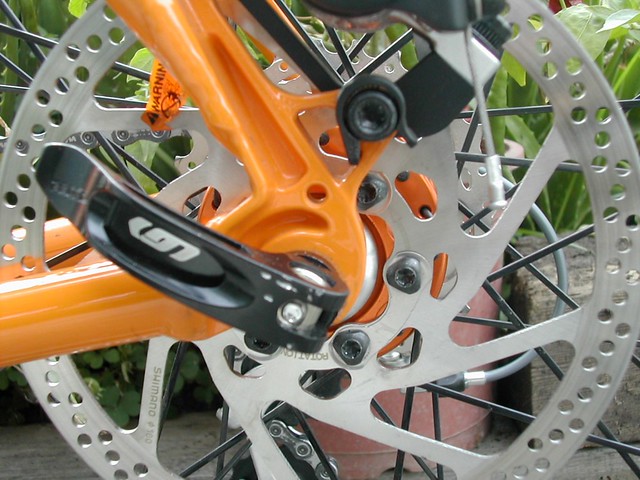
The Avid BB7 disc brakes are really a fantastic feature. I am still assessing them for their stopping power and ease of use, but I have been eager to compare them to my old Shimano Br-505R disc set. I was having some noise issues with the Shimanos, and thus I am pleased with Avid. The stopping power of discs trumps the cantilever brakes that are usually found on cyclocross and commuter bikes, and I can recall a few rainy days where the discs saved my ass in traffic.


In my early assessment, the bike rides like a Cadillac compared to the stiffness of the Las Cruces. Not that I didn't like the snap of the Las Cruces, but the steel tubing, long stays and fat tires really made for a plush ride. I am sure it will firm up a little with road tires, but I could just roll over anything.


The handling was much more firm and deliberate. The Las Cruces was just inside twitchy, while the La Cruz was firm. I could cut through scooters and cars while craning my neck without having to look back at the bars to be sure I wasn't going to lose control and hit something. I must say, I did miss the raciness of the Las Cruces, but the Seven has it in spades, so a little more stability is welcome at this point.


Another feature of the bike I am just getting used to is the Moto Ace Bell Lap Bars. These are really shallow bars with a slight flare to them. Once in the drops, they are pretty easy to reach the controls. I am used to the Deda Newtons, so it might take a little time to adjust. The shallowness would be very welcome for a rider with flexibility issues.


The front fork is also made from True Temper OX Platinum Steel. It feels rigid and absorbs the abuse from the road with aplomb.


This is really a gem of a bike and after trying to get so many people to pick one up for themselves, I can enjoy the ride for myself. This is really a special bike and an ideal ride for Taiwan.

Steel is resilient and can take a pounding on Taiwan's roadway, but also in train cars, busses and in the back of a van with a load of other bikes. It can take the right sized tire for the job and it can easily take you from the city to the mountains, from road to track without having to change a thing.

The rack mounts can allow you to take your regular ride and do the fabled round-island tour with a full load of gear. They just don't make enough of this type of bike.


Sadly, this version of the La Cruz is out of production, but Salsa does offer several models that I regularly recommend to riders in Taiwan for their stated purpose:

La Cruz Ti: The steel La Cruz may be dead for now, but its titanium brother survives. Salsa has been incorporating several affordable titanium models of their popular frames and the La Cruz Ti looks like a winner. Although it lacks the signature disc brakes, it could be a great bike.

Vaya: The Vaya can be viewed as the successor to the steel La Cruz. The Vaya is a ChroMoly steel frame that has been optimized for the credit card adventurer. It has disc brakes, relaxed geometry and it is orange.

Fargo and Fargo Ti: When the Fargo was introduced it immediately reminded me of a fighter plane-- The A-10 Warthog. The Warthog isn't pretty, but it is unstoppable and completely lethal, which is why it has been in continual service since 1977. The Fargo is a steel or titanium drop-bar go anywhere bike with disc brakes, rack mounts and five water bottle mounts. I can see this being used for touring and camping around Taiwan's East Coast.

Casseroll: If there was ever a perfectly balanced road bike for the non-racer, the Casseroll would be it. I have begged people to try the Casseroll. It has rack and fender mounts, room for 38mm tires, but more roadlike geometry. Steel. The Casseroll can be built as a geared, single speed or fixie. This is the All Rounder. Why won't anyone listen to me? So many riders in Taiwan would love this bike.

Salsa has several other models, including several mountain bikes, but the bikes above should be on your short list if you are looking for a well thought out, versatile, and tough bike that should last you a long time on Taiwan's roads. Although my alloy frame broke, I don't think it is indicative of Salsa products. Beyond that, Salsa backs up their frames with service that can only be described as Above and Beyond. I was in regular communication with Chuck at Salsa during my warranty process and he was courteous and he seemed to really care that the company stood behind their products and service. It is easy to tell that Salsa is a company of people who are passionate about what they do.

Unfortunately, the Salsa brand suffers a bit of a disservice in Taiwan as the local distributor has not done much in the way of promoting or preserving the best qualities of such a great brand for Taiwan's rugged landscape, so you may not even be aware of where to check them out if you are interested. Although I am aware of several distributors that would love to add Salsa to their stables, I am only aware of one dealer: Famous Bikes in Taichung.

Frame: Salsa La Cruz (True Temper OX Platinum)
Fork: Salsa True Temper OX Platinum
Group: Shimano 105 -> Ultegra 6600 (50/34 to 12-27)
Headset: Cane Creek -> Chris King
Bars: Salsa Moto Ace Bell Lap -> Deda Newton
Stem: ? --> Something Smaller
Seatpost: Salsa ?
Saddle: WTB --> Selle Italia Flite Gel
Rims: Salsa Delgado 29er Race --> DT Swiss1.1 / 1.2
Hubs: Shimano XT --> Chris King ISO Disc
Brakes: Avid BB7 Mechanical Disc
Tires: Continental 4000GP 25c / Panaracer Cross Blaster / Others
Pedals: Crank Bros. Candy SL (Generation 1)

Great Bikes. Great People. Great Company!!!

For any questions regarding Salsa bikes or their availability in Taiwan, contact Salsa: pman@salsacycles.com

------------------------------------------
This review has in no way been paid for or supervised by anyone other than Taiwan in Cycles.