body{background-attachment: fixed ! important; }
Showing posts with label ECFA. Show all posts

Tuesday, November 14, 2017

Bruised Bicycle Bellwether: Giant Reeling in China Market

Untitled
China, once the most promising bicycle market is now a heavy burden for Giant harming the company’s financial results. There are even no signs for improvement as Giant points to China’s slow economy. Even the country’s booming bicycle sharing systems, in which Giant is involved directly as well as via its own bicycle sharing program YouBike, could not give much financial relieve.--Bike Europe (11/14/2017)
The bicycle industry is already suffering with multiple pressures from a shift in retail channels to currency exchanges and cultural change in areas traditionally more favorable to higher-end cycling equipment. For most of a decade we have heard one of the industry leaders beating the drum for Taiwan's economic (and political) integration with the People's Republic of China. 

Or as Ralph Jennings wrote in 2009:
TAICHUNG, Taiwan (Reuters) - Economic powerhouse China and export-reliant Taiwan, political rivals for six decades, agreed on Tuesday to negotiate a trade deal that would cut tariffs and bring the two sides closer. 
Of course ECFA was never intended to be entirely about economic, but rather a means to rein in Taiwan's independence, which is supported by a vast majority of the population, in creating an economic dependency with deep political implications. 

ECFA garnered vocal support from Giant Manufacturing and Ma Ying-jeou's re-election campaign even saw then Giant chairman, Anthony Lo, issue a last minute vote of confidence to Ma's Kuomintang Party in the closing days of the election with an urgent call for support of his China-centered policies. He continued to remain bullish on Ma's vision and brushed the issue with tones of urgency. 

In 2010 Giant put its money where it's mouth was. 
According to reports from Taiwan media, appreciating the huge potential of the mainland market after the signing of the ECFA, Taiwan Giant Global Group plans to strengthen the capability and competitiveness of the mainland headquarters this year by launching a new investment plan to invest an initial RMB 1.16 billion for the establishment of the Bicycle Industrial Park in Kunshan, Jiangsu Province.

Reports disclosed that with the expansion of the market, Giant Global Group will increase its investment to raise its market share in the mainland bicycle market. Based on its original SUV brand GIANT, the Group will vigorously develop a new brand MOMENTUM to raise the market share of passenger vehicles. The medium-priced brand will be aggressively promoted through about 2,000 distribution channels.

Giant Global Group plans to increase its investment to build a bicycle plant in Kunshan, which has gained great support from the mayor of Kunshan Guan Aiguo. The 40-hectare new plant will consist of plants for bicycles, frames, carbon fiber and electrical vehicles. Besides, the cycle track & bicycle theme park plan will also be pushed forward. The investment in the initial stage amounts to USD 36 million (NTD 1.16 billion).

Reports disclosed that with the expansion of the market, Giant Global Group will increase its investment to raise its market share in the mainland bicycle market. Based on its original SUV brand GIANT, the Group will vigorously develop a new brand MOMENTUM to raise the market share of passenger vehicles. The medium-priced brand will be aggressively promoted through about 2,000 distribution channels.
 
Giant Global Group plans to increase its investment to build a bicycle plant in Kunshan, which has gained great support from the mayor of Kunshan Guan Aiguo. The 40-hectare new plant will consist of plants for bicycles, frames, carbon fiber and electrical vehicles. Besides, the cycle track & bicycle theme park plan will also be pushed forward. The investment in the initial stage amounts to USD 36 million (NTD 1.16 billion). (6/2010)
Giant's self proclaimed "Godmother of Women's Cycling", Bonnie Tu, doubled down on ECFA and the China market. According to a Bicycle Retailer article (7/2010), Tu could barely suppress her enthusiasm for the post ECFA China boom.
Bonnie Tu, Giant Manufacturing’s chief financial officer, told the Financial Times the agreement could help the company better manage its production. Giant has factories in Taiwan and China. Giant builds its high-end bikes, particularly carbon fiber, in Taiwan. Lesser value models are made in China. 
“If there is no tax issue, we can really integrate our factories and shuffle production as we like,” Tu said. “China’s economy of scale for high-end bicycles could be really big,” she added.
This despite the beginnings of a quiet exodus of Taiwanese firms from China. 
Our future lies in China and one of our goals is to develop this rapidly expanding market”, said Tony Lo, CEO of Giant Global Group at the press conference hosted by the Taiwan External Trade Development Council (TAITRA) at last week’s Eurobike show. “The best platform to build up this emerging market is the Taipei Cycle Show which is taking place from March 7 – 10, 2012,” said Lo.-- Bike Europe (8/2011)
... and later: 
Anthony Lo (羅祥安), chief executive officer of local bicycle maker Giant Global Group (巨大集團), said the government needs to establish a vision.
“What Taiwanese enterprises want to see is the government striving to help businesses build unique brands that can provide innovative products and services,” Lo said on the sidelines of the forum. 
Lo said Taiwan needs to integrate into regional markets as soon as possible so local firms can enjoy the trading privileges that other nation’s companies do, such as tariff exemptions. 
“The markets are changing so fast that the rules have been reset, and if we don’t catch up, it is going to be harder for us to hold our own in the global market,” he added.--Taipei Times (4/3/2013)
The China market has been a quagmire for some time and several indices have highlighted this situation.
The Chinese market for Taiwanese bicycles declined by 33% to 79,000 units. Though not yet that large, the Chinese market was seen as a main growth market for several years. This development has now stopped due to the economic decline in China.--(11/17/2015)
This past year Bicycle Retailer reported:
The weak link in global sales for Taiwanese companies, including Giant, remains China. "Giant China's performance continues to suffer from soft demand and the popularity of bike sharing, which affected sales recovery in the first half," Giant said. 
China's infatuation with bike sharing has forced companies like Giant and Merida to close some company-owned stores as retail sales have plummeted, particularly for higher end models. Independent shops have also been hurt by a lack of demand brought on by bike sharing. 
Still, Giant said it believes its co-sponsorship of pro-cycling's Team Sunweb, and its performance in the Tour de France and the Giro d'Italia, has elevated its global brand awareness and will drive future demand, especially for its carbon frames and accessories.
"Looking forward to the second half of the year, Giant projects Europe and the U.S. will continue its growth momentum," the company said. However, it cautioned that unpredictable exchange rates as well as continued turmoil in the Chinese market would be of concern for the remainder of the year. 
But if we just wait a bit longer...maybe China will do us a solid....

Monday, May 2, 2016

What's Wrong With The Bicycles?

IMG_8380 

  “Our future lies in China and one of our goals is to develop this rapidly expanding market”--Giant CEO, Anthony Lo (2011)


Despite all the glad handing and praise the bicycle industry is facing some serious challenges in the short to medium term. There are increasing signs that things are not all well in paradise despite the passage of the Economic Cooperation Framework Agreement (ECFA), which was rapidly pushed through Taiwan's legislature and signed by Taiwanese and Chinese representatives in 2010.

“The markets are changing so fast that the rules have been reset, and if we don’t catch up, it is going to be harder for us to hold our own in the global market,”--Giant CEO, Anthony Lo (2013)
Aside from the chemical and mechanical doping scandals that have plagued the professional peloton--bicycling's advertising juggernaut--and possibly squelched interest in the sport, brands have been looking toward new technologies to buoy the industry and churn profits in a sluggish year. Shimano had been a major proponent of disc brakes in the pro ranks for some time and had been expecting reap the benefits. Now with both the UCI and the French Cycling Federation banning the components, a major source of market stimulation has been destabilized. 

Shimano profits are down 20% in the first quarter of 2016, and SRAM is tightening its belt with layoffs due to flagging sales. SRAM's plan to layoff 40 employees deemed "redundant" by the company will be spread over the company's global business, including the United States, Europe and Asia. 
“No one ever wants to be in position to request that people leave an organization, but sometimes it has to happen. I am confident that this restructuring positions us where we need to be and puts us on a firm foundation to drive forward into an evolving bike market.”--SRAM President, Stan Day
Wholesalers carry too much inventory into the first quarter, with the new product year looming (what is it now, May?). 
The lack of sales growth over last year is worrying in light of better weather conditions in much of the country this year. The Upper Midwest and Northeast were slammed with heavy snows in early 2015 but saw better conditions this year. However, the BPSA figures show that sales to retailers in January and February still lagged, though March wholesale sales showed a 6 percent improvement over 2015. 
Suppliers are seeing slow road and cruiser shipments at the start of the year, with road bike sales falling 9 percent overall. But mountain bike shipments are up 13 percent, and hybrid and commuter are up 16 percent.
The trouble coming from the two largest suppliers of drivetrain components is especially ominous, especially as Shimano does not simply supply the high-end, but supplies drivetrain components for everything from Walmart children's bikes to the Tour de France. A sizeable dip says a lot about demand in all sectors and that may have some serious repercussions in Taiwan. But hey, China is where its at, anyway. It is the world's largest emerging market and Taiwan has a free pass, right. 
Now, as a little reminder, ECFA was supposed to stimulate trade between Taiwan and China, opening up China to imports from Taiwan, with the bicycle leading the way on Early Harvest list set for an immediate and lasting impact. In a report from 2010:
Giant Global Group plans to increase its investment to build a bicycle plant in Kunshan, which has gained great support from the mayor of Kunshan Guan Aiguo. The 40-hectare new plant will consist of plants for bicycles, frames, carbon fiber and electrical vehicles. Besides, the cycle track & bicycle theme park plan will also be pushed forward. The investment in the initial stage amounts to USD 36 million (NTD 1.16 billion). 
Sources revealed Giant Global Group currently possesses a bicycle plant in Kunshan with an annual output of 2.5 million. As the Group's largest manufacturing base in the mainland, the plant boasts about 50% of the products meeting the domestic market demands. After being put into operation, the new plant will meet the market demands for both GIANT and MOMENTUM and the plant will trade with Taiwan bicycle plants after the signing of ECFA.
So, how are things looking in the post-ECFA world
Taiwan’s economy contracted on a yearly basis for a second straight quarter as China’s economic slowdown dragged on the island’s exports. 
Gross domestic product fell 0.28 percent in the three months through December from a year earlier, according to preliminary data released by the statistics bureau Friday. That compares with a 0.6 percent drop projected by the median estimate in a Bloomberg survey of economists and the 0.63 percent decline in the third quarter. The economy grew 0.85 percent in 2015. 
Taiwan’s exports shrank last year as local manufacturers grappled with the double whammy of slower economic growth in their top market China and tougher competition from mainland rivals. It wasn’t all bad news though: The economy grew 3.22 percent at a seasonally adjusted annualized rate, the most since the third quarter of 2014, as lower crude prices helped consumers.
Exports totalled USD 22.2 billion in January, which represented a notable 13.0% contraction in year-on-year terms. January’s result represents a slight improvement over December’s 13.7% drop. Imports tallied a total of USD 18.7 billion in January, which was a sharp 11.7% fall over the same month of last year. The figure came in above to December’s 14.8% decline. 
FocusEconomics Consensus Forecast panelists expect exports to fall 0.6% in 2016 and to rise 3.9% in 2017.
But at least we have the growing demand for E-Bikes in China to make up for the dip in high-end/high-margin leisure bicycle consumption, right? The E-Bike is the fastest growing market segment for bicycle manufacturers and China is leading the way

Following legislation in Beijing, Shanghai and Guangzhou, it has been reported that Shenzhen may also start to limit the use of electric bikes. Chinese people are getting wealthier and buying more and more cars, which as we know has caused many problems, such as heavy traffic, serious air pollution and poor physical health in big cities. In fact a highly viable alternative to fossil fuel powered vehicles is already available; bicycles and e-bicycles together with public transit form a good system and a true solution to the problem.
The Chinese market for Taiwanese bicycles declined by 33% to 79,000 units. Though not yet that large, the Chinese market was seen as a main growth market for several years. This development has now stopped due to the economic decline in China.

Friday, March 11, 2016

Bullish or Bullsh*t: Is More Uncertainty Ahead for Taiwan's Bicycle Makers?

Untitled
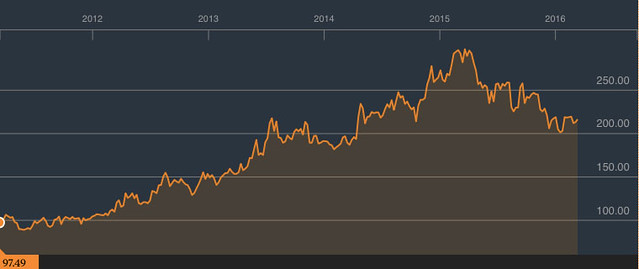
Giant Stock Price--Bloomberg

Every year the opening of the Taipei Cycle trade exhibition begins with an optimistic litany of industry figures and projections that seem to forecast sunny and clear with blue skies over the bicycle industry. This year we were treated to more of the same.

The latest statistics released by the Taiwan Bicycle Association (TBA) show that Taiwan’s bicycle export increased by 10.04% in 2015. Total export value reached 1.74 billion euro, compared to 1.58 billion euro in 2014. Also Taiwan’s bicycle parts export rose last year by 5.45%, with total value reaching just over 1 billion euro.

Despite the boilerplate assurances that the show was lights-out from the perspective of the exhibitors,  in private, and by proxy, there seemed to be more than just a general concern for the state of the entire industry in the short and medium term depending upon a company's position along the food chain from OEM/ODM, supply chain, subcontractor, brand, distributor and retailer. Even as TBA Chairman, Tony Lo, issued his report stylized as the industry's Auda Abu Tayi, from Lawrence of Arabia, declaring himself to be " a river to my people", there was an overall echo of anxiety in the relative quiet of the Nangang exhibition hall last week that did not resound with such confidence.

The greatest concern was the fact that the high-end bicycle market, which enjoys some of the highest profit margins, has been affected by multiple factors, including a sluggish European and American markets resulting in higher than normal inventory, aberrant weather patterns in the northern hemisphere, falling oil prices, the failure of the Chinese market to materialize as predicted due to unsustainable economic growth and oppressive air pollution.

Bike Europe reports
The market for Taiwanese bicycles in China declined by 33% to 79,000 units. Though not yet that big, the Chinese market was seen as a main growth market for several years. That development has come to a full stop thanks to the economic decline in China. 
The US is still the biggest single market for Taiwan made bicycles with 570,000 units between January and September this year, an increase of 26.3%. Export to the UK surged by 26.8% to 552,000 units and to the Netherlands by 17.3% to 316,000 bicycles. 
Next to bicycles, also total bicycle components export expanded by 7.01% reaching a value of 723 million euro.
Remember, the ECFA agreement was supposed to increase exports to China, and bicycles were part of the "early harvest" products upon the implementation of ECFA

Shimano, the groupset and component manufacturer that supplies components across several retail segments echoes this sentiment and has issued a cautious projection for 2016.
Shimano is taking a very careful position for 2016 and expects a decrease of its net sales (-7.6%) as well as an its net income (-23.9%). This will be the result of the strategy to bring forward the production scheduled for the first half of the fiscal year 2016 to the second half of 2015. Though the moderate growth of the European economies is expected to continue Shimano also expresses its concern over the possibility that the influx of refugees and the slowdown of the Chinese economy may lead to deterioration of the economic sentiment in Europe.
Despite all the bullish talk, Giant, Taiwan's largest bicycle manufacturer, has seen its stock price drop over 25% over the past year and the Financial Times forecasts advises investors to either hold or expect the stock to under perform.  

Another concern from some vendors was the increasing shift of Chinese companies competing for more of the high-end bicycle market. 

Many Taiwanese subcontractors and links in the supply chain have their start in the small to medium sized enterprises (SME) that served as the engines of the Taiwan economic miracle during the second half of the 20th century. Many of these companies were founded as joint family ventures where a day's work meant a seat at the dinner table. These companies thrived on the networks of personal relationships and upon the backs of brothers, sisters, aunts, uncles and children. 

Although the SMEs rapidly grew, many of them are still running on the narrowest of margins where the salaries are nowhere near competitive in the global workforce. It is no secret that Chinese headhunters are keen to exploit this weakness to woo knowledgeable employees into the service of China's competing enterprises. This is true in all of the sectors Taiwan has held the advantage of technical experience.

So, what will come of it?

For a few years we have seen bicycle events, a bicycle festival and the integration of the bike into tourism and city transportation. The idealist in me would like to think that good people want to make the wold a better place and simply want to promote cycling as a way to end our reliance on fossil fuels and save the planet.The pessimist in me knows that all of these events and programs are, at their cynical best, part of a greater plan to help sell more bicycles for the purpose of rewarding shareholders and satisfy a board of directors and make them rich.

Bike-Europe:
“We see a significant increase in the number of people and countries where people start cycling for sports, leisure and to commute,” said TBA chairman and Giant Global Group CEO Anthony Lo at the presentation of the industry sales statistics. “The average unit price of Taiwan made bicycles went down only slightly by 0.8% to 411 euro. The average export price for MTBs is now 618 euro and for road race 628 euro." 
Anthony Lo pointed out the importance of the cycling experience to get more people cycling. 
But I really think we have already seen the first, best, adjustment to drive sales with last year being the year of the disc brake. 

Disc brakes were actually quite a brilliant first step in trying to drive industry sales, and may prove to be far more effective that earlier attempts of a solution in search of a problem as we saw with the bottom bracket wars a few years ago. Disc brakes represent a radical change in form factor that currently requires the indispensable reengineering of almost every part of the bicycle to accommodate disc technology. Disc brakes require reinforced frames and forks with disc mounts. They require reinforced rims and wider hubs. They require groupsets to be redesigned for integrated hydraulic fluid units. They require the buyer to start anew and leave "yesterday's tech" behind. For someone with years of accumulated components and wheels, this is no small investment. 

The second initiative to reinvigorate sales has just gotten underway and I am pretty sure we'll be seeing a lot more of it-- Direct Online Sales. 

In the past, cheap brands like Motobecane were making gentle waves by selling bicycles online directly to the consumer without the typical retail markup. 

Then along came the German brand, Canyon, to completely upset the apple cart for the digital age by efficiently selling high-end racing bicycles exclusively through online sales. 

This approach drastically reduced overhead costs and served as a means to control the consumer's experience in an environment that is free from the typical competition in a standard retail store. 

Canyon has been going gangbusters in Europe, and now the big boys want to muscle in on the action by doing the same. 

First, Trek announced plans to sell online-direct to the consumer through its network of retail stores. Now Giant has entered the arena and the fight looks like it will only continue to get uglier with companies scrambling to offer similar services within a narrow time frame or risk being undercut by whoever gets there first.

Of course, the online-direct scheme throws decades of carefully groomed relationships between manufacturers, brands, distributors and retailers into chaos and the casualties are sure to mount, especially for the smaller brands that do not have the corporate backing to offer either a similar service, or a similar price point. Another casualty may be the choice a consumer has for components as each company will corral online customers into their own house brands as opposed to leaving it to the whim of the consumer. Lastly, it will be interesting to see how much of an effect this has on cycling culture as it is bound to change the traditional purpose of the bike shop. 

Lastly, the bicycle is going home. To better compete within the lucrative EU market, Taiwanese OEMs, assemblers and finishing houses are looking to move assembly to Europe in a move that will satisfy EU requirements for status as a domestic product. The Taichung based Fritz Jou Manufacturing (a loose term) just recently declared plans to move some "production" to Portugal. 
“We are joining Bike Valley Portugal as this is the ultimate project where the industry can take control over the supply chain again,” says President Fritz Jou of Fritz Jou Manufacturing. “In the past decades I have seen many production shifts based on GSP+, anti-dumping duties, and other tax incentives. These aspects are difficult to control by the industry. In the Bike Valley project we can finally produce where the market is, reduce the time to market and improve our flexibility. That is our ultimate goal.”
In short, it looks like there will be changes afoot in the coming years and Taiwanese companies had better be prepared for change.        


Tuesday, April 28, 2015

Chinese Manufacturers Eat Merida's Lunch

Changhua Wetlands
 
Bike Europe is reporting that Merida's profits have declined compared to last year. 

This reminds me of a conversation I had with a reporter from Bike Europe during Taipei Cycle as we amiably sparred over the prospect of Chinese manufacturers edging out Taiwanese companies for both design and production. 

The reporter seemed to doubt that China would ever displace Taiwanese manufacturers as he felt they had done a very good job holding onto sensitive data and processes that enabled the Taiwanese firms to merely exploit cheaper Chinese labor without losing any advantage. I was doubtful. I always revisit the great debate over silicon wafer manufacturing in China from 2002, when Taiwanese firms and economists alike declared that there would be no leakage of sensitive technology to China through Taiwanese operations in that country. We see how that all worked out. 

We then saw the world rally around ECFA, the trade agreement signed between Taiwan and China with the aim, as Fortune mentions, to "end Taiwan's economic isolation." Regardless of Taiwan's decades of deep supply side economic ties to the United States, Japan and Europe. 

Giant's Tony Lo was an early champion of ECFA as evidenced in this Taipei Times article:
Anthony Lo (羅祥安), chief executive officer of local bicycle maker Giant Global Group (巨大集團), said the government needs to establish a vision.
“What Taiwanese enterprises want to see is the government striving to help businesses build unique brands that can provide innovative products and services,” Lo said on the sidelines of the forum.
Lo said Taiwan needs to integrate into regional markets as soon as possible so local firms can enjoy the trading privileges that other nation’s companies do, such as tariff exemptions.
“The markets are changing so fast that the rules have been reset, and if we don’t catch up, it is going to be harder for us to hold our own in the global market,” he added.
If anyone would like a little more spice with your shock doctrine, you can also read up on the threat to Taiwan without signing the Cross-Strait Services Agreement, a non-procedural agreement that was illegally passed, then assailed by the Sunflower Movement

Despite the promises of greater exports to China and increased sales of Taiwanese goods to the billions in need of a toothbrush, The View from Taiwan points out how ECFA has not improved Taiwanese exports vs. Chinese imports. 

Ho hum....

So what was the cause of Merida's profit troubles
JPMorgan Securities Ltd. reported in the Taipei Times that, “A lack of fundamental improvement in the outlook of its Chinese business remains the biggest structural issue facing Merida Industry Co.” Given Merida’s continued weakness in business in China amid intensifying competition with Chinese manufacturers, JPMorgan foresees a 7 percent increase in turnover this year. 
Last year Merida officially opened a new Chinese factory with an annual capacity of 2 million units making it the number two premium bike manufacturer in the world.
Moreover, the Chinese sport and leisure bicycle business has failed to materialize in all its glory due to pollution and a preference for alternative forms of superficial prestige. Even the Tour of Beijing, which was to serve as a major marketing tool for high-end/high margin bicycles in China has been shelved due to concerns regarding sponsorship, organization and China's notoriously toxic smog
Lots of bike industry eggs in this one basket. 

Maybe the next administration will discover a regional friend with mutual interests.... Oh, hello Philippines!

Tuesday, September 23, 2014

Superfluous Things: Taiwan's Bike Sales Reel in Europe and China.

Sunset on Lanyu


  • On the tail of a New York campaign, the Taiwan Tourism Bureau is on full offensive in San Francisco. The Tourism has laid out its familiar narrative of world class cycling routes, the CNN infomercial on Sun Moon Lake being world class, and Wuling's 105km KOM Challenge. The question remains.... Can Taiwan live up to its own hype or will Taiwan's cycling tourism suffocate before it reaches maturity?
These influences are still very strong, but the Taiwan we know today reflects the influx of the mainland Chinese in 1949, led by Chiang Kai-shek, who fled the Communist takeover and brought with him as much of China's heritage as he could organize (apparently, the treasures of the Forbidden City had already been boxed up during the 1930s because of the Sino-Japanese War, so it was relatively easy to get them out). 

Feel free to write-in and offer your own correction to this piece.


Friday, April 5, 2013

Taiwan Cycling: A Shining Example?

IMG_3019
The Vancouver Sun had an interesting piece in which the writer uses Taiwan as a model for Vancouver. The author raises some good points, but risks over-idealizing Taiwan's cycling environment in his pitch to his Canadian readers.
The government seized the opportunity to offer incentives to build "bike parks" around the island. These are scenic rural tourist destinations replete with paved paths, tea houses, bike rental stations, ponds and bridges, and picnic spots. There are now dozens of such bike parks all over that country, and one can only wish some clever folks would build something like them in Canada.
"Bike hotels" are springing up replete with drive-thru lobbies, wash and repair rooms, cycling instructors and rentals. You can ride your bike right into your room and hang it on the wall. Paved bike paths and bridges are popping up everywhere in rural Taiwan. It's a recreation revolution.
While there are more cycling projects in Taiwan than ever before designated for cycling recreation, at best Taiwan's current cycling situation might be similar to having dozens of beautiful islands separated by shark infested waters and nary a boat in sight. The hotel he describes is the Yoho Bike Hotel near Heng Chun in Pingtung County. He also fails to delve into the quality or purpose for many of these trails and leaves it to the reader to imagine an ideal, when in fact, there are tremendous problems with traffic flow, speed limits and the quality of construction.
You can ride to the market, school, library, between towns, to the beach, all on smooth paved recreational paths than don't allow motorized vehicles or pedestrians.
The idea of interconnectivity may be stretching it a bit. I know people who opt for taking a taxi everywhere to simply stay off the dangerous roadways.
Politically speaking, the end result is that most Taiwanese are now in favour of spending yet more taxpayers' money on much more cycling infrastructure. Building safe and separated bike paths and dedicated overpasses costs money, and in urban areas that means lots of money. Simply painting an imaginary line on the pavement is not enough to encourage most beginner cyclists to start jousting with heavy metal.
I do take some exception with the paragraph above. I have yet to see the government directly engage citizens in transportation policy. Most bike lane projects seem to be directives issued from the Executive Yuan or township chiefs with a special budget allotted to them from the central government. This is often where we see bike lane funds misspent on painted sidewalks and crumbling tiled paths. The Taipei City government even voted against spending more funds on rebuilding the disastrous Dunhua Rd. bike lanes. 

I understand the writer is trying to instigate progress in Vancouver's cycling infrastructure by leveraging it against Taiwan's. Unfortunately, by heralding Taiwan's cycling policy without due balance, the interests of the citizens of Vancouver are not being served. While Taiwan makes a conveniently distant example to draw from, there may be better examples a bit closer to home.

Portland, Oregon may be one of the best cycling cities in the world, and it is within a day's drive from Vancouver. It may be more worthwhile to ask for some advice from other cities in the Pacific Northwest, than trying to use selected examples from Taiwan, which is still struggling with its own traffic culture and with the conflicted interests of the state and other political actors who benefit from the current direction of recreational cycling policy.


Also:


  • Giant's Tony Lo advocates Taiwan's "economic integration"(Read: economic and political unification with a large, belligerent neighbor) to ensure its economic viability. Shock Doctrine!!! It is no secret that Lo is politically aligned with the ruling KMT. It is a shame to see his company exploit Taiwanese national pride for profits while selling the nation downriver. Quote: "Lo said Taiwan needs to integrate into regional markets as soon as possible so local firms can enjoy the trading privileges that other nation’s companies do, such as tariff exemptions." This is a familiar talking point repeated by the KMT in their drive to ratify the ECFA agreement (in which bicycle makers were an early beneficiary). Of course, since ECFA was signed there have been no FTAs to date and ECFA has had almost no positive effect on the nations economy or regional competitiveness. 


  • The City Fix publishes a strange piece detailing the resurgence of cycling in China and Taiwan. I can't for the life of me figure out why the two countries are being discussed in the same piece as they are two separate states that, naturally, would have different policies and political cultures. It seems random in the least. You might find a better corollary in comparing the UK and India. 


Friday, September 16, 2011

Clips, Links, Videos... and cyclocross disc brakes


Team Neko took a little tour out to the Huisun Leisure Forest Park, a route I detailed a bit a few weeks ago.


I also had the pleasure of joining T-Mosaic Bikes for their Moon Festival BBQ. It had all the makings of a great party... including the guy who obviously missed the course in college on the effects of Scotch whiskey on the human mouth and body.

In other goings on...
--------------------------------------

Taiwan Links:

With the anniversary of ECFA coming in the midst of an election year, it is not surprising to see the big industrialists out trumpeting the benefits of such a trade deal with China.

TAIPEI, Taiwan – The start of the Free Trade Agreement between Taiwan and China which will become fully operational after Chinese New Year will grant Taiwan’s bicycle industry free access to the Chinese market. The big 3 Taiwanese bicycle manufacturers, Giant, Merida, and Ideal Bikes, are actively investing in the mainland market.

“Our future lies in China and one of our goals is to develop this rapidly expanding market”, said Tony Lo, CEO of Giant Global Group at the press conference hosted by the Taiwan External Trade Development Council (TAITRA) at last week’s Eurobike show. “The best platform to build up this emerging market is the Taipei Cycle Show which is taking place from March 7 – 10, 2012,” said Lo.

Sadly, the economic boon promised to Taiwanese has been anything but, while the social and political price appears to be staggeringly high. Much of the problem is that ECFA is not entirely driven my economics, but by Chinese racialists and their nationalist ideologues. Many of the "ripe" numbers have been provided by the Chinese side.

Taiwan's big three manufacturers are rushing into China hot and heavy... while other manufacturers are quietly retreating from rising costs and strong-arm government moves to commandeer private enterprises.

Also:
______________________________

Information:

Jean from this great blog... and this one... would like to remind TIC readers to become a part of the greater global conversation on cycling by contributing and participating in discussions in the lead up to the Velo-city Global Conference for 2012.

Why should cyclists in Taiwan be concerned about other cycling communities or contribute information and experience to a conference that will be held in North America?

The answer is simple. Taiwan is a part of a larger global community of cycling and there is very little known about Taiwanese cycling outside the manufacturing sector. Furthermore, Taiwan's government seems keen on building bicycle infrastructure and has routinely sent staff and representatives on research junkets to find out how other countries are building and fostering their different cycling cultures. Often Taiwan's representatives haven't a clue what we want or need. It would be great if they could hear it from some other "authority" who may know a little more about our resources and our challenges.
_______________________________

In Other News:
  • Poor bike path design kills? In Taiwan I am aware of cases of riders being seriously injured by bad designs. Tort Law good... Tort Law bad.
  • Cycling's Wonder Woman withdraws from Worlds after EPO allegations. Just when I was thinking I could still get sponsored for the pro ranks at 37... sheesh! Another rock star dream dies. Oh... and she's French.
  • What do you get when you cross a large predatory cat with the name brand of shut-in geekdom? Answer

Monday, July 12, 2010

Bike Trade Group Calls For FTAs and Protection In Wake of ECFA


In the wake of all the crowing and cursing ECFA, the new economic agreement between Taiwan and China, this little news story crossed the wire courtesy of CENS. This particular story caught my eye for its message, which I can only describe as being bizarre in the least, leaving me to speculate as to the actual message contained within.
TBEA Urges Gov`t to Sign FTAs with Other Nations, Regions
2010/07/09
Taipei, July 9, 2010 (CENS)--Taiwan Bicycle Exporters` Association (TBEA), the largest bicycle and parts exporters` association in Taiwan, recently sent letters to government authorities to ask for faster signing of free trade agreements (FTAs) with European Union (EU), the United States, and other Southeast Asia nations.
This opening paragraph caught my eye as it appears to be a direct challenge to the Ma administration to follow up their rhetoric with deeds. In the lead up to signing the ECFA agreement, administration officials cited ECFA as a prerequisite to signing other FTAs with other nations. The overarching theme in the press seemed to be, "Don't let Taiwan fall behind other Asian nations, sign ECFA or Taiwan will be isolated like North Korea." Of course this was a ridiculous and hyperbolic line from desperate officials as Taiwan could sign FTAs with any country it likes, but those take time. The issue was further obscured by Chinese officials who declared that there would be no FTAs with other countries for Taiwan under ECFA as that could be read as an assertion of sovereignty, which would undermine China's own goals of integrating Taiwan's economy as a regional subordinate to the PRC's.
TBEA pointed out that the South Korean government has been aggressively promoting its bicycle industry and has signed FTAs with the EU and other nations, which will serious threaten Taiwan`s bicycle exports.
This second paragraph comes way out from left field. South Korea? Are they serious? Taiwan has spent decades building facilities, technical skills and relationships within the industry that has resulted in cementing Taiwan's reputation as the county that produces the best bicycle frames and components in the world. Now, "Made in Taiwan" is not viewed as a negative in the bicycle industry.
In addition to asking the government to pay more attention to the development of bicycle industry in Taiwan and other nations, TBEA also urged companies in Taiwan not to share know-how and core techniques to rivals in other nations to keep core competitiveness on the island.
The third paragraph is striking in its call for the government to take actions to protect trade secrets by, I presume, not allowing certain bicycle manufacturers from transporting proprietary technology overseas... to South Korea? Yeah... I guess. A few years ago several companies in the semiconductor industry rallied around similar cries regarding exporting 12" wafer production to China and only allowing Taiwanese firms to set up 8" wafer facilities outside Taiwan. Regardless of the furor Taiwanese companies transported 12" wafer facilities to China where they were copied by domestic firms.

James Liu, secretary-general of TBEA, pointed out that both the government and the bicycle industry in Taiwan have to prepare for the threats from S. Korean counterparts to minimize impacts, though the EU has not formally approved the FTA with S. Korea.

Michael Tseng, president of major assembled-bike maker Merida Industry Co., Ltd. and also the steering chairman of the A-Team high-end bicycle/parts industry alliance, pointed out the
A-Team has been pivotal to shape Taiwan into the world`s key supply center of top-end bicycles and key parts by integrating dozens of world-class players in the alliance. The successful business model can hardly be copied by overseas rivals in a short period.
The final two paragraphs sum up the call to mitigate the impact of South Korean FTAs with Merida President, Michael Tseng, a major backer of ECFA, coming out to assert calm and confidence in Taiwan's domination of bicycle manufacturing.

If you are reading what I am reading you may be thinking something just doesn't sound right. I have come up with three basic scenarios behind the TBEA's calls for FTAs:

1. As a long time student of Taiwan and Taiwanese politics I have gotten myself thinking too much and the article is what it says; a call for FTAs to compete against South Korea. With its system of established and far reaching quasi-national conglomerates South Korea may have an organizational advantage over Taiwan's SMEs, which seem to be represented by TBEA.

2. South Korea has traditionally played the role as a diversionary foe when Taiwanese governments face domestic problems. It was no mistake that ties between South Korea and the ROC government reached an all time low in the late 80's as the KMT was trying to cope with civil unrest along with international and domestic calls for democratic freedoms. South Korea also has traditionally played into some Chinese nationalistic friction regarding "traditional Chinese territory". It could be that South Korea has been dragged out as a convenient "threat" to divert public attention from China, which is currently regarded as the real economic threat to Taiwan to better facilitate economic integration. The TBEA is actually running interference. When Taiwanese are not watching Korean soaps or listening to the Wonder Girls, there is a type of conditioned undercurrent of baseless Korean hatred.

3. The TBEA is calling out the Ma administration to make good on its promises to pursue FTAs with other countries and assert Taiwanese sovereignty and economic clout in an industry it owns... for the time being. It is a challenge to Ma's economic policies from an industry which fears it will face the same fate as the footwear industry and soon be forced to relocate to China where domestic Chinese companies will copy the processes and undermine the Taiwanese companies. The themes and language may be using "South Korea" as a proxy for "China", but in the current political climate where loyalty is rewarded with favors, and more concerning, dissent is punished, the members of the TBEA do not wish to go on record opposing an economic policy which may lead to a rapid deterioration in Taiwan's advantage in the bicycle industry. Some of the calls to diversify Taiwan's economic interests echoes Lee and Chen administration plans to "Go South" and not put all of Taiwan's eggs in one basket.

The Merida line is the administration calling on the TBEA to "be rational" as "irrationality" is often cited to brush aside calls for transparency and oversight.

What's This Elephant Doing Here?

I don't know... what do you think?

Wednesday, June 16, 2010

News Cycles and Links: Free Bikes!!!


*According to Cycling News Asia, Rikulau, the Taiwanese custom frame manufacturer is giving away FREE bikes. Yes, FREE!!! Rikulau specializes in high quality titanium and steel tubed frames and has a reputation for some very nice bikes. The new promotion offers a Buy One Get One Free for Father's Day. Between June 20th and July 20th, you can buy a 6AL-4V Titanium frame for 12% off and get a Reynolds 853 Mtb for FREE. If you don't mind graphics that look like the 80's Thundercats logo, this is a great deal.

*The KMT English language cheerleader, The China Post, speculates on what the ECFA cargo cult will mean for Taiwan bicycles.

*Cycling Satin Cesena discusses the important issue of bikes for women.

*Sesquipedaustralian writes the Epilogue of their travels around Taiwan last Lunar New Year.