body{background-attachment: fixed ! important; }
Showing posts with label air pollution. Show all posts

Thursday, February 4, 2016

We Aren't Worthy: Taipei Plays Host to Velo-city Global

Untitled

Between Feb 27th and March 1st Taipei will play host to the worldwide Velo-city conference; a conference designed by the European Cyclists' Federation to promote the integration of the bicycle into the modern city infrastructure. 

According to the ECF, the purpose is to:


  • Raise the status of cycling and to promote recognition of the benefits of cycling for both individuals and society as a whole.
  • Encourage consideration of cyclists’ needs in Europe in all aspects of transport planning and management, environment, safety and health, and promote cycle-friendly conditions throughout Europe.
  • Support member groups on matters of national and international importance relating to the aims of the ECF.
  • Undertake research on matters relating to cycling, transportation, environment and safety.
  • Enhance the information and advice available to member groups and thus assist in their activities nationally and internationally.
  • Promote the exchange of information and expertise between member organisations.
  • Provide information and expertise in order to raise the awareness of specific groups: international bodies and institutions, politicians, planners, manufacturers/trade groups, bicycle holiday agents/tourism authorities, environmental and transport groups with regard to cycling and its benefits and needs

Of course, the ECF is no longer contained to just Europe as it has become a global proponent of lobby for progressive bicycle policy. 

Then why choose Taiwan? 

On the one hand, I see this as an incredibly welcome and opportune time to hold Velo-city in Taiwan. There is a continued interest in bicycles on all levels from riders, private enterprise and policymakers. In the face of an unprecedented turnover in government over the past two years in the executive, legislative and municipalities largely in favor of the Democratic Progressive Party (DPP), along with the inception and emergence of a more progressive New Power Party, (NPP) it may not be business as usual in terms of bicycle infrastructure development, which has overwhelmingly favored superfluous recreation over transportation and utility. These projects increase the visibility of cycling but do precious little to reduce the reliance on motorized transportation and merely increase their carbon footprint by spreading slick lanes asphalt in an attempt to shift people from the swimming pools and basketball courts to the bike lanes. Both parties made inroads promoting Taiwan centered policies, especially the NPP, which supports policies promoting sustainability and energy independence.

There has been some positive increase in ridership of the various metropolitan public bicycle programs, but from this rider's perspective, most of the riders appear to be students who would be using mass transportation anyway as opposed to a personal motor vehicle. 

I am less optimistic when I read how this event is being imagined locally: 

The Taipei Times reports: 
Taipei Deputy Mayor Chou Li-fang (周麗芳) said.
The event is to feature eight select bicycle trails, each having a different theme, including hot springs, waterfront parks, culture, historic buildings and art, Chou said. 
She said that Taipei is to join the list of previous host cities, such as London, Copenhagen, Milan, Italy and Vienna, Austria, which would boost the city’s international profile. 
Chou said that Taipei made strenuous efforts to work with the central government and the private sector to secure its 2013 bid to host the event. 
By winning the bid, it justified Taiwan’s status as a “bicycle kingdom,” Taipei’s efforts to promote cycling and its bicycle trails, as well as Taipei’s status as an international city.
We often see Taiwan so hungry for international validation, citizens and leaders are tone deaf to the criticism or suggestions provided by international experts. 

The purpose of this event and the mission of the ECF is not to justify a city's or a nation's status as a success in integrating the bicycle into the city infrastructure or to boost a city's profile for tourism. The purpose is to exchange information, learn and improve upon the status quo. 

Taiwan still faces two major problems that threaten the future development of building a "bicycle kingdom". 

The first is the lack of cycling infrastructure in the cities and areas where people actually live and work. The ability to substitute the car or scooter for the bicycle in a viable manner between home and the office is severely limited by the lack of a comprehensive and connected system of safe bicycle corridors throughout the city, the lack of safe and viable bicycle storage facilities, the lack of support for commuting cyclists in businesses and the lack of space given to the bicycle. 

The second major problem is with the pernicious air pollution that regularly chokes our cities and drives the PM2.5 air pollution index into the danger zone. I have personally lost several cycling days this year due to unhealthy levels of pollution. I didn't have an asthma problem before cycling in Taiwan. The PM2.5 index used in Taiwan has been adjusted to Taiwan's own index, which shifts the entire spectrum of air quality rightward so that levels that would be deemed unhealthy in most countries, will still be deemed healthy or moderate by Taiwan's standards. Tackling the problem of air quality will be paramount to securing a future that is safe for cycling in Taiwan. 

My hope is that the foreign experts will find time to freely roam Taiwan by bicycle and provide our politicians and city planners with harsh critical and constructive feedback on how we can implement solutions. We don't need any more gland handing

Taiwan is not ready to feel it has ascended to the pinnacle of bicycle transportation and political leaders need to admit that we have a long way to go to make the changes needed to stand along side Copenhagen and Vancouver as equals in infrastructure development. But will anybody listen? 


Tuesday, April 28, 2015

Chinese Manufacturers Eat Merida's Lunch

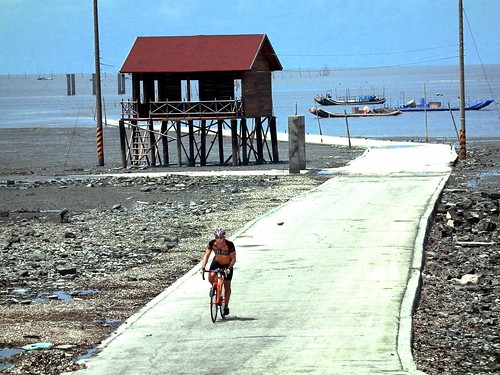
Changhua Wetlands
 
Bike Europe is reporting that Merida's profits have declined compared to last year. 

This reminds me of a conversation I had with a reporter from Bike Europe during Taipei Cycle as we amiably sparred over the prospect of Chinese manufacturers edging out Taiwanese companies for both design and production. 

The reporter seemed to doubt that China would ever displace Taiwanese manufacturers as he felt they had done a very good job holding onto sensitive data and processes that enabled the Taiwanese firms to merely exploit cheaper Chinese labor without losing any advantage. I was doubtful. I always revisit the great debate over silicon wafer manufacturing in China from 2002, when Taiwanese firms and economists alike declared that there would be no leakage of sensitive technology to China through Taiwanese operations in that country. We see how that all worked out. 

We then saw the world rally around ECFA, the trade agreement signed between Taiwan and China with the aim, as Fortune mentions, to "end Taiwan's economic isolation." Regardless of Taiwan's decades of deep supply side economic ties to the United States, Japan and Europe. 

Giant's Tony Lo was an early champion of ECFA as evidenced in this Taipei Times article:
Anthony Lo (羅祥安), chief executive officer of local bicycle maker Giant Global Group (巨大集團), said the government needs to establish a vision.
“What Taiwanese enterprises want to see is the government striving to help businesses build unique brands that can provide innovative products and services,” Lo said on the sidelines of the forum.
Lo said Taiwan needs to integrate into regional markets as soon as possible so local firms can enjoy the trading privileges that other nation’s companies do, such as tariff exemptions.
“The markets are changing so fast that the rules have been reset, and if we don’t catch up, it is going to be harder for us to hold our own in the global market,” he added.
If anyone would like a little more spice with your shock doctrine, you can also read up on the threat to Taiwan without signing the Cross-Strait Services Agreement, a non-procedural agreement that was illegally passed, then assailed by the Sunflower Movement

Despite the promises of greater exports to China and increased sales of Taiwanese goods to the billions in need of a toothbrush, The View from Taiwan points out how ECFA has not improved Taiwanese exports vs. Chinese imports. 

Ho hum....

So what was the cause of Merida's profit troubles
JPMorgan Securities Ltd. reported in the Taipei Times that, “A lack of fundamental improvement in the outlook of its Chinese business remains the biggest structural issue facing Merida Industry Co.” Given Merida’s continued weakness in business in China amid intensifying competition with Chinese manufacturers, JPMorgan foresees a 7 percent increase in turnover this year. 
Last year Merida officially opened a new Chinese factory with an annual capacity of 2 million units making it the number two premium bike manufacturer in the world.
Moreover, the Chinese sport and leisure bicycle business has failed to materialize in all its glory due to pollution and a preference for alternative forms of superficial prestige. Even the Tour of Beijing, which was to serve as a major marketing tool for high-end/high margin bicycles in China has been shelved due to concerns regarding sponsorship, organization and China's notoriously toxic smog
Lots of bike industry eggs in this one basket. 

Maybe the next administration will discover a regional friend with mutual interests.... Oh, hello Philippines!

Monday, April 20, 2015

Taiwan Cycling and Air Quality: A Tragedy of Commons

Untitled
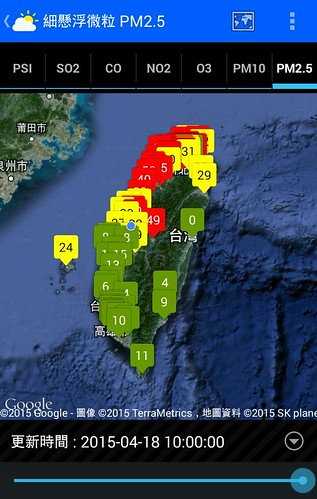
Taiwan Air Quality
 
This past weekend presented some great riding opportunities. The rain held off long enough for some people to brave Taiwan's notoriously unpredictable traffic. But maybe the wet roads and automobiles will not be what eventually kills off the Taiwanese cyclist. It may be something even more insidious and unavoidable. We may be felled by the air we breathe.

Over the weekend the pollutants on the 2.5 PM scale, or particles under 2.5 million micrometers in size, reached unhealthy levels measuring 154 micrograms per cubic meter or air from Taichung through Miaoli County. Later in the day the index in the Puli basin peaked well above 350mcg/m3. This is not and will not be the first time.  

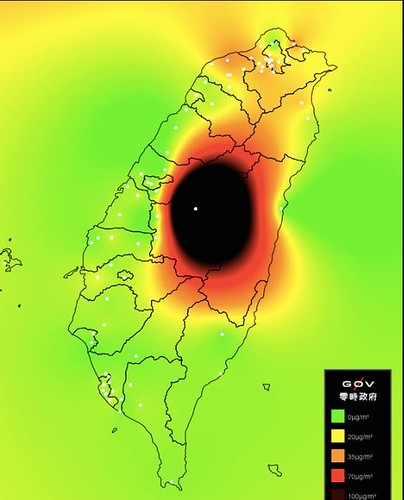
According to the Taiwan Healthy Air Alliance, the poorest air quality can be found in Yunlin's Mailiao Township, and in Nantou County's Puli Township. This is mostly due to the coal-fire power plant and the massive Formosa Plastics complex in Mailiao and Puli's natural basin trapping the air from the Nantou industrial area and the Dalin coal-fired power plant. With Puli being the gateway to Sun Moon Lake and several major tourist attractions and national parks, the government has been slow to take action. 

Untitled
Taiwan Air Quality 4/18/2015

Taiwan's air pollution is not merely the problem of individual localities and townships. This is a tragedy of commons. 

1. Taiwan can partially blame the poor air quality on the winter monsoon that sweeps China's industrial and natural air pollution across Taiwan during the winter months. In recent years deforestation and  environmental degradation in western China has led to an increase in seasonal sand storms that blow across Asia from the Gobi Desert. 

2. China can not be blamed for all of Taiwan's poor air quality. Taiwan draws much of its electrical power from six coal-fired power plants. Taichung's coal-fired power plant is the largest in the world and the world's largest single source of carbon-dioxide emissions with over 40million tons of CO2 emissions annually (more than the entire nation of Sweden emits annually). Five of the six coal-fired power plants are located along Taiwan's densely populated western plain shifting the dispersal of emissions lengthwise over most of Taiwan's population. The sixth is located in Hualien, one of the mainstays of Taiwan's eco-tourism push. 

3. Traffic emissions have gotten worse as more Taiwanese take to the roads on weekdays in order to arrive at their jobs that are moving further away from affordable housing on a Taiwanese salary. 

4. Another major source of Taiwan's air pollution is, in part, natural. Taiwan's soil is mostly loose clay pushed out of the seabed and as a narrow, steep island, Taiwan fails to retain much of its water runoff, leaving vast, dry stream beds. During periods of high winds, fine particles of dust billow up out of the dry stream beds and fill the air with dust. This is a phenomenon that had been observed as early as the 19th Century, so it is not the result of more recent industrialization. 

Still, I say the phenomenon is "in part" natural, as manmade factors also help to contribute to the problem. Like many other places worldwide, human initiated climate change has resulted in the increasing severity of seasonal drought with development and deforestation leading to greater erosion on hillsides and riverbeds leaving more land exposed to high winds. Moreover, much of Taiwan's topsoil is contaminated from agricultural and industrial toxins that can become airborne with loose soil. Heavy metals such as mercury, cadmium, and lead can be blown from the soil to mix with carbon-dioxide, carbon-monoxide, nitrogen-oxide sulphur-dioxide...the last three being the major pollutants from cement manufacturing... a mainstay in Taiwan's ubiquitous construction industrial complex. 

It is not difficult to see why this writer is incredulous in the face of vast government expenditures on leisure cycling when the government's plans will only encourage residents to go from the basketball court, swimming pool or badminton court to a bicycle lane. A leisure cycling path does little to curb emissions from where they are generated. It is simply politicians playing the all too cynical game of Three Card Monte with public funds.

Do the positives of cycling outweigh the negatives of breathing pollution?  
 ...as it turns out, face another peril: pollution. New research has found that bicycle commuters inhale twice the amount of black carbon particles as pedestrians. Inhalation of such gunk (aka soot) is associated with reduced lung function and even heart attacks.
The researchers, led by Professor Jonathan Grigg from Barts and the London School of Medicine, compared carbon levels in the lungs of five healthy bicycle commuters those of five healthy pedestrian commuters. The bicyclists had 2.3 times more of the bad stuff in their lungs. Presumably, the cyclists' heavy breathing -- all that good aerobic stuff -- is responsible for the increased presence of black carbon.
So, as cyclists in Taiwan where do we go? 

1. Taiwan could be entirely run on renewables. We have the engineering and infrastructure available to devote toward energy independence without the nuclear option. We do not have the political will to challenge Tai-Power. Renewables do not have the same patronage potential of the massive, centralized "power plant" that requires mountains of concrete and billions of dollars of rigged bids. One friend who worked for the Number 4 Nuclear Power Plant has confided that it was impossible to work on the facility without being compromised by corruption. Thus, he quit. Wind farms and solar arrays do not provide the "necessary" structural requirements that conceal the flow of expenditures. 

2. Taiwan needs to cooperate with other Asian nations to find multilateral support to help curb Chinese pollution in general. Moreover, Taiwanese companies need to avoid using China as a toxic dump by proxy as Taiwanese firms have invested in Chinese manufacturing, the pollution is coming home to roost. 

3. Higher wages, lower housing prices, better integration between pedestrian, bicycle and mass transit including urban bike lanes and bike racks on busses would be a great start for the commute. 

4. Increased efforts to both clean and eliminate industrial waste in the soil would be a great start. 

As we saw with the Kuokuang Petrochemical Complex in Changhua, awareness and activism can, sometimes, beat corporate interests and Taiwan's colonial economy. 

Until some major changes are implemented, we, as cyclists in Taiwan, must head out onto the roads with the understanding that we are being poisoned.

Taiwan will not be able to tout its bicycle tourism until Taiwan is finally breathable.


Appendix:

Taiwan Air Pollution Index: Real Time Tracking

Monitor Air Pollution app

Taiwan's Air Pollution Rank Worldwide