body{background-attachment: fixed ! important; }
Showing posts with label Taiwan bicycle Manufacturing. Show all posts

Thursday, May 12, 2016

Message Understood?: Outgoing Cabinet Poll Shows Wide Support for Bike Policy

Untitled

In what appears to be an attempt to bolster the deeply tarnished reputation of outgoing president Ma Ying-jeou, a cabinet level survey has revealed a previously unobserved groundswell of public satisfaction with a large swath of Ma administration policies to give the outgoing president a veneer of vindication. The new numbers serve as the final revelation to the ignorance Ma cited leading to the failure of many key policies, including cross-strait relations, economics, tourism, and transportation.

The Straits Times:
ST: And yet, voters delivered a stunning indictment of you, your policies and the KMT (Kuomintang) on Jan 16. What do you think led to such a state of affairs? I know you blame it on communications failure, you’ve said: “Actually there are many good policies that the public don’t understand because we haven’t communicated them enough.” Is that all there is? Do you feel you’ve been misunderstood?
... or (link)
"Ma's policies have painted him as for the one percent and China, at a time when society at large is fed up with both," said Jonathan Sullivan, associate professor at the University of Nottingham's School of Contemporary Chinese Studies in Britain. 
"Adding to these policy outcomes is Ma's personal reputation for aloofness, indecisiveness -- but paradoxically with an authoritarian streak -- incompetence and inability to balance the interests of his party, Taiwan and his own personal objectives," added Sullivan.  
Even staunch KMT supporters have turned their backs, with the party in tatters having lost its majority in parliament for the first time under Ma. 
"We had high hopes, but we saw our faith in him fading away," said Sun Chieh-yi, 59, a retired watch shop owner who comes from a traditionally pro-KMT family.
"People do not feel their lives are any better than before." 
The China Post reports:
The survey also found that about 70 percent of the respondents said they are satisfied with the results of the completion of the Hualien Taitung electric rail system, the Wugu-Yangmei Overpass on a section of National Freeway No. 1 in Northern Taiwan, and the addition of three stops on the High Speed Rail system.  
Policies that received wide support include the expansion of bicycle paths around the country, and the distribution of subsidies for childcare and free tuition for children under the age of 5, at 69.8 percent and 65.2 percent, respectively, the results show.
Let me remind the reader of what this bicycle policy is, in case you missed it. The central government, with a budget of NT1.2 billion (USD 36.4 million dollars), posted a series of brown sign posts along Taiwan's more heavily trafficked highways and maybe installed a few shower areas (not sure exactly where). This is a system that serves leisure tourism interests to better enable periodic long distance cycling trips between major cities. Unfortunately, these paths hardly do justice to Taiwan's beautiful cycling roads, and serve to be more about keeping cyclists close to businesses and transportation. Much of the main route covers the gritty Highway 1, with little more done than sign to tell riders that they are on the Route No. 1. Few, if any, real changes have been made to the route to make it less of a slog through an eyesore. Moreover, the designated cycling routes do nothing to address pollution or traffic congestion.

Of course, the landslide victory for the DPP to ring in the new year was mostly a referendum on the policies of Ma Ying-jiu, whose popularity struggled to cling to double digits for the remainder of his term. Moreover, an economic policy that saw the economy enter contraction as opposed to the salad days of Chen Shui-bian, who ruined the economy with a growth rate averaging 3.8 percent growth between 2000 and 2008, with two years averaging six percent. Ma tried to replace outsourced jobs with jobs in the service industry and in a heavy emphasis on tourism, which has been a net failure for Taiwan.

As far as cycling opportunities outside of tourism, European companies are looking to source less from Asian OEMs and do more of the assembly in Europe to take advantage of the EU. Monday night the editor-in-chief of Bike Europe held a presentation on cutting lead times and the shift to producing final products in the world's most lucrative bicycle market. Currently, The Netherlands is Europe's largest producer of bicycles, followed by Germany and Belgium a distant third. Still, most bicycles are still sourced from Taiwan.

Also:


Friday, March 11, 2016

Bullish or Bullsh*t: Is More Uncertainty Ahead for Taiwan's Bicycle Makers?

Untitled
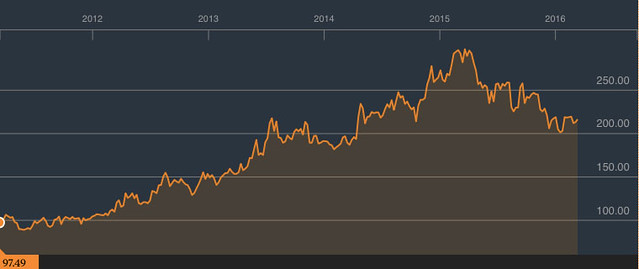
Giant Stock Price--Bloomberg

Every year the opening of the Taipei Cycle trade exhibition begins with an optimistic litany of industry figures and projections that seem to forecast sunny and clear with blue skies over the bicycle industry. This year we were treated to more of the same.

The latest statistics released by the Taiwan Bicycle Association (TBA) show that Taiwan’s bicycle export increased by 10.04% in 2015. Total export value reached 1.74 billion euro, compared to 1.58 billion euro in 2014. Also Taiwan’s bicycle parts export rose last year by 5.45%, with total value reaching just over 1 billion euro.

Despite the boilerplate assurances that the show was lights-out from the perspective of the exhibitors,  in private, and by proxy, there seemed to be more than just a general concern for the state of the entire industry in the short and medium term depending upon a company's position along the food chain from OEM/ODM, supply chain, subcontractor, brand, distributor and retailer. Even as TBA Chairman, Tony Lo, issued his report stylized as the industry's Auda Abu Tayi, from Lawrence of Arabia, declaring himself to be " a river to my people", there was an overall echo of anxiety in the relative quiet of the Nangang exhibition hall last week that did not resound with such confidence.

The greatest concern was the fact that the high-end bicycle market, which enjoys some of the highest profit margins, has been affected by multiple factors, including a sluggish European and American markets resulting in higher than normal inventory, aberrant weather patterns in the northern hemisphere, falling oil prices, the failure of the Chinese market to materialize as predicted due to unsustainable economic growth and oppressive air pollution.

Bike Europe reports
The market for Taiwanese bicycles in China declined by 33% to 79,000 units. Though not yet that big, the Chinese market was seen as a main growth market for several years. That development has come to a full stop thanks to the economic decline in China. 
The US is still the biggest single market for Taiwan made bicycles with 570,000 units between January and September this year, an increase of 26.3%. Export to the UK surged by 26.8% to 552,000 units and to the Netherlands by 17.3% to 316,000 bicycles. 
Next to bicycles, also total bicycle components export expanded by 7.01% reaching a value of 723 million euro.
Remember, the ECFA agreement was supposed to increase exports to China, and bicycles were part of the "early harvest" products upon the implementation of ECFA

Shimano, the groupset and component manufacturer that supplies components across several retail segments echoes this sentiment and has issued a cautious projection for 2016.
Shimano is taking a very careful position for 2016 and expects a decrease of its net sales (-7.6%) as well as an its net income (-23.9%). This will be the result of the strategy to bring forward the production scheduled for the first half of the fiscal year 2016 to the second half of 2015. Though the moderate growth of the European economies is expected to continue Shimano also expresses its concern over the possibility that the influx of refugees and the slowdown of the Chinese economy may lead to deterioration of the economic sentiment in Europe.
Despite all the bullish talk, Giant, Taiwan's largest bicycle manufacturer, has seen its stock price drop over 25% over the past year and the Financial Times forecasts advises investors to either hold or expect the stock to under perform.  

Another concern from some vendors was the increasing shift of Chinese companies competing for more of the high-end bicycle market. 

Many Taiwanese subcontractors and links in the supply chain have their start in the small to medium sized enterprises (SME) that served as the engines of the Taiwan economic miracle during the second half of the 20th century. Many of these companies were founded as joint family ventures where a day's work meant a seat at the dinner table. These companies thrived on the networks of personal relationships and upon the backs of brothers, sisters, aunts, uncles and children. 

Although the SMEs rapidly grew, many of them are still running on the narrowest of margins where the salaries are nowhere near competitive in the global workforce. It is no secret that Chinese headhunters are keen to exploit this weakness to woo knowledgeable employees into the service of China's competing enterprises. This is true in all of the sectors Taiwan has held the advantage of technical experience.

So, what will come of it?

For a few years we have seen bicycle events, a bicycle festival and the integration of the bike into tourism and city transportation. The idealist in me would like to think that good people want to make the wold a better place and simply want to promote cycling as a way to end our reliance on fossil fuels and save the planet.The pessimist in me knows that all of these events and programs are, at their cynical best, part of a greater plan to help sell more bicycles for the purpose of rewarding shareholders and satisfy a board of directors and make them rich.

Bike-Europe:
“We see a significant increase in the number of people and countries where people start cycling for sports, leisure and to commute,” said TBA chairman and Giant Global Group CEO Anthony Lo at the presentation of the industry sales statistics. “The average unit price of Taiwan made bicycles went down only slightly by 0.8% to 411 euro. The average export price for MTBs is now 618 euro and for road race 628 euro." 
Anthony Lo pointed out the importance of the cycling experience to get more people cycling. 
But I really think we have already seen the first, best, adjustment to drive sales with last year being the year of the disc brake. 

Disc brakes were actually quite a brilliant first step in trying to drive industry sales, and may prove to be far more effective that earlier attempts of a solution in search of a problem as we saw with the bottom bracket wars a few years ago. Disc brakes represent a radical change in form factor that currently requires the indispensable reengineering of almost every part of the bicycle to accommodate disc technology. Disc brakes require reinforced frames and forks with disc mounts. They require reinforced rims and wider hubs. They require groupsets to be redesigned for integrated hydraulic fluid units. They require the buyer to start anew and leave "yesterday's tech" behind. For someone with years of accumulated components and wheels, this is no small investment. 

The second initiative to reinvigorate sales has just gotten underway and I am pretty sure we'll be seeing a lot more of it-- Direct Online Sales. 

In the past, cheap brands like Motobecane were making gentle waves by selling bicycles online directly to the consumer without the typical retail markup. 

Then along came the German brand, Canyon, to completely upset the apple cart for the digital age by efficiently selling high-end racing bicycles exclusively through online sales. 

This approach drastically reduced overhead costs and served as a means to control the consumer's experience in an environment that is free from the typical competition in a standard retail store. 

Canyon has been going gangbusters in Europe, and now the big boys want to muscle in on the action by doing the same. 

First, Trek announced plans to sell online-direct to the consumer through its network of retail stores. Now Giant has entered the arena and the fight looks like it will only continue to get uglier with companies scrambling to offer similar services within a narrow time frame or risk being undercut by whoever gets there first.

Of course, the online-direct scheme throws decades of carefully groomed relationships between manufacturers, brands, distributors and retailers into chaos and the casualties are sure to mount, especially for the smaller brands that do not have the corporate backing to offer either a similar service, or a similar price point. Another casualty may be the choice a consumer has for components as each company will corral online customers into their own house brands as opposed to leaving it to the whim of the consumer. Lastly, it will be interesting to see how much of an effect this has on cycling culture as it is bound to change the traditional purpose of the bike shop. 

Lastly, the bicycle is going home. To better compete within the lucrative EU market, Taiwanese OEMs, assemblers and finishing houses are looking to move assembly to Europe in a move that will satisfy EU requirements for status as a domestic product. The Taichung based Fritz Jou Manufacturing (a loose term) just recently declared plans to move some "production" to Portugal. 
“We are joining Bike Valley Portugal as this is the ultimate project where the industry can take control over the supply chain again,” says President Fritz Jou of Fritz Jou Manufacturing. “In the past decades I have seen many production shifts based on GSP+, anti-dumping duties, and other tax incentives. These aspects are difficult to control by the industry. In the Bike Valley project we can finally produce where the market is, reduce the time to market and improve our flexibility. That is our ultimate goal.”
In short, it looks like there will be changes afoot in the coming years and Taiwanese companies had better be prepared for change.        


Tuesday, May 24, 2011

Moving Your Bikes To Taiwan... All Of Them.

I often come across forum threads and other opinionated info that treats Made in Taiwan as a pejorative. Even when I was writing copy about CNC machines over a decade ago we would give the Very Well Made In Taiwan label a knowing guffaw. Customers would insist that I highlight their purchased accolades for Taiwan manufacturing.

Opinions have changed.

Taiwan no longer carries the stigma of low production value and poor QC. That is not saying that there is no room for improvement, but there are obvious reasons why so many bike companies prefer to have their brand manufactured in Taiwan.

When the Cannondale plant closed in Bethel CT in 2009, the slamming of the doors echoed throughout the industry. The economy of scale was working against America as a producer of bikes.

Why do bike manufacturers move to Taiwan?

A recent article in Bike BIZ interviews Sam Schulte regarding the decision of his Tree Bikes brand to move production to Taiwan.

Operating the business on a wafer thin margin, Schulte answers back to those accusing his firm of 'selling out', explaining that in the current economy his 'dream' of domestic manufacturing simply isn't viable.

Schulte explains how missed deadlines were causing major financial strains, telling the website:
"It’s hard to find a machinist to do what you need for the prices and make it work. A lot of times you need to get machinists to give you a special price and they are really not making any money, and that causes product not getting done on time, and that’s why a lot of brands have been moving over to Taiwan. Taiwan factories can afford to give us the price we need and get it done in time to help the customer in the end. So that’s why we have decided to move over there."
On the other hand, in the case of Cannondale and Tree Bikes, the US economy could have used a few more jobs between 2007 and 2011.

For companies that decide to relocate their operations to Taiwan, it is wise to employ full time representatives to stay in Taiwan to monitor manufacturing as much of the manufacturing can be outsourced to other fabricators and there may be hidden networks of material supply that are not part of the original production agreement. This is quite common as factories have their own suppliers and seek ways to maximize their own profits from a manufacturing agreement.

I was recently made aware of a renowned Taiwanese company that agreed to certain terms of production with a very powerful American company, with terms that included some very high-end CNC machining centers. When the client's representatives left, the company purchased cheaper, much less precise machining centers. Word on the street says that Taiwan can make the finest equipment, but you need to build good relationships, remain vigilant and know your partners. The American company is currently looking into opening their own production facility.

Monday, January 10, 2011

Breaking Away: American Cycling, Taiwan Culture and the Mimetic Faculty


Peter Yates (July 24, 1929 – January 9, 2011)

Peter Yates, the director of the 1979 classic, Breaking Away, one of the earliest and best bicycle/coming of age movies, died Sunday at the age of 82.

The plot revolves around a young cycling enthusiast in a small Indiana college town, who is infatuated by all things Italian and all things cycling. He does his best to imitate what he imagines to be everything, "Italian". He tries to speak Italian, eat Italian and even scam on the college hottie like an Italian.

Italian he is not. He is simply another local kid, or "Cutter" who is NOT going to college with the prospect of a life stuck in a small town staring him in the face.

Dave, the protagonist, and many elements of the story, were lifted from the life and times of Dave Blase and his exploits in the 1962 victory of the Phi Kappa Psi team in the Little 500 at Indiana University.

This movie can serve as a starting point for several conversations about cycling, globalization and greater ideas on the power of the image.

To connect this all back to the subject of this blog, I think, and I may be reaching a bit so bear with me, that it not only represents a paradigm shift in the sport of cycling that has had both a direct and indirect on Taiwanese culture, but it also helps illustrate the shifting and impermanent cultural borders that are often portrayed and imagined as fixed and unchanging.

What?!

Breaking Away materialized just at the end of the 1970's when cycling was dominated by the powerful European teams of Italy, France and Belgium. The reign of terror Eddy Merckx had enjoyed for a decade was coming to a close and the surly Frenchman, Bernard Hinnault, was just beginning his own dynasty.

The United States treated cycling as a European farce and very amateur. And... the US sucked at cycling. With football, baseball and basketball... what else was there?

At the same time, Taiwan had used American aid (and pressure), state-run monopolies, joint ventures between state and private companies, and a vast network of small to medium sized enterprises (SMEs) to promote rapid industrialization to help manufacture goods that were mainly aimed at the American market.

By the time Breaking Away came out the United States had already announced its official withdrawal form Taiwan and an end to the 1954 Mutual Defense Treaty which enabled the US to station its military personnel on the island who spread American consumer culture off base.

The point I am edging toward here is that people will mistakenly attribute Taiwan's culture to China, yet for the past 100 years Taiwan's metropoles, its cultural centers... the locations Taiwanese have looked toward to emulate, compare and contrast themselves and their lives... those places, aside from the domestic, have been in either Japan or the United States. "How are we doing compared to America?"

When Breaking Away came out it was just at the tipping point for American Cycling. Team 7-11 was established in 1981to go head to head against the European greats. Team 7-11 featured several great American amateur cyclists including, Davis Phinney, who makes a cameo in Breaking Away as one of the evil Italians.

Team 7-11 gave Americans their first victories in the big European races and as it later morphed into the Motorolla teams of the mid-80's and then birthed the US Postal Service and Discovery teams of the 1990's. With greater success came better sponsorship and more success. American cycling increased its profile in the US athletic market. The increased profile also let to an increase in riders and Americans interested in cycling. These cyclists needed bicycles. Breaking Away had led the vanguard of American cycling and the consumer was quick to follow.

During this same period Taiwanese bicycle producers were coming into their own and offering better and cheaper manufacturing facilities than the Japanese factories. This is when Taiwan started to become the world's producer of bicycles. Taiwan was turning out frames and parts as OEMs for Nishiki, 3Rensho, Shimano and other companies.

Not only did Taiwanese encounter the bicycle as an economic mainstay in the period after Breaking Away was released, but as the popular image of the bicycle matriculated throughout American culture, especially with the rise of Lance Armstrong, that image was exported around the world in the form of advertising and popular media. These images were readily snapped up by Taiwanese. From this point Taiwan had a double cultural investment in cycling-- both economic and popular.

These dual influences have really helped give rise to a strengthening and more nuanced cycling culture that has transformed and been reflected back as something definitely Taiwanese. This only could have happened with the USA as one of Taiwan's cultural centers.

Beyond this, in the movie, Dave, emulates the Italians he idolizes.

This reminds me a little of, what I call, "The Iron and Silk effect". We have all seen this in Taiwan, and maybe been guilty of it at some time or another, of Orientalizing and engaging in a type of mimesis of what we think we are seeing or wishing to be. Periodically, I run into, more often than not, white men who want to be Asian. They wear the jacket with the Sun Yat-sen collar (Sun Jacket), pajama bottoms, maybe get really into martial arts and buddhist imagery... maybe a samurai sword on the mantle. They attempt to integrate themselves into the society and capture some of the imagined "magic" through the mimetic faculty. In doing so, they appropriate essentialized imagery and reflect it back into the people they are trying to mimic, which does not make them more alike as there is a consciousness on both sides of the contact of what is being appropriated and why. It remains an underoos fantasy.

The mimetic faculty and the use of the image has been used for millennia as a form of capturing the power held by the object. By drawing the Ibex on the wall of the cave there is a hope or belief in somehow capturing some of the essence or power the object holds to use for oneself.

Just as Dave in Breaking Away tried to capture the power of Italian cycling, thousands of cyclists tried to capture and appropriate the images in Breaking Away as they entered the sport of cycling, driving the image of the sport to far off places.

The image of drafting a truck probably sold more bicycles that that ad in the back of Sports Illustrated.