body{background-attachment: fixed ! important; }

Monday, January 10, 2011

Breaking Away: American Cycling, Taiwan Culture and the Mimetic Faculty


Peter Yates (July 24, 1929 – January 9, 2011)

Peter Yates, the director of the 1979 classic, Breaking Away, one of the earliest and best bicycle/coming of age movies, died Sunday at the age of 82.

The plot revolves around a young cycling enthusiast in a small Indiana college town, who is infatuated by all things Italian and all things cycling. He does his best to imitate what he imagines to be everything, "Italian". He tries to speak Italian, eat Italian and even scam on the college hottie like an Italian.

Italian he is not. He is simply another local kid, or "Cutter" who is NOT going to college with the prospect of a life stuck in a small town staring him in the face.

Dave, the protagonist, and many elements of the story, were lifted from the life and times of Dave Blase and his exploits in the 1962 victory of the Phi Kappa Psi team in the Little 500 at Indiana University.

This movie can serve as a starting point for several conversations about cycling, globalization and greater ideas on the power of the image.

To connect this all back to the subject of this blog, I think, and I may be reaching a bit so bear with me, that it not only represents a paradigm shift in the sport of cycling that has had both a direct and indirect on Taiwanese culture, but it also helps illustrate the shifting and impermanent cultural borders that are often portrayed and imagined as fixed and unchanging.

What?!

Breaking Away materialized just at the end of the 1970's when cycling was dominated by the powerful European teams of Italy, France and Belgium. The reign of terror Eddy Merckx had enjoyed for a decade was coming to a close and the surly Frenchman, Bernard Hinnault, was just beginning his own dynasty.

The United States treated cycling as a European farce and very amateur. And... the US sucked at cycling. With football, baseball and basketball... what else was there?

At the same time, Taiwan had used American aid (and pressure), state-run monopolies, joint ventures between state and private companies, and a vast network of small to medium sized enterprises (SMEs) to promote rapid industrialization to help manufacture goods that were mainly aimed at the American market.

By the time Breaking Away came out the United States had already announced its official withdrawal form Taiwan and an end to the 1954 Mutual Defense Treaty which enabled the US to station its military personnel on the island who spread American consumer culture off base.

The point I am edging toward here is that people will mistakenly attribute Taiwan's culture to China, yet for the past 100 years Taiwan's metropoles, its cultural centers... the locations Taiwanese have looked toward to emulate, compare and contrast themselves and their lives... those places, aside from the domestic, have been in either Japan or the United States. "How are we doing compared to America?"

When Breaking Away came out it was just at the tipping point for American Cycling. Team 7-11 was established in 1981to go head to head against the European greats. Team 7-11 featured several great American amateur cyclists including, Davis Phinney, who makes a cameo in Breaking Away as one of the evil Italians.

Team 7-11 gave Americans their first victories in the big European races and as it later morphed into the Motorolla teams of the mid-80's and then birthed the US Postal Service and Discovery teams of the 1990's. With greater success came better sponsorship and more success. American cycling increased its profile in the US athletic market. The increased profile also let to an increase in riders and Americans interested in cycling. These cyclists needed bicycles. Breaking Away had led the vanguard of American cycling and the consumer was quick to follow.

During this same period Taiwanese bicycle producers were coming into their own and offering better and cheaper manufacturing facilities than the Japanese factories. This is when Taiwan started to become the world's producer of bicycles. Taiwan was turning out frames and parts as OEMs for Nishiki, 3Rensho, Shimano and other companies.

Not only did Taiwanese encounter the bicycle as an economic mainstay in the period after Breaking Away was released, but as the popular image of the bicycle matriculated throughout American culture, especially with the rise of Lance Armstrong, that image was exported around the world in the form of advertising and popular media. These images were readily snapped up by Taiwanese. From this point Taiwan had a double cultural investment in cycling-- both economic and popular.

These dual influences have really helped give rise to a strengthening and more nuanced cycling culture that has transformed and been reflected back as something definitely Taiwanese. This only could have happened with the USA as one of Taiwan's cultural centers.

Beyond this, in the movie, Dave, emulates the Italians he idolizes.

This reminds me a little of, what I call, "The Iron and Silk effect". We have all seen this in Taiwan, and maybe been guilty of it at some time or another, of Orientalizing and engaging in a type of mimesis of what we think we are seeing or wishing to be. Periodically, I run into, more often than not, white men who want to be Asian. They wear the jacket with the Sun Yat-sen collar (Sun Jacket), pajama bottoms, maybe get really into martial arts and buddhist imagery... maybe a samurai sword on the mantle. They attempt to integrate themselves into the society and capture some of the imagined "magic" through the mimetic faculty. In doing so, they appropriate essentialized imagery and reflect it back into the people they are trying to mimic, which does not make them more alike as there is a consciousness on both sides of the contact of what is being appropriated and why. It remains an underoos fantasy.

The mimetic faculty and the use of the image has been used for millennia as a form of capturing the power held by the object. By drawing the Ibex on the wall of the cave there is a hope or belief in somehow capturing some of the essence or power the object holds to use for oneself.

Just as Dave in Breaking Away tried to capture the power of Italian cycling, thousands of cyclists tried to capture and appropriate the images in Breaking Away as they entered the sport of cycling, driving the image of the sport to far off places.

The image of drafting a truck probably sold more bicycles that that ad in the back of Sports Illustrated.

Sunday, January 9, 2011

(Video) Specialized Downhill Urban Mountain Bike Competition


WOW!

Bike Links and More


Just because my bike is broken doesn't mean I am idle. I had a great weekend shopping and researching bikes. I will add more info in a report to come. I have had all kinds of wonderful offers from friends. And I have been forced out of excuses to getting things done.
I hope I can use some of this time to write a few more less superficial articles that I have been putting off. I also hope to be riding... something... soon.

In the meantime here are some links:

Sabinna has an excellent article on composite frames, efficiency and future:
But, sure, the emotions and processes behind a consumer's decision to purchase a cheaper and slightly heaver alloy-framed bike vs a (assumed high-modulus) carbon alternative assure carbon fiber's position as the pre-eminent high-end material of choice. As the authors of the "Composites" article finish off: the future of carbon fiber will involve greater use of nano-materials, an emphasis on damping and making composites more environmentally friendly ie. bio-based polymers.
I am really not convinced carbon fiber is for everyone... but hey... with a profit margin which is something like 60% on a CF frame... I have an idea who really likes it.

Also:
Don't forget to stop by Cafe Terry for some Genmaicha Cake.

Links:
  • British boxing champion killed by a car while cycling.
  • Motorcyclist claims cyclists need training and licensing for their own safety. After all... look how safe motorcycling is in Taiwan.
  • The Inner Ring gets into Grand Fondo... no not dipping bread or other foods into a pot of molten cheese or chocolate.
  • The Independent says cyclists left unprotected by the courts. In Taiwan you almost never hear of cycling accidents in newspapers or on television.
  • USA announces Cyclocross Worlds Team. The women are the ones to watch.
  • Trek has unveiled new bikes and colors for Team Schleck...er Leopard. I really like those Schlecks.
  • Cycling for smokers? It is amazing how many guys I see resting at a 7-11 for a smoke break after a day of riding.
  • New film profiles The Gentleman Cyclist.
  • What a world cycling center should look like. Where's the roast corn?

  • Could This Be My Next Bike?

    Saturday, January 8, 2011

    Chinese State Media Sells Cycling Tourism in Taiwan

    The state owned broadcaster and English language propaganda outlet, Chinese Radio International, has released an interesting story promoting Bicycle tourism in Taiwan.

    After several days on the road in Taiwan, I've came to realize that the charm of this far-flung island lies not only in its landscape and scenery, but also its people.

    The opening sentence above immediately frames Taiwan as the exoticized and fetishized object of desire. This island that is supposed to rest snugly in the bosom on the "motherland" is perceived as "far flung". Furthermore, "its people" firmly locates Taiwanese as "other". Had the author followed traditional protocol they would have been "us" or "our compatriots".

    I have met many fellow travelers throughout the journey, most of whom are Taiwan locals who try to enjoy themselves away from the hustle and bustle in Taipei. Some of them even settled in the countryside of eastern Taiwan, making a living by managing shops selling coffee, travel souvenirs, and commodities of various kinds.

    A Du is one of these self-employed travelers. He sells bicycles in his shop and works as a local guide leading tourists on bicycle tours into the rural country roads in his spare time. A Du has his own theory of discovering the beauty of Taiwan. He suggests his customers see Taiwan from a different perspective, even if it means you have to lie down on the ground and listen to the trucks whooping by.

    Despite the ambiguity of the term, "Taiwan locals", the author goes on to fixate on this period of "contact" between "one" and the exoticized "other". In an oddly foreboding tone Taiwanese are described in ways that echo earlier European colonial enterprises that filled volumes on the "strangeness" of the natives.

    Wang Yuping, the owner of a lifestyle studio in Hualien, also shares A Du's attitude towards traveling. She operates a café shop where tourists can find an array of local travel information. The former Taipei dweller brings groups of travelers to visit ethnic families in Taiwan so as to offer them an in-depth view of Taiwan's culture.

    The term "ethnic families" is used to gloss over the troublesome topic of Taiwan's indigenous population and align them more closely with China's own ethnic construction of minzu, a term borrowed from Japanese nationalism to define human populations in terms of "race". The author sidesteps the thorny issue of who these "ethnic people" are while by proxy maintaining the Chinese nationalist belief that its modernist Han construct is not "ethnic".

    Entrepreneurs also have their eye on the expanding travel market in rural Taiwan. Zhang Qinglai spent ten years establishing a holiday resort in Yilan, which invites tourists to experience life on a ranch. He named his ranch "Shangri-La," in dedication to the peaceful and carefree lifestyle he wished the ranch could offer.

    I think this is just funny in that it references "Shangri-la", the name for the fictive Himalayan paradise of Tibetan lore.

    As Taiwan plans to allow individual mainland tourists to travel to the island this year, backpacking and independent traveling is also becoming a trend within the island. What's more, I believe the bounty of Taiwan's travel resources are in the lesser-known countryside.

    The way China officially conceives its relationship with Taiwan and the way that relationship is actually conducted are entirely different things.

    Beyond that, I have to wonder who the intended audience is for this article. It is wonderfully written in readable English and I suppose it is intended for "Overseas Chinese" and therefore the foreign audience may affect the content.

    Lastly, with China's state media getting into the act it signals the importance tourism plays in China's own goals for Taiwan.

    What I do see is more Chinese discovering Taiwan for its particularity and having to come to terms with its differences.

    Food for thought.

    Also:

    CENS declares Taiwanese bicycle export value has increased 10%

    Corporate Cycling On The Move: Taiwan Circled By Giants

    Giant has announced that 10 members of its top brass will embark on a 900km tour of Taiwan in an effort to get out of the office and reconnect with their profession at road level.

    Giant CEO Tony Lo will lead 21 Giant executives on the ride, advancing Giant’s mission of promoting the cycling lifestyle globally. The Formosa 900 will also showcase Taiwan cycling culture to Giant GMs from far-reaching corners of the world. The group will tackle tough mountain climbs and long days in the saddle as they circle the island in a counterclockwise route.

    I suppose they might find a country that is eager to construct ready-made points of interest in close proximity to Giant retail and rental shops. They might find several kilometers of bike trails to nowhere. They will see trinkets for sale and roast corn.

    What they will not see is a bike friendly environment outside the spots allocated by local leadership for cycling tourism.

    Wednesday, January 5, 2011

    (PART 1) Starting Over: My Next Bike For Taiwan


    I recently received an email from Salsa Cycles about my fractured HT and they, so far, seem very willing to see what they can do about this problem. One of the things I considered in buying my Las Cruces was the 5 year warrantee and Salsa's frame replacement policy. They have a very good reputation in this department.

    So I am now, again, in the position of building up my "Taiwan Bike".

    I have dispensed a lot of advise to other people looking for theirs... and now it is my turn to ask myself the usual questions about my riding and my my purpose.

    My riding profile might look like this:

    1) Long Distance: I typically do at least one... if not five 160-200km rides in a month.
    2) Climbing: I love the challenge of a good day of climbs and with Taiwan's topography it can hardly be avoided... unless I want to dedicate myself to triathlon.
    3) Hard/Fast Solo Training Rides. Race against time and traffic.
    4) Casual Friendlies: I love spending the day in the saddle enjoying a ride with friends.
    5) Light Touring with only a change of clothes.
    6) The Occasional Race.

    I imagined my last bike to be a bit like a Paris - Roubaix bike with a little more room for messy roads.

    I haven't done nearly enough dirty riding, so I will focus on how I see my riding. I like long adventurous road riding on all types of roads with bumps and some dirt. I like climbs and descents. I like to push myself physically. I like speed as well.

    I am looking for something I might term... a Giro bike. I was greatly inspired by the last Giro d'Italia and they covered most of the riding I do, but I am nowhere near that good. I don't worry about the touring part.

    As I start sketching what I want in a bike, the image is getting clearer.

    Now I need to find it.

    Any ideas?

    Tuesday, January 4, 2011

    Caffeinated Goodness: Cycling Through Taiwan's Tea Districts

    Tea Farmer Friends

    Yesterday, The Hungry Cyclist posted a photo and ran a short story on Taiwanese teas and his experience cycling through the northern tea hub of Ping Lin in 2009.

    His post aptly explains:
    Cutting through the steep hillsides and verdant tea plantations of PingLin is hot, hard work. The undulating coutryside and searing heat make for challenging cycling but also ensure that PingLin grows some of the best tea in the world.

    Mei Shan Tea

    Taiwan is one of the world's leading producers of high quality Oolong teas as well as other varieties. Beyond offering simply the leaves for a hot beverage, Taiwan's tea districts make up some of the nation's best cycling routes.

    Many tea growing areas offer occasional food and lodging that can make light touring a real possibility all around Taiwan. Furthermore, the best tea growing areas are high in the foothills and mountains of central Taiwan, which provide spectacular views along roads that are maintained fairly well.

    Despite the assumption that tea has been a long and traditional part of local culture, tea cultivation and consumption are relatively new to Taiwanese culture.
    Lugu Tea District

    Tea drinking culture in Taiwan has really only arisen within living memory as most Taiwanese were traditionally too poor to afford tea. The ubiquitous tea set and table that occupies so many Taiwanese living rooms is more a recent expression of wealth and status than a long held tradition.

    Leaf Testing

    Tea production in Taiwan really only started to develop during the final decades of Qing imperial rule and was more directly related to Taiwan's place in the 19th Century global marketplace as an agrarian center.

    Between 1860 and 1895 the American demand for Oolong teas provided the spark that led to the expansion of Taiwanese tea cultivation into a multi-billion dollar a year industry.

    Tea Baskets

    By the 1860's large swaths and pockets of Taiwan's western plain had been opened for cultivation and the local plains dwelling austronesian indigenous peoples had been incorporated into the Qing administrative structure. Even the sub groups of indigenes who had withdrawn into the foothills had relented and come under some form of Qing governance. Hoklo and Hakka speaking immigrant farmers from Fujian had established a strong economic culture on the plains an Hoklo became the dominant language of the marketplace. Still, most of Taiwan remained "beyond the pale" and ungoverned by the Qing imperial state. Highland indigenous peoples still resided outside the reach of a foreign government.

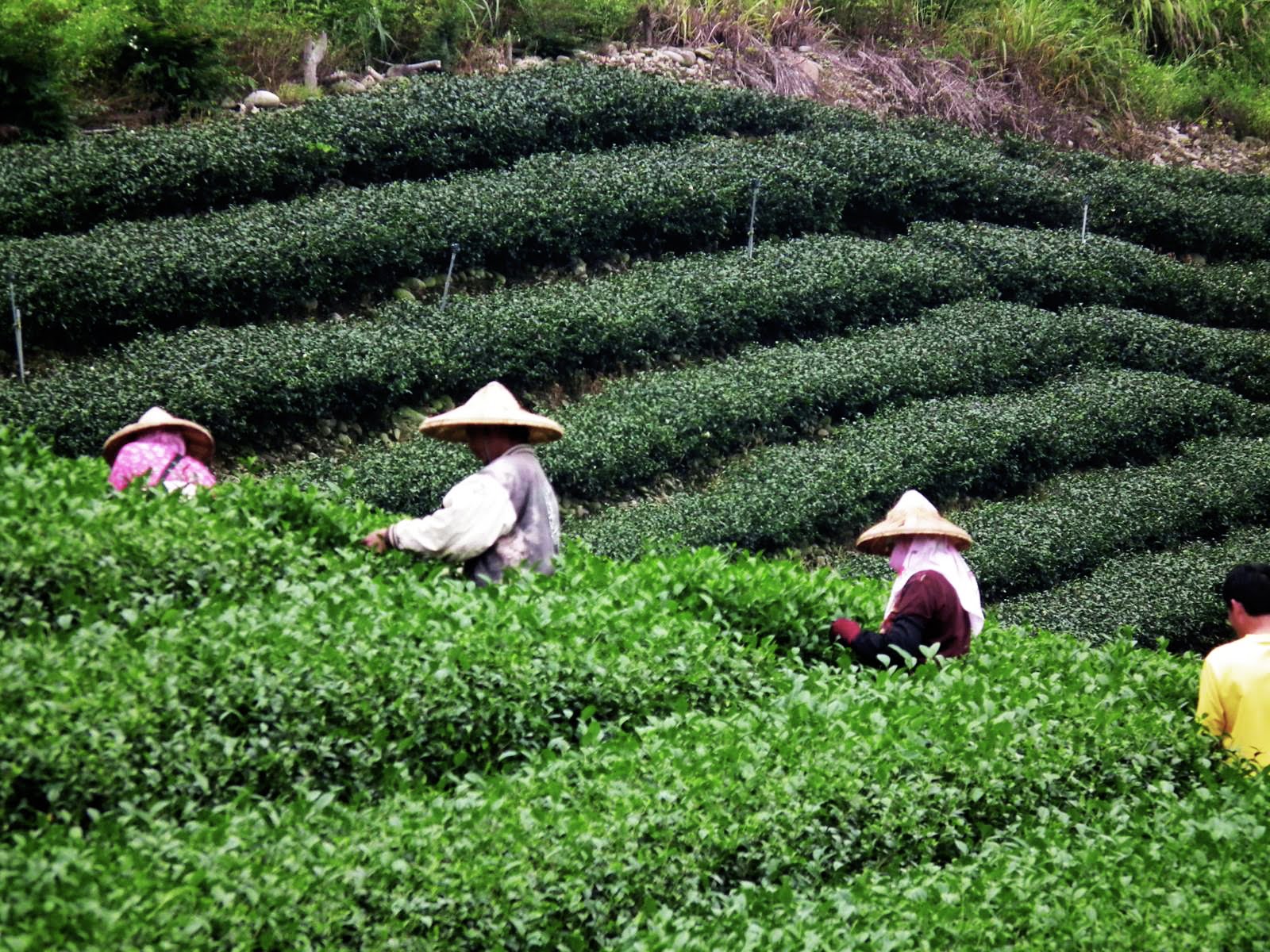
    Pickers

    During this period Taiwan's political economy was also greatly influenced by the geopolitical projects of European and American colonial interests. The Opium wars and their indemnities expanded foreign influence over the regional economy as Taiwan's agricultural production shifted from sustenance farming to feeding the voracious appetite of the West. The value of tea exports rapidly grew from 9.4% in 1864 to 58.4% in 1891.


    Fresh Tea Leaves

    The tea boom at the end of the 19th century turned the tiny tea plant into a virtual money machine for minting what was termed "green gold". Many Hakkas and lowland indigenes or ex-Aborigines used their experience as dry farmers (as opposed to wet rice farming), as well as their locations in the foothills, to transform their land into centers of tea cultivation. Much of the farming was done by tenant farmers who were required to cultivate the land and pay tax on the tea bushes. The taxation of production was perceived to be more fair than the head tax paid by some indigenous peoples and may have led to a gradual change of ethnic identity in the mountain regions.


    I am not only a cyclist, but I am also a tea lover. I have been drinking tea since I was 10 years old, drinking Red Rose black teas... until I scalded myself after grabbing a superheated mug out of the microwave, which resulted in a scar that stuck with me for 3 years.

    I have been interested in Taiwanese teas for over 15 years, when I would sit around drinking tea with my Taiwanese language exchange buddies in college. Ever since then I have been developing my palette for tea.

    As I cyclist it is even more exciting to go off on some mountain climb to see the fields where some of your tea was actually grown and picked.

    Many of the teas I sample and source end up at Miro Tea in Seattle, so if you are lucky enough to visit, Miro will have some excellent Taiwanese tea.

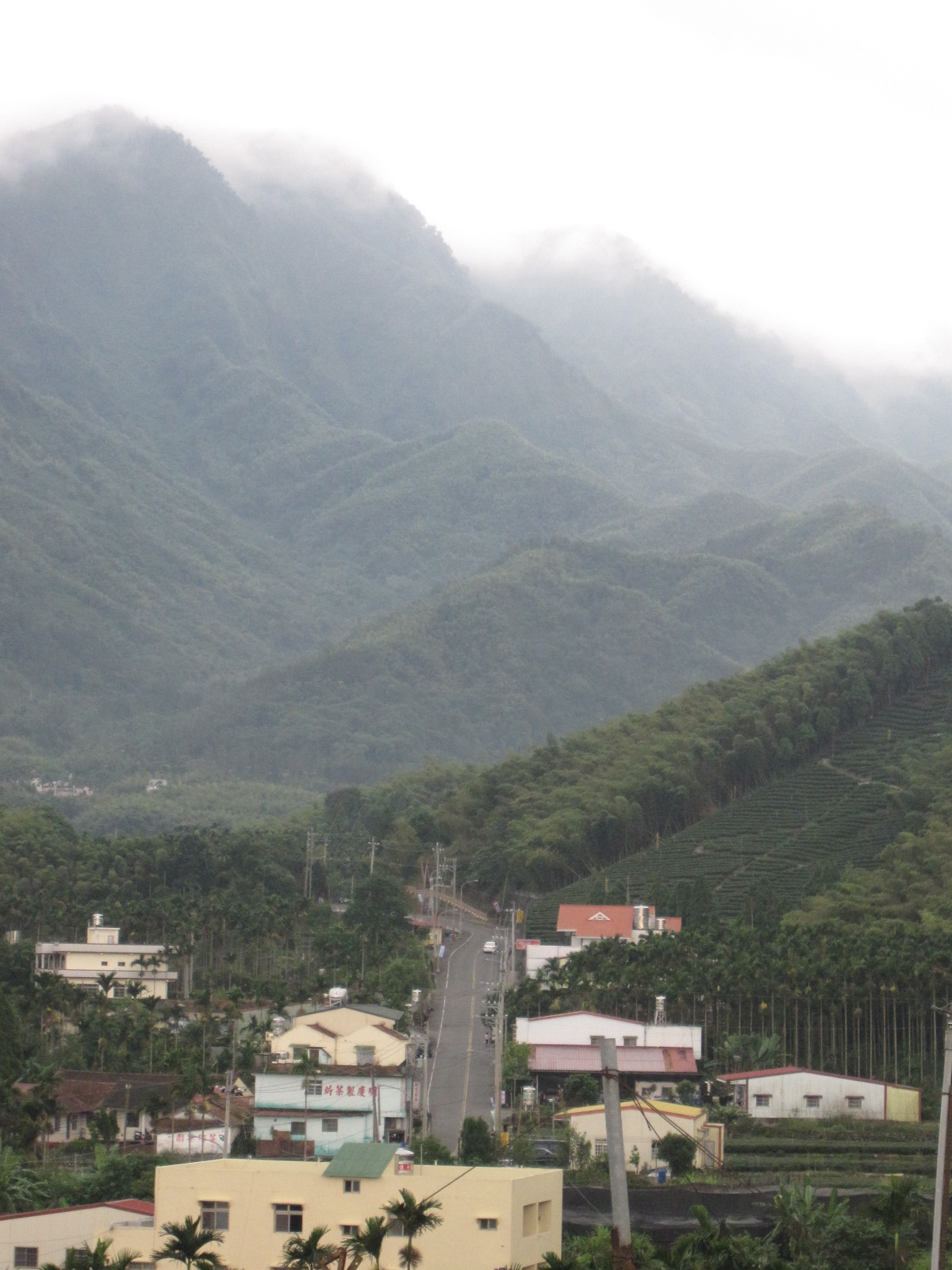
    One of my favorite rides is through the tea district of Lugu. I have ridden this area numerous times and I am always impressed by the scenery and the quality of many of the local teas.

    Runner Up

    This past weekend, the day before my bike broke, we took a non-cycling trip up there again to visit some friends.

    My friend and supplier of some excellent Dong-ding Oolongs, Jacky, was on hand to receive his award for the best tea in the Lugu Tea Farmers Association Winter Tea Contest.

    The contest took 21 samples from over 5000 farmers and subjected them to repeated, anonymous testing. This ensures greater fairness in the competition, which costs each farmer NT6000 to enter and is extremely labor intensive.

    Other contests in Taiwan are subject to manipulation by speculators in organized crime who buy up the winning tea before it is judged and then sell it for the inflated price.

    Jacky was able to sell his 21 jin (600g) to a collector for NT2.2 million.

    Winner's Dad

    We have visited Jacky's farm and hostel on several bike trips to Lugu, and Jacky is also the one who rescued me when I could not fix my tire high up on the Highway 16. We also bought some of his winning tea before Jacky was awarded the title of "King of Teas".

    A Boy and His Teas

    Aside from congratulating our friend, we also used the opportunity to test different teas and network with other farmers who were on hand to hawk their teas. For many farmers their chief concern was the dilution of Taiwanese teas with inferior and potentially tainted Chinese and Vietnamese varieties.

    The demand for Taiwanese teas far outstrips the supply, so many wholesalers are mixing their teas. Although Taiwan has very strict standards to limit pesticides and pollution levels in the teas, Chinese and Vietnamese growers are not subject to the same restrictions.

    The recent lowering of tariffs on Chinese agricultural products has made this practice even more of a threat to Taiwanese farmers.

    Award Ceremony

    For regular tea drinkers it is best to buy directly from a trusted farmer rather than a wholesaler. I am happy to have built some great relationships with local farmers and even biked out to check their fields.

    I am glad I am not on the other end of that

    If you are going to ride up to Lugu, I highly recommend taking the 131 to the 151. It is a nicer and quieter road. From there you can take several smaller roads all over the mountains.

    Big Business


    Lunch Time Sport


    San Lin Xi Field

    Hong Pei Tea

    On this particular trip we were interested in checking out some hong-pei, or charcoal roasted tea. We saw one farmer on the side of the road doing a roast.

    He was roasting the tea under burning rice husks.

    I love Taiwanese hospitality.

    This farmer not only answered our questions, but also took us on a full tour of his facility and an impromptu tasting of a batch he had finished that morning.

    Drying Baskets

    A Dime Bag

    We had to leave with some freshly roasted tea leaves. They need to sit a while, but they wee very good.
    Mr. Liu and I
    Subtropical Oolong from Songboling

    One wonderful ride I would love to do, is a tour of Taiwan's tea country.

    Tea country actually starts on the southern side of Alishan, where some farmers around meinong produce Oriental Beauty tea, which is oxidized as it is digested by the larvae of the Tea Green Leafhopper insect. The digestive juices of the Leafhopper give the tea a distinct sweetness. It also ensures the tea is free of pesticides.

    A trip up the Highway 20 to connect with the 159甲 over Alishan past the Gaoshan tea farms. Since Typhoon Morikot gave the government a pretext to relocate indigenous peoples from their traditional lands, many tea farmers are pushing for those areas to be opened up for tea farming.

    The 149 to Shuili goes right past the Taiho farms. Then a trip up the 14 to the top of Hehuan Shan to get to the back side of Lishan, where some of the best Gaoshan teas are grown.

    The Highway 7 gos from Lishan out to Taiping Shan and Iilan, where I like to buy some balanced Baozhong teas. Pinglin, which is famous for Baozhong teas, is right above Iilan.

    Baozhongs are often mildly oxidized, unrolled teas.

    The highway 7 also goes near Haishan and San Hsia and lets out by Ying ge, near Taipei. Yin ge is famous for its kilns and tea pots. This might be a great biking adventure through some beautiful country amid some of the best teas in the world.

    Lugu