body{background-attachment: fixed ! important; }

Saturday, October 27, 2012

Taiwan's Future In Cycles: China Post Calls For Government To Get Serious About Cycling

Gaomei Wetlands

Today's China Post has done a brave and commendable job in using its editorial page to focus on some of the core issues at stake in the development of Taiwan's bicycle policy. 

I use the word "brave" because it certainly can not be easy for a major publication to run against the grain of the government's steady flow of cheerleading over its own cycling policies that emphasize keeping the bicycle exiled to the Peach Blossom Spring of leisure and recreation. It is also brave of the editorial staff to question these policies that are tailor made to most benefit the bottom lines of some of Taiwan's largest companies. 
If you believe what the government says, this has been a brilliant year for cycling in Taiwan. Sun Moon Lake's biking path “won” some publicity on the CNN GO travel website, and there was another successful Tour de Taiwan. More bikes and locations were added to Taipei's YouBike rental system, and the Taipei Cycle trade show was just as big as ever. But these achievements — just like the doping scandal — are distractions. If our country is to take cycling up a gear from just a leisure-time activity to an integral part of our culture, we need to give serious thought about making commuting by bike safe, convenient and most of all popular.
The China Post rightly identifies that the future of Taiwan as a cycling success story will, at least in the short term, be invisible on the positive side of the balance sheet. It will require some tough choices, long term strategies, and some serious investment without a corporate sponsor. 
Let's face the biggest problem straight off the bat — the central and local governments like cycling because of cash and self-promotion.
The China Post is right on the money. Cycling infrastructure projects provide plenty of political capital for politicians who are eager to ride on the coattails of cycling's popularity while handing out inflated government contracts to other local and regional powers. For these politicians the beauty of these leisure projects is that they do not actually have to upset any apple carts.

If Taiwan's central and local governments actually took cycling's integration into the transportation grid seriously, it would involve deeper, result oriented investment in reorganizing the modern Taiwanese city and risk having to make some unpopular choices that might alienate some of the political actors that enjoy the fruits of the current state of roadway chaos. What I am coyly implying is that there is a lot of money and power at stake in the enterprise of routing of people through the urban landscape. Cycling decentralizes a lot of the transportation infrastructure that has already been negotiated. Embracing urban cycling would provide some opportunities, but it would also upset a lot of apple carts.
Again the constant feeling that local governments are far too focused on the meager profits of tourism and recreation is present here. Indeed, every level of government has failed to truly capitalize on the popularity of riding.
The disparity between Taiwan's leisure and utility cycling was made embarrassingly clear in the faint praise Taiwan's cycling investment received from Jack Becker, a Canadian bicycle advocate who was brought to Taiwan to, presumably, be feted into writing a gushing assessment of some cherry picked selections of the northern bike trail network. Becker rightly ignored the pressures of patronage to write a bit of reality for the government to think about. 

Becker noted:
While the Mayor is a former cycling racer, his past enthusiasm for cycling has not been reflected in cycling infrastructure on the street. The city is very proud of its 17 kilometres bike path along the seashore. The bike path attracts recreational cyclists from cities two and three hours away. They rent a motor coach and come in droves. This very expensive bike path winds its way on stilts over wetlands and along sand dunes. On streets, there are very few separated lanes that could be mistaken for bike lanes, since droves of motorcyclists ride in these lanes.
The China Post echoes this sentiment and what others, including myself, have been saying for a very long time. 
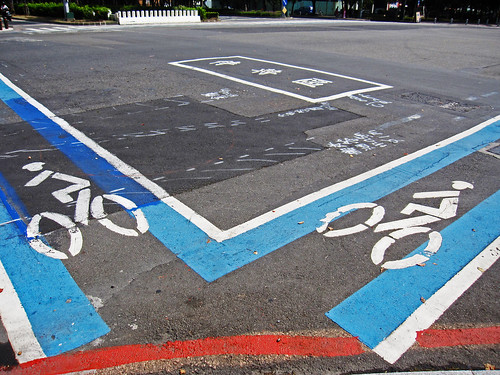
The biggest obstacle is getting bike paths constructed to make commuting safe. Dedicated bicycle lanes are not and will never be sufficient, given the local driving habits and amount of traffic. Taipei's YouBike system is admirable but is not built for commuting and the capital needs a systematic overhaul of its roadways and road rules. Unfortunately other attempts at cycling paths are not encouraging, like ones in which motorists unflinchingly dive in and out of the lane and others with uncomfortable, tiled surfaces.
If Taiwan is to realize its self-declared title as a "Bicycle Paradise", it will take long-term investment that will probably not show dividends until an election cycle far beyond the current political horizon. The government will have to resist playing to large corporate interests and their advisors. 

Not every government project needs to serve a partner in business. Some projects should just be completed to serve the citizen. 

I commend the China Post for their willingness to advocate a balanced investment in Taiwanese cycling. 

Read the entire editorial HERE

The View from Taiwan adds to the discussion HERE

EVENT INVITE: Help Me Celebrate My Birthday Over Alishan (Nov. 24-25)

Seven Axiom SL, Alishan in Taiwan


This November I'll be celebrating another middle age birthday on the bike and I'd like to put the call out to invite my friends and TiC readers to join me in a two day ride over Alishan

Instead of doing the ride in a 250km 4000m single day effort, we hope to make this a more manageable, friendly ride by breaking it up into two days. Two days leaves time for a little beer somewhere along the route. 

This ride should be suitable for most regular riders. The route is incredible and unforgettable.  It is challenging, but not devastating. 

Info: Nov 24-25th, Alishan. First day from Taichung to Tsaoling on the 149, then second day leave early and head up to Fenchihu on the 169 or 149. Reaching Fenchihu in the early afternoon, we'll take the 159A out of Shijhuo, one of Taiwan's loveliest roads, down to Chiayi city and catch the train or ride back home. Come one, come all!

Contact: ackymouse@gmail.com

Monday, October 22, 2012

Action Speaks Louder Than Words: Kaohsiung's Cycling To Success Away From The Spotlight

Untitled

This past weekend I was unable to ride. I had other commitments that took me to Taiwan's southern metropolis in the port city of Kaohsiung.

Despite being off the bike, I used part of my trip to look deeper into Kaohsiung's bicycle culture, which has received international recognition outside the usual channels of CNN-Pay-For-Play articles.

I find it surprising that almost every internationally syndicated article of Taiwanese cycling fails to mention Kaohsiung while piling the plaudits on Taipei's leisure bike trails and Sun Moon Lake.

It may be that in Taiwan's politico-economic climate, the leadership in Kaohsiung and Taipei remain poles apart in their vision of Taiwan as a center or a periphery, and therefore Kaohsiung will not receive any government help in raising her profile as a model for other cities in Taiwan or around the world for promoting the bicycle as a form of urban transport.

 Kaohsiung is a very different city than any other in Taiwan. It has wide boulevards and less traffic. The  slow lane is large enough for scooters and bikes, while the crosswalks separate cyclists from pedestrians.

I saw many casual riders out enjoying the day.


Although Kaohsiung is not perfect, I thought riders had plenty of options for roads and rides within the city. There were regular bike racks located around town and near gathering places for city residents. I particularly enjoyed seeing bikes parked near Kaohsiung's thriving cafe scene. Kaohsiung cafes seem to be filled with retirees who can barely hear each other as they shout in lively banter over the din. A very different vibe. It feels a bit like Tainan's food culture... in a cafe.


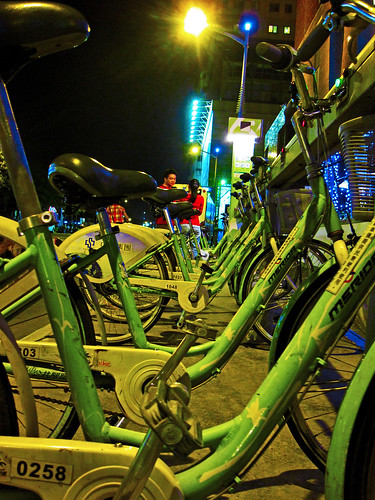
What really stood out were the bike rental stations located at various hubs around the city. I was surprised to see how many green and white rental bikes could be seen floating about the city.

Residents were actually using these bikes beyond simple recreation.

I saw numerous people approach the bike station, rent a bike, and take off into the city. It wasn't just at purely tourist oriented areas, but all over.

The bike rental program in Kaohsiung has actually provided a viable way to cleanly navigate the city.

The biggest problem I see is the lack of helmets, which increases the risk of serious injury... even on a slow city bike.

I have to admit, seeing all those bikes rented out made me feel the excitement of possibility.

Taipei and Taichung still have a long way to go to better organize the city infrastructure to accommodate the bicycle.

Let's hope other cities in Taiwan look to Kaohsiung for leadership in integrating the bike into our daily lives.

LINK:

 Be sure to check out another one of Michael Turton's Northern Cross Island bike trips . Like a pilgrimage to Mecca, Taiwan riders must do this journey with michael at least once in their lives.

Friday, October 19, 2012

Rabobank Leaves Giant At The Altar: Rabobank Pulls Sponsorship

Days after announcing an agreement in which Giant would hold exclusive rights to marketing Rabobank branded cycling gear as well as picking up the apparel tab for the Rabobank team, Rabobank has announced it will pull its sponsorship from professional cycling in the wake of the doping revelation uncovered in the Lance Armstrong investigation. 


“Great partners”The extension of the existing sponsor contract includes all Rabobank pro cycling teams. These consists of the Rabobank men’s road and cyclocross team, the Rabobank-Giant Off-Road team and, with its Liv/giant women’s brand, the Rabobank women’s team led by Olympic and World Champion Marianne Vos. 
“Rabobank and Giant have been great partners since 2009,” said Giant CEO Tony Lo. “We build bikes that help them win world championships, and their feedback pushes us to develop world-leading technologies. We’re excited to now extend that partnership into apparel.”
Taiwan's largest bicycle maker may be scrambling to fill the void left by one of the peloton's oldest sponsors and one of Giant's best marketing streams for high-end bikes. 

With great partners like these, who needs enemies?

It appears Giant may be stepping up as the title sponsor. 

Wednesday, October 17, 2012

October 20-21: Another Expedition on the Northern Cross Island Highway

IMG_8120


Michael is organizing another of his great Northern Cross Island rides. These rides are becoming legendary as Michael is becoming known as Mr. Northern Cross. 

I will be unable to attend. But if you have time this weekend, you should really take the opportunity for a fun two days on the bike. 

This is by no means a hardcore race. Rather, it is an accessible ramble into the mountains that most regular riders can enjoy.

Details:

October 20th-21st. Northern Cross-Island Highway ride. Leaving Yongning Metro 7-11 around 8 to ride up the 7A to the 7. Overnight in Lower Baling. Day 2 leave around 7, arrive in I-lan midafternoon. Taipei people should be home for dinner.

The Second Taiwan International Bike Festival and Links

8085503213_55055092f4_b 

 To coincide with Taichung Bike Week, Taiwan's second (actially third, but the first one got a do-over) annual International Bike Festival will kick off on November 10th. Taiwan's Tourism Bureau has been busy stoking international interest in the event with press releases and inviting bike bloggers to fly in and write favorable pieces about leisure bike trails, Giant Bicycles, Sun Moon Lake and eastern Taiwan. While I can't fault anyone for accepting the opportunity to be feted on the government's dime, I have to wonder if the patronage pays off for Taiwan. There has been an obvious thrust under the Ma administration to ease Taiwan's economy into one based on tourism. The bicycle is a major part of that equation. Check out this predictable press release from New Zealand or this gag-worthy brochure copy from the Canberra Times. The lucky bloggers had plenty to see as Taiwan again tries to lionize individuals to become industry icons. I hope in the future more cycling publications will send their own staff to see Taiwan's cycling culture away from a government minder or industry patron who is footing the bill.

The best part of the bike festival is the Maxxis KOM Challenge, a sadistic race from sea level to 3275m. This year's Giro d'Italia King of the Mountains winner, Matteo Rabottini, will be here to learn a thing or two about the misery Taiwan's topography can throw at the world's best.

Also:


Monday, October 15, 2012

One Killed and 26 Injured in Tour of Changhua Bike Event

Untitled

As riders were still filtering in to the finish line at the Tour of Changhua, word around the reception area spread that several riders had been injured, and some critically, somewhere along the course. 

This morning it was confirmed that there had been 26 injuries and, sadly, one fatality

This seems to be an awfully high price for an event that is organized in the name of "fun". Immediately questions arose as to who or what was to blame. 

The Merida sponsored Tour of Changhua has become one of the largest biking events in Taiwan. Over its three-year run, the ToC has annually drawn in excess of 7000 cyclists as participants or non-registered followers. This is both a testament to the event's popularity as an open event, as well as a testament to the growth of road cycling as an activity for sport and leisure in Taiwan.

Cycling is a dangerous sport. There are certain risks involved in propelling oneself at high speeds down public roadways. Lots of things can happen. The risk is acknowledged as soon as we clip the chinstraps of our helmets. Automobiles often pose the greatest threat to cyclists, but even in the guarded confines of a professional race there is still room for tragedy to strike. 

This was by no means a professional race by any stretch of the imagination. 

What's Wrong with the Tour of Changhua:

1: Numbers

Unlike professional cycling, few of the 7000 participants in the Tour of Changhua are generating the watts that put them on the razor's edge between life and death. 

For Tour of Changhua organizers, but I have seen this for other races as well, the number of participants signifies the success of the race. With more entry fees paid there are more eyes on the sponsors. With any large gathering in Taiwan there seems to be a lot of weight placed on the numbers and 7000 makes for an impressive figure to show the public. 

The sheer number of riders is the race plays the greatest role in increasing the chances for injury. With 7000 riders all trying to snake through the same stretches of roadway, it becomes a problem of fluid dynamics. It may be wise to curtail the number of riders.

2: Organization

The second problem is in the disparity between skilled and unskilled riders. 

The Tour of Changhua starts all riders on a first come, first serve basis. Fast and slow, skill and unskilled riders are all packed cheek by jowl in the starting area leaving the faster riders to pick through the unstable group to advance up the road in decent time. Many of the novice riders lack the strength and basic skills to safely ride a bicycle in close proximity to other riders. On Sunday I had a few riders steer into me while muscling up the initial climbs. 

Anyone can go to the store and pick up the latest, highest tech racing bike on the market in exchange for cash. There are no skill tests to pass. Therefore, there are lots of riders out there with twitchy race bikes and not a clue how to handle them safely in a group. 

Group riding takes practice and some training. I can't begin to tell how many times I dropped onto someone's wheel, only to have them constantly oscillating their speed. Dangerous. 

The Tour of Changhua organizers might consider dividing the field into a competitive group and a recreation group. This might smooth out the action and keep it a bit safer on the course. 

3: Route

One of the key factors was the route. After announcing the official route, the organizers reversed the route in the name of safety. They did not want novice riders to face a hill climb 50km from the start. They feared riders would collapse from exhaustion. 

Instead, riders were making high speed descents into sections of poorly patched blacktop from a recent construction project. The bumps and seams in the road surface would have ruled it out of any professional event. It was at that spot I saw my first ambulance of the day. 

The route was also not closed to cars. On Bagua Shan I was surprised to see oncoming traffic with no separation between cars and riders. Occasionally the call, "che!" or , "car"  came echoing down the pack. 

The section that had the fatality and another serious injury was along the creek near the finish. It was narrow, with one low barrier between the rider and a deep creek bed. Several riders lost control and crashed there. 

It may be that the Tour of Changhua needs more experienced cyclists to plot the route with time for the government to ensure it will be safe by the time riders leave the starting gate. In many cases the choice to send riders on those roads was a simple act of negligence. 


Conclusion:

The Tour of Changhua is still a relatively safe race. Still, the organizers failed to learn from prior mistakes and, in the name of spectacle, put a lot of lives at risk. There are still several things the Changhua government and race organizers can do to make this a better and safer race for everyone. It is something Taiwan's race organizers can all learn from. 

It is sad when it takes a death to force change. 
WebRep
currentVote
noRating
noWeight