body{background-attachment: fixed ! important; }
Showing posts with label Chiayi. Show all posts

Wednesday, September 10, 2014

Tackling Tranquil and Terrible Tainan: The View from Taiwan's Southern Expedition

NathanRide_208

Michael Turton of The View from Taiwan has posted a magnificent spread detailing his tour of the foothills of Tainan. The full article can be found HERE.

Here is an excerpt:

The 179 turned out to be absolutely brutal, 16 kms or so of up and down hills, none big, but almost all 10-12% grades, a couple every kilometer. Because the area around the reservoir is a conservation district, there was no development -- no houses, no water, no people, nothing. The road surface was broken up with great gashes that ran parallel to the direction of travel, dangerous invitations for your wheels to slide into. And of course, no views, the whole thing was vegetated over. It was basically 16 kms of brutal ascent and descent, with nothing flat.

Monday, June 28, 2010

Cycling Through 228


Chiayi Memorial

During my ride to Chiayi last Sunday I came across two separate memorials to what is known as "The February 28 Incident" or simply, "228"-- an episode of mass violence in which the Chinese nationalist soldiers and police killed and executed tens of thousands of Taiwanese within the course of three weeks in a large scale exercise of state violence. In Taiwan the three simple digits still carry tremendous weight and meaning that would be otherwise lost on a cultural outsider as the event has followed a historical trajectory that pervades Taiwanese society at all levels, from those who remembered and even perpetrated the violence, to those who remember hearing about it in hushed tones behind locked doors as a deafening silence. Younger Taiwanese all recognize the numerological code, but often conflate it into the Formosa Movement and other clashes between citizens and the state.

Nearly every area in Taiwan has some kind of 228 memorial as political and social forces necessitated its reverence. In some cases a memorial stood in defiance in other cases in memoriam. Of the memorials I passed on my ride, each has integrated established narratological forms into the construction to reify the event and secure "the story" of 228 in the public consciousness. The memorial in Yunlin is inscribed with a short narrative to explain 228 to the viewer, and the Chiayi memorial uses a memorial sculpture depicting a history of oppression at the hands of outsiders.

It has been argued that the February 28 Incident and its aftermath made a distinct Taiwanese history knowable through a complex system of iconalization, mythmaking, ritualization and deployment in a process Stanford historian Hayden White describes as “narratological causality”, which asks us to “consider the relationship between what we perceive to be the ‘facts’ of history and their performative and narrative construction.”(White 1987, 194). The events become less of a “true account” of the past, but rather a constructed mythologization of events in an “ irreducible overlap between what has happened and what is said to have happened” as historians and political actors impose their own treatment of history.


The first open commemoration activities for February 28 resulted following the end of martial law in 1987, when the newly formed opposition party, the DPP, sponsored seventeen commemoration events across Taiwan as an extension of the opposition movement (Edmonson 2002, 30). The DPP used the first commemorations to introduce 228 to the public and historicize it in a manner that would link specific 228 related platforms, such as apologies and compensation, to Taiwan Independence and democratization.

Close-up of Sculpture

The initial commemorations were often put down by the authorities, which served to reenact 228 and solidify public support behind the opposition forcing the president to try to discredit the protesters by assailing their motives as political gamesmanship. Despite Lee’s public dismissal, the strategy used by the DPP forced the KMT to finally confront the February 28 Incident. In 1991, president Lee Teng-hui ordered a full investigation into the Incident with inconclusive results. In successive years Taiwan would see the first state commemoration ceremony, a memorial, museum and an apology from the president.

In 1997, the February 28 commemoration involved a parade combining a conglomeration of civic groups and government officials, both oppositional Taiwanese and “New Taiwanese” or "Mainlander". The event followed a route that brought the marchers through the historical sites of 228. The event was explained by Lin Yi Hsiung “as a symbol of social activism’s link to the Incident through a struggle against Tyranny, a battle most civic groups feel embroiled in… and the new Taiwanese discourse of Taiwan’s antagonistic relationship with China…that is why the theme of the march is ‘Remember February 28, Don’t Become Chinese’.”(Wachman 1994, 71).


Reflection Blocks

This paradigm shift of February 28 in Taiwan as a collective national memory of opposition to tyranny has expanded to embrace even the nationalist Chinese on Taiwan who had previously been targeted by the opposition as the perpetrators. China’s growing threat to Taiwan’s defacto Independence and security have become woven into the fabric of the memory of February 28 as the “aggressor”. Peng Min-ming , the DPP presidential candidate during the 1996 elections emphasized the link between foreign aggression and the Incident when he declared, “ The February 28 Incident only proves Taiwan must not unify with China, otherwise an even worse historical disaster would take place.”( Liberty Times 2004). In 2004, Peng’s sentiments were shared by the approximately 2 million people who, on February 28, linked hands, forming a human chain that spanned Taiwan, tip to tip. The event was organized partially as a campaign stunt for the upcoming presidential elections and inspired by a similar exercise in the Ukraine. The symbolism of the event was to create a wall defending the “homeland” against China’s missiles. The event was the high point of the election (Taiwan Ri bao 2/29/2004). It also simultaneously delineated the Taiwanese "us" from the Chinese "them" and repositioned Mainlanders from "outsiders" into a collective Taiwanese "us", or at least offered to provide a bridge to reconciliation.

An excellent example of 228's location in Taiwanese life and culture comes from the 2004 presidential campaign. On March 19, 2004, the incumbent president President Chen Shui Bian and Vice-President Lu were both grazed by bullets while riding in an open motorcade. Before the public had been informed that both injuries were not life threatening, the buzz on the street returned to the February 28 Incident. Many people openly pondered the possibility of another uprising, while others prayed to the ghosts of February 28 for peace and for the welfare of their leaders. The immediate connection between the attack on the president and the violence, retribution and ethnic mistrust of the February 28 Incident demonstrates how the resonant silence of 228 combined with its politicization and reemergence as a mythologized common memory and continues to frame the Taiwanese experience in a mimetic symbol of Taiwaneseness. And in an eerie twist, the injured Chen Shui-bian narrowly won the 2004 presidential election by 0.228 per-cent of the vote; a fact that was not overlooked by his supporters.

The memory of the February 28 Incident has passed through over sixty years from a tragic event that transpired over the course of March 1947, beginning with an attack by KMT officials against an individual on a public street. Since that event, the February 28 incident had been in a state of constant negotiation and relocation in Taiwanese society. The impact of the February 28 incident as event, led the KMT authorities to publicly silence the experience in public, forcing the experiencers of 228 and their progeny to mythologize the experience in a social-political frame of disenfranchised citizens against the forced political marginalization of the Taiwanese majority in Taiwan. Despite the massive shifts in state structure, these memorials continue to play a role in creating a Taiwanese collective memory and they symbolize an imagined collective experience that is uniquely located on Taiwan.

Yunlin Memorial

In more recent years there has been an effort on the part of the central government to ignore 228 and Taiwanese have even been called upon to "forget" and "move on". This begs the question: Is there a place for this entity of 228 in the 'Greater China" narrative that seems to be the goal of Chinese nationalists on both sides of the Taiwan Strait? It seems, now that 228 has been unleashed from its decades of suppression, it is possible to let it fade beyond memory as the forgetting is voluntary and not mandatory. That is the real danger.

References:
*Edmonds, Richard Louis. Goldstein, Steven M, ed. 2001.Taiwan in the Twentieth Century: A Retrospective View. Cambridge University Press.

*Wachman, Alan M. 1994. Taiwan: National Identity and Democratization. New York, M.E. Sharpe, Inc.

*White, Hayden V.1987. The Content of the Form: Narrative Discourse and Historical Representaion. he Johns Hopkins University Press

Sunday, June 27, 2010

(201km) Long Bike Rides and Getting Caught Out In The Rain

Rainclouds over the ChoShui

On Sunday I did everything in my power to set myself up for failure, or at least a bad ride. All I knew for the week is that I wanted to do a long ride and make up for a week of rain. I wasn't sure what the weather would be like and just didn't think about riding. Without a plan I could not make the physical or mental preparations that can make or break a day of endurance riding. That means that I did not spend the week eating correctly. I did not spend the night before hydrating properly. I did not prep my body with stretching on the non-riding days. I did not mentally trace my route and imagine when and where to expend my energy. I did not plot my course on a map and look for "outs". I did not even have any fruit at home for breakfast. I didn't even know where I was going until I woke up. This is absolutely the wrong way to go about things. Seriously.


Taichung's Ugliest Piece of Public Art (Look at the anatomical proportions. I guess with a flying man-cow-horse you can make up any proportions you want. WTF?!)

I woke up late as I had fallen asleep on the couch while watching World Cup and never set my alarm. This would seal my decision to head down the Highway 3, which is a hillier route to southern Taiwan. I wasn't sure how far I would go, but I figured I would head back when I felt about "half-way". The humid air was already boiling by early morning and I knew it would be one of the hottest days of the year. The sun is about a week away from its closest point to the earth (July 6) and the temp would soon be up into the high 30's.

A Friendly Group of Cyclists

Being the first really sunny day in a while there were several cycling groups already out and on the roads by the time I took off. Some were huge packs (convoys) and others were just a four or five riders out for the morning. At one point as I was zoning out into my music I heard a loud "woof", and turned to find a big Taiwanese roadie on too small a bike greeting me for a couple pulls. With all that energy I was afraid he'd push me past my comfort zone on a long ride. I try not to get into "chase the rabbit" games on long rides as the energy is always needed at the end. Luckily he was all about enthusiasm and not performance, so he made a great riding partner for a few clicks.

The Sweetest Place in Gukeng

The temperatures soared by mid morning and with the humidity I knew I had to pay extra attention to my hydration situation and my nutrition intake. I stopped near Gukeng, by the Honey Museum, for some water and sport drink.

On these really hot days it is important to drink enough and not too much. I was trying to drink water to Fin Sport Drink at a 2:1 ratio. Periodically, I stopped for water and bought an extra bottle to dump over my head to bring my temperature down and to wash the salts off my face. I've come back from some rides looking like a salted ham. The Fin is the least sugary electrolyte drink and it is the easiest to drink on a long, hot ride. I also rode with my leg muscles over my lungs to keep my HR down. The heat can be really dangerous and I have had some rides where I came home and collapsed with headaches and fatigue from the heat. Hot riding can be done well, but it has to be done right.

The Yunlin 228 Memorial

Near Gukeng I also stopped to take a look at the Yunlin 228 Memorial. Local 228 memorials have sprung up in nearly each county as the result of the indigenization phenomenon that started with the end of martial law in 1988. I will blog more on this a little later.

Pineapple Fields and Hills

I headed along the mountains into Chiayi County. It is pineapple season and the sweet smell of pineapples was enough to overpower the smell of pig shit. I kept an eye on the white, billowy clouds that hung on the mountains and hoped the gorgeous weather would hold, but maybe a special order of opportune cloud cover would have been an ideal treat.

Whah... Cow!

I was getting excited as I was moving along the foothills and the local communities are often distinct and colorful. You never know what surprises lie up ahead.

Groovie Ghoulies

I passed through Mei shan and through a small procession of pilgrims to the local temple. They even had a dangi spirit medium preparing to flay himself near the front of the temple.

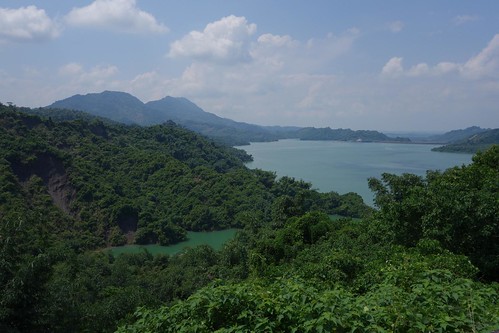
Renyi Reservoir: Originally established by the Dutch and expanded by subsequent colonists.

I decided I would head back before noon at Huan-a Rd. I had been passing through the area of Saaora speaking people also once known as Tevoran. The Tevoran area was used by several groups of Siraya speaking plains indigenes as an area to seek refuge during headhunting season. Tevoran was also used by many of the Maddou villagers in 1636, when the Dutch embarked on their campaign of retribution. The custom of withdrawal in times of impending threat may have led to the popular, and inaccurate trope that the plains indigenes retreated into the mountains and became the highland Aborigines.

Chiayi 228 Memorial

I finally made it to the 159甲 to Chiayi City. At the base of the hill there is another 228 memorial. Chiayi actually built the first 228 memorial in Taiwan near the train station as it marks the final battle of the failed rebellion. The newer memorial uses a "totem pole" depicting a greater trope of Taiwanese oppression at the hands of outside powers.


Chiayi (Proof:火雞肉飯 lower left)

As I rolled into Chiayi City, I felt a single raindrop hit my face. I looked up and saw a large, dark cloud rolling in from the southwest. At that I calculated I would have enough fuel in the tank to get home at speed and busted for Taichung. The race was on. I was keeping my speed at about 35-40kph. and made quick work of the counties. I was so concerned that a front would move in from the southwest that I didn't notice the mountains I had just come out of were veiled in advancing rainclouds.

I pushed myself to sustain my effort. Despite rainclouds on all sides I was riding in a trough of sunlight. The heat was simply intense and riding through the thick, humid air was just a labor.

As I closed in on Changhua, I noticed a massive, black raincloud sitting right over Taichung, held in place by Bagua Shan and Dadu Shan. By this point I stopped at a 7-11 to buy a plastic bag for my electronics. I was pretty much resigned to getting soaked.

I soldiered on into the face of the storm and the rain just wouldn't start. I thought I might be able to make it home without getting wet. I was sorely wrong. Just 8km from my front door the clouds opened up. It was as if someone pushed the "rain" button and it just poured. My ipod promptly died and I just kept going. I figured with the bibs on it would be like an old time swimming suit. All I needed was a handlebar mustache and a penny-farthing. The coolness of the rain actually gave me a boost of energy.

My bike performed flawlessly in the rain. The disc brakes worked as if dry and that gave me the confidence to continue at a slower, but safe 33kph. I figured I would pedal my ass off to get home and then I could relax with a hot pizza, rather than sit around some place dry for an unknown period of time. That was all fine until the electricity started and I was seeing spots from a flash of lightning over my head.

I thought about what to do if my bike gets hit by lightning besides die. Anyone know? I figure with such small tires, being exposed and with metal clips in the shoes, the prognosis can't be good. I hid for 15-20 min. then I decided to brave the storm once again. I though if I could ride close to tall things I would be ok. I pedaled the remainder of the way home with even a couple guys on scooters cheering me on for riding in the conditions. A little adventure for what I had assumed would be a so-so ride.

Storm Over Changhua


Bike route 562079 - powered by Bikemap

Saturday, May 22, 2010

Chiayi Foothills and Hua Shan


Traditional Tea Picking

Today Michael T. and I were joined by the new fellow in town, Darren R., who has just landed in the central city of Feng Yuan all the way from Portsmouth, England. It was great to have another excellent rider in the crew and he was also great conversation. Welcome to the neighborhood!

The initial plan the team from the welcome wagon had prepared was a serious day of climbing all the way out to the Alishan Train Station. Unfortunately due to a problem with the navigational equipment... of course... the navigational equipment... we missed the turn-off that would have taken us on a grueling day of climbing and forearm busting descents. Instead, we meandered around the beautiful tea areas of Chia yi county.

The Foothills

We drove down to Gukeng, in Chiayi County and parked near to 228 Memorial Park right off the highway 3. After loading up at the Gukeng 7-11, we hit the Chiayi Local Route 158 into the hills.

Darren Starts His Ride

The 158 was a nice little rural road through farms and up hills. This seems to be a popular place for weekend cyclists. We were passed by several groups on their way down the mountain. Even the low views are spectacular.

Farms of Chiayi

The green cliffs of the foothills loom in the distance and tease you for a descent picture; a call that can never be answered with any justice or accuracy using a simple camera. I wish my pictures could convey the beauty of this area, but your imagination will have to suffice.

The Cover of A Million Tea Boxes

The 158 connects to the 149/149甲. These are the same road for a while so be careful when they split. We saw a few riders making good time on these hills and wondered how they could have the energy to maintain that type of energy after so much climbing. I wondered where they had been coming from on the other side.


Meet The Central Mountain Range

Just on the back of the first hill the road comes to an abrupt crossroads and smashes into a wall of mountains as it splits with a fantastic peek at the Central Mountain Range.

Giving the Bike A Rest

We took the 149 toward Meishan and began a nice climb into the high mountain tea farms. The area around Changhu 樟湖 was spectacular. I stopped at one corner along the rim of the valley to watch the old women picking tea by hand and a couple eagles play a game of tag above the tea farms. It was a magnificent scene.

The View From The Summit

Just as I could feel my legs getting into the idea of a long day of climbing I realized I was on the summit of a hill... on the front side of the range. Below me was the plain with Douliu in the distance. I couldn't imagine how this road could ever get back into the mountains to go up to Alishan. After a brief discussion, we discovered we had overshot the turn-off onto the 149甲 and were too far to make it back and finish the ride in a day. We had to commit to taking the 145 to the end.

Debris Flow Mitigation Demonstration Area in Hua Shan
Fun For The Whole Family

Sadly, the end came up rather swiftly at the bottom of a screaming descent. I was able to hold 62.kph down several stretches and used the opportunity to practice cornering. I am still gun-shy of cornering as cars tend to over shoot their lanes and a few close calls can stay with you for a long time.

We stopped in Hua Shan in Taiwan's coffee growing area and had a bite to eat before heading down to the car. Due to the region's new distinction as a "coffee area", it is impossible to find anything that is not coffee related and we went thirsty for far too long.

We finally made it back to Gukeng with much fresher legs than anticipated, but a fantastic ride in the bag.

Total: 35 mi/56km

Michael has a write-up and pictures here.

Wednesday, May 19, 2010

5/22--Meishan Township Climb--梅山鄉


Bike route 497396 - powered by Bikemap

Upward and Onward?

Seeing as the weather up in northern Taiwan is going to be a mess and I still need to get some climbing into my legs, it appears this weekend will be southward bound. If everything works out I hope we can do this hilly route without getting rained on and salvage a weekend of riding. It isn't the rain that worries me as much as descending off those hills on slick roads.

If anyone is interested or would like to meet near Douliu, let me know. We have limited vehicle space and may not be able to accommodate everyone. This should be a good warm-up for June if we can make it work.

Sunday, April 11, 2010

225km (140mile) Warm-up Ride: Taichung->Nantou-Chiayi and back!

Last week I turned in a good 90 mile ride and I knew I had to increase the length to get into shape for my upcoming 260km ride to Kaohsiung. Last week I had a pretty bad flat and it did quite a bit of damage to the sidewall of my rear tire. I have been riding a set of Continental GP4000 tires for two and a half years and I love them. Still, with 7000 miles on them they are getting a bit worn. With tires, as they start to wear down they flatten out and feel hard and fast. The speed isn't so bad, but the level of comfort plummets and the level of confidence in the tire plummets as well. I went out Saturday to find a replacement set and couldn't find any in all of Taichung. Many places carry the tires, but were sold out. The Contis are a well made tire with good road feel, speed and enough tack to grip the road on hard turns. They have been very reliable as well. It took me over two years to get my first flat. My Saturday odyssey took me to ten or more shops and what surprised me most were the 'alternatives" some of the shops tried to offer. It told me a lot about the differences between shops in Taichung. I am sorry, but a "Road King" or a Bridgestone is not a suitable replacement for a Conti GP. In my opinion, tires are not one of the components you can compromise on. The right tire plays such an important role in handling, comfort, performance and safety. Tires can last for a couple years, so I am not about to waste money on something I will regret for two years. I also learned how uninformed many shops are on tire width. Most shops carry 23c tires because that's what the pros have. There is no difference in speed between the 23c and 25c tires. If anyone tries to tell you as much then they don't know tires. A 25c offers more comfort without a drop in performance. A lot of pros use 23c because they are slightly lighter. In Sunday's Paris-Roubaix they were using 25-28c tires. Grrrr! I have some nice 25c on order, but I had to endure several hours in the saddle on old, hard tires with structural weakness.

Ride Map

April is quickly becoming a heavy riding month for me as I prepare for my trip to Kaohsiung 高雄 at the end of the month. As I dial in my fitness, nutrition and cadence, I have put together a few rides that could be considered "long" by any measure. Seeing as this was Paris-Roubaix weekend, I thought I should push things a little closer to my goal of 260km, the official distance of the Queen of the Classics.

Lots of Riders Out

My ultimate goal was to reach the central city of Chiayi 嘉義 and return, so I naturally headed toward the inland town of Nantou 南頭. This would be my longest single-day ride to date and so I started slow with a nice warm up along the Highway 3, which is the major corridor to the interior of central Taiwan. The goddess Mazu was having her birthday celebration this weekend and the pilgrims were out in force. The roads were full of tour busses and gangsters galore, which made for some dicy riding. The weather was warm and not as windy as Saturday.

Pilgrims on Parade

The route through Zhushan 竹山 and Linnei 林內 on the Highway 3 is a fantastic ride on a bike if you like cruising at a good clip. There are more scenic routes, but when you are trying to log distance the idea of getting lost on an unknown backroad is not part of the plan. My speed through Linnei to Douliu 斗六 was in the mid-twenties and I kept along with a caravan of gangster-pilgrims from Changhua. At first a guy was going to have some "fun" and throw a firecracker at me... until I sternly shook my head and glared. I pulled up along side and, in my best Taiwanese, made small talk. From that moment on they were rooting for me. A black Nissan Cefiro (usually the biggest danger on the road) pulled up and the red-mouthed dudes in the car shouted with approval as I kept pulling away from their caravan. Today was full of friendly and encouraging people.

The Cobbles of Douliu

I ran into several groups of cyclists on the road and we all commiserated together over our good bikes with underpowered engines. I really enjoy the instant rapport you feel with every other cyclist on the road. There is a sense of respect and understanding. Rarely do you run into a guy with something to prove.

Stone Ox River

Outside Douliu, I connected to the Highway 1 South. I hate the Highway 1, but at least it goes somewhere. My speed was inconsistent at this point and I was facing a bit of wind. I was only 55 miles into my ride and I was starting to worry.

Rails of Chiayi

The ride to Chiayi is faster than I had anticipated and I was there well before noon. The sun was really beginning to bake and I was aware that I needed to take more liquids.

Performing Arts Center

As I got closer to Chiayi I was pleased to see the Chiayi Performing Arts Center. The architecture resembles the classical temples and houses of Qing era Taiwan. This is in stark contrast to the ornate, faux-traditional, Northern Han style the Kuomintang erected during the 1960's and 1970's to reflect a glorious China that existed in the imaginations of the Mainlander elite, but was foreign to Taiwan. Compare this building to the Palace Museum, Democracy/Dictator Memorial Hall, and other Nationalist monuments in Taipei.


Ah! The 168

I got lost in Chiayi city because I felt I had to get within the city limits to truly claim to have gone to Chiayi. On a long ride there is nothing worse than getting lost. Each kilometer going nowhere could be better put into going home. Each kilometer and minute wasted is one more that will have to be made up with that much less gas in the tank. Needless to say I was a bit aggravated. I finally backtracked to the Highway 1 again (I didn't want to backtrack anything) and then I turned off onto the Chiayi Local 168 to Hsin Gang 新港. The 168 is a marvelously straight road with plenty of biking space... and a very heavy headwind from the ocean. My speed plummeted and I didn't want to waste energy fighting with it. At one point I was passed by another cyclist and started to doubt myself. I had to conclude he was on his 5th kilometer of a 10km route. I eventually met up with him and we chatted about our routes. Sure enough... he was on a 10km route. Whew!

Monk Bisiness

At about Bei Gang 北港 I found the gearing I have been looking for all my life and was spinning at around 20-21 mph for most of the final 70 miles. I actually felt better on the latter half of the ride than at the beginning. I was really pleased with this stage of my ride. I think I will try to keep this speed and cadence all the way to Kaohsiung. The road was filled with Mazu well-wishers, but not too bad. The heat was really beating down after 1:00pm. I stopped at a 7-11 to get more water and noticed my forehead was caked in salt. I looked like a margarita glass. I had clouds of white salt all over my jersey as well. I decided to take in some sport drink as well to get the salts back and better retain water.

Plowing Through

I reached the Yunlin Local 154 and made the choice to go back through Hsi Liu 西螺. It is a prettier ride and I was sure of making my 200km goal for the day. I just kept the speed up but I have to admit, I was not entirely comfortable. My tires are just worn down and hard, so I really can't wait to change them out. I feel pretty good. My legs aren't as tired as they should be and I have no more big rides planned until April 24th. Now I will just keep rested and stretched with some small conditioning rides throughout the week.

I know there are a few people out there who I have promised to ride with, but I really need to get this big ride taken care of and then I will be free as I don't have any big project on deck. I look forward to riding with you all again when this is over. Until then I will be focused on making April 24th a success.

Final Score 140 miles (and no that is not the real time of arrival. I arrived about 5:00pm)