body{background-attachment: fixed ! important; }
Showing posts with label Sheng Shing Station. Show all posts

Sunday, March 4, 2012

Backwards Day: Sanyi Saddle Sore


On Saturday I took some time to share some cycling moments with my buddy Chris, and in doing so, I was inspired to go out Sunday morning with the odd notion that I would go out and inflict a heavy amount of pain upon myself, then return home all the better for it. That was the plan.


I took off with a rough idea of what I wanted to do. It involved mixing a couple previous routes through southern Miaoli County into one route for climbing and distance.

I was deep in the drops before ever leaving the front door. Everything felt great. I was humming along feeling great. My speed was encouraging and at times I felt motorized.

The question I had in the back of my mind, was how long I could sustain this pace.

I left the door prepared for an entirely different ride.

I left prepared for a winter ride with breakfast, a few stops and a tailwind on the return trip.


Route 49

As I cut through Fengyuan, I noticed they had changed my regular viaduct to the Highway 3 and had neglected to post any signage at the location.

I thought I'd have a go of it, and chose the middle lane for scooters.

The next thing I knew, I was on the Highway 13 in Houli.

Today was to be Backwards Day.

As the visionary landscape artist, Bob Ross, used to always say, "There are no mistakes... only happy little accidents."

I decided to work this error into my plan for the day and approach the route backwards. This meant hammering up to Sanyi on the Highway 13 and then traversing over to the Miaoli Route 130 via the Route 49.


This is a beautifully forested route, which pitches and dives through the foothills of Miaoli.


I incidentally cut through the Sheng Shing Tourist Station and dodged the meandering tourists as I tried to escape as quickly as possible.

Sheng Shing Station


There were several recreational cycling clubs out enjoying the weather.
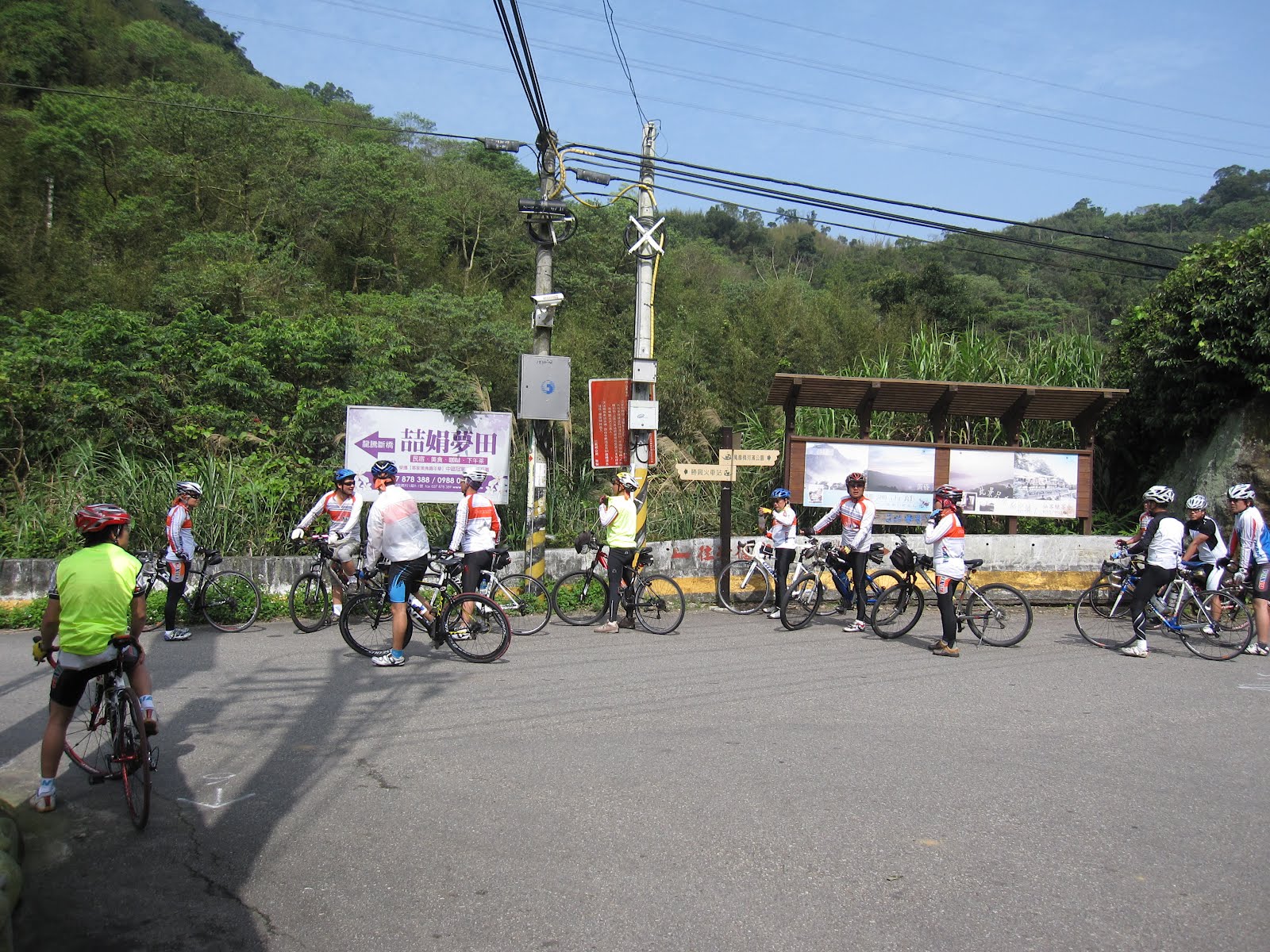

I was also pleased to see the Route 130 included as an official part of the Miaoli Bikeway.


The morning haze had burned off by mod-morning. All of a sudden it dawned on me that I hadn't brought my sunscreen.

In Taiwan, it seems we have the first "hot ride" of the year at about this point. This is when the weather transitions from winter chills to blazing heat.

The transition is hard on the body.

After a good ride is oppressive heat, the summer riding becomes much easier... but oh the getting used to it....


Here I was, stuck at the bottom of a stiff climb, the sun beating down... wearing a jacket. I hadn't eaten enough and I wasn't carrying as much water, having gotten used to sipping my supplies in the cooler weather I was expecting.


I mounted my attack on the back of the Route 130 up Guan-dao Shan. It was nice to take my time to enjoy the views going up. I usually reserve this stretch of pavement for the screaming descent it offers, but this time I was learning all about what this mountain is made of.

While the front side of Guan-dao Shan is a hot, quick spin to the top, the back side is a slow burning grind. It is much less fun than the opposite way.

I was passed by numerous riders who already knew what I was thinking and took the descent from the front rather than heaving up the side I was on.

The Climb

There were a couple riders joining me from the Sanyi side.


I came upon one old guy in coaching pants, who had managed to eat the whole climb out of the saddle on his mountain bike.

He wasn't carrying any water, but instead he had a soaked rag stuffed into a jury rigged container made from a plastic bottle.


I was soon slicing down the opposite side of the hill, pivoting on axis as the inertia made steering as easy as a little shift in weight.


By the time I got to the Highway 3, I knew I was pretty tired. So, I turned left onto the Highway 3 and went out to Dahu to continue my ride up the Route 55 on Pinglin Road.


Pinglin Rd. is another of those roads I have only ridden from Jhuolan and it seems far more forgiving coming from the southern end.


By this time my jacket was caked with the chalky white dust from the salt that had been distilled from my body, baked out by the unrelenting sun.


The part of Pinglin Rd. near Dahu has three or for good climbs that were just killing me.
I felt a cramp in my quad and eased off the bike for a stretch.

Just at that moment a yokel in a blue truck comes by and shouts out the window that I should be riding up the hill and not resting.

It was like the guy wanted to be punched in the face.

First of all, this is the first real climbing I have done since November.

Second: I had just hauled my ass up several nasty little climbs and one major hill.

Third: After losing so much to overuse injuries, the last thing I want to do is to mess my leg up again, and therefore, I take every sensation in my leg seriously.

And therein lies the big question.... How does one come back from an injury of this nature without re-injuring oneself while increasing stress on the muscles? You only know when too much is too much after the fact.


I suffered through the remaining hills with the assurance that with a steady wind from the north, it would be gravy all the way to Jhuolan. I imagined sliding out of the hills and into downtown Jhuolan with a steady wind at my back to mask my lack of conditioning.


I was sorely mistaken.

From other corroborating reports I have heard, Taiwan experienced the most inexplicable steady wind from the south... just for a couple hours yesterday about mid-day.

It made the whole route a pugilistic fight for ground and headway. What a pisser!

Pinglin Rd.

I arrived for a rest stop in Jhuolan and then headed toward Taichung. Before long, a breeze was pushing me from behind. I was charging forward in a deep tuck at 45kph toward home.

I am sure I am a better person for all of this... but it was admittedly a pretty hard day in the saddle.


Bike route 1440174 - powered by Bikemap

Tuesday, November 30, 2010

Thinking About Sheng-Shing Station (勝興車站) and the Nature of Touring Taiwan

Bike Routes Around Sheng-Shing

Yesterday, Taiwan's central government kicked off its 2011 tourism campaign in which cycling appears quite prominently as one of Taiwan's 10 major attractions.

The government has narrowed the campaign into three key ideas; 1) "Tour Taiwan 100", an obvious (and shamefully ideological) focus on the 100th anniversary of the Republic of China, which first arrived in Taiwan between 1945 and 1949. 2) Authentic Taiwan, an attempt to distill and locate Taiwan's cultural authenticity through invented symbols and meanings provided by the government. 3) Great Service in Taiwan; a plan to woo Chinese tourists with Taiwan's strange and exotic service culture.

Authentic Taiwan will promote the culture and traditions of Taiwan through four key events, one for each season: Taiwan Lantern Festival (Spring), Taiwan Cuisine Festival (Summer), Taiwan International Cycling Festival (Autumn) and the Taiwan Hot Springs and Fein Cuisine Carnival (Winter). In conjunction with these events, there will also be a number of new initiatives such as ‘Taiwan Tea Adventure’ and ‘Taiwan Night Market Competitions’ designed to promote the other aspects of culture on the island.

It appears the bicycle aspect of this campaign will focus on East Coast tourism and "Aboriginal" entertainment.

This news could not have come at a more fortuitous time for this blogger, who was just about to write a little bit about his trip through Sanyi, and specifically, Sheng Shing Station (勝興車站)with some interesting insights into this tourist attraction and others like it in Taiwan.

Route Marker

Sheng Shing Station is the site of an old Japanese Colonial era train stop along the old North-South route to Kaohsiung, which was completed by 1908.

The area is located in the foothills just above Sanyi, a town that is regarded as a Hakka town predominantly populated the descendants of Hakka speaking immigrants from the foothills of Qing era Fujian, and the descendants of Kaxabu and Taokas speaking indigenous peoples who have lived in and around the Dajia River basin and river valley for thousands of years.

Japanese Era Building?

At first glance it appears the hoards of tourists that descend on Sheng Shing Station each weekend are looking for the things many tourists around the world seek when they travel; a little escape from their hectic lives in the cities. Here they seek some type of refuge in a little idyllic rail road town full of shops pedaling "traditional" food and handicrafts. These tourists may also hope to enjoy some of the authentic "local Hakka culture", eat authentic "local" food, and see lives that are different than their own.

In Sheng-Shing visitors can walk the old cobbled streets, enjoy the aesthetic beauty of the traditional, antique buildings and really get a feeling of authenticity of what life in this little town must have been like during its heyday almost a century ago.

Romantic Getaway From City Life

At first I was fascinated at how the local people had located their cultural and historic authenticity in the Japanese Colonial period (1895-1945), which had been so reviled by the Chinese Nationalists when they arrived on Taiwan. The Chinese Nationalists spent an enormous amount of energy trying to eradicate any residual evidence of the 50 years the Japanese spent colonizing and transforming Taiwan into a model colony of the Japanese Empire. The Chinese Nationalist Party (KMT) hoped to eradicate the Japanese "taint" and replace it with the symbols and meanings of their own Chinese Nationalist colonial project.

The task would have been too great as the social and structural implications of the Japanese colonial project were just too great and too deep to destroy. It would have meant burning Taiwan to ashes. Therefore, several structures like this old station remain and communities have constructed entirely new local identities around these vestiges of life during the Japanese era.

What I found so interesting was that without the Japanese experience, these local communities like Sheng-Shing would look much different or might not exist at all. Moreover, the local residents have made the projection of their Japanese experience their raison d'etre. It is not a Chinese identity or a projection of Qing era Hakka culture. Instead, the locals have chosen to "other" themselves to exist in a different time or mythical past than the tourists. The tourist is allowed to break from achronological time and visit people and places from the "past".

At first this seems astounding that an identity from the Japanese colonial period, which has long been over, could still find salience in modern Taiwan.

Hakka Food

I then stepped back a little and considered that the locals may not necessarily fix their identity in the symbolism of the Japanese era, but instead may be responding to provide the tourists with exactly what the tourists want to see.

They have constructed a facsimile of a Japanese era railroad town with faux cobbles in the streets, imitation wood facades covering more recent concrete-box buildings, and quaint little shops or stalls to sell the things that probably never existed in the time and place being portrayed by the locals.

The locals have created a fabrication to satisfy the exotic fantasies of the visitors, who, themselves, have located and identified Shing-Sheng's authenticity in a particular time, which is the actual object of desire-- not the locals.

Sheng-Shing Station Street

I was then reminded of one of my favorite passages from Michael Taussig who examines the way indigenous/local cultures, which have become the object of desire by the West, appropriate the West's imagery and symbolism, then reflect it back like a type of video feedback:

"To become aware of the West in the eyes and handiwork of its Others, to wonder in fascination with their fascination, is to abandon border logistics and enter into the "second contact" era of the borderland where "us" and "them" lose their polarity and swim in and out of focus. This dissolution reconstellates the play of nature in mythic parts of contactual truths. Stable identity formations auto-destruct into silence, gasps of unaccountable pleasure, or cartwheeling confusion gathered into what I call "mimetic excess" spending itself into a riot of dialectical imagery"--Taussig, Mimesis and Alterity p.246

Although Taussig had a more profound contrast between West and Other, I think the basic thesis can be applied here in the dialectic between the Local and Non-Local.

In the case of Sheng-Shing Station, it is not as simple as the locals engaged in cultural production or the commoditization of identity for consumption by the visitor. Nor is it necessarily a simple case of locals industriously deploying their cultural/historical resources for economic benefit.

The locals are not providing the visitor with the facsimile of what the visitor wants, but is instead reflecting back the reflection.

The locals (or the developers behind them) have produced an image of what the locals imagine the visitor would like to see. This exercise requires the locals to imagine themselves in the eyes of the visitor and project what that image may look like, while the visitor consumes the local's image of what the local thinks the visitor would like to consume. It becomes an endless house of mirrors of unintended parody in the world of mimesis and its alter.

Despite this strange and almost ridiculous contrivance, the result gains a type of authenticity as a living local culture that could not exist without the visitor, the visited and their preconceived imagination of the other reflecting back at themselves.

Many of Taiwanese tourism destinations are built around this relationship and make it interesting to watch, and thus when the government starts pedaling "authentic" local culture, I wonder if this is what they have in mind?

Sources:
1. Taussig. Michael.1993. Mimesis and Alterity: A Particular History of the Senses. New York, NY. Routledge