body{background-attachment: fixed ! important; }

Wednesday, March 23, 2016

Taiwan Cycling Maps and Routes: Relaunch

Untitled

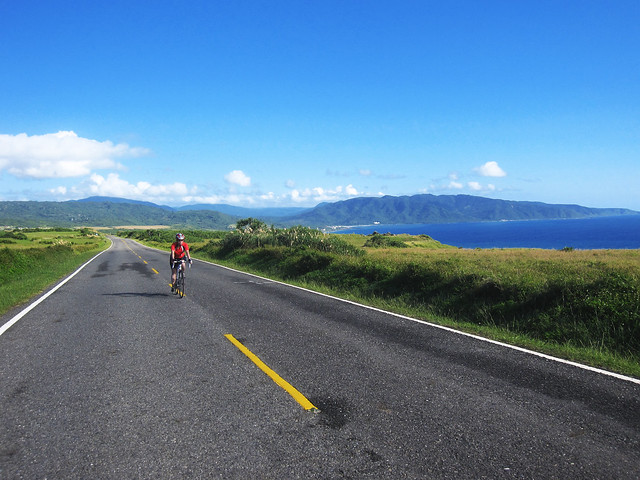
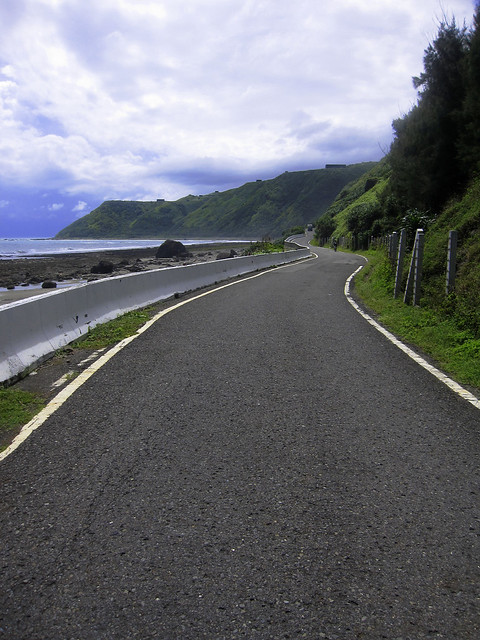
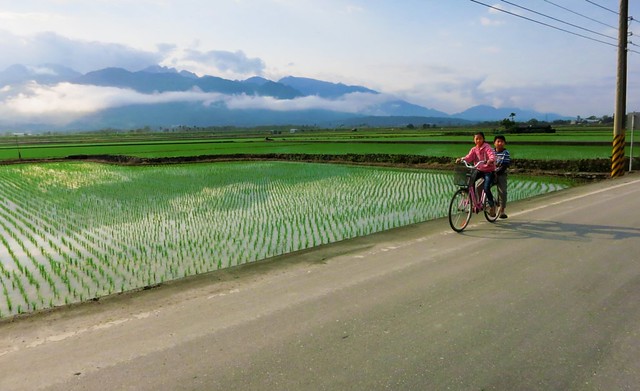
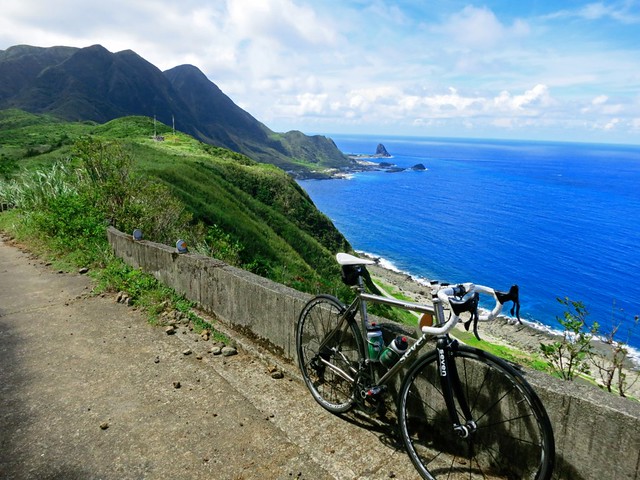
I would like to use this opportunity to relaunch my catalogue of Taiwan Cycling Routes and Maps. After a series of very unfortunate and untimely technical glitches, I have painstakingly recreated the maps I had on display.

They are now ready for your perusal.

I would like to apologise for any problems or inconveniences the missing maps may have caused.

These are not the only routes in Taiwan, but they may serve as a conversation starter.

Enjoy!

A.

Pedal Pumpers Push Pedestrians: A Clash of Cultures in a Conflicted Kingdom

Untitled
Religious Zealots in Traffic
The Taipei Times ran an editorial from the Taipei based reporter, James Baron, who brings into focus some of the problems Taipei is facing with its overlapping bicycle policies.

Baron writes: 
The effort to turn Taipei into a cycle city has borne fruit. 
The Guardian ran a piece called “Return of the Bicycle Kingdom? How pavement cycling is transforming Taipei” on Tuesday last week that focuses on the initiatives that have shot bicycle usage figures for the city way past those of New York and London. The author of the article, Nick Mead, who was in town for this year’s Velo-city Global Conference, heaped deserved praise on the YouBike system and the riverside cycling paths. 
He also referenced a threefold increase in cycle lanes within three years, though the caveat that this extra space would be on the sidewalk and, thus, taken from pedestrians was telling. Another interesting figure was the 386.24km of sidewalk that is now apparently open in its entirety to cyclists.
I also wrote some about this article Here and Here. But I don't get up to Taipei enough to see the daily interaction between bicycles, motor vehicles and pedestrians. The Guardian article seemed a bit fanciful, and not the Taipei I have encountered. But I gave the writer the benefit of the doubt is writing honestly about his experiences. I also imagined that maybe it is worse off where he hails from, making Taipei look like a city park. 

One paragraph that struck me about the article was this gem:


“We want to be a cycle-friendly city, but we’re not trying to be like Amsterdam or Copenhagen,” Anne Chung, transport commissioner for Taipei, tells me on the sidelines of the VeloCity global cycling conference, which is taking place in Asia for the first time. “There are too many scooters and motorbikes at the moment and it is too dangerous to ride on the road with them, so the pavement is safer for cyclists. We want people to make cycling part of their lives and be able to combine cycling with the metro and buses for the ‘last mile’ of their journeys. We want to be able to tell car and motorbike users that there is a smarter way to get around.”
But upon further investigation Baron uncovered a different story. This struck me as a bit strange, considering the occasions public officials have sought to tour the Netherlands and Copenhagen looking for inspiration for Taiwan's future development.

Possibly, one of the biggest problems may be in how the central and local governments have not been able to decide where cycling belongs. It becomes and ideological problem. Digging way back in the TiC archives I found this piece that really captures the root of the problem.

"Although the MOTC is moving to take the lead for national biking policy, projects to develop local bike paths continue to be financed by the Ministry of the Interior’s Construction and Planning Agency (CPA) and the Cabinet-level Sports Affairs Council (SAC). According to a construction plan by the SAC, a budget of NT$4 billion (US$125 million) will be devoted to the development of an integrated network of biking paths around Taiwan from 2009 to 2012, continuing similar efforts started by the council in the early 2000s for sport and recreational purposes." 
You can see by the alphabet soup above, how bureaucratic divisions, budget rivalries and lack of cross-agency communication can impede the process of integrating cycling into the transportation grid. To expand on the paragraph above, it is obvious that cycling in Taiwanese officialdom is neither transportation nor a sport.
The bicycle has no place to go, because bureaucrats have not been able to envision where to put it. Many see the bicycle as a piece of leisure sporting equipment-- a cash generating toy-- that is fun for non-cyclists to play with on weekend jaunts past cafes, kitsch markets, souvenir shops, and restaurants. Others see the bicycle as transportation and integral to reducing congestion in the cities. 

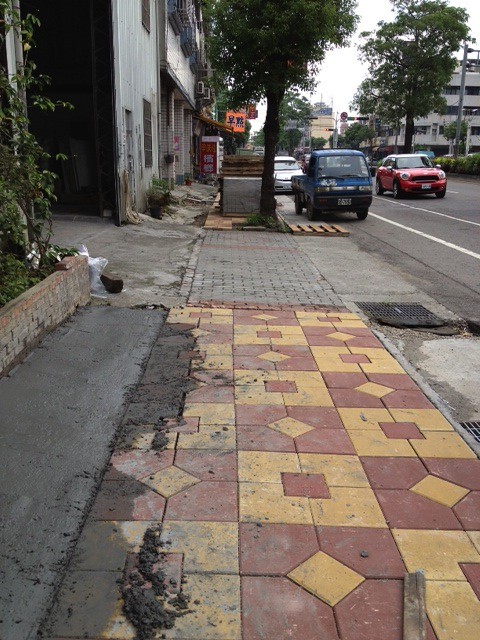
By relegating the bicycle to the sidewalk, the city is sending the message that the bicycle is not regarded as transportation.This is a policy and an outlook that needs to be reversed for Taipei and other cities to really begin making progress. They need to provide road space for bikes and treat the bicycle as an important cog in the transportation grid rather than a mere toy.      

Wednesday, March 16, 2016

YouBike You Know: The Guardian Promotes Taipei YouBike Program

Untitled
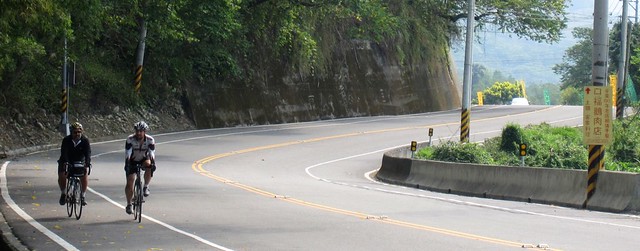
Taxpayer Funded Bike Path in Daya Township, Taichung City


The Guardian has a couple (HERE and HERE)of successive pieces to promote the YouBike system. I think the YouBike system and Taipei bicycle lanes are becoming what they should have been when they started when the planning went into effect almost ten years ago. Both Mayor Ma and Mayor Hau approached cycling in Taipei from the perspective of bicycles as toys or sports equipment. They both emphasized the business oriented approach to cycling, where leisure cycling can cater to rental businesses, cafes, tourism and entertainment: a very bourgeoise view of one of the most transformative inventions in human history with the beneficiaries being the business and the entrepreneur. They tried to pump up interest in recreation cycling through the promotion of leisure bike paths outside the city; a movie to stimulate domestic bicycle sales. After unleashing thousands of rental bikes into a city without any space for them, the report from Jennings sums up the problem.

“We’re now making plans for education and promotion work,” said Liu Chia-yu, a division chief under the city’s transportation department. “For bike riders, we’re saying not to compete with pedestrians, and for people on foot, if you run into a bike give it some space.”    
Thousands of riders have hit the roads and they are only now making plans to educate for safety.

Mayor Ko, on the other hand, has had the political will to take on the city infrastructure with a tenacity bordering on arrogance. He wants the city a certain way and he is going to try to do it. A grid of bike lanes and actual cycling space is really what nobody had wanted to address in the past. I hope other cities will follow suit. 

Sadly, a lot of time and money was wasted catering to special interests.


Sunday, March 13, 2016

Taiwan's Round Island Trip: The Cultural Zeitgeist of Circling Taiwan's Center

IMG_3808.JPG
Jhuolan: Highway 3   


Many cyclists who live in Taiwan or come to Taiwan to visit, at some point or another, get the idea to bike around Taiwan. Locals call it the 環島 (huan dao) trip, and it has become an indelible part of local Taiwanese culture, often as a rite of passage or personal challenge. Although the idea of biking around Taiwan is nothing new, the huan-dao experience really gained traction following the release of the 2006 sleeper hit, Island Etude. Inspired by a true story, the plot is driven by a young man who, along with his acoustic guitar which he incredibly straps to his back, attempt to circumnavigate Taiwan by bicycle and in the process encounter a variety of people, their lives and ideas. The movie found salience in Taiwan at a time when the culmination of pro localization policies that had begun under president Lee Teng-hui, and continued under his successor, Chen Shui-bian, had reached their nadir before 2008 ushered in the reactionary policies of Ma Ying-jiu-- policies that hoped to both reign in Taiwan's 本土化, or localization movement, and reframe Taiwanese culture into a greater Chinese context. Island Etude did not serve to instil in Taiwanesea sense of a unique and separate Taiwanese culture, but rather, it found salience-- especially with younger Taiwanese-- in its ability to provide a visual representation of an identity that has been regularly challenged and denied by Chinese nationalists on both sides of the strait who have chalked up the Taiwanese identity to the fortunes of political actors and their ethnic politics rather than an expression of popular sentiments. Island Etude served as a very powerful symbol as circling Taiwan sketched a defined border as both a loving embrace and as a defensive shield that is understood by those within as belonging to a collective "we/us" vs. an undefined them. Within the closed loop of Island Etude's huan-dao trip, the film deals with overlapping ideas of identity, culture, environmentalism, cosmopolitanism, localism and ethnicity within the meaningful symbolism of Taiwanese cultural life.

Over the next eight years, the Ma administration would attempt to both promote Taiwan's huan-dao trip with the creation of Taiwan's first official round-island bicycle route, while attempting to obscure and reframe Taiwanese culture as a mere subgroup of a glorious Chineseness.

The power of Island Etude can be indirectly felt in the firm rebuke of Ma Ying-jiu'diminutizing cultural policies, and in the rise of several social movements, many of which were led and organized by Taiwan's younger generation-- movements which are loosely united through a shared sense of a Taiwan-centered identity and the feeling that the policies enacted by the Ma administration were antithetical to the goals of protecting Taiwan's security, environment, economy, culture and, most important,Taiwan's precious democracy. It was the generation of the Sunflower Movement that really made the huan-dao into the cultural phenomenon it is today, as it is the generation that has has filled the act with meaningful symbolism that weaves together identity, social action and the imagination of what Taiwan is and what it can be. 

---------------------------------------------------------------------------------------------------
In the spirit of Island Etude's 10th anniversary, I would like to present my own huan-dao 環島 route for those looking to also embrace Taiwan and learn the contours of land through the physicality of cycling.

There are so many options and so many roads. There are so many things to see and do. 

This route is a winter route running counter-clockwise assuming the rider will be arriving at the Taoyuan, Taiwan International Airport for a couple weeks of cycling without camping equipment.

I would advise the rider to be in good physical shape and have gearing for climbs. 

I'll start this route in Sanhsia 三峽 as it is near the end of the Blue-Line of the MRT and close to the airport.

Untitled
Highway 7 (Northern Cross Island Highway)

Untitled
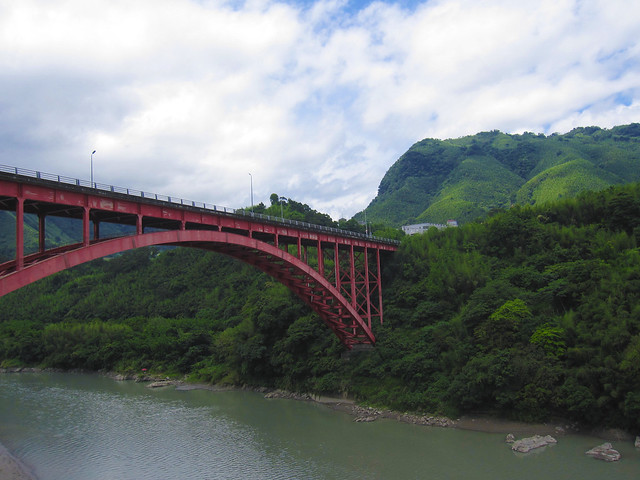
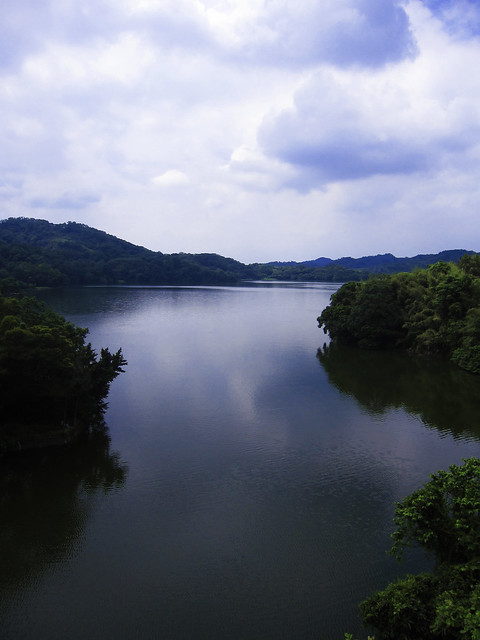
Mingde Reservoir: Miaoli Route 126

Untitled
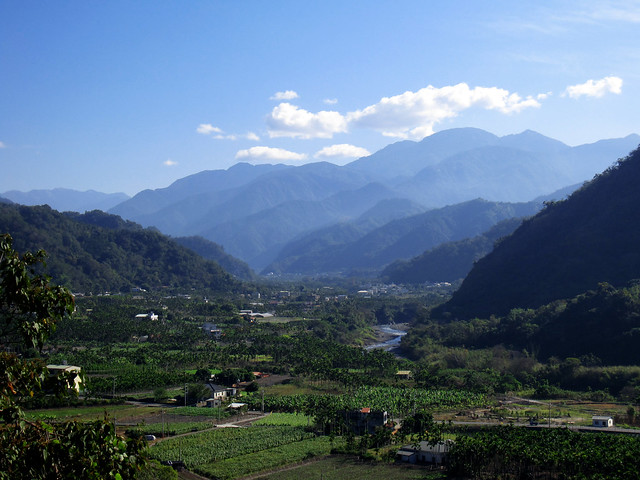
Guoxing Township: Highway 21

Wujie
Wujie, Nantou: Route 83

Untitled
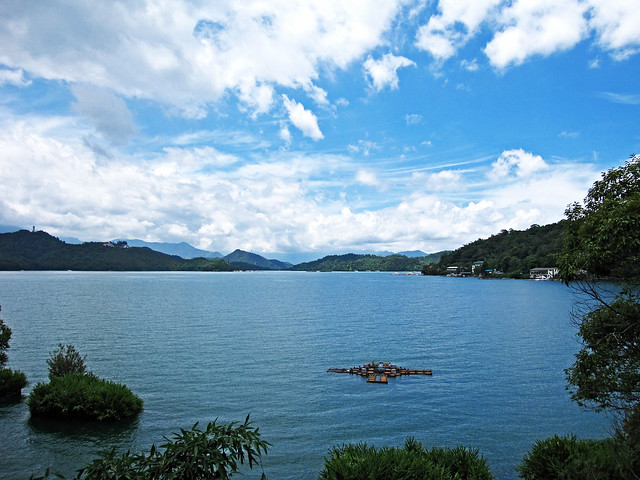
Sun Moon Lake: Route 21

  Untitled
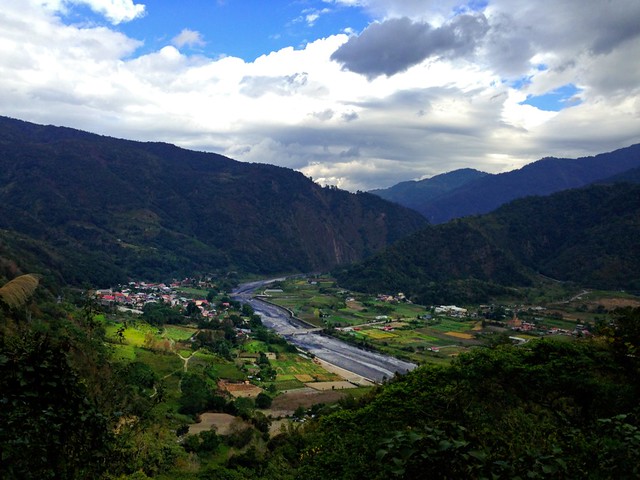
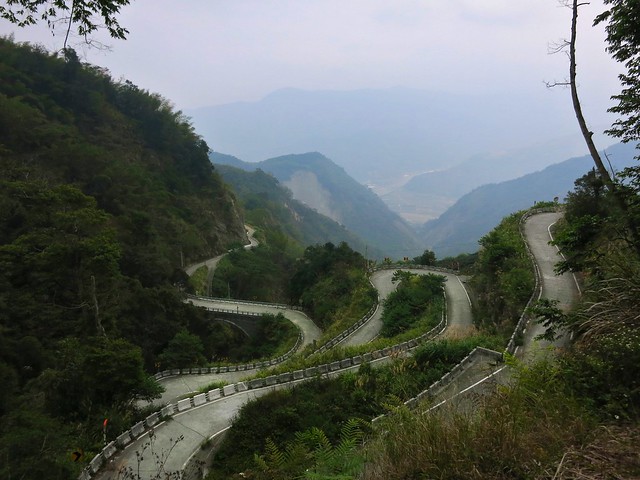
Renai Township: Nantou, Route 56

Untitled
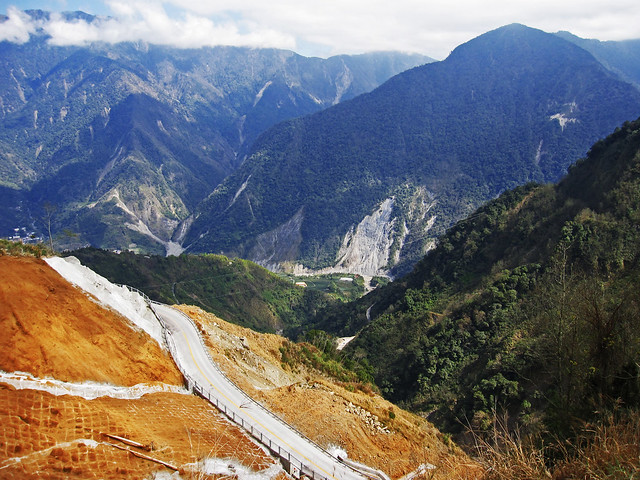
Tataka (Tatajia), Alishan: Highway 21

IMG_4774
Highway 27, Kaohsiung

Untitled
Kenting: Route 26

Untitled
Manzhou Township: Highway 26

IMG_3566
Zhuofu Industrial Rd., Fuli, Taidong County.
Seven Cycles Axiom SL: Biking Lanyu
Lanyu

IMG_0597   
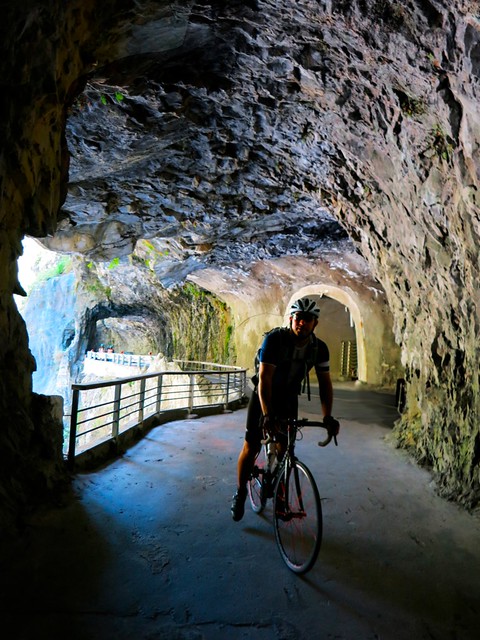
Taroko Gorge: Highway 8, Hualien


Untitled      
Iilan: Highway 9


Route 3,435,248 - powered by www.bikemap.net

Saturday, March 12, 2016

Paved With Good Intentions: More Trouble for Taipei Bicycle Lanes


According to this report from SETN.com, Taipei has taken two steps forward and one step back in implementing a grid of bicycle lanes throughout the city.

The project, which was initiated by Mayor Ko Wen-je, an avid cyclist and former bike commuter, sought to better incorporate the bicycle into the urban transportation network. One major problem with Taipei's YouBike program-- a system of bike rentals through the city-- is that there are realistically few dedicated places to ride. Cyclists and bicycle commuters have had to fight both traffic and pedestrians in their battle for space in Taipei.

Of all the plans proposed thus far, Mayor Ko seems to have the right idea. But as a fortune cookie warned me a long time ago, "The road to hell is paved wit good intentions." (True story...and it was then that I realized that all fortune cookies were not positively ambiguous.)

It now seems that after spending NT180 million, the contractors responsible for the bike lane construction had precious little experience in actually designing bike lanes, resulting in some potentially hazardous, expensive and avoidable boo boos.

According to the Chinese language report, the city contractors used thick construction grade paint for path markings. The paint is a known hazard to cyclists as it produces an extremely slick surface in wet weather. The contractors also used porous asphalt and left metal utility covers exposed and with wide gaps. All of which pose a potential danger to cyclists and have been designed out of existing networks in Japan and other countries.

Here's to hoping Taipei gets its bike lanes squared away to be held up as an example for the rest of Taiwan to follow.   

Friday, March 11, 2016

Bullish or Bullsh*t: Is More Uncertainty Ahead for Taiwan's Bicycle Makers?

Untitled
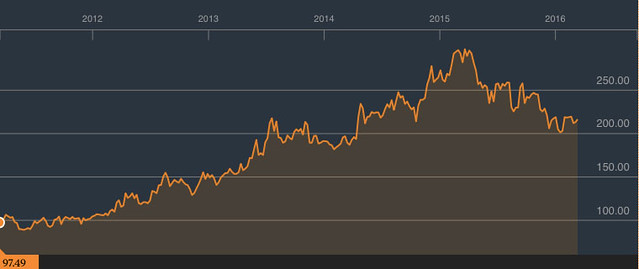
Giant Stock Price--Bloomberg

Every year the opening of the Taipei Cycle trade exhibition begins with an optimistic litany of industry figures and projections that seem to forecast sunny and clear with blue skies over the bicycle industry. This year we were treated to more of the same.

The latest statistics released by the Taiwan Bicycle Association (TBA) show that Taiwan’s bicycle export increased by 10.04% in 2015. Total export value reached 1.74 billion euro, compared to 1.58 billion euro in 2014. Also Taiwan’s bicycle parts export rose last year by 5.45%, with total value reaching just over 1 billion euro.

Despite the boilerplate assurances that the show was lights-out from the perspective of the exhibitors,  in private, and by proxy, there seemed to be more than just a general concern for the state of the entire industry in the short and medium term depending upon a company's position along the food chain from OEM/ODM, supply chain, subcontractor, brand, distributor and retailer. Even as TBA Chairman, Tony Lo, issued his report stylized as the industry's Auda Abu Tayi, from Lawrence of Arabia, declaring himself to be " a river to my people", there was an overall echo of anxiety in the relative quiet of the Nangang exhibition hall last week that did not resound with such confidence.

The greatest concern was the fact that the high-end bicycle market, which enjoys some of the highest profit margins, has been affected by multiple factors, including a sluggish European and American markets resulting in higher than normal inventory, aberrant weather patterns in the northern hemisphere, falling oil prices, the failure of the Chinese market to materialize as predicted due to unsustainable economic growth and oppressive air pollution.

Bike Europe reports
The market for Taiwanese bicycles in China declined by 33% to 79,000 units. Though not yet that big, the Chinese market was seen as a main growth market for several years. That development has come to a full stop thanks to the economic decline in China. 
The US is still the biggest single market for Taiwan made bicycles with 570,000 units between January and September this year, an increase of 26.3%. Export to the UK surged by 26.8% to 552,000 units and to the Netherlands by 17.3% to 316,000 bicycles. 
Next to bicycles, also total bicycle components export expanded by 7.01% reaching a value of 723 million euro.
Remember, the ECFA agreement was supposed to increase exports to China, and bicycles were part of the "early harvest" products upon the implementation of ECFA

Shimano, the groupset and component manufacturer that supplies components across several retail segments echoes this sentiment and has issued a cautious projection for 2016.
Shimano is taking a very careful position for 2016 and expects a decrease of its net sales (-7.6%) as well as an its net income (-23.9%). This will be the result of the strategy to bring forward the production scheduled for the first half of the fiscal year 2016 to the second half of 2015. Though the moderate growth of the European economies is expected to continue Shimano also expresses its concern over the possibility that the influx of refugees and the slowdown of the Chinese economy may lead to deterioration of the economic sentiment in Europe.
Despite all the bullish talk, Giant, Taiwan's largest bicycle manufacturer, has seen its stock price drop over 25% over the past year and the Financial Times forecasts advises investors to either hold or expect the stock to under perform.  

Another concern from some vendors was the increasing shift of Chinese companies competing for more of the high-end bicycle market. 

Many Taiwanese subcontractors and links in the supply chain have their start in the small to medium sized enterprises (SME) that served as the engines of the Taiwan economic miracle during the second half of the 20th century. Many of these companies were founded as joint family ventures where a day's work meant a seat at the dinner table. These companies thrived on the networks of personal relationships and upon the backs of brothers, sisters, aunts, uncles and children. 

Although the SMEs rapidly grew, many of them are still running on the narrowest of margins where the salaries are nowhere near competitive in the global workforce. It is no secret that Chinese headhunters are keen to exploit this weakness to woo knowledgeable employees into the service of China's competing enterprises. This is true in all of the sectors Taiwan has held the advantage of technical experience.

So, what will come of it?

For a few years we have seen bicycle events, a bicycle festival and the integration of the bike into tourism and city transportation. The idealist in me would like to think that good people want to make the wold a better place and simply want to promote cycling as a way to end our reliance on fossil fuels and save the planet.The pessimist in me knows that all of these events and programs are, at their cynical best, part of a greater plan to help sell more bicycles for the purpose of rewarding shareholders and satisfy a board of directors and make them rich.

Bike-Europe:
“We see a significant increase in the number of people and countries where people start cycling for sports, leisure and to commute,” said TBA chairman and Giant Global Group CEO Anthony Lo at the presentation of the industry sales statistics. “The average unit price of Taiwan made bicycles went down only slightly by 0.8% to 411 euro. The average export price for MTBs is now 618 euro and for road race 628 euro." 
Anthony Lo pointed out the importance of the cycling experience to get more people cycling. 
But I really think we have already seen the first, best, adjustment to drive sales with last year being the year of the disc brake. 

Disc brakes were actually quite a brilliant first step in trying to drive industry sales, and may prove to be far more effective that earlier attempts of a solution in search of a problem as we saw with the bottom bracket wars a few years ago. Disc brakes represent a radical change in form factor that currently requires the indispensable reengineering of almost every part of the bicycle to accommodate disc technology. Disc brakes require reinforced frames and forks with disc mounts. They require reinforced rims and wider hubs. They require groupsets to be redesigned for integrated hydraulic fluid units. They require the buyer to start anew and leave "yesterday's tech" behind. For someone with years of accumulated components and wheels, this is no small investment. 

The second initiative to reinvigorate sales has just gotten underway and I am pretty sure we'll be seeing a lot more of it-- Direct Online Sales. 

In the past, cheap brands like Motobecane were making gentle waves by selling bicycles online directly to the consumer without the typical retail markup. 

Then along came the German brand, Canyon, to completely upset the apple cart for the digital age by efficiently selling high-end racing bicycles exclusively through online sales. 

This approach drastically reduced overhead costs and served as a means to control the consumer's experience in an environment that is free from the typical competition in a standard retail store. 

Canyon has been going gangbusters in Europe, and now the big boys want to muscle in on the action by doing the same. 

First, Trek announced plans to sell online-direct to the consumer through its network of retail stores. Now Giant has entered the arena and the fight looks like it will only continue to get uglier with companies scrambling to offer similar services within a narrow time frame or risk being undercut by whoever gets there first.

Of course, the online-direct scheme throws decades of carefully groomed relationships between manufacturers, brands, distributors and retailers into chaos and the casualties are sure to mount, especially for the smaller brands that do not have the corporate backing to offer either a similar service, or a similar price point. Another casualty may be the choice a consumer has for components as each company will corral online customers into their own house brands as opposed to leaving it to the whim of the consumer. Lastly, it will be interesting to see how much of an effect this has on cycling culture as it is bound to change the traditional purpose of the bike shop. 

Lastly, the bicycle is going home. To better compete within the lucrative EU market, Taiwanese OEMs, assemblers and finishing houses are looking to move assembly to Europe in a move that will satisfy EU requirements for status as a domestic product. The Taichung based Fritz Jou Manufacturing (a loose term) just recently declared plans to move some "production" to Portugal. 
“We are joining Bike Valley Portugal as this is the ultimate project where the industry can take control over the supply chain again,” says President Fritz Jou of Fritz Jou Manufacturing. “In the past decades I have seen many production shifts based on GSP+, anti-dumping duties, and other tax incentives. These aspects are difficult to control by the industry. In the Bike Valley project we can finally produce where the market is, reduce the time to market and improve our flexibility. That is our ultimate goal.”
In short, it looks like there will be changes afoot in the coming years and Taiwanese companies had better be prepared for change.        


Tuesday, March 8, 2016

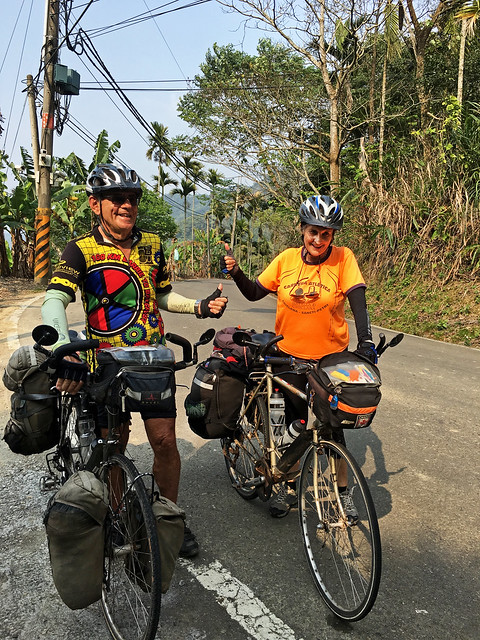
Cycling Seniors Setting Off For Sun Moon Lake: A Warm Formosan Welcome for Andrew and Alison

Untitled

About four years ago I was contacted through this blog regarding a proposed bike trip around Taiwan. This is not too unusual. I often field questions and provide advice to would-be travellers to help them better plan a trip around Taiwan. Personally, I enjoy the process of collaboration and, as a long time resident, I also share a sense of deep pride in my home and its potential for cycling. I would hate for someone to leave Taiwan feeling disappointed or underwhelmed. I know how much I enjoy cycling Taiwan and I want visitors to feel the same sense of excitement. I think of it, in some measure, as soft diplomacy. Moreover, I really enjoy meeting great new people.

More times than I can count, I have spent hours in correspondence and plotting routes for strangers to make their cycling trip a bit more than simply following the largest and ugliest highways around Taiwan. And more times than I can count, I never hear any more from the people again.

It is in this light that I was pleased to see a message in my Inbox from Andrew Jacob of Toronto as he was ready to resume his plan to cycle Taiwan with his lovely lady, Ms. Alison Cohen. They also hoped to meet me on their way through Taichung.

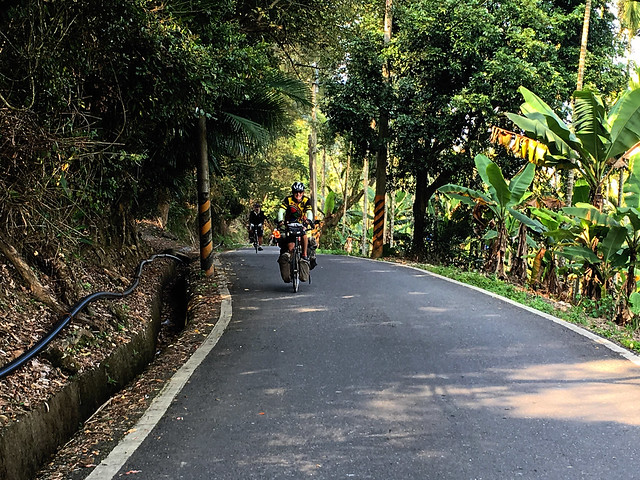
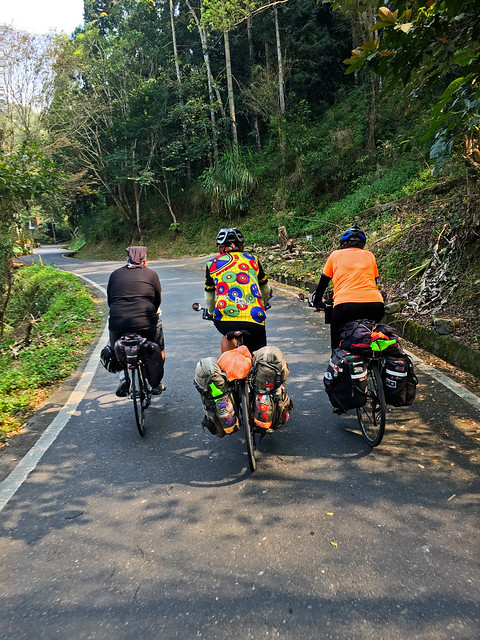
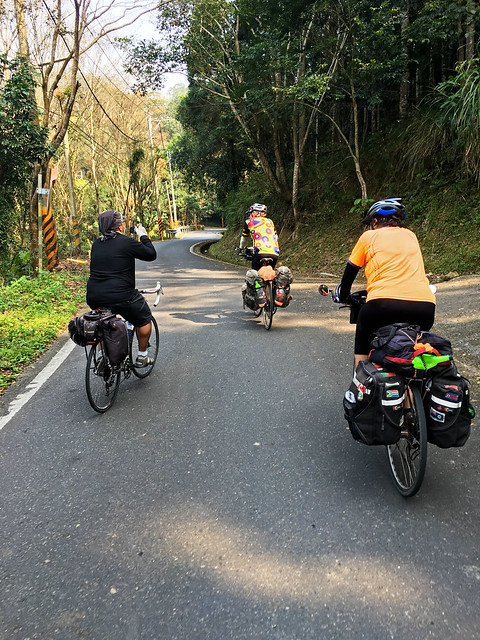
We decided to make a day of it, so I was joined by Michael Turton from The View From Taiwan in guiding these two wonderful people to Sun Moon Lake.

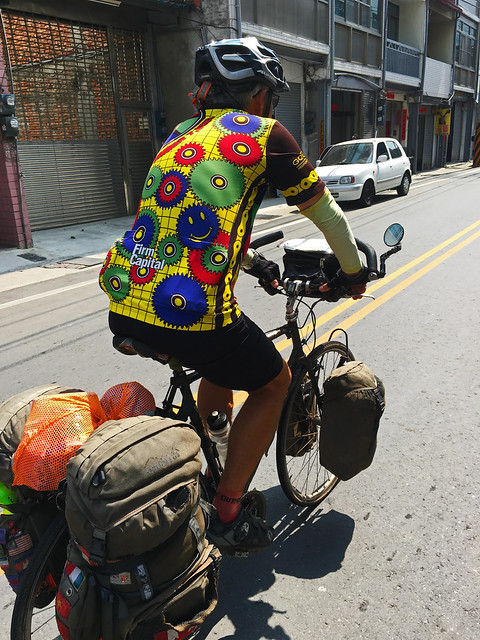
While looks may be deceiving, Andrew is over seventy and Alison must be about thirty-five... *wink
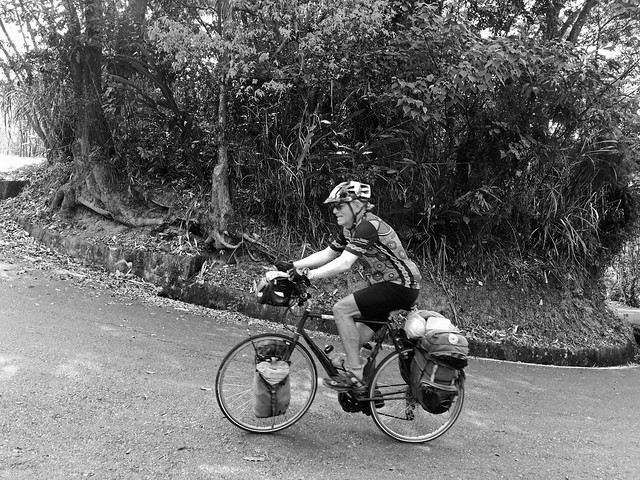
They were hauling between 15-17kg a piece and were ready to plod their way through the foothills of central Taiwan.

Untitled

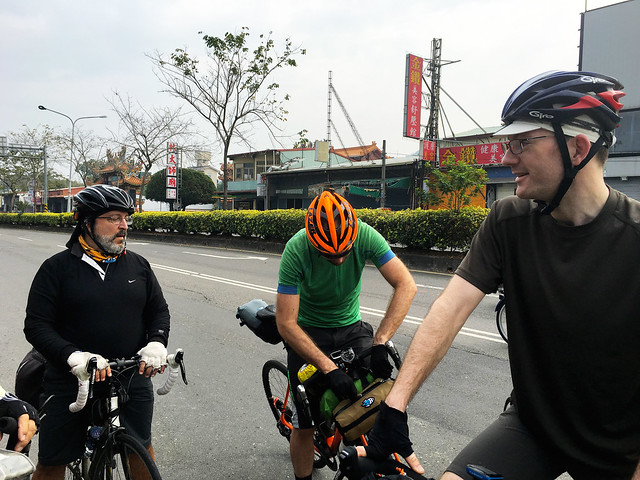
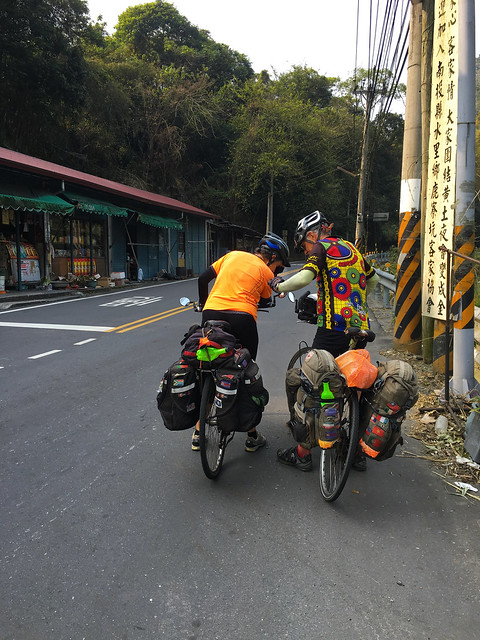
We hit the Highway 3, which wasn't my first choice, but the easiest choice for tolling up to the lake. On our way we ran into a couple industry guys fleeing from Taipei Cycle to circle Taiwan in just a few days.
Untitled

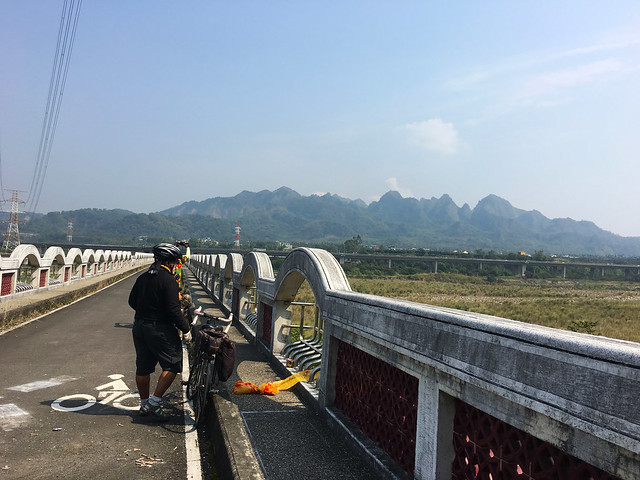
After enduring the buzzsaw of scooter racing on the Highway 14, we eased off onto the Nantou Route 6 in a pleasant respite from a major arterial.
Untitled

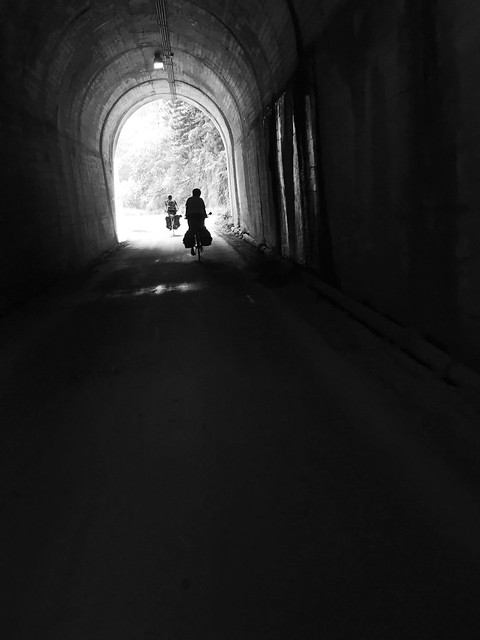
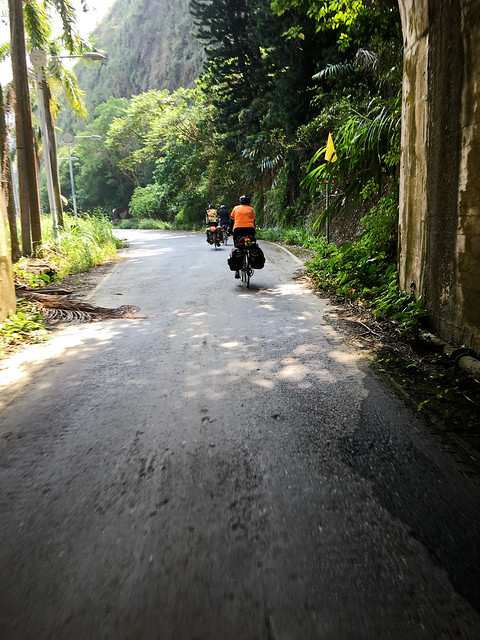
The Nantou Route 6 is relatively smooth with a couple of old tunnels that once served regular traffic into the Puli Basin.
Untitled Untitled

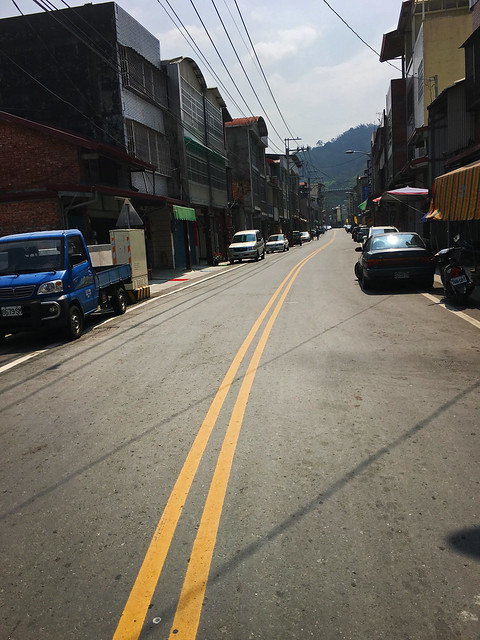
Strawberries are still in season, so we stopped for a sample at a roadside stall.
Untitled

The plan was to take the Route 147 to the Route 131 and then up toward the lake. After a pitstop for lunch, we were on our way.
Untitled

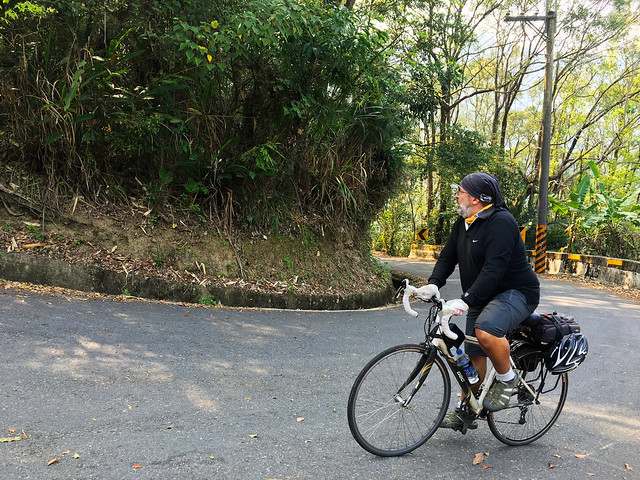
Andrew and Alison rolled steadily along and we pretended not to see the occasional *non-hill.

Untitled Untitled

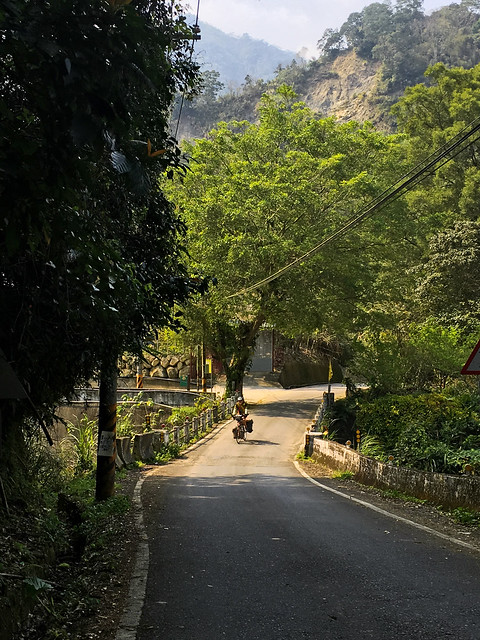
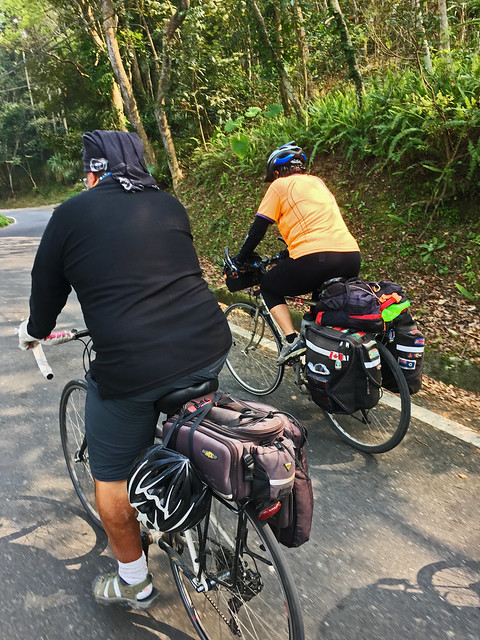
The Route 147 is a quiet, shady lane that cuts behind Jiufen Er Shan and really only has one significant climb.
Untitled Untitled Untitled Untitled

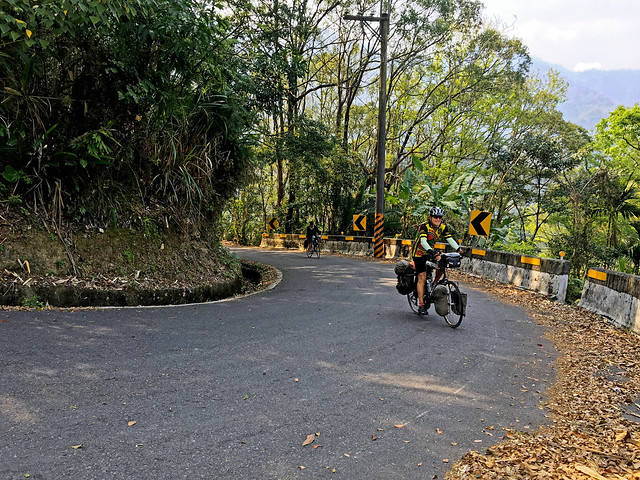
We eventually hit the final ramp and pushed our way to the top.
Untitled Untitled

After blasting downward through hillside farms beneath tall trees and betel palms, we had landed on the 131.
Untitled

An enjoyable day of cycling doesn't have to have the highest climbs, longest distances, quad-busting speeds, or pad your Strava numbers.

A great day of cycling is often one that is punctuated with chatter, stories, thoughts and laughter. This was one of those spectacular rides on a roads that linked between people as well as places on the map.

In a little postscript to our ride. Andrew wrote to tell me of their experiences with Taiwanese hospitality and having complete strangers come out of the blue to offer them fresh fruit and lodging.

So if you happen to see Andrew and Alison out on the road, be sure to wave and even see if you can join them for a few kilometers. You won't regret it.
Untitled

Andrew's Adventure Blog: http://rollingbicycletours.blogspot.tw

Michael's Post on our day: Here