body{background-attachment: fixed ! important; }

Monday, December 5, 2011

Problems Over-Developing A Bicycle Paradise

Map of New Development in the Rift Valley

A couple pieces have caught my eye over at The View From Taiwan, and I thought I could weave cycling into the discussion.

Two articles in particular stand out. The first involves the rapidly expanding development of Taiwan's East Coast. And the other highlights recent criticism of a bill that would critically impinge on the rights of Taiwan's First Peoples.

Michael does such an excellent job with many of the details, so I will simply expand upon the ideas here to better demonstrate how these initiatives impact and will be impacted by cycling and bicycle tourism.

Much of the hoopla surrounding the recent Taiwan Cup and Taiwan's International Bike Festival involved showcasing Taiwan as a cyclist's paradise. Although we each have our own idea of what cycling paradise entails, the thrust of the Taiwan Tourism Bureau's presentation revolved around the amenities and activities specifically constructed to cater to the bicycle tourist. Many of the projects put on display were the result of a tourism building boom that had given the Ma administration plenty to crow about, and moreover, these projects have provided construction and development companies a fertile playground to capitalize on the deliberate transformation of Taiwan from a leader in technology and industry into a tourist Mecca.

Although I support expanding rider support all over Taiwan, the country's penchant for unchecked development, illegal construction, kickbacks , payoffs and creative zoning threatens to not only discourage visitors who are looking to enjoy Taiwan's rugged wildernesses, but it also threatens the collective rights of Taiwan's indigenous inhabitants, many of whom own the lands along the Rift Valley between Hualien and Taidong.

Amis representative Konon Panay (古孟巴奈) said the central government did not define and grant Aboriginal lands, but it has been depriving Aborigines of their lands in the name of development.
Under the government of the Republic of China (ROC), the often correlative concepts of "development" and "eco-tourism" can be viewed as demonstrative of Taiwan's problematic postcoloniality.

When the Republic of China (ROC) arrived on Taiwan in 1945, the government instituted a program which located Taiwan's Hakka, Hoklo, Pingpu* and Aboriginal communities as "backward" in need of the modernity the ROC claimed to possess. The authoritarian government of the ROC used development programs in an attempt to "modernize" and transform the people of Taiwan into something subjectively better and "improved". Non-Taiwanese were located closest to the civilizing center and Aborigines at the furthest points.

In many ways the ROC scheme reflected pre-existing beliefs of Qing era transformationalism, or the belief that "savages" could be improved if they could learn to act like "humans", as well as the social darwinism that was popular with Sun Yat-sen and his cohorts. Taiwan's Aborigines were believed to be a degraded people who could be improved through the ROC civilizing program.

Many Aborigines were asked to move from traditional villages into "modern" concrete houses. Not only was the move away from traditional homes an attempt to modernize them, but the act can be viewed through the Confucianist lens as an act of taming; of transporting indigenous people through time to near the present and away from the "wilderness", which has been traditionally viewed by Han people as both savage and degraded. Even during the Qing colonial era, farmers along Taiwan's western plain were implored by official decree to "tame/open the wasteland" through farming. These believes reflect the deep connection between traditional Confucian views and official ROC ideology. Emma Teng's book Taiwan's Imagined Geography provides a great read on how these beliefs manifest themselves in official writing on Taiwan's indigenous peoples.

I think these beliefs can be seen from 2008, when Taiwan's current president and Chinese Nationalist standard bearer Ma Ying-jiu addressed a group of Aborigines.

Ma was quoted as saying:
"I see you as humans and as citizens of this city. I'm going to educate you well and do a good job of providing you with opportunities. That's the place from which the attitude of aborigines needs to be adjusted...now that you've come here, you need to play by the rules here..."
The pejorative distance between city and country, savage and non-savage, degraded and elevated are on full display with Ma clearly envisioning himself in the position of the civilizer.

The moves for development groups to go in and develop the indigenous lands along the Rift Valley while stripping or weakening the rights of indigenes to manage their own development creates a system of patronage, where the indigenous peoples must rely on the development groups and their political benefactors for economic support. Many of Taiwan's development schemes are not only owned by outside investors, but often many of the only jobs created are in service or entertainment where indigenous people are requited to perform quasi-traditional performances for the pleasure of tourists thus becoming the exotic object of desire on their own ancestral land while most of the profits go elsewhere. I recall "Aboriginal dancing" being one of the "highlights" promoted to visiting journalists for the Taiwan International Bike Festival.

The prospect of cycling tourism has become one of the driving forces behind much of this development; development that is neither sustainable, tenable, ethical or just.

For these reasons I would recommend cyclists ask for cycling development in Taiwan with a lighter touch to best enjoy Taiwan. I hope those people who arrive in Taiwan on a government paid junket or for cycling tourism can covey the belief that often less is more and we care about more than simply bike trails or hot springs. We care about the entire cycling environment including how the land was acquired and how much local involvement goes into planning cycling infrastructure. For now many of the decisions on bicycle infrastructure and development are made by politicians, developers and their corporate backers.

* Pingpu existed under the Japanese, but were incorporated into Hakka and Hoklo groups under the ROC by 1953.

ADDED:
Food For Thought: Two thoughtful articles about tourism from Ryan at Savage Minds. Article 1 and Article 2

Sunday, December 4, 2011

Steeling Away On A Light Tourer: Some Great Steel Bikes For Touring Taiwan


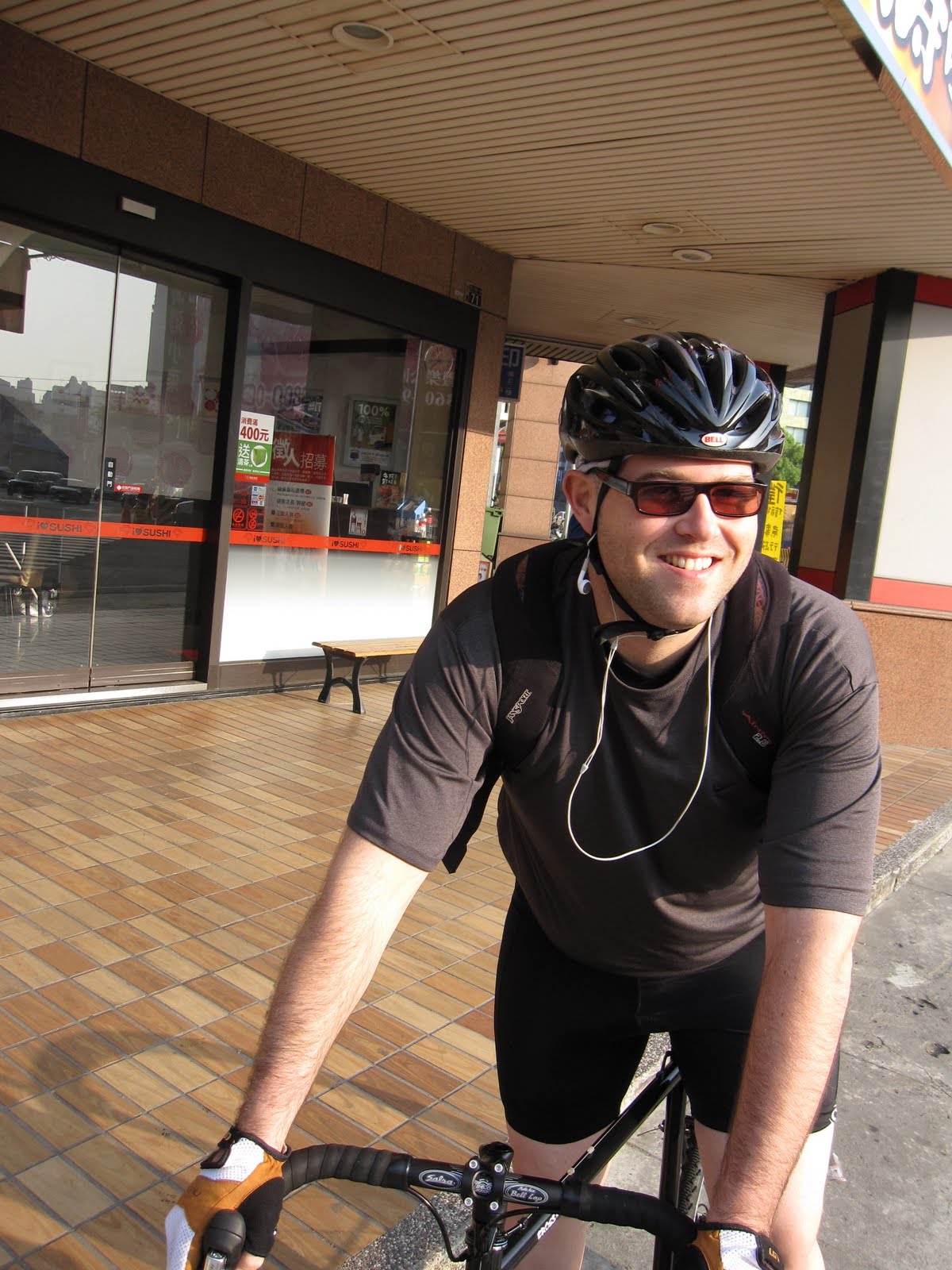
This weekend Chris B (pictured below) toured around on his brand new Surly Cross Check. The Cross Check is one of my most recommended bikes when riders or prospective riders email me to find out what kind of bike they should ride in Taiwan for a little of this and a little of that.

Although carbon fiber race bikes are all the rage, the aggressive geometry and lack of expansion is really limiting to most riders who are not interested in racing.

A better choice for a multipurpose bike for Taiwan's roads is the Cross Check or other similar bikes. Unfortunately, the margins on steel are lower than carbon or aluminum, and thus the big retailer/manufacturers really don't want to put their customers on a great steel bike, and would rather offer race bikes or flatbar aluminum XC bikes.

The Surly Cross Check is technically a bike designed for cyclocross racing, but its designers understand that racers are in the minority and keep the design to the loosest affiliation with the muddy sport.

What the engineers have done a great job of, is isolating the aspects of cyclocross racing that enter our daily lives, and concentrated on putting those qualities into a frame that can be the jack-of-all-trades.

The Cross Check can be a commuter, a light tourer, cyclocross racer, drop-bar, flat-bar, city, country beast of burden.... You can beat it all to hell and the 4130 CroMo steel frame will buck up and take the abuse.

Chris was looking for a bike to do it all from a loaded commuter to weekend recreation... from sunny day touring to muddy day single track.

Also, Chris is a really big guy.


The frame is 4130 CroMo steel. It is not a featherlight bike and comes in at about 5lbs heaver than my titanium Seven. Still, it is better to take the weight off the ass, than pay out the ass for just a few grams. As a non professional racer Chris could care less.

The steel frame with long chainstays gives a stable, supple ride to take the bite out of the asphalt. The bike is a bit of a truck, but it can easily crank up to speed. I found the handling to be very stable and forgiving. You can look away to chat with friends without worrying about rocketing into a ditch.

The relaxed geometry suits Chris very well. He has some weight to lose and it puts less pull on his lower back to stay in position. He can also be more upright to enjoy the views or keep an eye on traffic and not just the wheel in front of him.


The Cross Check, like other cyclocross or touring bikes, comes with cantilever brakes to accommodate fatter tires (up to 45mm), which means Chris can switch out tires from skinny road slicks for asphalt, to fat, knobbies for the dirt. The Cross Check comes with Ritchey Speedmax tires that are ok for the road, but wear out after a couple months. They stick well on hardpack or sandy roadways.


One downside about the cantilever brakes is that they don't have the stopping power of a good set of discs or caliper brakes. A change to Swiss Stop or Kool Stop pads will get them a bit closer.


The cable routing along the top of the top tube allows for shouldering the bike up stairs or over obstacles. When I was riding my old Salsa around Taiwan I found this cable routing to be optimal.


The bottom bracket is finely TIG welded and felt stiff enough. The ride was compliant more like a tourer, but over rough terrain it will save your ass.


The stock Cross Check comes with a wide array of Shimano and Tektro parts to bring the cost down. These can all be upgraded or changed out if the rider feels they can do better. The important factor here is that the bike can be adapted to grow with the rider.

Another feature that is lacking on so many other road bikes in Taiwan, is the use of both rack and fender mounts. You can throw a rack on the back, add a pannier and load up on supplies for work or a camping trip.

The rear cog is a 9spd 11-32 cassette that, when combined with the 48/36 tooth chainrings, should be perfect for most rides and climbs, as long as you are willing to train for it. This avoids the need for a road triple.


The front derailleur is Shimano Sora and the rear uses Deore... again... it can always be changed and should be fine for Chris... for the moment.


One thing that is a bit different about the Cross Check is the bar-end shifters. These are often preferred for touring rather than racing. The Bar-end shifters are great when you are in a more upright position, hands on the bar-tops and you want to shift as opposed to the more aggressive road positions optimal for speed. Personally, I like STI shifters, but I think this is great for where Chris is now, and I don't see anything wrong with them.


The fork is an all steel fork, so it should be strong and also soak up the road chatter.

This is really a bike that can be configured to do it all and last a long time. With a little frame saver sprayed inside the tubes this bike should last Chris as long as he wants the bike.

This is really the bike so many people are asking for, but not enough people know they want it or that it exists.


Chris paid NT34600 at:

Famous Bikes
Manager: Tom Jian
No.5 Xitun Rd. Sec.2
Taichung City, Taiwan
Tel: 0933239055
email: famous.bikes@msa.hinet.net

Famous also carries other brands of similar, steel-framed light tourers.

Dom A. bought a nice Louis Garneau steel touring bike from Famous with a similar configuration of Shimano and Tektro. Dom has taken his bike around Taiwan and abused it very well over the past year and a half.


Famous Bikes is a Salsa dealer as well. Salsa sells several great light and heavy steel and titanium touring frames that are well speced and don't cost a fortune.

If you are seriously considering a frame like these, go contact Tom at Famous and be prepared to wait. Many of the frames over 54cm have to be imported back to Taiwan and it can take a couple months to receive a shipment.


Taiwan in Cycles Shill policy: HERE

Feeling Like A Kid Again: Chris Enjoys First Adult Ride Through Gaomei Wetlands

Saving A Fallen Comrade

This Sunday I had the pleasure of taking a friend out for his first real ride since childhood.

What is really special with this ride, is that it marks a new stage of his commitment to himself, his family and his life.

When I first met Chris last year he was-- well-- shall we say... fat. He was 6'1" and 348lbs (158kg). The only numbers he was putting up were some pretty scary ones at the doctor's office.

What it all really boiled down to was that he had to make some radical changes in his life if we wanted to have any chance at enjoying a long, healthy future. Moreover, he felt the need to better educate his little boy on the lessons of leading a healthy lifestyle. Chris saw no other way than leading by example.

Chris has since become a strict vegetarian. He made the time in his schedule to start running and swimming.

Then, about 6 months ago, he approached me for advice on buying a bicycle for commuting, exercise and general transportation. He was looking for every possible way to get and keep fit.

After 6 long months the bicycle arrived, and it is a beauty. He bought a Surly Cross-Check (detailed in another post) to suit all his needs, and he has been gradually building up his strength.

With the bike as a carrot, he dropped to 242lbs. (110kg) and has strengthened his cardiovascular system to better support harder efforts.

By Sunday he seemed about ready for a group ride.

Chris

We met with Dom, Jeff, and the indomitable Michael Turton for a morning of pedaling through the flats around the Gaomei Wetlands and back to Taichung. It was steel bike day, so I brought out my La Cruz for a lazy spin to join the theme of the day.

Jeff and Michael

It is always great riding with these guys. The atmosphere is always friendly and the saddle talk is laddishly jovial, but also slyly intelligent.

The first part of the ride was "the hook", where we roll very fast down a hill to introduced Chris to the addictive sensation of velocity before an easy roll through the flats to the Taichung Harbor Port.

Chris and Dom
Wolfman Jack


We hit one of the local bike trails and rumbled up toward the Gaomei Wetlands.


Just as we coasted through the narrow lanes of Gaomei, we ran smack into the blue smoke and commotion of a religious procession.


The wetlands were filled with people wading out onto the mud flats and scouting wildlife through expensive optics. Some of the local ragamuffins showed up to flip a little sass our way before we cruised up the sea wall in search of food.


The trails back to the Highway 1 are quiet and, if you look closely, you can spot some rare vegetation, mud skippers and swarms of crabs.


Just at the Dajia end of the Dajia Bridge (by the Bridgestone Tire Center), there is a lane that goes wending off into the fields. If you have the time for a little adventure, the roads play out like a child's maze. Michael knows the route better than anyone, so we followed his guidance past the burning stalks of rice, up to Houli.


With only one minor hill, we all charged up above Taichung and happily spun into town.
Chris was full of energy and managed to keep up without any problems. It was awesome to see him out there with a smile on his face astride his first new bike since childhood.

There is just something about riding bikes with your friends that brings back the joys of childhood and makes a person wonder why they ever stopped.

I am looking forward to more rides with Chris and the rest of the guys. I will probably be taking a few weeks off, but I will be back... and in greater numbers.

Well done Chris, and thanks!


Wednesday, November 30, 2011

Frozen Fates of the Far East: Cycling The Rift Valley


The Frozen Fate blog has a wonderful write up of biking Taiwan's East Coast. Lots of valuable information regarding renting bikes and riding in Taiwan from a visitor.

There are multiple cross-mountain roads connecting the two highways at various places along the length, so one can either do one or combinations of both. Also of note is that, Route 193 that runs parallel to Highway 9 from Yuli into Hualien City is highly recommended over Highway 9 at that stretch due to much less traffic, and the rolling terrains combined with the countryside sceneries makes for a more exciting ride, compared to Highway 9 which has many big trucks passing through.

This is a favorite route for cycling tourism and it has been heavily promoted by the tourism industry for the level of infrastructure available for cyclists.

Also:
  • Taichung Bike Week is well underway and several of the big players are in town to show their wares. Campagnolo has been keen to demonstrate their electronic shifting. ProLite and Token are looking to raise brand awareness with booth presence as well.
  • The 2012 edition of the Tour de Taiwan is looking for qualified English/Chinese interpreters to assist riders, teams and journalists during the event. Qualified interpreters must hold a TOEIC certification. Details HERE.

Saturday, November 26, 2011

Taichung-Alishan-Taichung: A Little Day Ride (250km)


This was a big weekend for me in so many ways. My birthday was Sunday and we also selected a date for a cesarian as my daughter has decided she likes sitting upright in the breech position.

At 37 with a baby on the way, I really needed a big ride to remind myself why I love the long rides before I enter the unknowns of parenthood and long rides become a luxury. Youth's last stand.

For this day I chose to match the fearsome duo of distance and altitude for a blockbuster of a single-day ride.

I decided to ride from Taichung over Alishan's lesser used southern route (149甲), and then back to Taichung in a day.

The logistics of a ride like this are never easy. Several factors need to be taken into consideration including food, hydration, speed, endurance, emergency supplies, alternate routes, mechanical issues and a whole range of scenarios that can keep a rider up all night.

I had not done a significant ride in twenty days as I took a week off to recover and then got rained out. Carbo-loading for these rides can get expensive, so when they fail you are stuck paying for a meal larger and more expensive than you really needed.

I packed in pizza and pasta the night before, with a fruit smoothie before bed. I really couldn't afford to eat like that for another weekend without doing something with it.

The weather checked out for the day, so I packed my yellow distance backpack with:

  • Arm/Leg Warmers
  • Warm Base Layer
  • Tubes x2
  • Tire (700x25c) x1
  • Asthma Inhaler
  • Antihistamine x4
  • Tylenol x4
  • Mini Pump
  • Gels 150cal (small)x3
  • Gel 180cal (large) x2
  • Apples x2
  • Pizza slice x2
  • Waterproof bag x1
  • Toolkit x1
  • Phone
  • I.D. Card
  • Money (NT 2300)

The chances of something going wrong in an area far from a bike shop warrants the extra weight penalty. You just never know.... Especially on a solo ride.


After feeling as ready as I was going to be, I dozed off Friday night around 9:30pm to get some rest before the big day... until... a well-wisher, who shall remain anonymous, woke me up with a text to my phone at 11:30pm. I never got back to sleep. I rolled around in bed running through all the "what if" scenarios, worrying about my knee and getting pissed off about work.

I finally gave up on sleep and got suited up for battle, adjusted my tire pressure for a day in the saddle, slathered on another layer of chamois cream, and slipped out the door around 3:00am.


In the cool night air I was feeling it. It was game on and I was passing quickly through the pothole-lined intersections of the Highway 3. In the early morning many intersections are marked with flashing yellow lights and I took full advantage to duck on through in the absence of the usual snarl.

After reaching Zhushan in an hour and a half, I stopped for coffee to give the sun a bit more time to come out before heading into the mountains.

I could see dawn was close as work gangs from the tea farms were gathering and milling about the 7-11 parking lot to hitch a ride up into the hills. They all wore rubber boots, hoods and had their fingers wrapped for protection.


I continued at a slower pace up the Route 149-A toward Caoling. I had ridden these roads before, so I could rate my progress and make adjustments in my level of effort. I was a little disappointed to be passing some spectacular scenery in the dark.


Any regrets over the scenery were soon put to rest at dawn, when I realized the entire area was covered in a haze from the moist air rising up out of the ground. It was one of those days that seemed to be perpetually morning. (For better pictures of this route see this earlier report)


The first climb was right where I'd left it, but this time I made real quick work of each hairpin and switchback.


I occasionally had to yield to large construction vehicles that were having a harder time than I was chipping into the mountain.


At several points the road folds back upon itself to reveal the river valley below with its speckles of rooftops and a built environment that is quickly dwarfed by the masses of nature.


By the time I crossed into Yunlin County I was feeling absolutely committed to finishing this ride.


I could look out in the distance at the rocky peak I needed to blast through before diving back down for the second ascent over Alishan. This was just the appetizer.


I edged up to the cliffside and could just make out the scarred roadways leading to the Caoling Tunnel. It just looked nasty. The whole hillside looked like it could lose grip on the bedrock entirely and slip off into the rubble pit below.

Everything in the village at the top told of a futile battle against the ravages of climate and weather. The construction from last year was the construction of this year. A fine, yellow dust was settled on just about every surface that hadn't crumbled into a showcase of roadside decay.


I finally found the even spot in the road and went for broke through the tunnel to Caoling.


Wham! The hilltops and manicured hostels are a welcome sight from the blight on just the other side of the ridge. It is like punching a hole into the center of the Central Mountain Range.


Yes, it is a pleasant sight for about five minutes until the moment of truth where you dive into Caoling and commit to finishing over Alishan. It was at this point I felt a little discomfort in my knee... the kind that has been dogging me for so many months. I kept stretching to push it out of my thoughts. Then I bombed into Caoling for a little breakfast of apples and gels.


Caoling is a little tourist haven tucked behind Alishan. There are waterfalls and hikes galore. I was able to swing by and replenish my water at one of the shops before sneaking out under the noses of a hundred gawking tourists.


Caoling's police station offers a bicycle rest station with a pump, restroom and supplies. Sadly, it is at the top of a long flight of stairs, so I gave it a miss at the risk of renal failure.


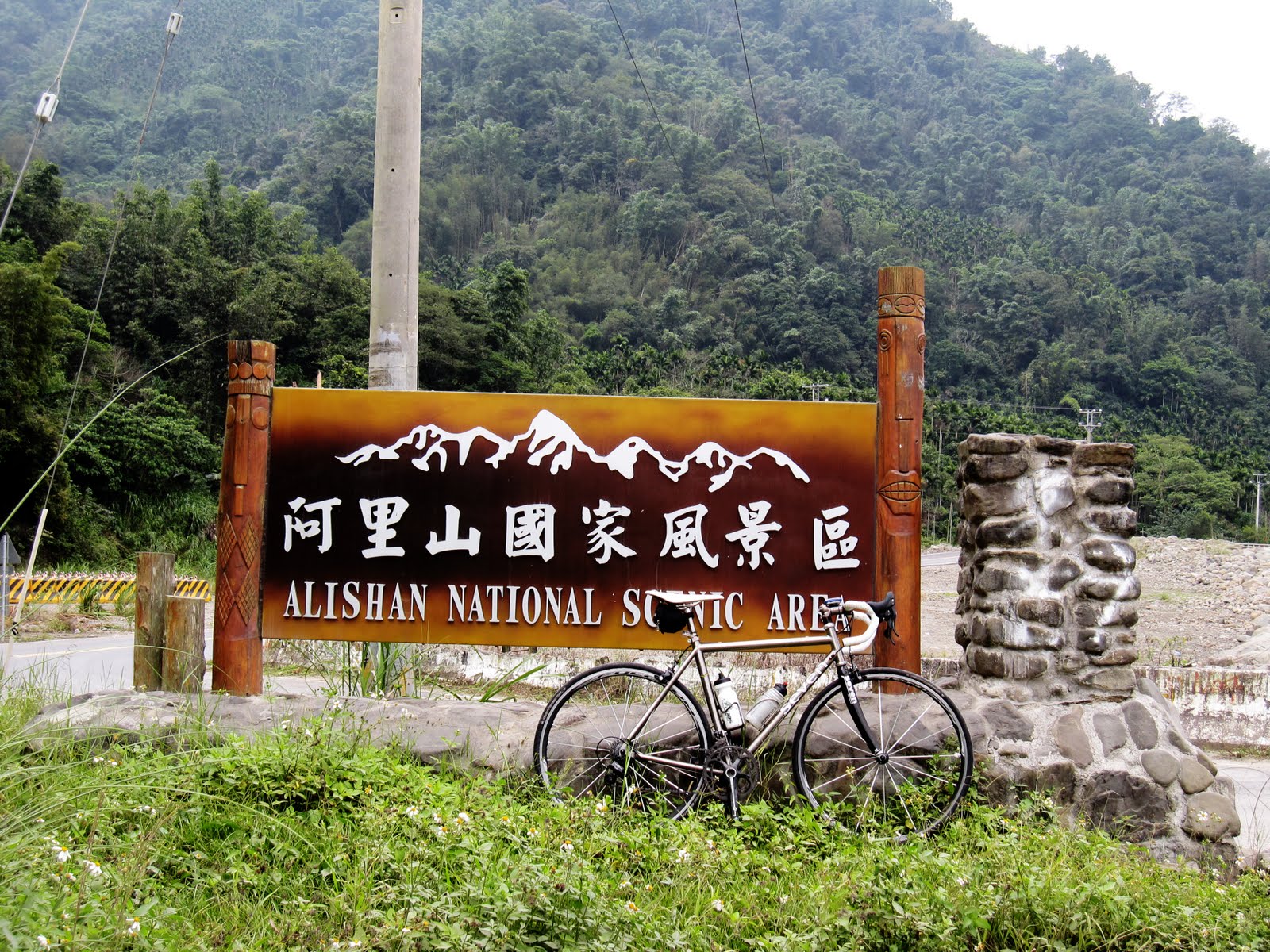
At the bottom of a screaming descent I found myself at the gates of Alishan National Scenic Area. There is just something incredible about crossing the threshold into one of Taiwan's great wilderness regions.


I ambled along the river past hostels and farms. The gravel business is booming along the Chingshui River. I was still waiting for a lick of sunshine that never arrived. Instead the clouds spit occasional droplets at be from behind foggy ridge lines.


At last I was on the 149甲 on my way up Alishan. The road work is never finished, and it will never finish in my lifetime, so I just took it as part of the experience. The bridge has been rebuilt, but there is always something to make things dirty.


I also never put on my daylight glasses. It just seemed too dark... all day.


I heaved and pressed my way up the squiggle to Taiho Village. Just past the scene pictured above, there is the Taiho Restaurant and Hostel where you can buy refreshments if you need a little more to finish the climb. This part is all torn up and requires walking the bike around the construction mess. After about 50m it is all clear to the top.

From Taiho the rugged green tea farms open up and engulf the highest points of the mountain. Elephant Mountain sits off in the distance and plays on your imagination of exactly how rough Taiwan's wilderness can get.

There are still a few vestiges of Taiwan's Japanese colonial past when Alishan was both a logging, agricultural and tourist center. Push-car railways once meandered through these very mountains.


It was only 10:00am and I was closing quickly on the summit. I could easily map out my route as the white roadways slithered across the ripples below. Amazing!


My knee was far from happy, but still within finishing the ride. I was at 73 miles and I still had an entire trip back-- against the wind.


The drop into the tourist trap at Fenci Hu is quick, and the sight of shops, roast sausage and lovers looking lost on the roadside is actually quite warming after a long climb up the desolate back of Alishan.


I stopped for a coffee and a celebratory rest to eat my pizza. The fog was sticking to the mountains, so I didn't stay long. The last thing I needed was rain or any more cold.

A few other cyclists were making their way up the mountain from Chiayi. I passed a dozen or more on my way down the 159甲. I took few pictures on the way down as there was nothing to see in the haze and I just wanted to drop elevation and get on the road home.

What makes Alishan such a tricky mountain, is that it isn't what you'd normally expect. Usually an ascent is hard, but the descent is just the reverse. With Alishan, the descents all include a degree of climbing. This is especially rough if you've already humped up the thing... any incline is heartbreaking.

I bit down and made my final climbs on Alishan before screaming into Chiayi.

With nearly 100 miles under my belt for the day, I headed toward Taichung on the Highway 3.


The Highway 3 is pretty even around Taichung, but in the southern parts it undulates in a series of punchy climbs and steep dips.

For each climb I would leap out of the saddle and pull my ass to the top. My energy dipped a little, which was remedied with some sugar.

I finally made it to the area around Mingjian in Nantou County and made the fateful decision to follow the Changhua Route 137 home rather than simply going up the Highway 3 again. The difference was a trade of stop-and-go traffic for undulating hills and a little more distance with one final climb.

I just punched it up the 137 with some good speed and mighty bursts out of the saddle. I finally hit the Highway 74 and just ate it up. The adrenal gland is some powerful magic.

Then, just about 4km from home, all I could think about was chocolate. I couldn't ignore it. I stopped and downed a Kit Kat and a coke to fuel my push home. I had dropped 2-3mph from my usual sprint up the same road, but by the time I turned onto my street I was going full steam.

After a full day in the saddle, I was home for supper. My knee had remembered to get sore again and I was still feeling better than one might expect.

An awesome day of riding!

Score:

Distance: 250km/155mi
Altitude Gain: 3749m/12,303ft


Bike route 1344229 - powered by Bikemap