body{background-attachment: fixed ! important; }
Showing posts with label Taiwan Air Pollution. Show all posts

Thursday, October 12, 2017

Stifled Dream of a Bicycle Paradise: Pollution and Industrial Blight Cloud Taiwan's Future in Cycles

Untitled

With the annual bicycle festival right around the corner, the Tourism Bureau is again hard at work pumping Taiwan's place in the bicycling universe with lofty powder-puff pay for play articles that seek to lure potential cycling tourists to our shores in search of a life of exotic adventure in the timeless swirling mists of the Far-East.

By the beginning of October the official Tourism Bureau budget is ripe enough to fete cycling writers and bloggers on managed tours of Taiwan's hand picked cycling monuments, which all seem to rest amid the swelling bosom of tourism furniture-- hotels, hot springs, knick knacks, food...etc...or they serve to validate government expenditures on infrastructure like meandering bike paths or bike-share programs that mainly cater to students. The copy retains a familiar form along the official Tourism Bureau talking points listed for each writer to earn airfare and a travel stipend. We see glowing reviews of "the Bicycle Paradise" or the cute moniker "the Cycling Kingdom" with its knowing wink to King Liu the figurehead of Giant Manufacturing Co, Ltd. the maker of several branded bicycles and components.

Take these examples:  


"...majestic mountains, scenic cliffs, awe-inspiring waterfalls, quaint peaceful lagoons and all the while being surrounded by water on all sides. Taiwan is really an enchanting tropical paradise to go seeking adventure 
Combined with the country’s natural splendor with advance infrastructure i.e. good roads, Taiwan makes an ideal destination for cycling. Due to its vast infrastructure budget spent by the government for the maintenance of its roads, Taiwan altogether has over 3,000 kilometers of road network making it a paradise for cycling enthusiasts to venture within." --Arabian Gazette
..................
"Over the last two decades, Taiwan has transformed into a cyclist's paradise, opening thousands of kilometers of interwoven bikeways through some of the island's most beautiful landscapes. The extensive new network of routes has earned the country many accolades, including a spot on Lonely Planet's 2012 Best Countries to Visit list and CNN Travel's top "Cycling Routes That'll Take Your Breath Away," and for good reason. By bike, visitors can cruise past hillsides painted with colorful flower farms, marvel at the geology of Taroko Gorge's marble walls, follow old rail lines through retired mining tunnels, cross thrill-inducing suspension bridges and sample sweet pineapple cakes from local farm stands."--Smithsonian

...................
"Premier  Mao  stated  that  he  envisions  Taiwan  becoming  a  “cycling  paradise,”  and  relevant  strategies  are  necessary  to  achieve  this  vision". --Executive Yuan (2015)

...................
"Taiwan is considered by many to be a cyclist’s paradise with its picturesque bike trails through the island-nation’s awe-inspiring scenery. Thanks to extensive funding in the past decade, Taiwan now boasts thousands of miles of bike roads that wrap around the 14,000 square-mile island. The country’s bike paths show off the country’s diverse topography, from plains on the Eastern Coast to Mountains that are at 3,275 altitudes. The breathtaking lush green mountains and beautiful water scenery make your biking adventures heavenly".--Student Universe
They get the swirling mists, but of a more ominous variety. Don't get me wrong. Taiwan is an amazing place to be a cyclist. I have ridden through the valleys of awesome. I have seen inspiring things that I can't fully describe and have gloriously suffered in ways that only a cyclist with a love for the ride can fully comprehend. It is not that I don't like Taiwan or that I don't want people to cycle Taiwan. My complaint is quite the opposite. I love Taiwan and I love being a cyclist here. I want riders from around the world to embrace this country like I have. I want them to speak of Taiwan cycling with the reverence of the old European routes. I really do. And too often Taiwan gets in its own way of making good on its claims. I too often feel embarrassed for the people who have read my writing and taken the plunge to visit for a ride only to find their routes choked with pollution levels too dangerous to cycle without tempting asthma. I am embarrassed by glistening natural vistas marred by the industrial blight of smoke stacks, cement factories or the rotting concrete shell of a failed mega-resort. In Taiwan we almost get it right so often and we have a lot of potential, only to overdevelop our way into having all the charm of a shopping mall food court. I wrote about this issue back in 2015. I am writing about this issue today.      

AirQuality2

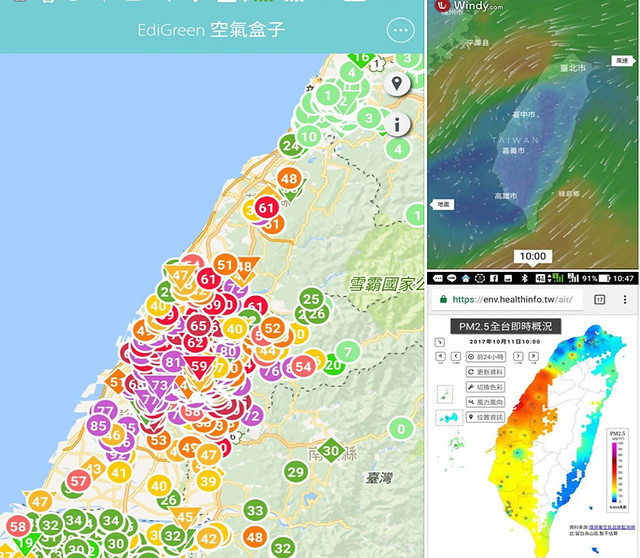
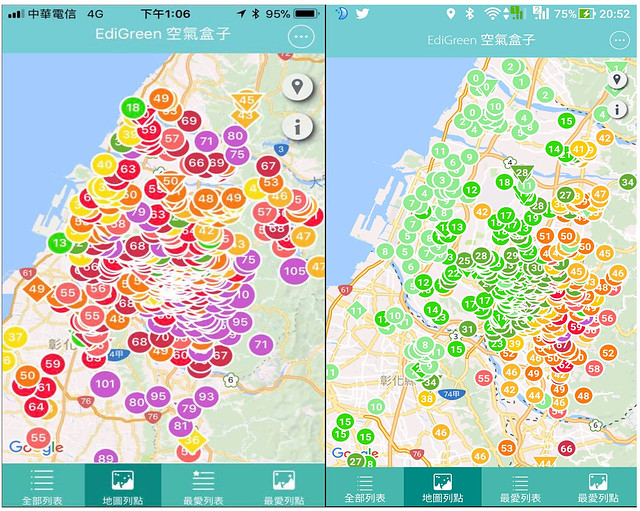
The leading culprit in ruining the Taiwan cycling experience is the pernicious air quality. There is no way to escape it. I might lose more than a month of riding each year due to air quality. During the dry winter months the air can be especially noxious.

In a recent article Taichung City Mayor, Lin Chia-lung states his strong support for cycling as an integral part of the central city's identity with a commitment to cycling infrastructure. 


Mayor Lin indicated that cycling enthusiasts are in for a treat, as the festival features exciting events including Giant Cup, Taichung Cycling Tour and Wheels Ride Festival Taiwan, encompassing activities such as self-challenges and family cycling recreation. Moreover, the century-old Tour de France will be hosting the L’Etape du tour” in Taiwan for the first time on September 17, making cycling an integral element of Taichung City’s brand. The city government strives to expand city diplomacy and forge sister city ties by continuing to create cycling-friendly environments and fostering the cycling movement. 
According to him, Taichung is the primary industry cluster of cycling; aside from the headquarters of Giant, the city also features popular tourist recreational bikeways in Houfeng, Dongfeng and Tanyashen. The city government is promoting the “Cycling 369” program to establish 300 iBike rental stations, 600km of bikeway and 9,000 iBikes. Furthermore, the “OK Taiwan – Departing from Taichung” round-the-island cycling tour will be launched to promote cycling activities and industry to domestic and overseas markets.--Taichung City Government 
This is one face of Lin Chia-lung. The other is of a glad-handing politician eager to garner support from the industrial sector in his bid to woo industrial production facilities to Taichung and push Taichung further over the threshold as Taiwan's second largest metropolitan area. 

In addition, Mayor Lin made some noises last April to the tune of reducing pollutants by 40%.
In an exclusive interview conducted by “YAHOO TV! Weather Risk” at the Taichung City Government Building, Mayor Lin suggested that the air quality of Taichung has been improving in the last 5 years. The content of PM2.5 was 22.8μg/m3 last year in average, which was a decrease of almost 40% from the level of 35μg/m3 in 2011. There are several sources of pollution, including the exhaust from motor vehicles, carbon black from kitchens, uncovered construction work sites, or open-air combustion in addition to the emissions from power generators.--Taichung City Government
A problem with these claims is that they rely on Taiwan's EPA, which has long been rumored to be in the pocket of industry and politicians. Polluters are even allowed to report their own numbers. Even the scale of measurement was adjusted to suit Taiwan's higher levels of pollution. 

In a piece I wish I had written myself, blogger Michael Turton from The View from Taiwan outlines why Mayor Lin may be just paying lip service to the environment. 
The midnight spike in air pollution, using the app airvisual. This is from the Taichung area. The app usually shows a spike, a small one, between midnight and 2 AM. Why? Because factories in Taichung are quietly dumping pollution into the air in the wee hours to avoid EPA fines. I've come to dread Sunday nights because the factories on the hill below our house frequently dump foul-smelling shit into the air.
Turton's speculation is supported by the data. It appears factories and the infamous coal-fired power plant in Longjing spend the wee hours ferociously pumping out pollution that often lingers around the Taichung Basin throughout the day before wafting southward. The thought may be that people are either sleeping or indoors working while the pollution levels spike.

In a 2015 report on the impact of air pollutant on human physiology, National Taiwan University released the following report and recommendation:


Upon studying the physiological effects of particulate matter among laboratory rats, Prof. Tsun-Jen Cheng (鄭尊仁) found that fine and ultrafine particles cause damage to the respiratory system upon entrance into the lungs. Affecting the coronary artery and the autonomy of the nervous system, fine particles may lead to the onset of arrhythmia and heart attacks.
Prof. Ta-Chen Su (蘇大成) also discovered that the incidence of cardiovascular inflammation in the blood is related to the inhalation of fine particles. For instance, epidemiological statistics show that the sudden hike in hospitalization for cerebrovascular disease during the winter coincides with short-term increase of air pollutant levels. Statistics also show that the severity of Taipei’s City’s air pollution is highly linked to the thickness of the internal carotid artery, making levels of PM2.5 an important indicator for studying long-term atherosclerosis. Su’s study also suggests that exposure to PM2.5 is detrimental to the development of the infant’s nervous system.  
Vice-Dean Chan further noted that Taiwan’s annual PM2.5 standard of 15 µg/m3established by the United States, it is also much higher than the WHO suggested concentration of 10 µg/m3 . Traffic is the major source of air pollutants in Taipei, whereas in Central Taiwan, fine particles are produced primarily by thermal power plants. Urging authorities to take more proactive actions against air pollution, Chan emphasized the importance of setting emission standards according to the human capacity instead of industrial development. Prioritizing health over development, emission standards should be set by the Environmental Protection Administration in conjunction with the Ministry of Health and Welfare, and not, as in the present, with the Ministry of Economy. 
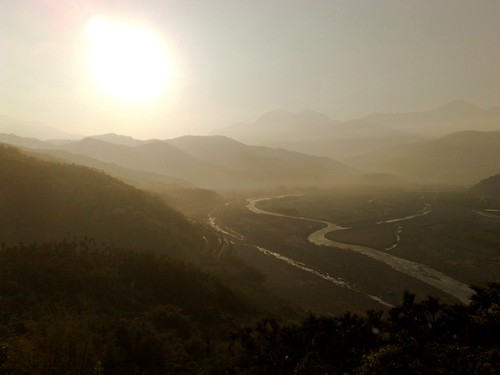
It is a sad irony that a country that so badly wants to be taken seriously as a "paradise"... enough to make such grand and public proclamations of the sort... can be simultaneously working so hard to hinder positive development in realizing the cycling fantasy. Air pollution can be hard for a cyclist to escape. Even from the highest peaks the views that memories are made of are often obscured by a yellow-white haze. Nobody should be expected to come to Taiwan and enjoy cycling through Venus. 
AIr-Quality1

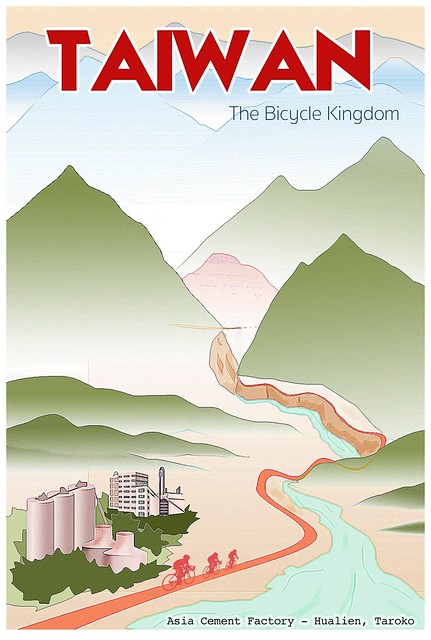
It is not only the air that interferes with Taiwan's desire to become a cycling paradise. Too often unchecked and unregulated development in sensitive natural ands ecological areas serve as a regular reminder to visitors of the blight of concrete and development. The shell of the nearly complete but wholly illegal Miramar Resort in Taidong is the perfect poster child of overdevelopment. Another shameful monument to industrial blight is the Asia Cement Factory near the mouth of the famed Taroko Gorge on Taiwan's east coast. Taroko Gorge is the natural monument that frames Taiwan's KOM Challenge, the world renowned one-day cycling race from the ocean to 3275m. Not only is the Asia Cement Factory and mining operation an eyesore in a sensitive area, it was also built on a site that was procured through deceptive and illegal means. 

A fantastic paper, Making Indigenous Lands into ‘concrete’: land grabbing in the embededness of cement industry in Taroko area, Eastern Taiwan by Yung-ching Lo 羅永清 concludes:
Taiwan experienced rapid economic development in the 1970s and 1980s and it inspired an entire development discourse on the ‘Taiwanese miracle’ (Simon 2002). As Simon’s article ‘The Underside of a Miracle: Industrialization, Land, and Taiwan's Indigenous Peoples’ has pointed
22
out, this view overlooked three important facts that should be taken into account when examining the development in Taiwan. First: rapid development was made possible largely by an oppressive regime of martial law that quelled worker unrest. Second: development took place at immense social and environmental costs. And finally, those costs have been disproportionately borne by Taiwan’s indigenous peoples. 
These factors place an enormous weight on the ethnical shoulders of a visiting cyclist. As the cycling world converges on Taroko to close out Taiwan's international cycling season this October 20th, with some of the biggest names in the sport attending, they will not only be faced with Taiwan's immediate beauty and serious climbs, but they will also see the cost of the Taiwan industrial state apparatus. 

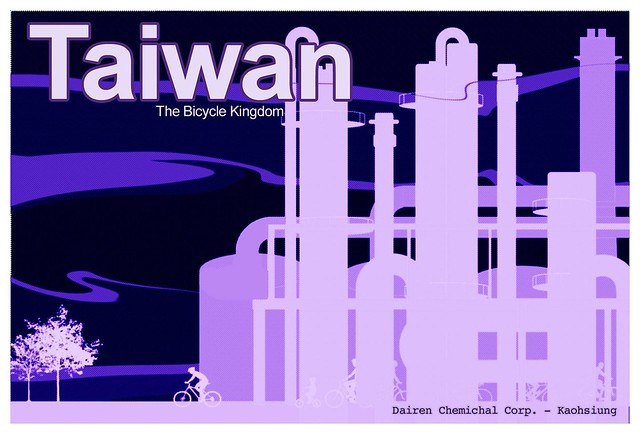
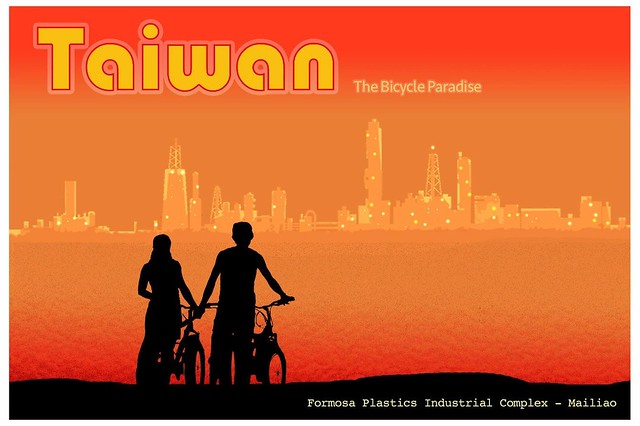
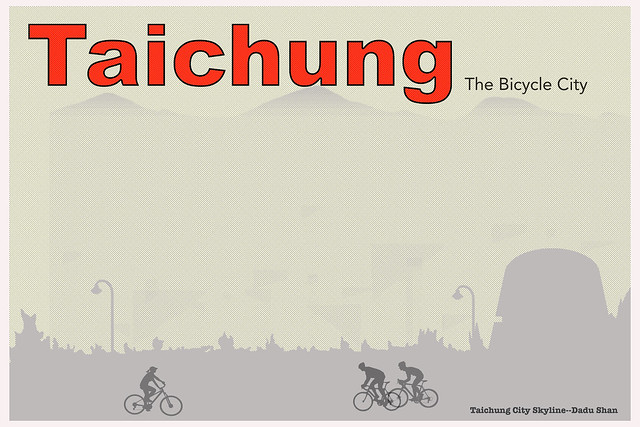
It is with these thoughts in mind that I produced the protest postcards below. They are a reminder of the gulf between our reality and our fantasy as a cycling paradise. Too much work needs to be done before our officials and representatives can even begin to stake authentic claims to "a cycling paradise". The pressure to change needs to remain constant, even on days when the air clears. This is not how I want Taiwan to be remembered.  
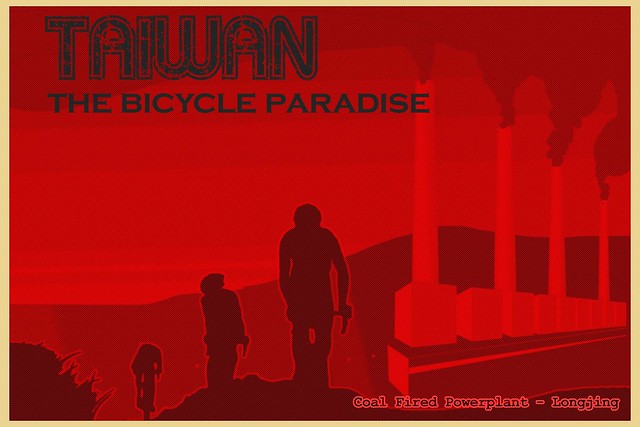
Taiwan Bicycle Paradise: Postcard

Untitled Untitled Taichung-City

Wednesday, February 24, 2016

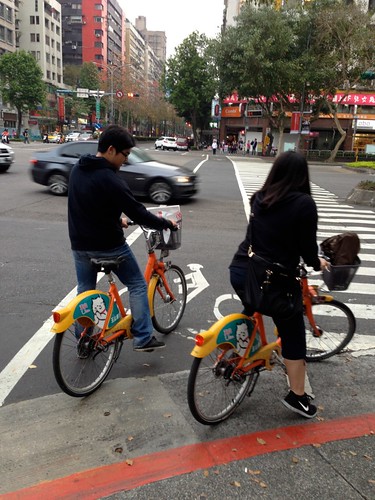
You Bike Saving Taipei Traffic? Not Yet!

IMG_3019


For the next couple of weeks a lot of attention will be focused on Taipei and cycling in Taiwan. In the lead up to Velo-city Global, Taipei Cycle and the Tour de Taiwan, Star2.com takes a look at the development of Taipei into a cycling friendly city. 

The piece is a pretty lengthy piece that looks into the recent developments in infrastructure development. You can read the whole thing HERE and come to your own conclusions. 


Here are a few items of note:


The article attempts to link Taipei's hosting of Velo-city Global as validation of Taipei's recent development. 


When Taipei won its bid to become the first Asian city to host the premier cycling conference Velo-City Global 2016, YouBike’s success was credited as one of the main factors. 
A 2014 report by European Cyclists’ Federation on Taipei’s cycling achievement noted that cycling mode share (percentage of total trips done by bicycle) in Taipei is up 30%. It now stands at 5.5%, a figure yet to be matched by many European capital cities (in cycling utopias like Copenhagen and Amsterdam, however, bikes account for more than 50% of trips in the cities). The usage figure for YouBike matches the world’s best, and women make up 50% of the cycling population – a gauge of the city’s cycle-friendliness.
This is interesting seeing as of 2013, Kevin Mayne, the director of the European Cyclists' Federation (ECF), the organization responsible for Velo-cities Global, was quite critical of Taipei's efforts. I wrote about it at the time and had this to say (Full Post) :
According to the report: 
Mayne's observations and recommendations came amid the opening of the 2013 Taipei Cycle bicycle expo in Nangang.
Mayne's stinging criticism underscores what many cyclists in Taiwan have understood for a long time. The solutions are there, but the political will is not.
Cities friendly toward cyclists usually have speed limits of below 30 kilometers per hour, he said, citing German and Dutch cities as examples.  
He said the bike-sharing system in Paris, for example, offered 15,000 bikes when it was first launched, while Taipei's bike-sharing system, Youbike, currently offers only 1500.  
Mayne's observations are welcome words to cycling advocates as he knowingly, or not, shines a light on the fact that much of Taiwan's trouble in realizing its own ad copy comes from the fact that cycling and cycling infrastructure is often deployed by opportunistic politicians to score cheap points or direct public funds into politically advantageous locations. There is no wide-spread commitment to cycling beyond tourism. Much of what has been built is simply for show with little concern for function.
"Taipei, March 20 (CNA) Taiwan needs to lower its speed limits and allocate more space for cyclists if it hopes to achieve its aim of transforming into a "cycling island," a foreign expert said Wednesday."
Mayne, whose federation consists of national cycling organizations throughout Europe, said speed limits in Taiwan are too high for cars and scooters to coexist with cyclists.
He said lowering speed limits is also a "cheap" solution to building Taiwan into a cycling paradise, as nothing needs to be built. "What you need is political will and enforcement," he added. 
Mayne also advised cities in Taiwan to allocate more space for cyclists and to take bolder steps to improve the environment for them, citing New York, Paris, London and Vienna as examples of cities that are currently doing so and upon which Taiwan could model itself.
It may be that in the past three years Taipei's infrastructure has greatly expanded beyond Mayne's expectation, or, like other international conferences, Taipei was willing to incur the additional costs of being a host city. 

I will concede that You Bike and other bike-share programs have greatly expanded and the bikes are being used. The customers tend to be predominantly students who don't want to ride the bus home from school.Taipei has not reduced speed limits nor provided too much more space for cyclists. 


The article continues: 


“Before we even talk of putting cycling into the equation, we need to talk about the whole public transport system,” says Dr SK Jason Chang, the director of Public Transport Research Center and Professor of Transport Systems at National Taiwan University. 
In short, for bike-share systems to work and to encourage commuters to cycle the first or last mile of their journey, they need to be able to transfer seamlessly between the various modes of public transport. 
A strong support from the central government and collaboration with the bicycle manufacturing industry are also vital ingredients for the scheme to work, Chang added. The city government forked out funding for the bike-share infrastructure and Giant Manufacturing Company designed and supplied the bicycles, and operates the scheme. Taiwan’s Environmental Protection Administration (EPA) subsidised the first 30-minute rental for the bikes.
As for being part of the solution, therein also lies part of the problem. The government tends to rely almost solely on industry to provide benefits for its citizens, while the industrial actors do not serve citizens, but rather, a board of directors and their shareholders. There is too much potential for tax dollars to be used less efficiently when being directed by a private bicycle company that is seeking to maximize profits. 
To date, most of the advocacy work has been led by Cycling Lifestyle Foundation, a semi-commercial organisation funded by Giant – the world’s largest bike manufacturer by revenue. Based on Giant founder King Liu’s vision: “to promote cycling as part of our lifestyle,” the Foundation works closely with government and policy makers to promote cycling as a mode of recreation and sustainable transport.
It is troubling that Giant, the company that has been tapped to direct several You Bike programs, including the program in Taipei, has been allowed so much leverage in creating a system that works to secure exclusive, markets for Giant products and bends the consumer to the options provided by this one company. Giant's founder and nominal president, King Liu, also served as a special advisor to Taiwan's President Ma Ying-jiu. This wouldn't the the first time we have seen Giant involving itself in national policies that have impacted society as a whole. Giant's CEO, Tony Lo was publicly involved in pushing for the passage of Taiwan's disastrous ECFA agreement with China; an agreement that has flooded Taiwan with Chinese imports with nothing even close for exports to China. But I digress.  

And so, a private company that has high-level representatives working in the Ma administration, and large interests outside of Taiwan, is the largest advocate for cycling in Taiwan. They might as well design public bike paths that lead directly to Giant retail outlets...or has that already happened? 


It should be noted that Mr. Cheng, the expert cited for this article, has served as an advisor to Mayors Ma Ying-jou and Hau Lung-bin to tackle the transportation problems of Taipei. The article continues to draw in some questionable politics from Mr. Cheng's narrative as it continues: 


When President Mayor Ma Ying-jeou was elected into office in 2008, he announced a NTD30bil (RM3.7mil) funding for Energy Savings Emission Reduction Policy, which triggered a boom in green transportation and cycling became all the rage. 
“All these combined factors made the bike-share programme take off,” says Chang. 
.......

When then Taipei Mayor Hau Lung-bin wanted to initiate the pilot bike-share programme in Taipei, the Foundation sent an entourage of Giant bike technicians and Yang to Paris to learn about the Vélib bike-share scheme in 2008. Over the years, the Foundation has invited government officers on all-expense paid study trips abroad (cough!) to check out best cycling practices. 
“Now that recreational cycling is well established, we are promoting cycling commuting to complete the last piece of the puzzle,” says Yang who has the ear of the city and central governments. “We need more bicycle paths in the city so more people will be willing to commute by bicycle. More cyclists mean safer streets and less traffic accidents.” 
What Mr. Chang should have said was that Taiwan's Energy Savings and Emissions Reduction Policy have improved in spite of Ma Ying-jiu's policies. Most of the forward motion we have seen has been the culmination of external factors, prior programs and the reaction, in the case of the scrapping of the 4th nuclear power plant, to widespread public disapproval. As of this writing, most of Ma's proposals have not been completed or have been negated by energy intensive industrial policies, while renewables have been chided by Taipower, the EPA and the government as being unreliable as they look for more excuses to build large concrete power plants that are easier to use as political bait for embedded interests. 

Moreover, Hau Lung-bin was responsible for the NT$60million debacle of a bicycle lane on Dunhua S. Rd. which smacked of patron politics. The Dunhua bike lane was removed at tremendous cost.


For the past several years Taipei has concentrated spending on leisure bike trails and opportunities for tourism without addressing the immediate interests of the city.

Taipei's current mayor has recently come under fire for the city's traffic congestion, due, in part, to his initiative to construct a grid of bicycle lanes throughout the city-- a move which may be politically costly, but far more effective than prior initiatives.

Probably, one of the greatest unaddressed issues may be the inability for the government to reign in the cost of housing, forcing people into longer commutes at greater distances. Although the use of motorcycles has dropped with the implementation of rail lines, single automobile use has actually risen to 3512 for every 10,000 residents.  

Environmentally, Taiwan, with its resources in technology development should be miles ahead. But it is not.

What made the bike share scheme take off was when the city purchased higher volumes of bicycles from Giant, but the issue is to be sure those bikes are replacing motor vehicles.      

After sugar-coating the situation in Taipei, the article continues with some revealing criticism. 

In a recent survey by the DOT on cycling safety, nearly 40% of pedestrians complained about cyclists who ride on arcades (five foot way) or sidewalks, and 20% of respondents abhor cyclists who weave in and out of traffic or ride outside of designated cycling lanes. 
“Our population is dense, we just don’t have enough room to accommodate infrastructures for different modes of transport. People have to learn to respect and live harmoniously with each other,” admits Commissioner Chung. Taipei has 2.7million people living within a 271.79sqkm space, with a population density of 9,944 residents per sqkm (Kuala Lumpur’s population density is 6,890 people per sqkm). 
“We will continue to run campaigns to educate people about respecting each other’s right of way and road safety.”
One of the city’s main priorities is to reduce the number of cars and motorcycles on the road, Chung said. 
“Our vision for Taipei city is zero traffic death,” adds Chung, whose preferred mode of transport is YouBike and she doesn’t own a car or motorcycle. 
In Taipei and the metropolitan areas, motorcycles outnumber cars (about 3.1million motorcycles versus 1.5million cars by the end of 2014) and account for 54.1% of total traffic fatality within Taipei city. Over the years, the city has reduced parking spaces for motorcycles, eradicated free parking for cars and widened the sidewalks for pedestrians and bike lanes.
Successful, Taipei in not.  

So, what are some things Taipei can do to live up to its wish to become the capital of a "bicycle kingdom"? 


  • Bicycle racks on every city bus. This is common in many countries and a system I grew up with, but not in Taiwan. 
  • Bike storage on EVERY train. Currently, there is a complicated system for transporting bikes on trains that is little understood by everyone involved, including TRA employees. Trains with a bike car do not run at convenient intervals. Cyclists on trains should receive an incentivized priority and not be treated as a problem. 
  • Safe bicycle storage throughout the city. You Bike solves part of this problem, but for riders with their own commenting set-up, there is nowhere safe to lock a bike for the day.
  • Reduce speed limits and enforce traffic laws regularly and evenly. Keep cyclists safe. 
  • Make bicycle education a part of driver training programs. (I know... sigh...)   
  • Separate bicycles from other traffic. Bicycle space could easily be created by clearing the sidewalks for pedestrians to travel. Any parent immediately understands the challenge of safely pushing a stroller down the occupied public sidewalks. These obstructions push pedestrians and bikes into conflict. There is space, the city just has to create it.
  • Suspend funding for leisure trails until a higher standard in met within the city. 
  •  
  • Adopt stricter regulations on industrial emissions and rapidly invest in renewables to phase out the heavily polluting coal fired power plants for cleaner, safer air quality to make cycling outdoors a healthful experience.  


Monday, February 22, 2016

Taiwan Promotes Healthy Bicycle Lifestyle Amid Killer Pollution?

Over Jiji

Taipei Cycle (March 2-5) hopes the Velo-city Global conference will help boost flagging interest in the bike expo that has been searching for more of a purpose amid competition from Taichung Cycle, Eurobike and Interbike trade shows. BikeBiz has a brief interview with Yi-jyh Kang, the executive director of exhibitions for the Taiwan External Trade Development Council (TAITRA).

My favorite part of the interview is the last comment that has been ripped straight out of the talking points memo, complete with a mention to an old CNN infotisement Here, Here and Here: 


And Taiwan has been growing its cycle infrastructure…?
Taiwan is known as a Cycling Kingdom for its strengths in manufacturing high-end bicycle products with reasonable prices. However, we are doing more than that. The industry and our government are promoting the “cycling lifestyle” and would like to encourage people to get used to cycling in daily lives. For instance, the bike rental system, YouBike, is very common for public transportation in Taipei and New Taipei City. Besides, the government is constructing cycling paths all over the island, like the one around Sun Moon Lake was even selected as one of the tenmost beautiful cycling paths in the world by CNN. With convenient facilities and beautiful sights, Taiwan is becoming a cycling paradise and more and more people are crazy doing cycling tour here. I would very much like to recommend all of you to come and truly experience cycling here. This is going to be something that you’ll never forget.

Oh, and then there's this....

Although not exactly cycling related, this story should pique the interest of outdoor athletes in Taiwan. The Taiwan Healthy Air Action Alliance alleges Taiwan's air pollution problems may have led to death and injury in the Kaohsiung Marathon.

The Taipei Times reports:

Severe air pollution might be to blame for the death of a runner during a marathon on Saturday and the critical condition of another marathon runner, who fainted while running on Sunday, a group said. 
The runner died after collapsing in a marathon in Yunlin, and the runner who lost consciousness was participating in a marathon in Kaohsiung. The second runner was hospitalized after defibrillation. 
Yunlin and Kaohsiung had elevated levels of fine particulate pollution measuring 2.5 micrometers or less in diameter (PM2.5) during the marathon events. 
The Taiwan Healthy Air Action Alliance yesterday said that the PM2.5 levels during both marathons reached the “purple” level — the most severe degree of PM2.5 pollution defined by the Environmental Protection Administration (EPA) — and although there is no definite causal relationship between air pollution and the two incidents, the health hazards of air pollution could be equal to those of natural disasters.
Of course, these claims have not been verified as other mitigating factors may have led to the participant's death, but it is something to think about. Currently, southern Taiwan is on the receiving end of a weather system out of China that is delivering high levels of dust and pollution combined with our own local varieties.

Cough!

Current air quality can be monitored here.

Taipei
Hsinchu
Miaoli
Taichung
Changhua
Tainan
Kaohsiung