Something is afoot as there seems to be a sudden influx in cycling related news regarding bicycles and Taiwan. And why not? There is something to be sold.
Tiffany Hsu has a very lengthy piece that made it into the Los Angeles Times detailing Giant as a major shaker in the bicycle industry. Hsu does an admirable job in her reporting as she refrains from annexing Taiwan to China or creating artificial conflict in that regard. The more interesting pieces of the article are the points where Giant CEO, Anthony Lo, speaks his mind and reveals a little bit about Giant, the company's trajectory, and moreover, it sheds a little light on how Giant is writing its own mythology.
Tony Lo says he has the solution for traffic- and smog-choked Los Angeles: Get people to hop on bikes.
For Lo, it’s a convenient proposal to make. He’s chief executive of Giant Manufacturing Co., a Taiwan-based company with U.S. headquarters in Newbury Park that calls itself the world’s largest bicycle producer by revenue.Such concerns weigh heavily on the small island nation, which is trying to reduce its reliance on fossil fuels as smog drifts across the strait separating Taiwan’s western coast from China.Of course, as I have recently written in an earlier post, it is not entirely accurate to simply blame China for our own air pollution. For much of the year Taiwan's air pollution is the result of domestic polluters and our reliance on coal-fired power plants. Naphtha cracker production is also a major source of airborne pollution as we have seen with the Formosa Plastics foundry in Yunlin, which was recently the focus of a protest against PM2.5 emissions as the topic has gained some political traction. Taiwan continues to rely on the burning of fossil fuels with two recent dips, which correlate to periods of negative economic growth.
In recent years the Taiwanese have embraced cycling culture as never before, Lo told a group of American journalists last week.
“In the past 10 years, Taiwan has turned from a biking desert into a biking island,” he said at Giant’s original manufacturing and assembly plant in the Dajia District of Taichung City. “If Taiwan can do this under not very favorable conditions, there’s no place where it cannot happen.”
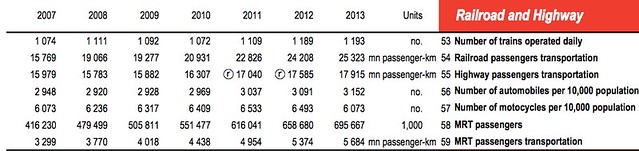
The number of motorcycles and scooters in the country is declining, he said. Increased demand for bikes allowed Giant to launch a hotel that caters to cyclists, a public bike rental system with more than 5,000 bicycles and a brand dedicated to women called Liv.Mr. Lo's assessment is a cynical one at best. According to the government's own statistics (through 2013), while the number of scooter drivers has dropped in recent years to 2007 numbers of 6073 scooters per 10,000 residents, the number of private automobiles has risen to 3152 for every 10,000 residents, an increase of 204 vehicles. The data spanning from 2007 to 2013 shows shows very little change in the reduction of private motor vehicles and, at first glance, appears to follow Taiwan's economic health as opposed to an interest in physical health. The numbers do not include bicycles for transportation, but the real difference seems to be from mass transit, such as trains and MRT systems which respectively saw large increases in ridership with the introduction of more frequent trains an expanded MRT systems. The bicycle is really insignificant in Taiwan's transportation infrastructure.
Of Course, Tony Lo should know this. Both Lo and Giant's founder and president, King Liu, have close ties to the government as the latter served as a special presidential advisor on transportation and bicycle policy.
This partnership between the corporation and the government has produced little by means of emissions reduction-- the U Bike program being the only meaningful program that is aimed at transportation-- and instead focused largely on the more lucrative side of the business, which is to view the bicycle as a tool for prestige and leisure. I have written multiple times that there is nothing wrong with leisure cycling. It is a great way to exercise and see Taiwan. I would also argue that it does little to reduce emissions as it is simply replacing other activities that also do not produce emissions-- activities such as jogging, badminton and crochet. I might also argue that the focus on leisure cycling could potentially be adding to the very problem Giant claims to be solving. Since leisure cycling does not act to limit an individual's regular carbon emissions associated with necessary transportation it is important to look at Giant's goal of producing and selling more product.
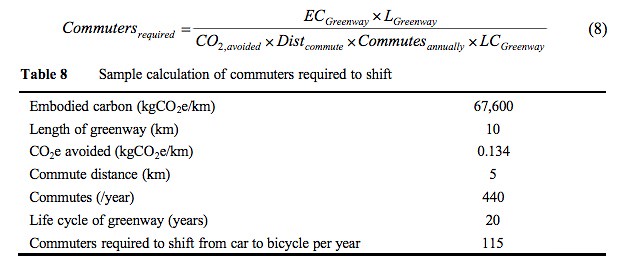 If we consider the environmental impact of bicycle production, it is far lighter than a car. On the other hand, industrial bicycle production requires sourcing raw materials, energy from fossil fuels, toxins and other emissions. It is important to consider the greater environmental impact of these machines of leisure. As Giant has helped reduce the cost of leisure and recreation bicycles, it has increased the number of carbon fiber frames and components on the roads. Carbon fiber is not a commonly recyclable material and will often end up in a landfill. The longer a bike lasts, the smaller impact it will have. Unfortunately, the bikes Giant wishes to sell are the bikes with the highest profit and the highest rates of turnover. Giant's recommendation to the government has been to construct more leisure cycling paths. One of the best studies on the topic concludes over the course of the 20 year lifespan of a bicycle path, it would require 115 cyclists 440 commutes per year over 5km to offset the carbon footprint of the cycle path. Of course, this is for commuters in which the cycling is a substitute for other forms of transportation. Read the whole paper HERE.
Giant launched in 1972 making bike parts for companies such as Schwinn Bicycle Co. but introduced its own brand in 1981 after losing orders to China.
Not long after, Giant and its Taiwanese rivals decided to focus on high-end bikes to distinguish themselves from the cheaper models churned out by Chinese competitors.I find this section of Hsu's piece very interesting as it almost entirely focuses on the Chairman, Tony Lo, rather than the president and founder, King Liu.
Giant has, at great expense, promoted the story of King Liu to capture the hearts and minds of Taiwanese. I personally enjoy this recent characterisation from Want Want China Times:
I find King Liu a very interesting case, in examining how much of the story was left on the editing room floor.
The King Liu story is built upon the foundations of a Horatio Alger narrative-- scrappy a down-on-his-luck figure overcomes adversity to pull himself up by his bootstraps and realize his ultimate boon.
He began his own business raising eels at the age of 35, but he was brought to the brink of bankruptcy when a typhoon destroyed his eel ponds.
He subsequently founded Giant in 1972 as a contracted manufacturer of bicycles, where he struggled for three years to keep the new company from collapsing.
Just when he was able to turn his company from running in the red to running in the black, a client whose order accounted for three-fourths of Giant's revenue suddenly stopped working with Liu's company.
More miseries lied ahead, he says in the book. At the age of 63, Liu was diagnosed with gastric cancer and had to have half of his stomach removed, and then many of Taiwan's bicycle component makers moved overseas, causing Giant to lose nearly all of its suppliers overnight.
At 73, Liu found himself plagued with sleep apnea, blood clots, and a slipped disc. Despite the obstacles, he decided it was time to ride around Taiwan on his own Giant bicycle in defiance of the opposition of every one of his family members and friends.In many ways this is the Taiwanese monomyth that resonates throughout Taiwanese culture. As the locus of multiple colonization projects, Taiwan's social, economic and political structures have been forced to adapt to changing realities. Taiwanese have a history of pragmatic change and adaptation. The unfolding narrative is one of survivors. An examination of Taiwanese popular music and literature is full of fantastic tales of the wandering man who leaves home to make his fortune, only to return home or to dream of returning to his hometown. Songs such as, 離開故鄉來流浪, 舊皮箱的流浪兒 and 出外人 are classic examples of the popular image of the wandering man.
The myth of King Liu is, in my opinion, deliberate in this type of imagery to appeal to an existing sense of local pride. The moniker "Bicycle Kingdom" that is often used in fawning print articles is a cute reference to King Liu.
What Giant seems to ignore in the mythologizing of King Liu, was the mighty hand of the KMT party-state and the role of the Lo family in Giant's success.
By the mid 1960's Taiwan was entering unfamiliar territory. As a sojourn state, the prospects of American aid in "retaking the mainland" were quite dim. Taiwan was under strict martial law with an strong state controlled economy (price restrictions, monopolies and tariffs). Taiwan had been protected from world economic fluctuations due to artificial government stimulation, few foreign investments and the infusion of American aid. (See Gold;1986)
Under pressure from the United States, Taiwan embarked on economic reforms that stemmed from multiple state directed plans to use Kuomintang funds to spur investment and economic growth in the private sector. As the term "private enterprise" tended to euphemistically mean "owned by local Taiwanese", the state hoped to curtail opposition. These SMEs became subcontractors for Japanese manufacturers in an export economy. Taiwanese' close ties to Japan made the arrangement a smooth transition. By 1972, the KMT party state searched for a new 6 year plan and investments to boost the economy. This is the time of King Liu's misfortune with eels. He essentially was given a KMT backed loan to switch from the local economy to the export economy. There is speculation that Tony Lo's "mainlander" background may have served as a buffer or guarantee for the fledgling bike manufacturer and its state patron. I am curious if Lo will be stepping up to replace Liu as the "Visionary Giant".
About 2,000 people work in Giant's Taichung complex. Roughly 20% of them hail from Vietnam and Thailand and are housed in dormitories.
Like many other major economies, Taiwan is facing a disconnect between employers and the workforce. Many companies have positions to fill but can’t find the needed applicants locally.
“We don’t have enough labor in Taiwan,” Lo said. “Young people don’t want to go into manufacturing.”
I find the quote above to be quite interesting. In Taiwan we often see tycoons and wealthy politicians lament the "laziness" of young Taiwanese. In one recent Want Want China Times article:
Pan Wei-kang, a lawmaker from Taiwan's ruling Kuomintang, says members of the country's younger generation lack ambition and have lost competitiveness compared to their contemporaries in mainland China and the Philippines, writes our Chinese-language sister paper Want Daily.
Pan said young people in Taiwan are generally well educated but many of them are unwilling to face reality. Many college graduates fail to find jobs and continue to depend on their parents financially or go on to graduate study or take part in working holiday visa programs to defer joining the workforce, the lawmaker said.These sentiments were often hurled at the students who came out in force to support the Sunflower Movement and are, in general, feeling ever marginalized in Taiwan.
The anthropologist, Anru Lee, in her excellent work on labor in Taiwan In The Name of Harmony and Prosperity: Labor, Gender and Politics in Taiwan's Economic Restructuring, writes:
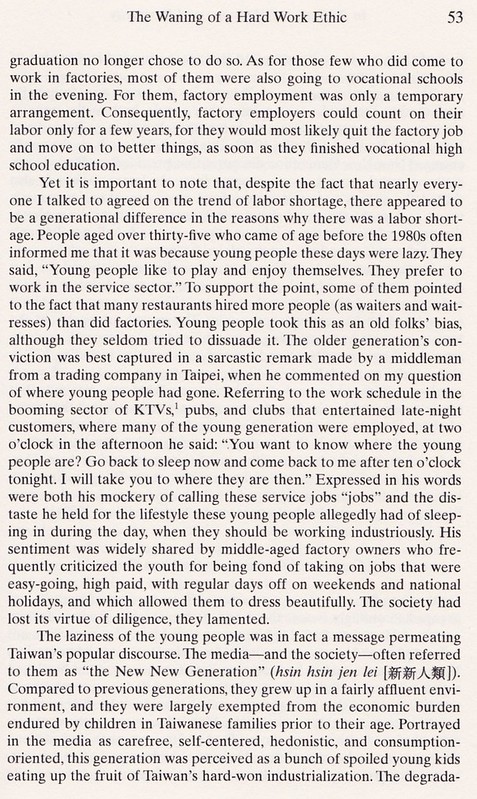
The myth that Taiwanese young people are spoiled and lazy is false. Young Taiwanese with college degrees take low starting salaries. Last year, Terry Gou, another famous tycoon based in Taiwan, insisted the young people of Taiwan were spoiled and that a reasonable starting salary for a college graduate at the technology colossus, Foxconn, should make NT22,000 per month (roughly USD$729). Many Taiwanese are pressured into working massive amounts of unpaid overtime. Many foreign workers make just over NT15000 per month.
I was recently privy to both an applicant and potential employer's negotiation. The applicant has 10 years of experience as a buyer. She had been a stay-home mom for two years and was hoping to go back to work. She demanded NT26,000 per month. The potential employer would edge no higher than NT24,000.
When we consider the problem of unaffordable housing from the current housing bubble, where the rich have saturated the housing market for safe investments, the rising cost of utilities, young people can not afford to work for Giant.
Meanwhile....
Tony Lo is in China helping to shift the leading role of the Asian bicycle industry to a China based organization that will likely promote industry centered growth for whatever is best for the few at the very top of the food chain.
Lee, Anru. 2004. In the Name of Harmony and Prosperity: Labor and Gender Politics in Taiwan's Economic Restructuring. New York, State University of New York Pres.
Gold, Thomas B. 1986. State and Society in the Taiwan Miracle. New York, M.E. Sharpe, Inc. ISBN 0-87332-399-8