body{background-attachment: fixed ! important; }
Showing posts with label YouBike. Show all posts

Tuesday, May 3, 2016

Taiwan's Public Cycling Decline

Untitled

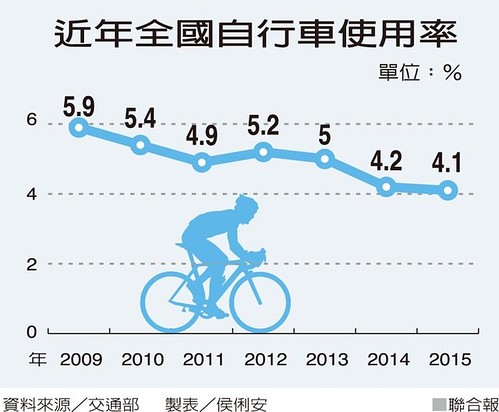
The United Daily the Liberty Times both have reports detailing the Ministry of Transportation's report on a steady decline in bicycle use nationwide.

Taiwan, which often bills itself as the "bicycle kingdom" in promotional material, is experiencing a contraction in the use of public bicycles as well as bicycles for transportation.

The key factor, as pointed out by the Ministry of Transportation, was the easing of fuel prices over the past year, which has encouraged people to opt for the use of personal motorized transportation for shorter trips. Many respondents also cited "convenience" as a factor.

While bicycle use has grown in Taipei, New Taipei City, Hsinchu, Hualien and Pingtung, ridership has fallen elsewhere, negating any gains. According to the data, Yilan, Yunlin, Miaoli, Kaohsiung, Taoyuan, Taichung and Tainan all experienced negative growth in ridership over the past seven years. The Ministry of Transportation feels the expected rise in gas prices could again fuel growth, but some experts are less optimistic.

It is also interesting to look at the areas that experienced the greatest growth and to wonder about infrastructure spending and government subsidies in those areas as they correlate to political alignment.

The study also found that riders between 15-18 years of age were most likely to participate in bike-share programs--a statistic supporting the assertion that Taiwan's bike share programs do little to cut emissions.

In most areas, there is still no real space for bicycles on the roadways, making commuting by bicycle inconvenient, impractical and dangerous.

While Taiwan's bicycle programs have been highly touted in the international press, this report really serves to highlight the disparities between Taiwan's far north, and the rest of the country, as well as how few reporters ever venture out of Taipei.

It could also be that the bike trend is over in Taiwan.    

Monday, April 11, 2016

Let Them Ride Bikes! : Toy For The Wealthy Makes Cycling Safer


Untitled

Vox has recently published some very good articles on how bike share programs are faring in the United States and elsewhere with some interesting findings and it provides an opportunity to reflect and consider how Taiwan's bike share systems differ from those elsewhere, and how many of those differences are structural, political and cultural.

This blogger has been, as usual, critical of Taiwan's bike share programs and trails for being either dangerous, ineffective, wasteful, ill-considered or cynically shortsighted for political stature. While they occasionally get things right, there are still few places where the bicycle is treated like traffic. Taipei has even gone out of its way to encourage sidewalk riding in conflict with pedestrians. In Taichung, where I live, within 30km of Giant, the major player in Taiwan's bike share schemes, there is almost no space allotted for the bicycles on roadways. Still, with more bikes on offer, more riders are taking to the streets. Meanwhile, Seattle, a city with a mature cycling culture, is looking at a budget shortfall for its Pronto bikeshare program.

Vox points to the disparity of income and race in the use of American bikeshare programs.
Bike share users skew significantly whiter, wealthier, and more likely to be college-educated than the overall populations of the cities they live in. That's despite the fact that nationwide, the people who bike regularly are actually disproportionately low-income and nonwhite.
It is in this light that some critics feel taxpayer money could be better spent on other needs beyond a perpetually niche toy for the wealthy. As one critic pointed out in the TiC comment section:
But this is reality, and I make do with 150cc "Grand King" motorbike. And the reality is surely that for the majority of people in Taipei and elsewhere, bicycles are toys (and often very expensive ones) rather than a serious means of transportation. And so it is hard to see why should the Taipei city government spend vast sums of taxpayer's money altering public infrastructure for the benefit of a relatively well-off minority who already have alternatives available to them.
The great thing about Taiwan, is that its urban areas are still tightly nucleated clusters with high population densities spreading upward rather than outward. There is still a little bit of the egalitarian sense of space in urban areas where neighbors at different ends of the income scale can live in relatively close quarters without the income apartheid experienced in other countries. Daily needs are still within walking distance or a short distance from home. Of course, the housing bubble compounded by income stagnation is rapidly changing this... and not for the better and younger members of the workforce are pushed further and further from their places of employment. It is far more possible to realistically integrate cycling into the urban environment if there is the political will to do so.

Currently, through my own empirical observations, the majority of You Bike/Ubike users are students skipping the bus and still too young to legally drive scooters. These systems are cheap and efficient. There are stations mounted near libraries and shopping centers and places students use.We know that fossil fuels are limited and polluting, we know in Taiwan we regularly experience weeks on end of unhealthy air pollution from stagnant air held against the high mountains, so what is keeping the rest of the population tied to their cars and scooters? Are bike lanes really just a wasteful bone throw to the wealthy boys and their toys? Does any little bit to help count?

I am inclined to believe not. Remember that automobiles were once the domain of the wealthy and now look at the networks we have provided for them. If you build and enforce lanes for bikes in the cities and integrate them into other forms of transportation, like busses, trains and other forms of mass transit, it removes the obstacles that prevent a potential user from hitting the road. Currently, it is too easy for a user to find excuses for not riding. There is no space, it is inconvenient, the MRT station is too far, there is too much traffic, there are no places to park the bike. If those obstacles are removed, it clears the way for more bicycle use. The other thing it could do, is intentionally allow less space for the automobile, providing an incentive to non-polluting transportation or mass transit and a punitive for personal engine traffic. If the roads are packed and the bike lanes are clear, the bike lanes are bound to fill up. But that would take either environmental disaster or strong political will to implement.

In another article posted by Vox, the conclusion abroad is that bike share is safer than when users commute on their personal equipment.
Bike sharing has seen explosive growth since 2007, with systems in at least 94 citiesand more than 35 million trips taken. There have been some serious injuries, yes. But — knock on wood — we've seen zero US deaths from bike sharing so far1. Contrast this with the overall estimated cycling fatality rate of 21 deaths per 100 million trips.
On Facebook several commenters were scoffing at this figure as applied to Taiwan and Taiwan's notoriously reckless or clueless drivers. Unfortunately, for statistics sake, because the bicycle is not regarded as transportation, the figures on bicycle injury and deaths on Taiwan's roads are not recorded. This may also be a defensive strategy to avoid the political ramifications of constructing bicycle space in urban areas.

Currently, Giant is being asked to build or consult on several more bicycle programs in other countries.

Ralph Jennings has been posting a lot on this issue and reports in Forbes:
In other cities with share programs, company founder King Liu tells Forbes in an interview, “riders have no feeling for their bikes. They’re old or they break down a lot. The air pressure is too low, the chain falls off or the bell doesn’t ring. But bike sharing is a trend in global cities. Traffic in the cities is increasingly bad.”
The Taipei program just breaks even and the company acknowledges it must think hard to perfect rental systems in other cities. It’s got four others in Taiwan at the moment. But whether or not it makes money, operation of a quality bike sharing program excites riders about cycling, says the company’s Chief Executive Officer Tony Lo. As a case in point, sales of Giant’s recreational bikes in Taipei have risen along with the popularity of the Taiwanese capital’s YouBike sharing program since 2012. Giant’s 6 million bikes produced last year for sales were largely for sports and leisure rather than just getting around town.
That brings me back to the trouble with Pronto.

Could it be that with such a wide-spread cycling plan and space for cyclists (3ft), enough people have their own equipment and don't need to borrow?



Wednesday, March 16, 2016

YouBike You Know: The Guardian Promotes Taipei YouBike Program

Untitled
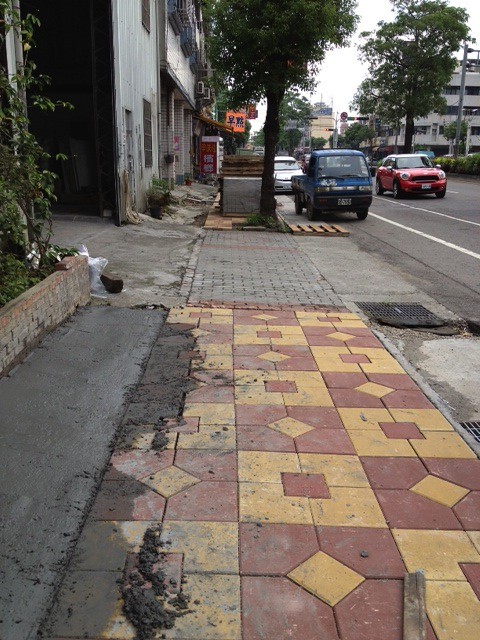
Taxpayer Funded Bike Path in Daya Township, Taichung City


The Guardian has a couple (HERE and HERE)of successive pieces to promote the YouBike system. I think the YouBike system and Taipei bicycle lanes are becoming what they should have been when they started when the planning went into effect almost ten years ago. Both Mayor Ma and Mayor Hau approached cycling in Taipei from the perspective of bicycles as toys or sports equipment. They both emphasized the business oriented approach to cycling, where leisure cycling can cater to rental businesses, cafes, tourism and entertainment: a very bourgeoise view of one of the most transformative inventions in human history with the beneficiaries being the business and the entrepreneur. They tried to pump up interest in recreation cycling through the promotion of leisure bike paths outside the city; a movie to stimulate domestic bicycle sales. After unleashing thousands of rental bikes into a city without any space for them, the report from Jennings sums up the problem.

“We’re now making plans for education and promotion work,” said Liu Chia-yu, a division chief under the city’s transportation department. “For bike riders, we’re saying not to compete with pedestrians, and for people on foot, if you run into a bike give it some space.”    
Thousands of riders have hit the roads and they are only now making plans to educate for safety.

Mayor Ko, on the other hand, has had the political will to take on the city infrastructure with a tenacity bordering on arrogance. He wants the city a certain way and he is going to try to do it. A grid of bike lanes and actual cycling space is really what nobody had wanted to address in the past. I hope other cities will follow suit. 

Sadly, a lot of time and money was wasted catering to special interests.


Wednesday, March 2, 2016

228 Pole to Pole with Mayor Ko and More

IMG_2272
It has been a busy week for cycling in Taiwan. With a three-day weekend last week and the Velo-cities Global conference leading up to the Taipei Cycle trade show, a lot of cyclists have been hitting the roads for a little taste of Taiwan's cyclescape. 

The charge was led by Taipei's incredible mayor, Ko Wen-je. Ko was noted as a commuting cyclist from his time before politics as a surgeon and director at the NTU Hospital in Taipei. When Ko was elected, he made it a priority to try to right the decade of cycling wrongs Taipei has suffered as the bicycle was trotted out as a convenient campaign tool and bicycle infrastructure was merely a gift to special interests. Ko has pushed ahead with commuter bike lanes that actually integrate the bicycle into the grid as opposed to banishing it out into the hinterlands...earning praise from the Netherlands.  

This year, Mayor Ko decided to bike the length of Taiwan in the Lighthouse to Lighthouse ride; a 520km effort in under 24hours. The affair garnered criticism from the usual crowd as he had abandoned Taipei city during commemoration events for the brutal 228 Massacre of 1947, in which troops sent by Chaing Kai-sheck swept the streets of Taiwan with machine-gun fire in the weeks following an island-wide uprising in protest of the Kuomintang (KMT) and its maladministration. (Cycling Through 228) 

During the events sparked by 228, Mayor Ko's grandfather, as a member of the local gentry, was arrested and brutally tortured for his cooperation with the Japanese colonial administration during their fifty years of colonization. 

Mayor Ko describes his decision (Taipei Times):
An emotional Ko became teary several times during his speech, which seemed similar to his 228 speech in Taipei last year. 
“I was moved to tears giving a speech [recalling the memories of my grandfather] in the 228 ceremony last year, but my father did not shed a tear. Fathers are stronger when their children are weak. It is a father’s nature to protect their children. It was then I decided my father and I would not cry anymore on 228 Memorial Day. We have to move on from sad histories, so I chose to commemorate the 228 Incident in a different way this year,” Ko said. 
“I challenged myself with a ‘twin tower’ bicycle trip — from Taiwan’s northernmost Fuguijiao Lighthouse [in Keelung] to its southernmost Oluanpi Lighthouse [in Pingtung County] — to seek redemption for the soul with a 520km physical undertaking. In the past, our tears were filled with rancor and hate. Today, we opened up a future of tolerance and forgiveness with sweat,” Ko said.
I have a lot of respect for Mayor Ko as a cyclist and as a mayor. My impression is that he is really willing to do what needs to be done to make a commuting by bicycle a viable reality in Taipei. 

It is in this light that I think the Velo-cities Global conference could be useful, rather than merely looking at it as an award for a job well done. It should be more of a promissory note to move forward and learn without the backslapping we have seen time and again in the media. 

BikeBiz reports:
“We are here in Taipei to celebrate the future," said Manfred Neun, president of the European Cyclists’ Federation and the World Cycling Alliance. He was flanked, in the picture here, by Giant's CEO Tony Lo and company founder King Liu. 
Neun continued: "By bringing together more than 160 speakers among experts, professionals, mayors and public authorities, Velo-city Taipei is the place where the evolution of cycling takes shape.” 
Taipei's Deputy Mayor Lin highlighted Taipei City Government's plan to rejuvenate the city and make it more livable by 2050. “From now on, neighbourhoods will develop wherever the bicycles go. The cycling-orientated network will lead city-wide development."
Of course, when you are flanked by the holy trinity of the advisor to the president on cycling, the head of Taiwan's largest bicycle advocacy group and the supplier of the YouBike system in Taipei, it all looks good. Giant CEO, Tony Lo, even had the grace give an old chum another political hand and praise Ma Ying-jiu for YouBike...a plan that had been severely mismanaged under Ma.  

Taipei still has a long way to go, but lets hope Mayor Ko stays the course and resists the politically expedient, but almost useless, leisure bikescapades. 

Tuesday, December 25, 2012

YouBike: Is Renting A Bike In Taipei Right For You?


Here is a video from We View Taiwan, explaining the Taipei YouBike system, which, if we believe the PR, has seen a miraculous rapid turn-around from embarrassing disaster, to shining star of Taipei.

In a recent article in the Taipei Times, the Taipei government unveiled plans to expand the system and award new subsidies to the contractors.


As the city government and its partner in the bicycle program, Giant Bicycles, celebrate the scheme’s one-millionth ride, Taipei’s Department of Transportation is to establish five rental stops today at Lingyun Market, Nangang Elementary School, Nangang Software Park, and the Mass Rapid Transit System’s (MRT) Houshanpia and Gongguan stations as part of its plan to set up 162 stops across the city by next year. 
Currently, there are 41 rental stops at stations along the MRT’s Bannan, Wenhu and Luzhou lines, 11 of which are in Xinyi District (信義). The most-used stops are at Taipei City Hall and Sun Yat-sen Memorial Hall MRT stations, as well as at National Taiwan Normal University, the department said.

There are still plenty of bugs in the system. Most notably, there are all these bikes and no practical space to safely ride.