Por Cheng-han, a Malaysian student enrolled at National Cheng Kung University in Tainan, has arrived safely at school following an epic bike journey that spanned several foreign countries before reaching Taiwan. The countries he crossed included: Vietnam, Laos, Thailand and China.
Por received assistance from relatives in Nanan, China, where his family lived before emigrating to Malaysia (Truly Asia). The goal of the trip was to raise awareness for the Panang Animal Sanctuary Society (PASS).
In an interview with the CNA, Por explained his desire to study in Taiwan to complete a degree in political science and possibly pursue a career in politics.
I am very interested in the education he will receive.
I came across this article (zh) posted by a Taiwanese cyclist who has undergone a series of operations to repar the collarbone he broke while trying to escape one of the recent rain squalls that have been plaguing cyclists on Taiwan over the past two months.
In essence, the author ducked into a gas station and lost his grip on one of the steel grates surrounding the station.
The EPA requires all gas stations to be ringed by special collection gutters to prevent polluted runoff from entering the storm drain.
The author believes the gas have made a minimal effort in the installation of these units, which has resulted in a hazardous situation for two wheeled vehicles. (apparently, bikes and scooters wipe out on these all the time).
Ride Safe!
So far the government has done little about improving the safety around gas stations. Therefore, the next time I need to pass a gas station or drop in for a little relief, I will be sure to avoid the steel grating and steel drain caps. It is pretty much common sense to avoid metal plates in the road, but I guess things could be made a bit safer.
I just thought I would post this recent picture of DPP Chairwoman, Tsai Ying-wen trying on a bike helmet. Tsai is currently running for the Mayorship of New Taipei City in November's municipal elections. In several posts I have referred to the bicycle as a seme for the Taiwanese identity and Taiwanese national pride, therefore becoming an object of political capital coveted by political actors of various colors. Whoever owns the image of the bike owns what it represents to the electorate.
Update:
Battle of the Bikes
Yesterday the DPP New Taipei City candidate, Tsai Ying-wen, led a bike centered campaign event to draw out supporters. Meanwhile, the KMT candidate led his own event flanked by bicycles. (Liberty Times and China Times articles.) In the New Taipei City elections the bike often deployed as a symbol of a future of sustainability.
It has been reported elsewhere, but I thought I would post as well. This October Taiwan will be hosting a major celebration of the bicycle.
The event will be held between October 16-24 in eastern Taiwan (where more cycling events should be held) featuring the Taiwan Cup, a stage race involving members from the the boys in orange, Team Rabobank. There will also be events for amateurs and of course what this is really about... manufactured tourism. link
Around The Hub:
Biking in Taiwan has a great write-up on Balaka Road.
Joe Friel is working on a series focusing on an issue that concerns many of us over 30--- Aging and its impact on performance... on the bike.
T-Mosaic will host an evening ride followed by a bicycle BBQ on Sept. 19 for Moon Festival.
Armstrong's Team Radio Shack is suing for damages following slight. If only I could sue for every party I was never invited to. Radio Shack was also angry after failing to receive an invite to the Vuelta.
Truly a tragedy on Shakespearean levels. Driver commits suicide after killing friend and cyclist.
The CNA (Focus Taiwan) is reporting that the elected R.O.C. president, Ma Ying-jiu, would like to include the annual Tour de Taiwan in his planned festivities to ring in the centenary of the R.O.C.
Some highlights and commentary below:
"We hope that cycling, a sport that promotes energy conservation and carbon emissions reduction, will become a major sport among Taiwanese people, " Ma said.
The first issue is that the record shows Ma Ying-jiu, his administration and his party are no friends to the environment. Ma's government has spent NTD 3 million in taxpayers money to defend and cheerlead the expansion of the petrochemical industry in Taiwan. The latest is to build a new plant in one of the last wetlands along the western plain.
Ma's party has used its legislative majority to pass a law that would relax restrictions on land developers. Much of this law is aimed at paving Taiwan for Chinese tourists. The government seems bent on creating attractions for the sole purpose of drawing Chinese tourists, whether there is a need or not. It is a manufactured demand for attractions.
Let's not forget the 5th phase of the Sixth Naphta Cracker plant, which the government's Environmental Impact Assessment Committee determined to be too burdensome to require reduced carbon emissions.
The list goes on...
The Ma administration and the KMT is a tool for very few to become very rich at the expense of the very many. They are not concerned about the environment as long as it does not prevent them from maintaining power. Only when an issue threatens a politicians chances for holding office will the environment be a concern. Fortunately, since the democratic reforms ushered in under Lee Teng-hui, there is now some civil recourse. Unlike the days when the government simply did as it wished under the instruction of a dictator and maybe a little organized crime for the elbow grease. The Number 3 Nuclear Power Plant on a coral reef in Kenting and the 98,000 barrels of nuclear waste for the indigenous Dao people to sit on, are just two examples of this era.
Mr. Ma, you are no friend to the environment and your high talk of carbon emissions rings empty!
"Taiwan is a kingdom of bicycles, not only because it produces high-end bicycles but also because the people use them and have made them a symbol of Taiwan,"Ma added.
In effect this quote highlights the fact that Ma Ying-jiu recognizes the fact that Taiwanese have constructed a new national and ethnic identity with their own shared symbols of meaning i.e. culture that is not a part of the Chinese experience. Symbols like the bicycle and its impact in helping Taiwanese imagine their community through shared experiences, in this case an economic experience forged between local, global and unique structural forces, has effectively created a dichotomy between Taiwan and China in terms of "one" vs. "other". The process of othering China under similar social, economic and structural circumstances has been the basis for the Taiwanese identity for over 100 years and an identity separate from Han people on the continent for hundreds of years. (I do not use the term China as it is problematic and anachronistic).
The most surprising quote from the article nearly knocked me out of my chair.
"You feel attachment to the land when you pedal your way over every inch of it,"he pointed out.
Ever since the beginning of Taiwan's localization movement under Lee Teng-hui, Ma Ying-jiu has attempted to put on the face of a "New Taiwanese", or a person born in China who feels a separate experience on Taiwan and a shared historical trajectory and destiny binds all people to the land as "local" or Taiwanese. As a matter of fact, Ma was the first politician to openly deploy the term.
For Taiwan neophytes, the localization movement grew in tandem with the democracy movement in the 1970's and 1980's as Taiwanese rejected the Chinese Nationalist ideology that had been brought to Taiwan in 1945 by the Chinese Kuomintang, and enforced under a brutal system of martial law and a single party dictatorship. The KMT attempted to maintain power despite representing only a small minority of other Chinese Nationalists who fled China. Democracy was opposed as was the establishment and promotion of local Taiwanese languages and cultures. Instead, the KMT Leninist state used its power and various forms of intimidation to promote a single highly centralized "national" language, culture and ideology that reflected the philosophy of Dr. Sun Yat-sen.
Sunism is a conglomeration of various philosophies, but draws heavily from some of the popular ideas of the time, which also helped to inspire fascism. Sun sought to use the 18th century pseudoscientific beliefs in racialism and social darwinism to accomplish two ends; a) to delegitimize the Qing as "outsiders" and "non-Chinese" through "blood" descent, and b) maintain all the territories acquired by the Qing expansion that pushed the borders of the Middle Kingdom out to two non-traditional places--the desert, and the ocean (Taiwan). Sun classified "Han" as a "pure race" that was bred to be the rightful leaders of the "Asian races" ahead of the "brown and black skinned people" who Sun felt were degraded and "subhuman". Sun believed it was a Chinese nation that would lead the master race of Asia through its superior culture and breeding. The Chinese nation became a civilizing project and a colonizer. We can still see much of this at work in China today. Not only did Sun place Han as ethnically/culturally superior, but he determined that Han equaled modern as well. This gave the Republic of China the pretext to engage in transforming all people's within its dominion into Han and Chinese nationalists. This is how the ROC ruled Taiwan for 45 years; in the relationship of colonizer and colonized.
Ma Ying-jiu hails from this tradition. For his entire career he has advocated this brand of Chinese nationalism, and up until the early 1990's he was an ardent opponent of democracy and localization. Ma, who was born in Hong Kong and grew up in one of the insular communities of other Chinese immigrants (refugees) who enjoyed benefits derived from their ethnic status as "Mainlanders", has always tried to oppose, suppress and deny the separate Taiwanese identity. As a student at Harvard he is widely believed to have been a student informer on the overseas Taiwanese who opposed the KMT's single party dictatorship.
Since becoming president, elected on an economic platform, Ma has made several moves away from the popular Tawan-centered model of his two predecessors, toward a Greater Chinese ideology. Furthermore, he has made little effort in upholding or asserting this identity, or any other for that matter, other than Taiwan as an ambiguous geographic location. For the first time in 20 years Taiwan is being led by a believer in the strong China centered identity espoused by Sun Yat-sen and the Chiang family dictators, the younger being Ma's patron in the KMT political world.
Over the past two years Ma has backed away from negotiating with China from a position of strength and switched to a position of acquiescence, in part to realize the Chinese nationalist dream of the united "fatherland". He backs every measure which erodes Taiwanese sovereignty over their land. Ma even asked Taiwanese to avoid waving their own flags in a sporting event against Chinese teams... in Taiwan, while the Chinese could do what they wished. Ma has twice refused to make even a symbolic attempt at joining the United Nations, he often refers to cultural and economic links between Taiwan and China as "domestic" or "region to region".
Lastly, I resent the use of a cycling event in the centenary of the ROC, as Taiwanese were in no way a part of its founding and only came into contact with the ROC in 1945 after being a Japanese colony for 50 years. For most of the Taiwanese experience with the ROC they has no access to its rights nor its privileges. Right and Privilege was left to people like Ma Ying-jiu... connected party insiders. The ROC is an entity that enables a system of ethnic disharmony and inherent inequality as some citizens are "Chinese" enough and others are not and can never be. The entire enterprise needs to be scrapped and rebuilt around Taiwan as a center and not a periphery. Only this can ensure equality for all people. Unfortunately, Ma is working hard to see this will never become a reality.
I can not look into Ma's heart of hearts to know how he really feels, but if his actions are any indication his words are empty words.
With the recent unstable afternoon weather and the biblical amount of rain that fell on Saturday, my plans for a Sunday Century were put on hold. I just didn't want to get out to Miaoli and have the skies open up for three hours.
Instead, I decided with all that rain there had to be some mud out there somewhere.
Furthermore, in many places around the world, this weekend is the beginning of cyclocross season. Cyclocross is a discipline in bicycle racing that has riders race drop-bar bikes around a course of mud, grass, sand and clay. The courses usually have sections of barriers the riders must dismount and jump over. Other sections require the riders to dismount and shoulder the bike up steep inclines. Basically, it's a lot of fun.
So, I took off my slicks and slapped on a pair of Mavic Locust CX knobby tires for a ride up into the trails around Taichung County.
A small stream near the Taichung Local #100
When I first arrived in Taiwan over a decade ago, this route was one of my earliest trips after buying a second-hand motorcycle registered to some other foreigner who no longer lived in Taiwan. That is just how we did things back then. Anyhow, I got lost and found this glorious river valley with deep pools and nature abound. There had once been a back way in, but it has since been blocked by a landslide following an earthquake. Now, only part of the river is really accessible. There are plenty of waterfalls to soak in, and one you can dive into, though several people have drown in it. It had once been a little secret, but has since become popular with local expats as a place to BBQ and drink cheap beer.
With so little access, the valley has become more overgrown and the dirt road that follows the river has become less knowable.
The Road To The Falls
I planned to head back by noon to avoid any trouble with the weather, so I got out early and maybe a little too fast.
When I left, I filled my tires up to their maximum 75psi for better riding on the road. The knobbies take a lot of roll out of a set of tires and I am not sure how or why so many people ride mountain bikes with knobs on the road.
I also forgot my multi-tool and my mini-pump. I only had one CO2 cartridge in my bag, and so I would have to leave my tires inflated to 75psi to avoid pinch flats. Suddenly I was on a "one flat and out" rule for the day. I didn't want to get stranded out there.
The valleys are amazing
I arrived at the trailhead to find it was in much worse condition that I had remembered. The path had deep ruts carved into the clay from the heavy rains and large stones had been scattered all over the place from landslides. There were short sections of slick pavement divided by longer sections of slick clay, dirt and debris.
My chosen route
One thing I noticed was that my bike handling skills have greatly improved. I was able to spin out, un-clip, and hop off when the traction failed me. The best tactic was to aim for the center line where there a 2ft crop of crass had grown up. The grass offered better traction, but the centerline hid some major stones. Many sections had become so overgrown that I felt like I was riding through the undergrowth with no trail at all.
The easiest part
A major part of the cyclocross experience is the portaging and running with a bike. I had several of these moments when the hills became too steep or too rough to ride over. Some of it became a game of shifting weight to apply traction or to improve control. I blasted through little streams that divided the sections of track.
Miles from nowhere
This route is probably at about the limit of my skills and equipment. It is one gnarly path. Despite the difficulty, the area is filled with wildlife. Aside from the large butterflies and egrets, I managed to see a pheasant. I also heard a troop of macaques off somewhere in the distance. Furthermore, I was alone. There would be nobody coming up or going down that hill.
Local Flora
I continued to fight my way up over some dicey "single track" and through some nasty elephant grass, but the hill was just getting nastier and nastier. Every movement was a negotiation with terra firma.
Singletrack
She needed a rest
I finally entered a clearing where someone had a small cluster of banana trees, about two dozen Loquat trees and a shack. I was at about 2000ft and wanted to keep going, but I noticed a half dozen puppies hiding under a tree and did not want to meet a protective mama dog. My ascent was over. I could see a thick bank of clouds rolling in from the ocean and figured the rain was on its way.
Looking at the descent
It was time for the dangerous descent.
Descending is much harder as gravity becomes your enemy. You need to just stand and hang your ass over the rear wheel to stop from going over the handlebars. The entire descent was completely a technical adventure. I was pulled into deep ruts and toward melon-sized stones. Control becomes a very loose definition of downward progress.
What a nice stretch
I managed to ONLY take two spills with minor damage, just a few cuts and some burns from the sharp grass.
Posing
Lower down I picked up some speed and managed to negotiate the deep mud puddles and other surprises with ease. I am very glad to have 32 spokes on each wheel. I know I meted out some pounding on them coming down.
Falls
I finally made my final run back to the falls where I surprised a father and his children who were going to play in the water or catch insects.
"Talk about mud flaps, my girl's got'em"
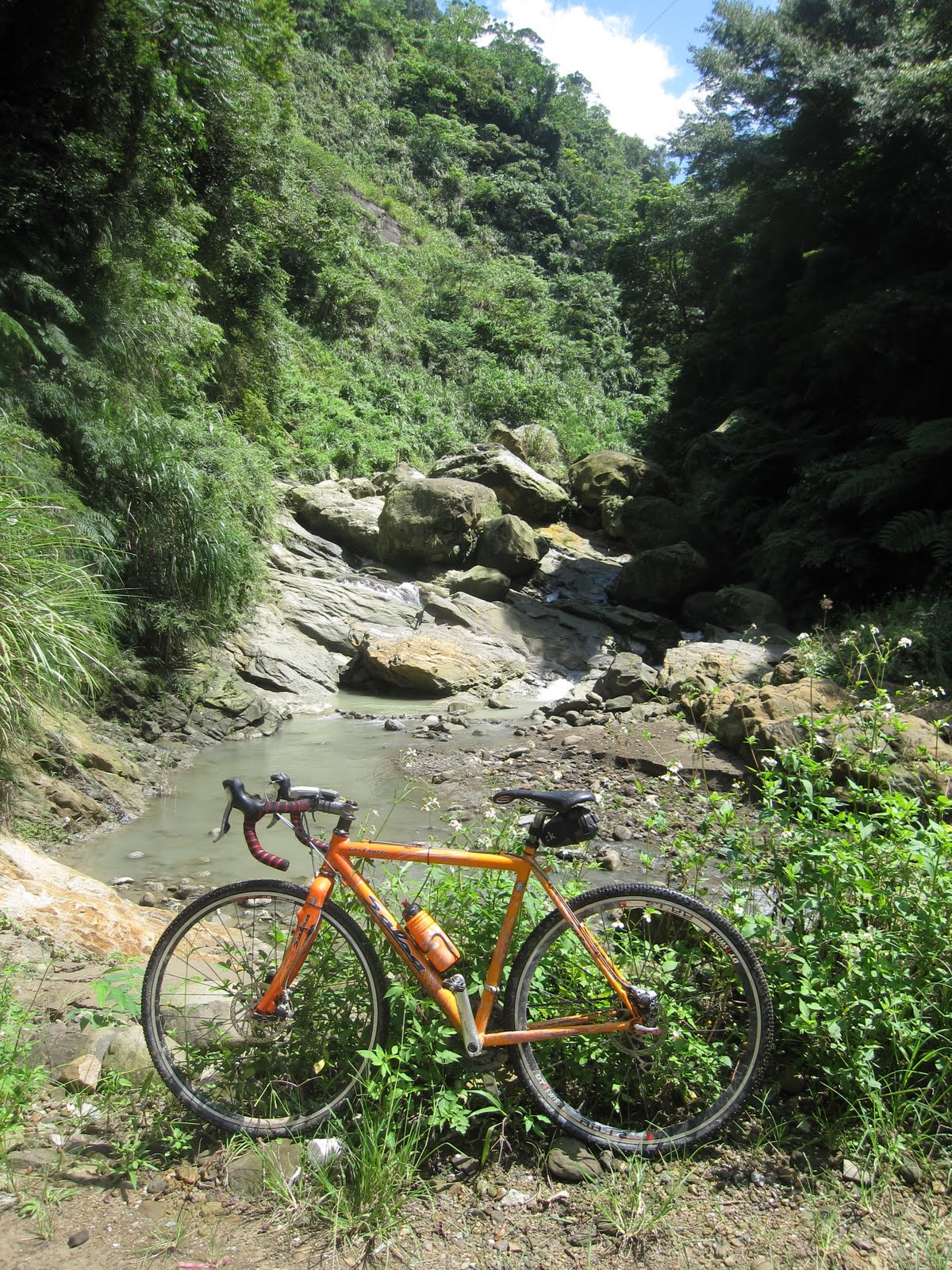
The bike looked beautiful. Mud and filth caked all over the frame and components.
Splatter
The discs performed flawlessly, save for a squeak in the rear brake.
Salsa's next CX bike could be the Sanchez (dirty)
Caution: This route and this kind of riding can be dangerous and expensive. It is easy to take a fall or lose traction. The bike takes a lot of the abuse, so the rider doesn't have to, and that means it is very easy to have a catastrophic failure out in the middle of nowhere. Do not do this unless you are prepared to replace parts or buy a new bike.
On the way out
Here is a little video of my adventure to give you all a look at how we do Jungle Cross in Taiwan.
All over the wire there is this story floating around. A bike thief in Chia yi city was apprehended by police after stealing a bicycle. Upon further investigation the officers discovered the family was living in squalor and the theft was morally justifiable in that the thief was merely trying to supply his daughter with some wheels to ride the 3km to the bus stop on her daily commute to her vocational school.
Most Taiwanese of a certain generation can sympathize with losing a bike to theft. In my wife's family everyone has lost a bike or two, but that didn't stop a family member from bringing home replacements that were "found" on the street. This bike for a bike behavior was widely practiced during the 1980's as many Taiwanese were beginning to express their affluence through consumer items and bikes were not so widely available. I remember something similar with helmets several years ago. If someone needed a helmet they would steal one and the loser would just have to steal a new one. It was somehow justified.
The moral of this story, if there is one, and I am not sure that there is, is that the modern concepts of law and justice in Taiwanese society are tempered by the more abstract traditional and structural beliefs in benevolence, fate and magnanimity (see this post). These beliefs also make law enforcement and judicial decisions seemingly arbitrary and calls into question the notion of justice as fairness.