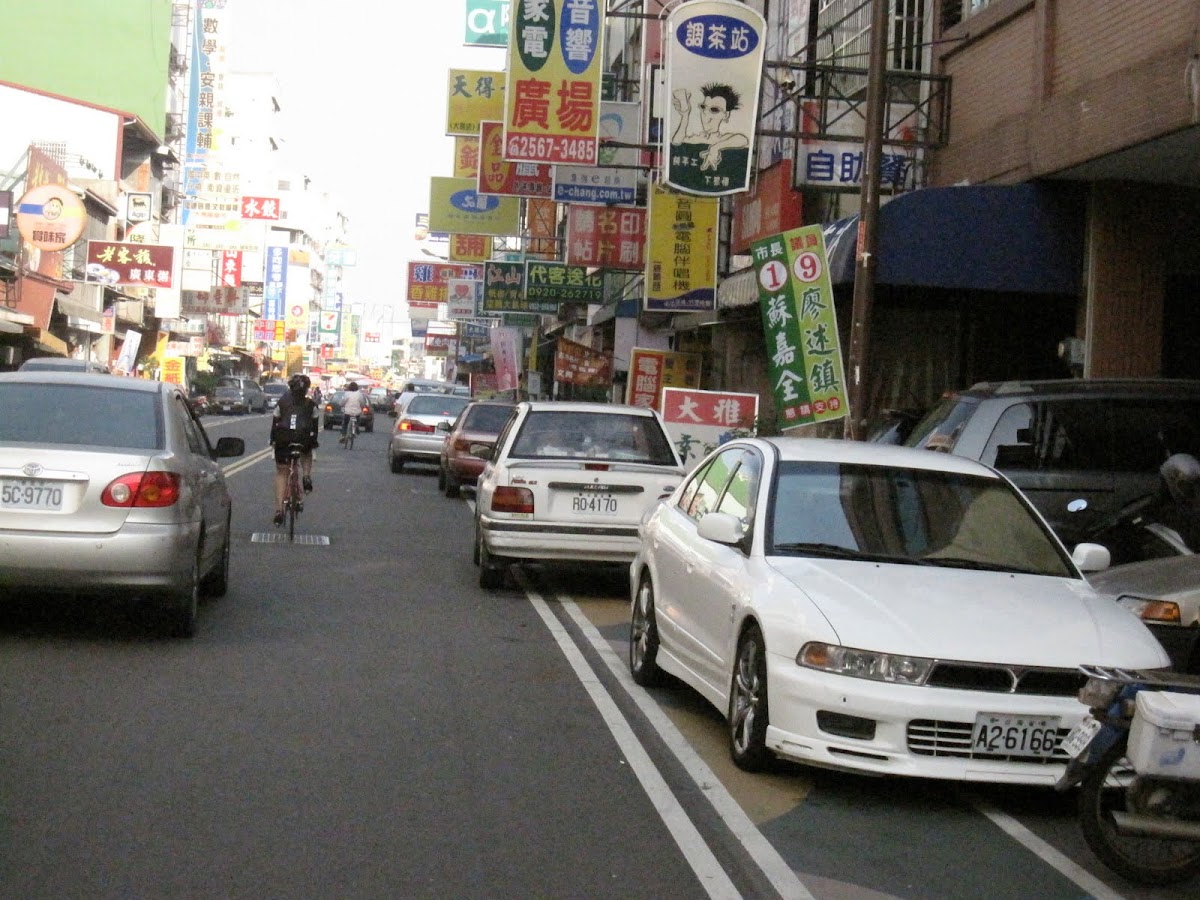
That Green Strip Is The Daya Bike Lane
The Taipei Times published an interesting letter from Bruno Walther from Copenhagen explaining how Copenhagen has committed itself to systemic change in regard to transportation and the bicycle's status within the transportation grid.
Walther makes some very good observations and touches upon a few things I have pointed out myself.
Walther states:
Copenhagen is achieving systematic change, where a car-dominated system is now being replaced by a public-transport system. The most important lesson is that all elements have to be implemented together because people will not make the switch to public transport as long as cars and scooters achieve the primary goal — getting from A to B — more effectively than the public transport alternatives.
Once public transport achieves this primary objective more cheaply, efficiently and safely, people will happily make the switch in large numbers, with great benefits to the urban environment, public health, and energy efficiency.
Piecemeal solutions will not be successful — see the Dunhua cycle lane disaster — but comprehensive, smart solutions will — note the case of Copenhagen.
The main point Walther makes is that Taiwan is lagging very far behind in terms of transportation and access, today's term du jure.
Walther cites how Copenhagen has dedicated itself to a comprehensive and systemic transformation from the private automobile to mass transit augmented by the bicycle.
So why is Taiwan having such difficulty in instituting a similar policy? As an island nation with a limited amount of land and resources for development, land that could be even more limited should sea levels continue to rise, one would assume Taiwanese would be ecstatic over revamping their transportation system to rely less on fossil fuels. Instead the Taiwanese seem bent on channeling funds into the tourism infrastructure rather than transportation networks.
There are several factors at play and this critique is entirely from my own experience, observation and educated guesswork.
1. Why is tourism taking precedent over transportation as Taiwan constructs a bicycle infrastructure?
As most cyclists have noticed, whenever the government announces any new investment in the cycling infrastructure, it is almost entirely focused on promoting tourism and recreational cycling. Whether it be a new bike route, rail car, trail, service or regulation, the overarching premise is that it will result in friendlier environment for bicycle tourism. We have stretches of bicycle lanes that take scenic excursions to nowhere for the purpose of tourism and recreation, but there is really nothing for utility transportation.
Many of Taiwan's bicycle projects are conducted in a piece meal fashion at the local level with very little input from the central government on how they can fit into a larger system of cycle-transport. There is also very little input from the intended users before a plan is put into place.
One of the major problems is that Taiwanese officials can not seem to agree on what cycling is exactly. I do not mean they don't understand the concept of riding a bicycle (though I wouldn't underestimate the intelligence of a bureaucrat)... what I mean is that the various government agencies that may have a hand in managing a future bicycle infrastructure are still at odds over which agency should be responsible for cycling. Some feel cycling is a recreational and athletic activity and therefore the related infrastructure should be managed by the Sports Affairs Council. Others feel cycling is transportation and should be managed by the Ministry of Transportation. There is plenty of bickering over government funds.
Another issue may be that by comparison tourism is the pennywise side of a pound foolish proposition in cycling policy. Over the past few years Taiwan has gone from promoting itself as the "Green Silicon Island" to highlight Taiwan's prowess in chip production and technology, to "The World's Largest Ball Of Twine Island", where everything is to be put on display for a tidal wave of free spending tourists from China.
Tourism makes great short term sense to a lot of politicians in many districts. The prospect of tourism dollars may seem irresistible in areas that are seeing their local industries outsourced as tourism does not require a tremendous amount of initial investment and it does not require much more capital than finding something to see or do.
The second part of the equation has more to do with flow.
If you haven't noticed, I seem to suggest organized crime is behind a lot of government decision making and operations. There's a reason for that... a hem!
Many aspects of the tourism industry are deeply involved with organized crime and thus tourism is a boon to the underworld who control so much of Taiwan's entertainment. Tourism benefits organized crime groups by maintaining a construction base from with the underworld can reap huge profits. Many... a hem!... Many construction companies are owned by crime bosses as one of his "legitimate" business. He may also own a gravel and concrete company to supply his construction company with cheap cement. In Taiwan when you see a construction contract awarded... assume there is some political payout hidden within. Construction projects are clean ways politicians use to patronize organized crime in exchange for political support and cooperation where the politician can also get rich. Tourism allows politicians to "invent" necessary construction projects. "If you build it... they will come."
Another part of the equations are the services that support tourism: restaurants, transportation, alcohol, lodging, and more illicit ventures. These all have heavy ties to organized crime. An entertainment facility could not operate without organized crime involvement. They either get a stake in the business through shake downs, or they receive contracts to deliver alcohol. Many tour bus companies are the "white" side of a "black" enterprise.
With tourism, both the construction and service sides collect government funding and funnel it into the accounts of people who play influential roles in mobilizing factional support for local politicians.
On the outside it looks, politically, like a good delivery of bread and butter to the townships. Tourists come, drop money, leave, and repeat. A politician may try to convince voters that this river of endless cash is going to be mutually beneficial.
A recreational bike trail is a very easy sell as it requires comparably very little investment and allows all types of rental shops and food service shops to open along the trail. It is also relatively easy to maintain.
Above ground, the tourism model is also preferred and in some cases sponsored by giants in the bicycle manufacturing industry.
Companies like Giant have taken a keen interest in taking the lead in developing bicycle infrastructure that favors its own business model. It is no coincidence that King Liu, founder and chairman of Giant Manufacturing Co. Ltd. holds a cabinet level position as a special advisor to Taiwan's president Ma Ying-jiu. For the time being, tourism fits Giant's model for providing bikes and support services for tourism. The fact of the matter is simply that Taiwan's two major parties, the Chinese Nationalist Party (KMT) and the Democratic Progressive Party (DPP) have both been major supporters of big business. Only the tiny Green Party has really held to a pro labor, pro environment platform.
Clean, green cities would probably be a greater and longer term draw for tourists and business, but it is too costly with too few immediate dividends.
Why isn't there more cycling advocacy in Taiwan?
This is also a complicated question. Although there are some cycling groups that seek to promote their own interests, there is very little advocacy in Taiwan for a more utilitarian approach to cycling as transportation.
I think at the root lies the Taiwanese relationship with politics.
The road to democracy was not easy and many people who did not live through it, do not understand how pervasive the authoritarian KMT colonization project was.
Between 1949 and 1988 Taiwan existed in a state of martial law where any political opposition or criticism was taboo. The KMT and its Chinese Nationalist ideology became the state religion. The closer one identified with the Chinese Nationalist ideals, the greater opportunity and social mobility one might have. On the contrary, those on the periphery were dealt with as untrustworthy and often denied access to power. Sometimes this discrimination was based on ethnicity, other times it was predicated on one's party allegiance. Compulsory party membership was required of all employees of the civil service and military, including conscripts.
With such power, to fall afoul of the government or displease someone with close relationships within the district or local party offices, could have serious repercussions. There were many avenues for political revenge during the era of "white terror". These included ruined credit, or jail time for any made up offense (advocating communism was a favorite). Furthermore, it was not uncommon for relatives and acquaintances to also be held responsible for another person's actions. This policy sought to create a system of paid and unpaid informants who might tip off the government to any dissent or budding insurrection.
The government's paranoia and people's use of that paranoia to settle personal disputes cast a chilling effect over Taiwanese public life that can still be felt today. You didn't want to accidentally meet the wrong person in fear of being implicated.
People do not want to get involved with politics. Involvement in politics is often assumed to be "dangerous" and stirring up political passions can have unintended repercussions. Many people don't want to "antagonize" a powerful constituency. Chinese nationalist ideology seeks to pursue "harmony". Many people would rather avoid friction or causing a situation where one party is feeling "incomfortable". Policy and politics is left to politicians. After such a long experience with martial law, many people do not feel empowered to get involved. There still tends to be an assumption of top-down leadership. There is also an assumed belief in the power of the presidency, when in fact, the (do-nothing) legislature can wield immense power that could be used to promote a more comprehensive and sustainable transportation infrastructure.
A related factor may also be that an issue like bicycle advocacy often requires a person's beliefs in cycling to run counter to their traditional and defensive voting pattern and thus it is socially easier to not rock the boat. Many people in Taiwan feel they are locked to support one political party over another, whether that party is working for the individual's interests or not, based on a defensive fear of change or losing some other privilege.
Lastly, the government doesn't seem to be interested in listening. The big interests have their say and that is the end of the discussion.
There are plenty of other reasons as well.
More thoughts...
Status:
Cycling for utility is often viewed as a "poor" person's transportation. In Taiwan, like other Confucian cultures, relationships are structured on a pyramid of status. These networks are extremely important and hold a type of decorum associate with them. Taiwanese often crave to gain status over another person through the acquisition of material and the giving of gifts. Utility cycling has not made it into a symbol of higher status, and thus less emphasis will be put on these activities.
Aesthetics:
Weather may also play a part as the humidity lessens the desire to use the bicycle as a viable form of daily transportation. It is difficult to slip into a shirt and tie after sweating outdoors. Many Taiwanese feel brown skin is unattractive and do not want to be exposed to sunlight. This preference reduces the number of people who would use bikes for transportation.
There will have to be a degree of cultural change before more advocacy can really catch on.


