body{background-attachment: fixed ! important; }

Thursday, August 19, 2010

Treatise On Superfluous Things: Giant "Woos" Women


The New Face of Women's Cycling?

“To get more women on the road, we have to get them to think of these things as accessories... Natural, everyday accessories, like handbags."-- Bonnie Tu, Giant CFO

As a man talking about women and women's cycling, I am sure I am putting myself in great danger of talking like an ass. When was the last time a man really understood women? I also have to say that in order to write this I had to... er... man up and actually put my sophomoric maleness aside or at least under a critical light to better do justice to this topic in a more mature way than I am usually comfortable doing. Since when has acting mature ever been fun? I am also inspired by the many women riders I have met and seen in my time as a cyclist in Taiwan.

Ok! Here goes nothing...

Now that my wife has finished her thesis, she has been exploring the idea of buying a bicycle for exercise and recreation. I have tried to keep my distance and only offer help when she asks, as I have a tendency to get really excited about bikes and then kill the buzz. Shhhh!

My wife has been doing a really good job with her research and I am having fun watching her do all the responsible stuff that comes with buying a bike. She has bought books, magazines and searched online for as much information as possible for what she should be doing.

And then I got the following email:

"I hate how they promote women's bikes"

Along with the email she included a link to the the Liv/giant website.

Liv/giant is a company-wide concept of products and retail space aimed primarily at women and at increasing the number of women who ride bicycles. According to Giant CFO, Bonnie Tu, who is also taking point on the Liv/giant campaign, the goal of the concept is to "woo women into cycling".

On this blog I have explored the idea of how women approach and interpret cycling, and moreover, how increasing women's involvement in cycling can transform the cycling landscape. Although Giant offers a range of bicycles for women, I am sadly disappointed in the way Giant perceives women and women's cycling. Despite the company's massive revenues and leading R&D, Giant by no means lives up to its name as a leader in the future of women's cycling.

The Liv/giant website linked above provides a fantastic opportunity to analyze and discuss the semiotics of Giant's message; a message that makes me increasingly uncomfortable.

The Website:

The link leads to a slick, modern website with large photo images and soft graphics. The sequential photo montage depicts a glamourous young woman in fashionable clothing, make up and stylish hair, relaxing and enjoying a life of leisure outdoors and on a boat. The images are indistinguishable from those you might find in the scented pages of the top fashion magazines, like Elle, Cosmopolitan, Vogue, and Marie Claire. In every picture the model is wearing a skirt or tube dress, and high-heels. At first it is difficult to discern what exactly is being advertised as a bicycle only appears in only four of the ten slides, the other slides seem completely irrelevant to cycling. It actually appears that the bicycle is merely an accessory to the clothes, make-up and the girl. That may be Giant's point after all... not to sell bikes, but to sell bicycle clothing to women.

Ready To Ride?

"We should not be too familiar with the lower orders or with women."--Confucius

It is obvious the model depicted in the advertisement does not ride a bicycle. If she were riding a bicycle she would not be wearing skirts, heavy fabrics or clothing that might drape into a chainring. Her hair would surely not be glossed into place and her make-up would have run down her face in the heat and humidity. She would not be white, and would have much better muscle tone. Unless she has clips in the base of those heels, I don't see how she does it. Nothing about the woman indicates that she rides a bike.

I am actually having a hard time believing this concept and marketing campaign was headed by a woman and a cyclist. Not only does Giant buy into and promote the oft repeated stereotype of women in Taiwan as vapid, silly creatures, who shallowly concern themselves with fashion and spend someone's money on handbags and accessories, but Giant, a company that sells one of the greatest tools for mobilization and liberation, employs imagery of their object from what feminist theorist, Laura Mulvey, identifies as the "male gaze", a term which borrows from Jacques Lacan to demonstrate how media images can be gendered to reflect the sole view of the heterosexual male as the predominant frame.

The fetishized, gendered images of the slender female body with ample necklines, bare, airbrushed skin, and voyeuristic glances up skirts, long, slender legs, appeals more to the mass-marketed male frame of of the eroticized woman that has been the the predominant grammar of fashion photography for decades. This type of fetishization of the sexualized female (for the pleasure of the male) does not empower women, but rather reinforces feelings of insecurity and a negative body image: These are not empowering images for the majority of women and they do not reflect women's athleticism, strength, power and determination. They are the exact opposite of how cycling should make a person feel. Nothing can encourage positive ideas of body image faster than by pushing the body to do amazing things and to accomplish the "impossible".
Gear For Cycling?

"Nobody should doubt that our women’s bikes are designed for women by women.”-- Bonnie Tu, Giant CFO

Bonnie Tu presumptuously claims to be the "godmother" of Women's cycling and yet I can't help but feel she views Taiwanese women through the chauvinistic and dismissive lens shared by so many men. Although many women (and men for that matter) in Taiwan (and elsewhere) buy expensive name brands and buy into modern materialism, Giant's concept feels even more awkward and patronizing considering the new roles of women in contemporary Taiwanese society... including Bonnie Tu, who holds the deputy post in one of the nation's largest and most successful companies. Compared to many countries around the world, including the United States, it is not uncommon for women in Taiwan to excel to become leaders in their respective fields and vocations. Taiwan has already had a female vice president and may very well have a female president or at least presidential nominee in the near future. Women not only hold high positions in politics, but also in every major vocation in Taiwan. Women in Taiwan have taken the agency to plot their own lives and careers to pursue a variety of interests. I am always surprised by the great plurality I have experienced in Taiwan. This is why I am so puzzled that Giant would reduce women's cycling to "an accessory, like a handbag". This is an insult to all the strong, intelligent and capable women out there who do not need to be coerced into buying a bike just to go with a good pair of pumps. Women in Taiwan are perfectly capable of buying a bike for any number of intelligent reasons, and do so.

On A Pedestal: Liv/giant Boutique in Taichung

Lastly, I feel this marketing approach is short sighted and irresponsible in many ways, not the least of which is the impact of selling bicycles as simply accessories. If this is a successful approach and manages to convince more women to buy bicycles it is easy to view it in a positive light. It might even be economically savvy and make lots of money for Giant. More power to them if women respond to this type of marketing. The downside is that although cycling is more friendly to the environment than automobiles, they do not come without an environmental price tag. The metals have to be mined, the materials transported, the electricity spent, and all the other little things that go with industrial production . A bicycle can only negate that footprint if it is actually used and used well. Selling bikes as superfluous fashion accessories that may do lots of sitting really does little to negate the environmental deficit of the bike's production.

I see nothing wrong, and lots right about a large bicycle company targeting women and giving women a space in the marketplace to explore cycling without the feelings of intimidation and inhibitions in dealing with a male dominated sport. The Liv/giant store does a lot of things right, but I DO wish Giant would approach women cyclists with more respect and the acknowledgement that Taiwanese women have the ability and the intelligence to approach cycling for its obvious merits and not for the superficiality of the runway.

"Let me tell you what I think of bicycling. I think it has done more to emancipate women than anything else in the world. It gives women a feeling of self-reliance. I stand and rejoice every time I see a woman ride by on a wheel... the picture of free, untrammeled womanhood."-- Susan B. Anthony


She Pedals Magazine


For an excellent alternative in the portrayal of women's cycling, I suggest the approach taken by SHE pedals magazine, a magazine devoted to women's cycling that depicts women cyclists enjoying the sport while maintaining their femininity without falling into a dated male caricature. I picked up a copy in Palm Desert and found it to be a provocative portrayal of the sport. Even in the cover image we see a silhouette postured to display independence and power. Her physique is not waifish, but fit. She is confident and assertive.

Good Advice

I would also suggest picking up a copy of Every Woman's Guide to Cycling: Everything You Need To Know, From Buying Your First Bike To Winning Your First Race by Selene Yeager. It offers more confidence building information for beginning female cyclists than Twiggy. Muscles like those will never get her in a Giant ad, but I bet she can kick some ass on the bike.

Women deserve far better treatment from Giant.

Bike Pic Of The Day

It's ok... he's a derailleur hanger

Tuesday, August 17, 2010

10yo Boy Collapses During Forced Bike Ride

Ummmm... This report from the China Times is so amazingly shocking and so full of ridiculous quotes, I am going to post the whole thing:

TAIPEI, Taiwan -- Police were called to rescue a 10-year-old boy, who collapsed by the roadside with exhaustion after his mother made him cycle part of the way on a 63-kilometer trip yesterday.

With not enough room on her 50cc scooter for her three children, the mother forced them to take turns on a bicycle during a journey from Nantou to Taichung.

The family was traveling from Taichung to visit relatives in Nantou. A one-way trip using their form of transportation took them six hours to complete. Their return trip was brought to police attention when a passerby saw a little boy sprawled out on the side of the street in exhaustion.

The woman claimed that she and her children — aged 12, 10 and seven — were unable to fit onto the small scooter. She found them a bike and made the siblings take turns riding it while she gave the other two a lift in the scooter.

When a passerby noticed a 10-year-old boy lying by the side of the street, they quickly took him to a nearby police station. The officer in charge described the boy as “soaked, tired and hungry,”noting that there were wounds on his elbows that possibly resulted from falling off the bike.

After treating the boy's wounds and feeding him instant noodles, the officer was told about the extent of his onerous journey. The family had already made the trek once, when they left home in Taichung for the children's grandmother's house in Nantou. It was on their return trip that they were nearly crippled with exhaustion.

In total, the family traveled 120 kilometers in 12 hours. Under questioning, the mother said she did not want to spend money on train tickets because she was afraid of motion sickness. When the police officer offered to give the family a lift home, the mother reportedly refused, put on her raincoat, and told her kids they had a long journey ahead.


Most of the insanity speaks for itself, but there is one issue that was only touched upon at the end, and that is how Taiwanese society deals with incidents of domestic abuse and neglect; especially in cases involving children. According to a recent report, of the 13,400 cases of child abuse reported last year, 87% involved one parent.

Although the number of reported cases of abuse and neglect has risen 35% since 2005, anyone with experience working around Taiwanese children and young people will immediately view the numbers with caution as the majority of cases are never reported.

Although the Child and Youth Welfare Law has been on the books and regularly amended since 1973, very few citizens who suspect cases of abuse, harm or neglect to a child actually file a report. Even government employees who are bound to report these cases, like the officer cited in the article, look the other way.

The reason many people in Taiwan do not take action in domestic issues has several causes that are both traditional and structural and these influences manifest themselves throughout Taiwanese society in many different forms. The first is a traditional Confucian view of relationships, which is constructed as a pyramid with elder males on the higher end and women at the lowest. Children and women have been viewed both traditionally and within the ideology of the ROC, as something "lesser" or "lacking" (I have another post on the way). Another traditional component may be the valuation of "harmony", which has been a major factor in social negotiation in traditional and contemporary society. Taiwanese often would rather restore harmony than incur the risks of disharmony. We often see these points negotiated at traffic accidents where it is more efficient and harmonious for the police and claimants to quickly negotiate a solution. Another related factor may be the Taiwanese recent experience with a strong, centralized state. In inserting oneself into other people's relationships one stands the risk of linking onto a wider network of relationships that may bring a whole new set of social and political liabilities.

In this case the officer restored harmony by allowing the woman to simply leave after reviving the child. Saves on paperwork!

Monday, August 16, 2010

Fat Zoning and Muscle Memory

Here are a couple articles that may be of interest to those who are training or want to start training.

The first is Matt Fitzgerald's new book, Racing Weight, about the myth of fat burning zones and on strategies to increase your weight to power ratio.

The second is a little article concerning some new research in which a team of scientists have discovered that muscles retain their memory of earlier form, far after you have destroyed them under layers of doughnuts, beer and reruns of Three's Company.

Taiwanese World Cyclist Goes Into The Wild

Taiwanese world cyclist, Wu Shih-chang, has safely arrived in Vancouver B.C. after a harrowing test of nerves and strength pedaling through the Alaskan wilderness.

Wu reported encounters with hunger and bears during the Alaska leg of his global adventure in which he hoped to stick to his meager budget of only $8000 USD allotted for his entire trip.

The Taipei Times reports:

Wu said he first thought that riding around the world on a bicycle was a romantic thing to do. After setting out, however, Wu said he came to realize there was nothing romantic about it, as he instead had to deal with loneliness and learn to survive.

Every day, he was busy thinking about how to make his food last until the next food stop 100km down the road and about where he would set up his tent that evening.

Wu said that during the first few days of his ride in Alaska, he miscalculated and didn’t bring enough food. With the next shop more than 100km away, his blood sugar levels dropped and he started feeling dizzy, as all the trees seemed to be white. After that experience, he said he never dared set out again on an empty stomach.

The bears probably wouldn't be a problem during the fat days of summer, but should be avoided in the spring when there are young cubs and in the fall when food supplies dwindle before hibernation as Timothy Treadwell learned in 2003.

Carrying enough food may be a greater issue, especially being from Taiwan, where there is always a 7-11, roadside stall, betel nut stand and in some cases roadside produce available for easy purchase. Many Taiwanese underestimate the vastness of continental living. My father-in-law could not understand why I could not take him to visit Seattle, San Francisco, L.A., Las Vegas and the Grand Canyon in 4 days of driving. Concepts of "far" can seem much different around the world.

Most of all, I would really like to applaud Wu for his spirit of adventure. It takes guts, brains and courage.

Thinking About The Future

A Random Sign On The Road

I think I have said it before and I will repeat it here again... I have been thinking a lot about cycling on this trip and especially in the comparison between the cycling I am seeing in Taiwan and what I happened to experience in Seattle and Palm Desert.

Component Pioneer, Phil Wood

Both places offer a wide gradient of cycling culture and share many similarities in execution, but there were also many structural differences that left me wondering.

Cycling Events Advertised

I think many of the structural differences stem from a common source: Our history and relationship with the automobile. When the idea crossed my mind I was taken by the idea that the relationship with the auto, which is often viewed as the antithesis to the bicycle on the roads, may actually be one of the chief drivers behind how cycling culture developed and continues to evolve in both Taiwan and the United States. The Seattle cycling communities seemed to greatly differ by city, neighborhood and city block. The type of riders you would encounter might change from weekend triathlete to urban commuter in the space of a hill. In Taiwan both utility, recreational and competitive riders can be found clustered together in and around urban centers with bike shops serving at the... er... hub of the group. Although this is similar to what many American bike shops do, I think there are some important differences.

Bike Shop

To keep from getting too long winded and at risk of over simplifying many of the dynamic forces, I feel a large part of the American cycling experience is built around the infrastructure and values that evolved around the U.S. Interstate Highway System, which was commissioned in 1956 under the Federal Aid Highway Act and with the support of the Eisenhower administration in promise and guise of "self defense". The "interstate" grew into the world's largest network of limited access roadways that could rapidly move goods and people from less densely populated areas to the highly concentrated urban centers. My grandfather was one of the chief architects of Washington State's Interstate network and believed freeways were the future of America.

Some Bikes On The Street

What my grandfather could not envision was the extent of suburban sprawl that would eventually creep further and further away from the cities and encroach into ecologically sensitive areas and watersheds. The cities became less populous as residents moved into the suburbs to grab up more space to enjoy the lifestyles of leisure being promoted as the "American Dream". Urban environments in many American cities fell into decay and many districts were left to the poor or deserted, especially at night. Rent control was often the only thing keeping some urban blocks populated. Even many of the poor moved into some of the more dilapidated suburbs. Urban centers were becoming less dense with more Americans requiring more land and resources.

Bike Touring

The focus of life in the suburban periphery became the automobile and the US transportation networks focused its sole purpose of providing infrastructure for the car. It was only in the past calendar year that this status quo has been challenged and changed to include bicycles and pedestrian traffic. With the challenge of the American romance with the automobile and lawmakers eager to snap up tax money to support the oil habit, cycling became a type of counter culture in opposition to car culture. Cycling was less convenient, less direct and impractical in a world where everything is a 10 min. drive away. Out of pet food? Hop in the car. Need to get stamps? Drive up the street to the post office. This is the world I grew up in.

Urban Grocery Getter

As the suburbs have moved to the limits of a practical commute and traffic congestion continuing to worsen despite the ever expanding system of roads, federal, state and local governments have begun asking government officials, citizens and land developers to rethink the future. The ideal environment for sustainable living is one in which people can live in more densely populated centers where a person's employment and needs are within non-driving distance. Many metro-areas have already begun repopulating the cities and making urban centers more livable and affordable.

Bike Racks

Seattle has begun investing in far reaching networks of bicycle routes, park & rides, bike-fiendly mass transit systems and other light infrastructure to better accommodate and integrate the bicycle into the new urban landscape. In an even bigger move, King County, the county in and around Seattle, has initiated a program to exchange sky for land, allowing developers to build higher downtown in exchange for buying and not developing green space. The counter culture of bicycle commuting is becoming a normal and integrated network with plenty of community support.

Bikes At Fancy Restaurant

Taiwan experienced a different economic and industrial trajectory in which much of the industrial infrastructure was built up by the Japanese during Taiwan's 50 years as a Japanese colony. Much of Taiwan's development occurred parallel to development in many parts of the United States. By 1906 Taiwan's transportation system was complete and would remain largely intact and unchanged until the 1960's and by 1935 there were over 7000 factories employing 68,000 Taiwanese workers. This number jumped to 143,000 industrial workers by the height of WWII.

Simply Enjoying The View

Despite the rise in industrial labor, Taiwan would not be counted as an industrialized nation until 1965 when the urban population reached 5 million. Taiwan experienced rapid economic growth as the United States supplanted Japan as Taiwan's chief market for export. Many Taiwanese families that could not leverage their ethnicity for government work, higher education used family capital to start small to medium sized industrial enterprises on land that had once been family rice field. 3.75 million urbanites over 12 years of age were gainfully employed.
Many Places To Lock A Bike

With economic growth came growing affluence and one symbol of that affluence was the light 2 stroke scooter or motorcycle to replace the bicycle and pedal-cab. Automobiles were still largely considered out of reach for most families until the mid 80's. The scooter provided a quick, reliable and relatively cheap form of transportation that not only reduced reliance on other forms of transportation, but also allowed more Taiwanese to enter the workforce; especially women. The utility bicycle became representative of "the poor" and the scooter became a prestige item.

Bike Lane On Bridge

Wide Shoulder For Bike Traffic

Taiwanese cities expanded and continue to expand, but remain densely populated with most people's needs within a short walk, bike or scooter ride away. In many general ways Taiwanese cities represent the modern American aspiration for the city. There was no need for suburban sprawl and Taiwanese live together in the urban setting despite socioeconomic class and many families only have one car, not one car for each member. The roads do not act as great dividers of populations as they do in America where the wealthy in Bellevue all live in a certain area and buy carbon TT bikes for a weekend with friends... or the poor urban dishwasher who rides an old steel beater to work. In Taiwan a Colnago might live next to a Jelum.

Bike Corridor

Power Line Trail Converted To Bike Corridor

This very efficient urban lifestyle in Taiwan is in decline as bubbling housing prices and exaggerated property values that are prone to speculation have begun making the cities unaffordable and unlivable for all but the most affluent Taiwanese or potentially wealthy Chinese who are being courted to fill the bubble and make very few... very rich. The centers are becoming unlivable.

Cyclist On Freeway

Father And Son Out For A Ride

Taiwanese are being pushed further and further from their workplaces and the efficiency of urban living is in greater decline. More Taiwanese, especially in the North, are seeing their commutes stretch into the hours with little sign of respite. While the United States is busy courting a Taiwanese-like model for urban living, Taiwan is beginning to emulate the United States.

Space Savers

Actual Awareness "Give Cyclists 3 Feet".

From what we have seen as of late, the central and local governments have placed a higher priority on recreational cycling over utility cycling with an expanded tourism infrastructure, but little development for the growing need for commute-friendly pathways, safe bike lockers and practical spaces for bicycles.


Bike Lockers

This is where Taiwan can learn from cities like Seattle and start seriously integrating the bicycle into the transportation infrastructure to make it easier for residents to avoid automobiles and scooters in their commutes and employ alternative forms of transportation like mass transit and park & rides that work in conjunctions with the bicycle for transport and not just recreation. I know this is a simple narrative, but it gives me a great deal of food for thought

Mixed Messages

Saturday, August 14, 2010

Happy To Be Home: 91 miles Around Miaoli County


Despite my month of traveling to exciting and far away places, I was happy to be home and on my own bike. I was even happier to be again be riding through Taiwan's beautiful countryside.


I had planned to ease into my weekly riding again with a route that wouldn't be too demanding and I also wanted something new. I checked my map and thought the Miaoli 60 to the 119 looked good and I had never ridden that road. So with thoughts of boundless adventure, Michael T. and I sent out for a day in the saddle.


By the time we found the Miaoli 60 just before Dahu the sun was ablaze overhead and we were drenched in sweat. The hills looked a bit more intimidating than I had envisioned, but it is always worth a try.


Everything seemed ok until the road practically disappeared. It abruptly went from road to track. Luckily (or not) we ran into some strawberry farmers who shared their prickly pears with us and told us the road was passable and moreover, they would applaud us if we rode up it. I took the bait and hammered up the grade with all my weight over my handlebars just to keep the wheel on the ground.


The brutally steep roads continued up to a peak where I prematurely congratulated myself for making quick and easy work of such a bastard of a climb.


My spirits were dashed as we descended into a quiet valley that merely promised more climbing to get out. We were both burning up by this point and begged a farmer to let us douse our heads under a hose.


The climb out of the valley was darkly shaded... if only to conceal the steepness of the climb. It seemed there was a double digit grade behind every corner with no space for recovery. The only thing I could think of to make light of the situation was the descent on the other side.

Finally, we reached the peak, where a family nominally ran a local tea stop. Rest, water, sport drink and a lengthy examination by the kids later, we were ready for a forearm busting descent down similar grades as those we had just ridden up.


The nerve wracking decline eventually mellowed into one of those verdant river valleys that hide along the hills of Taiwan's plain. We just glided down hill, along newly paved roads and through villages that have not yet been infected with the tourist bug. The 119 took us out to the 128, where we could make it to Tong-luo for lunch.

After a filling of dumplings and noodles, it was again time to make hay for home, but not before hitting the coast and the shade of the 61 Freeway.


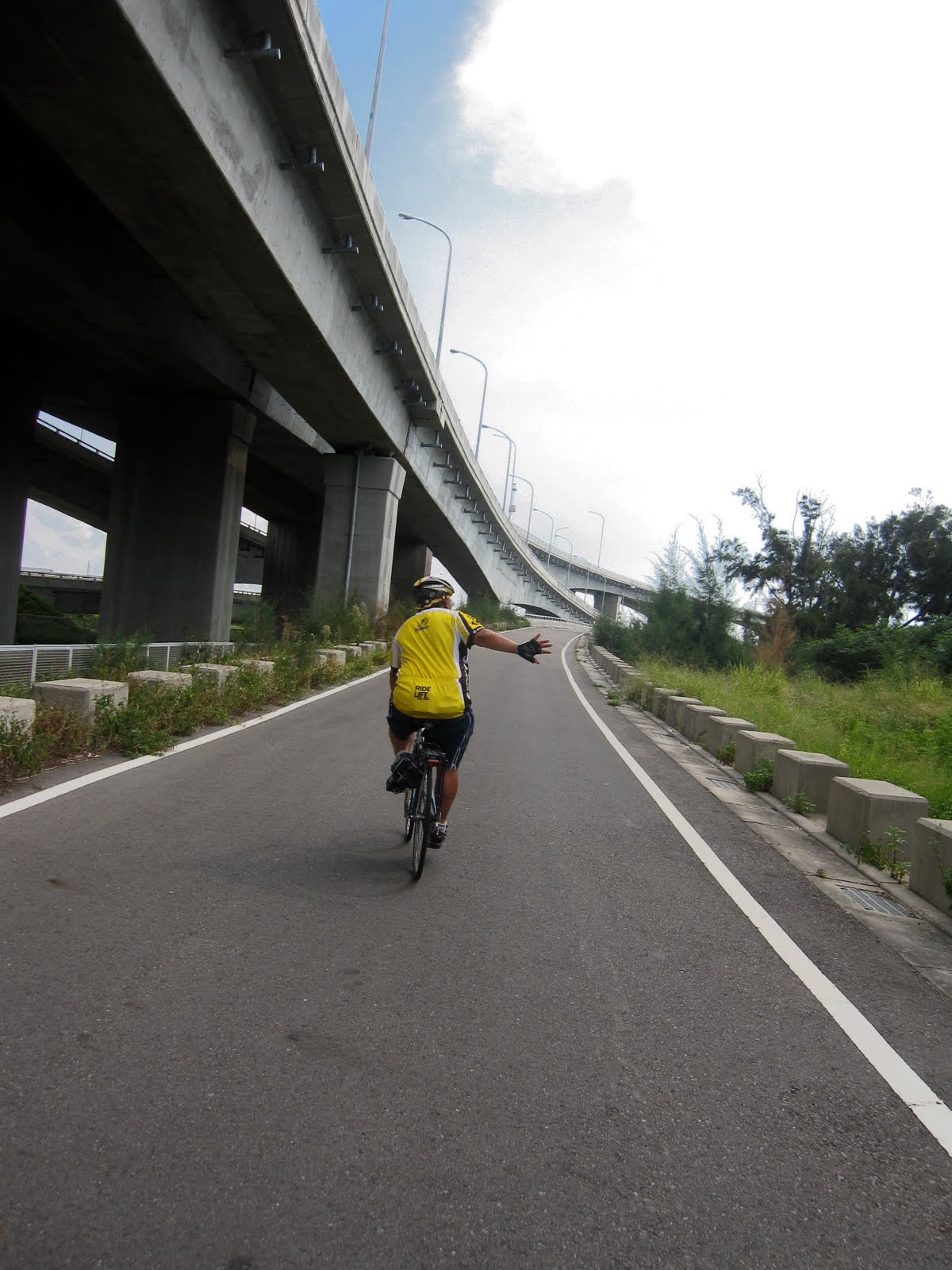
We hugged the coast and passed countless groups of locals who had moved their old furniture out under the viaduct to make a defacto clubhouse beneath the span. The area is quiet and sometimes desolate and the cool breeze coming off the ocean was exactly what we needed.

At last we hooked up to the 140, a long, flat, straight and direct road that doesn't have much to admire other than its directness. It took us behind the Red Burned Mountain to the 13 under the Sanyi Interchange, where we could head toward Houli and Fengyuan to home. Right as we started pulling into Fengyuan, the clouds opened up and I was quickly sopping wet. I just continued home at a rapid speed and took a nap.

I would seriously recommend the Miaoli 60 to anyone who is a good climber, who wants to be a good climber, and completely trusts their equipment. Those are some hill climbs!


Bike route 651228 - powered by Bikemap