body{background-attachment: fixed ! important; }

Friday, May 6, 2016

Short Rides: Friday Links

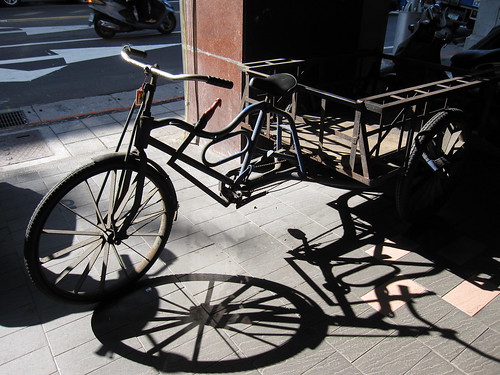
Untitled Ebikes: 

Beginning July 1, Taiwan's Ministry of Transportation will be tightening regulations on Ebikes requiring riders to be licensed and the vehicles to be registered with the MoT. The new regulations will view the Ebike as a light motor vehicle as opposed to a bicycle. The move was due to the sharp rise in collisions between Ebike riders and pedestrians. Taiwan's strategy is a bit more subtle than the heavy-handed approach China has taken to address the problem by banning the vehicles in several major cities. 

Travel and Politics: 

A traveller from Hong Kong uses the bike to take a gentle dig at Beijing by contrasting Taiwan's urban development to Hong Kong's recent trajectory. 
On our first stop in Taipei what struck me was the freedom of movement; there are bikes everywhere. 
It’s similar to the mainland in that regard, but you soon notice how the government has been responsive to the needs of its citizens. 
Everywhere you go in Taiwan there are bike paths, sloped shoulders to drive on and off the pavement, and even lights specifically set up for cyclists to bike diagonally at crossing. 
As a tourist I felt I could travel anywhere with little concern for practicality.
 Pollution and Commuting: 

The Guardian has put out a piece that claims the benefits of cycling outweigh the harm caused by inhaling exhaust fumes in traffic.
The researchers modelled the effects of cycling and walking at different levels of air pollution and established a tipping point – the length of time after which there was no further health benefit, and a break-even point, when the harm from air pollution began to outweigh the health benefit.  
For Delhi, the most polluted city on the World Health Organisation’s database, the tipping and break-even points for cycling were 30 and 45 minutes per day respectively, while for walking they were 90 minutes and six hours and 15 minutes respectively.
While the researchers looked at the levels of particulates – PM2.5 – in the air and not NO2, which has also been established as harming health, “we did lots of sensitivity analyses and the message would have been the same”, said De Nazelle.
Personally, I don't feel braving PM2.5 levels over 150 is enough to convince me to test the researchers hypothesis. I do know that my asthma will flare up after riding in that shit and we should all be lobbying to not have to make the choice to bike in it at all. I guess they are trying to get us all to feel better about the realities. 

Disc Brakes: 

Don't throw away that disc brake equipped bike just yet... it appears the UCI has decided to give limited testing another go this June.  

Wednesday, May 4, 2016

Ride of Silence: May 18th in Taipei

Untitled
"The graphic above represents Taiwan's bicycle casualties over the past year:
Each broken bicycle on this page represents a broken home. We located the corresponding information from the accident data provided by the government, although it has been difficult to find (and not entirely a full account), I hope we can remember those lost riders. They were once a story with blood and tears in their lives, not just a government statistic. May they rest in peace."
--Ride of Silence-Taiwan (for the full interactive graphic in Chinese, please go to the Ride of Silence Taiwan website)

Taipei will be joining over 250 other cities worldwide in the commemorative Ride of Silence; a rolling memorial to all the cyclists who have been killed on the streets in Taiwan and around the world in cycling solidarity.

Where: The Ride of Silence starts at the Ximen MRT Station and follows a 10k route to the Songshan MRT Station. (MAP)

When: 5/18/2016, 7:00-7:30pm.

What: 

  • Organizers hope riders will show their solidarity by wearing either black or white clothing, while keeping the mood respectful of the victims.
  • Riders should keep the mood subdued and ride in silence at no more than 20kph for the duration of the ride.
  • Riders will be required to wear helmets and obey all traffic laws for the duration of the ride.


Tuesday, May 3, 2016

Taiwan's Public Cycling Decline

Untitled

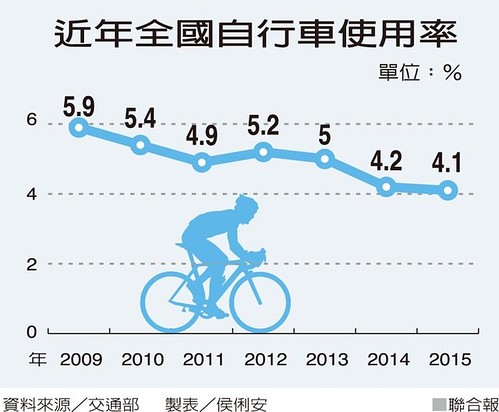
The United Daily the Liberty Times both have reports detailing the Ministry of Transportation's report on a steady decline in bicycle use nationwide.

Taiwan, which often bills itself as the "bicycle kingdom" in promotional material, is experiencing a contraction in the use of public bicycles as well as bicycles for transportation.

The key factor, as pointed out by the Ministry of Transportation, was the easing of fuel prices over the past year, which has encouraged people to opt for the use of personal motorized transportation for shorter trips. Many respondents also cited "convenience" as a factor.

While bicycle use has grown in Taipei, New Taipei City, Hsinchu, Hualien and Pingtung, ridership has fallen elsewhere, negating any gains. According to the data, Yilan, Yunlin, Miaoli, Kaohsiung, Taoyuan, Taichung and Tainan all experienced negative growth in ridership over the past seven years. The Ministry of Transportation feels the expected rise in gas prices could again fuel growth, but some experts are less optimistic.

It is also interesting to look at the areas that experienced the greatest growth and to wonder about infrastructure spending and government subsidies in those areas as they correlate to political alignment.

The study also found that riders between 15-18 years of age were most likely to participate in bike-share programs--a statistic supporting the assertion that Taiwan's bike share programs do little to cut emissions.

In most areas, there is still no real space for bicycles on the roadways, making commuting by bicycle inconvenient, impractical and dangerous.

While Taiwan's bicycle programs have been highly touted in the international press, this report really serves to highlight the disparities between Taiwan's far north, and the rest of the country, as well as how few reporters ever venture out of Taipei.

It could also be that the bike trend is over in Taiwan.    

Monday, May 2, 2016

What's Wrong With The Bicycles?

IMG_8380 

  “Our future lies in China and one of our goals is to develop this rapidly expanding market”--Giant CEO, Anthony Lo (2011)


Despite all the glad handing and praise the bicycle industry is facing some serious challenges in the short to medium term. There are increasing signs that things are not all well in paradise despite the passage of the Economic Cooperation Framework Agreement (ECFA), which was rapidly pushed through Taiwan's legislature and signed by Taiwanese and Chinese representatives in 2010.

“The markets are changing so fast that the rules have been reset, and if we don’t catch up, it is going to be harder for us to hold our own in the global market,”--Giant CEO, Anthony Lo (2013)
Aside from the chemical and mechanical doping scandals that have plagued the professional peloton--bicycling's advertising juggernaut--and possibly squelched interest in the sport, brands have been looking toward new technologies to buoy the industry and churn profits in a sluggish year. Shimano had been a major proponent of disc brakes in the pro ranks for some time and had been expecting reap the benefits. Now with both the UCI and the French Cycling Federation banning the components, a major source of market stimulation has been destabilized. 

Shimano profits are down 20% in the first quarter of 2016, and SRAM is tightening its belt with layoffs due to flagging sales. SRAM's plan to layoff 40 employees deemed "redundant" by the company will be spread over the company's global business, including the United States, Europe and Asia. 
“No one ever wants to be in position to request that people leave an organization, but sometimes it has to happen. I am confident that this restructuring positions us where we need to be and puts us on a firm foundation to drive forward into an evolving bike market.”--SRAM President, Stan Day
Wholesalers carry too much inventory into the first quarter, with the new product year looming (what is it now, May?). 
The lack of sales growth over last year is worrying in light of better weather conditions in much of the country this year. The Upper Midwest and Northeast were slammed with heavy snows in early 2015 but saw better conditions this year. However, the BPSA figures show that sales to retailers in January and February still lagged, though March wholesale sales showed a 6 percent improvement over 2015. 
Suppliers are seeing slow road and cruiser shipments at the start of the year, with road bike sales falling 9 percent overall. But mountain bike shipments are up 13 percent, and hybrid and commuter are up 16 percent.
The trouble coming from the two largest suppliers of drivetrain components is especially ominous, especially as Shimano does not simply supply the high-end, but supplies drivetrain components for everything from Walmart children's bikes to the Tour de France. A sizeable dip says a lot about demand in all sectors and that may have some serious repercussions in Taiwan. But hey, China is where its at, anyway. It is the world's largest emerging market and Taiwan has a free pass, right. 
Now, as a little reminder, ECFA was supposed to stimulate trade between Taiwan and China, opening up China to imports from Taiwan, with the bicycle leading the way on Early Harvest list set for an immediate and lasting impact. In a report from 2010:
Giant Global Group plans to increase its investment to build a bicycle plant in Kunshan, which has gained great support from the mayor of Kunshan Guan Aiguo. The 40-hectare new plant will consist of plants for bicycles, frames, carbon fiber and electrical vehicles. Besides, the cycle track & bicycle theme park plan will also be pushed forward. The investment in the initial stage amounts to USD 36 million (NTD 1.16 billion). 
Sources revealed Giant Global Group currently possesses a bicycle plant in Kunshan with an annual output of 2.5 million. As the Group's largest manufacturing base in the mainland, the plant boasts about 50% of the products meeting the domestic market demands. After being put into operation, the new plant will meet the market demands for both GIANT and MOMENTUM and the plant will trade with Taiwan bicycle plants after the signing of ECFA.
So, how are things looking in the post-ECFA world
Taiwan’s economy contracted on a yearly basis for a second straight quarter as China’s economic slowdown dragged on the island’s exports. 
Gross domestic product fell 0.28 percent in the three months through December from a year earlier, according to preliminary data released by the statistics bureau Friday. That compares with a 0.6 percent drop projected by the median estimate in a Bloomberg survey of economists and the 0.63 percent decline in the third quarter. The economy grew 0.85 percent in 2015. 
Taiwan’s exports shrank last year as local manufacturers grappled with the double whammy of slower economic growth in their top market China and tougher competition from mainland rivals. It wasn’t all bad news though: The economy grew 3.22 percent at a seasonally adjusted annualized rate, the most since the third quarter of 2014, as lower crude prices helped consumers.
Exports totalled USD 22.2 billion in January, which represented a notable 13.0% contraction in year-on-year terms. January’s result represents a slight improvement over December’s 13.7% drop. Imports tallied a total of USD 18.7 billion in January, which was a sharp 11.7% fall over the same month of last year. The figure came in above to December’s 14.8% decline. 
FocusEconomics Consensus Forecast panelists expect exports to fall 0.6% in 2016 and to rise 3.9% in 2017.
But at least we have the growing demand for E-Bikes in China to make up for the dip in high-end/high-margin leisure bicycle consumption, right? The E-Bike is the fastest growing market segment for bicycle manufacturers and China is leading the way

Following legislation in Beijing, Shanghai and Guangzhou, it has been reported that Shenzhen may also start to limit the use of electric bikes. Chinese people are getting wealthier and buying more and more cars, which as we know has caused many problems, such as heavy traffic, serious air pollution and poor physical health in big cities. In fact a highly viable alternative to fossil fuel powered vehicles is already available; bicycles and e-bicycles together with public transit form a good system and a true solution to the problem.
The Chinese market for Taiwanese bicycles declined by 33% to 79,000 units. Though not yet that large, the Chinese market was seen as a main growth market for several years. This development has now stopped due to the economic decline in China.

Sunday, May 1, 2016

Portraits: Narcissism

Untitled

Funny, I rarely ever get to see myself riding a bicycle. I usually have to settle for pictures of the bike to add scale to pictures.
Here are a few outtakes from Saturday in and around the twilight villages nearLongjing (龍井) as I put these DT Swiss Dicut RR21wheels to the test on a few hill repeats and slo-mo captures.  

Untitled Untitled Untitled Untitled Untitled Untitled

Friday, April 29, 2016

Bikes, Sex and Power: Taking Back The Bike

Untitled

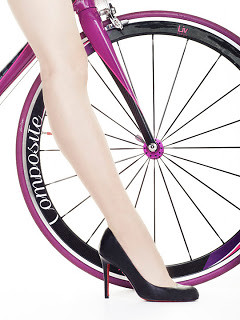
A few years ago I wrote a small article--one of my earliest-- in regard to Giant's Liv Giant line of women specific bicycles and related products. The marketing campaign at that time--the one from which I found the title picture of this post-- featured a whole assortment of sizzling glamor shots depicting a menagerie of pixie-waif models painted in couture make-up, exquisitely styled hair, wrapped in flowing designer gowns, and capped with nine-inch heels. The models were on boats and, in one case, seemingly out beyond the Dune Sea, with the occasional Giant branded downhill mountain bike or road bike in partial view.

The Liv/Giant project was the pet project of Bonnie Tu, Giant CFO, who enthusiastically took to the cycling press to promote her vision of women's cycling.
“To get more women on the road, we have to get them to think of these things as accessories... Natural, everyday accessories, like handbags."-- Bonnie Tu, Giant CFO 
Imagine if the above statement had been uttered by a man.... Being a woman does not excuse Bonnie Tu from overt sexism.
"Obstacles still exist: Asian women don’t want to get a tan from being outside and they fear looking masculine on a bike. But with a focus on fashion and lifestyle, Giant’s boutique is making inroads with upper-class, executive women, said Tu while giving BRAIN publisher Marc Sani and I a tour the day before the Taipei Cycle Show."--Bonnie Tu, Giant CFO 
"What she’s
found: “Men are concerned more
with tech and performance. Females take technology for granted — it’s important, and they assume that they are getting the best. But as women, we believe we are entitled to something chic, beautiful, and distinctive. We believe design should be better. We care about the total look.” --Bonnie Tu, Giant CFO(2016) 
At the time I was completely astounded by the amount of absolute contempt a successful female business leader in Taiwan could have for both her customer and her gender. and I wrote:
Bonnie Tu presumptuously claims to be the "godmother" of Women's cycling and yet I can't help but feel she views Taiwanese women through the chauvinistic and dismissive lens shared by so many men. Although many women (and men for that matter) in Taiwan (and elsewhere) buy expensive name brands and buy into modern materialism, Giant's concept feels even more awkward and patronizing considering the new roles of women in contemporary Taiwanese society... including Bonnie Tu, who holds the deputy post in one of the nation's largest and most successful companies. Compared to many countries around the world, including the United States, it is not uncommon for women in Taiwan to excel to become leaders in their respective fields and vocations. Taiwan has already had a female vice president and may very well have a female president or at least presidential nominee in the near future. Women not only hold high positions in politics, but also in every major vocation in Taiwan. Women in Taiwan have taken the agency to plot their own lives and careers to pursue a variety of interests. I am always surprised by the great plurality I have experienced in Taiwan. This is why I am so puzzled that Giant would reduce women's cycling to "an accessory, like a handbag". This is an insult to all the strong, intelligent and capable women out there who do not need to be coerced into buying a bike just to go with a good pair of pumps. Women in Taiwan are perfectly capable of buying a bike for any number of intelligent reasons, and do so.
I wrote a follow-up with a little more insight into the problem:
" under capitalism, patriarchy is structured so that sexism restricts women's behavior in some realms even as freedom from limitations is allowed in other spheres. The absence of extreme restrictions leads many women to ignore the areas in which they are exploited or discriminated against; it may even lead them to imagine that no women are oppressed"-- bell hooks
In the wake of that first article I learned that Bonnie Tu and several high ranking decision makers at Giant had, in fact, read my article (I honestly felt flattered) and I learned they had actually discussed my observations, but they felt steadfast in their decision to move forward with their marketing campaign--a campaign that served to depict women as sexualized objects too weak and too insipidly stupid to not only dress appropriately for cycling, but to not even be able to feature them using a bicycle. Yes, the women in the advertising were not even pictured using the products they were hired to sell. I was disgusted by the blinding arrogance in the upper echelons of a company where nobody dared to step up and point out such a disastrously wrongheaded mindset for such a forward thinking company. 
"All major brands claim they design specifically for women, but it’s not true. It means something when I say I’m the godmother — nobody should doubt that our women’s bikes are designed for women by women."--Bonnie Tu
 That was back in 2010.

The bicycle is one of the most egalitarian inventions to come out of the machine age. It is a great equalizer that has been leveraged to not just provide physical mobility across the strata of age and gender, but it has also provided socioeconomic mobiliy and empowerment to the powerless. The WorldBank even commissioned a report on the impact of transportation and empowerment of women. So it is a shame to see how it is marketed.
One of the most advocated interventions by development agencies has been provision of bicycles in the rural areas. Though it might seem a positive, benignant intervention on surface, a little unearthing of the gendered aspect of bicycle usage will reveal that many cultures do not accept such movement of women primarily due to rigid culture underpinnings in women’s movement and its representation. Overton (1996) documents a case in rural Mozambique where bicycles that were distributed to poor village women to alleviate their extreme transport burdens were taken from them by their husbands or other male relatives, who often only used them for recreational and status purposes. 
Now, we come to see how little attitudes have changed, especially at the highest level of cycling for sport where the embedded sexism of the entire sport was encapsulated in the one utterance of Shane Sutton, (resigned) head of British Cycling, who glibly told cyclist Jess Varnish that se was "too old" and to, "just move on and go have a baby."

Lee Rodgers boils it down:
“The men get all the glory and TV coverage as they are doing a ‘proper job’,” she writes, “while the girls are ‘allowed’ to be there on the day. That would be sexual discrimination by design. The rewards would follow the coverage, so the men would get the prizes and the girls some token gifts. Welcome to the reality in the world of elite cycling where sexism is by design. And cycling is not alone. 
“When challenged, those at the top of these sports are well versed in the platitudes they need to put out to deflect the temporary criticism. A well-crafted statement of intent, a desire to rectify; but the reality is decades of inaction. Sexism spins all the way down from the top to the bottom. Somewhere in the middle of this are Shane Sutton and Jess Varnish.” 
She’s right, and anyone who would argue against is nothing less than stupid or willfully misogynistic – or both, as the two do both go hand in hand. What will happen here, once the initial hullabaloo has died down (and it wasn’t exactly a cacophonous din in the first place), is absolutely nothing. Sutton will retain his job, Varnish will be labeled a trouble maker as Cooke was, and the world will trundle on as before.   
When I think about the gendered state of cycling and when I think of cycling's non-gendered potential, I see no difference between the opinions of Bonnie Tu, Shane Sutton and the men of Mozambique. They are all misogynists. Like the men from Mozambique, Bonnie Tu wants to reduce the bicycle and therefore the woman, into a mere status symbol, a tool of recreation, and an image to be consumed by a male. Giant's marketing scheme is aimed entirely at the male gaze, not the female cyclist. Shane Sutton's views are those of the consumer. He wants to consume the female cyclist, use her for her powers as long as she is useful to him, and then disempower her by separating her from the source of her power and mobility so that she can assume a gendered social role.

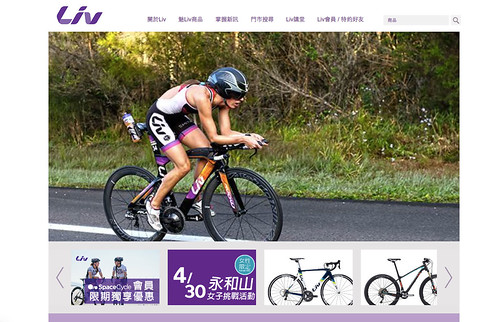
As I go back, six years later, I am pleased to see that someone more important than myself has gotten ahold of Giant's ear and redirected Liv/Giant toward a more inclusive culture of what women's cycling can be. UPDATE: (The voice comes from Mark Stocker's DDG agency in Taipei...read between the lines here.) Giant's new website is full of women enjoying almost every aspect of cycling and actually using the products. These are athletic women, these are independent women, these are muscular women, these are woman with an entire range of identities; mothers, daughters, wives, people, athletes and cyclists. These are more like the people I see on the bicycle. The next boundary to break might be age. There are no senior cyclists pictured.

Over the past month I have been involved with two solo tours of Taiwan undertaken by two different and inspiring women. Neither of them were in gowns and make-up. They were covered in road grit like everyone else. 

My point is, if over the course of a few years Giant is able to see its erroneous thinking, and reimagine how the company imagines women in cycling... then why can't the rest of the sport and industry make the same choice. Of course, I am not going to believe the change in heart has anything to do with anything other than good business sense, but even in the shrewd world of making money it is evident that bringing women's cycling on par with the men's sport, is simply good business.   

Giant is not perfect by any means, and they have numerous other issues, but this is one case where being Giant did not stop them from making some serious changes in realigning themselves with the realities of its customers without demeaning them. Now if Ms. Tu would kindly step away from the mic.  
   

   Untitled

Tuesday, April 26, 2016

Keeping Swiss Time: Inside DT Swiss-Taichung

Untitled

When most riders shop for a new bicycle, most of the emphasis is placed squarely upon the frame. Is it light enough? Is it stiff enough? Will it make me faster? Is it sexier than I am? The frame is really the heart of the bike. It is the truss that supports all other systems. So if the frame is the heart, then the soul would have to be found in the wheels. To reference Willian S. Burroughs in Words of Advice for Young People, "...not every soul is worth buying."

If riding a bicycle is, as Robin Williams believed, as close as you can get to human powered flight, the wheels serve to tether us to terra firma...if just barely. Wheels are an extension of our senses on the road--a palm to read the braille of the road or the scuff of the track. They transmit the earth below us into our bodies and we telegraph our reply back into them as the circuit of communication with our machines. Riding a route is to physically experience the terrain with all of our senses. The wheel is what gives a cyclist the super powers to climb up or to plunge down alpine slopes or skim the earth at blurring speeds powered by no more than our own legs. We owe so much of our saddle top experience to the input we receive from our wheels, and yet, they tend to be the most neglected of a bicycle's components as their value is the least understood by the consumer. Bike brands know this and the wheel becomes the sacrificial lamb in generating the most palatable MSRP.

For cyclists who understand the vital role an excellent set of wheels plays into ride performance (possibly more important that the groupset), a wheel upgrade is usually a first priority.

When it comes to building a complete, high performance wheelset, there are few manufacturers that can compare to the pedigree of DT Swiss, the wheel and shock manufacturer from Biel, Switzerland.

Although DT Swiss can follow its roots all the way back to the Swiss metallurgic culture of the 15th century (and possibly beyond), as the technology for drawing wire matured in and around Biel, the modern incarnation of DT Swiss AG was forged through a partnership amid the fractured remains of the United Wireworks in 1994.

Since its inception, DT Swiss has cultivated a loyal following with cyclists and with other brands in search of an OEM capable of supporting a reliable supply chain with the industrial experience from which to customize, launch and brand new wheelsets.

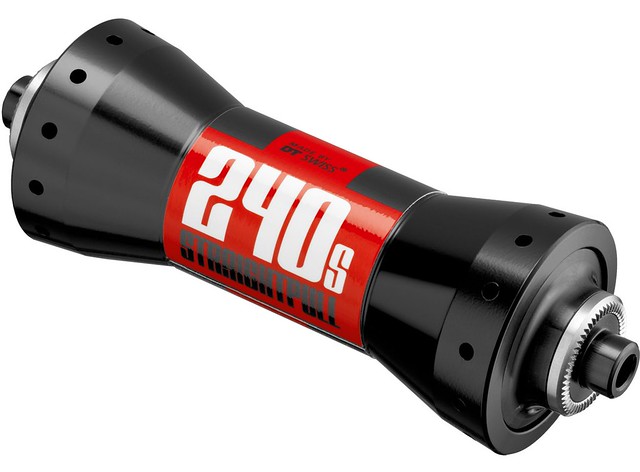
Although DT Swiss now offers a wide range of products for road and MTB cycling, the core of the company's success rides with its pairing of the now legendary 240 hubs with its patented spoke designs, including the super light weight Aerolite bladed spokes. The varied combinations of these two components have allowed DT Swiss to provide a complete, light, reliable and high performance wheelset in several configurations for a variety of uses.

DT Swiss products can be seen performing at the highest levels through the company's sponsorship of both road and MTB cycling teams. DT Swiss extends sponsorship to the professional peloton in IAM cycling as well as Team Stolting, 8Bar, Focus CX Team, Cube Action Team, Intense Factory Team, Scott Odlo, Yeti Factory Race Team and many others.  


Untitled
DT Swiss 240s Hubs

Here at TiC, I am usually very critical, wary and pretty standoffish when it comes to articles that appear to promote a product, brand or technology. Sometimes I am downright ornery. The equipment I use and write about is all based on my own (un?)educated selection, using my own money just like everyone else. As a consumer I always view product and brand promotion in the cycling press with a sprinkle of suspicion as there always seems to be a bit of patron politics at work and I am always left wondering what the reviewer really felt, but didn't want to offend their patron in print. I have always maintained full disclosure as part of my responsibility to the reader. This case is no different.

When I was offered the opportunity to visit the DT Swiss facility in Taichung, I had to give it some serious consideration. I finally decided I could, in good conscience, tour the facility and publish an article as long as I was free to write unobstructed and unhindered by those nice people at DT Swiss.

As a former customer of DT Swiss, it was my opinion that any weight my writing may lend to the company, will be matched in quality, reliability, support and corporate equity. If this had been another company I felt produced substandard products or lacked a wide net of support, I would not do it or I would not be shy about highlighting the negatives. I would hate it if my enthusiastic recommendation nudged someone over the edge to buying a product that turned out to be unsafe, with an evasive warranty, or complete shit. This matters to me.  

Untitled
DT Swiss-Taichung Office

In 2007, DT Swiss extended their operations to Taiwan, where they now employ 180 full-time office and production employees at three different Taiwan locations. The move put the Swiss manufacturer directly in the epicenter of the bicycle industry, which paved the way for closer cooperation between the supply chain, the manufacturer and the end user. It was a move that made it possible to inject DT Swiss production standards into a greater number of products and brands through OEM partnerships. You may be riding on DT Swiss technology without even knowing it.

Currently, DT Swiss handles production for Scott Syncros wheelsets, as well as supplying high-end hubs for other highly regarded brands, such as: Giant, Specialized, Trek and Cannonade-- allowing brands to market an in-house wheelset rather than having to reinvent... the...wheel (ahem!...sorry).

Moreover, DT Swiss handles OEM work from over 400 international customers, including: FFWD, Reynolds, ENVE, Intense, Pivot, Yeti, Canyon, Cube, Ghost, Rose, Orbea, Felt, Fuji, Ibis, Santa Cruz, Rocky Mountain, Norco, Devinci, KTM, Merida, GT and a whole universe of other established brands.

Untitled
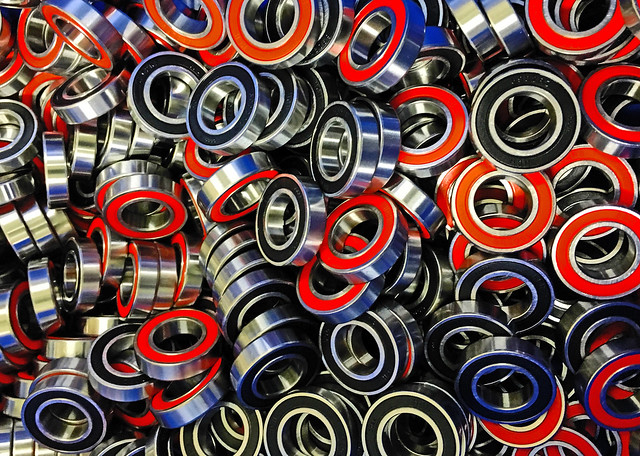
Bearings

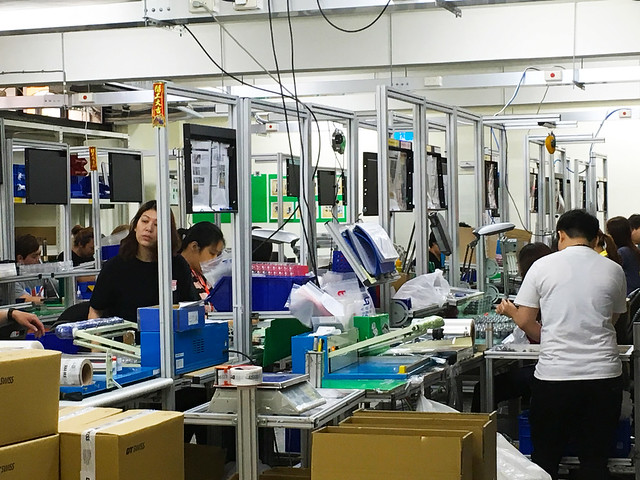
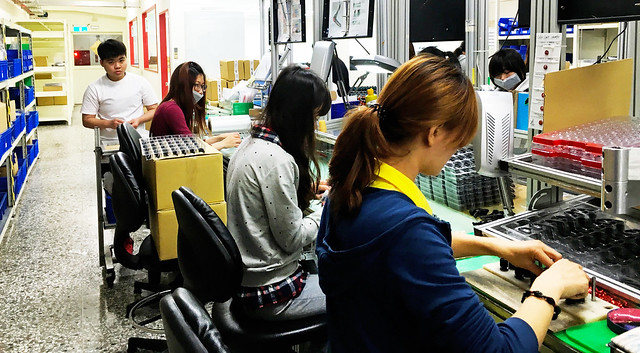
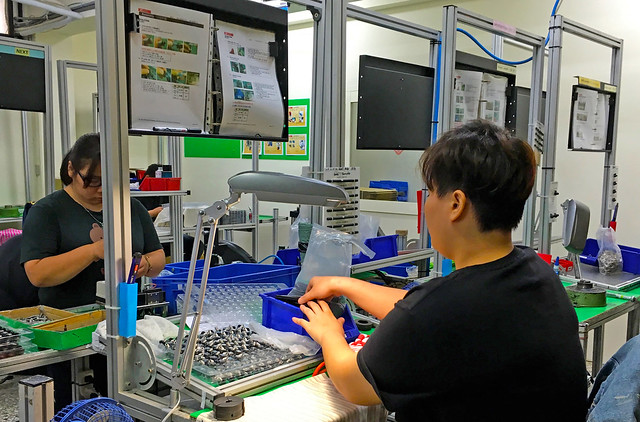
Having worked in light industrial jobs a time or two in the past, the factory tour was completely familiar as we passed from floor to floor and room to room in a sequence that fits the logic of synchronized production. While manufacturing work is not necessarily Hollywood sexy, bathed in key lighting and dry ice, the facilities were clean, orderly, and a completely scaled replication of the home facilities in Biel. This allows the company to retain tight controls on quality and procedures.
Untitled
Hub Production

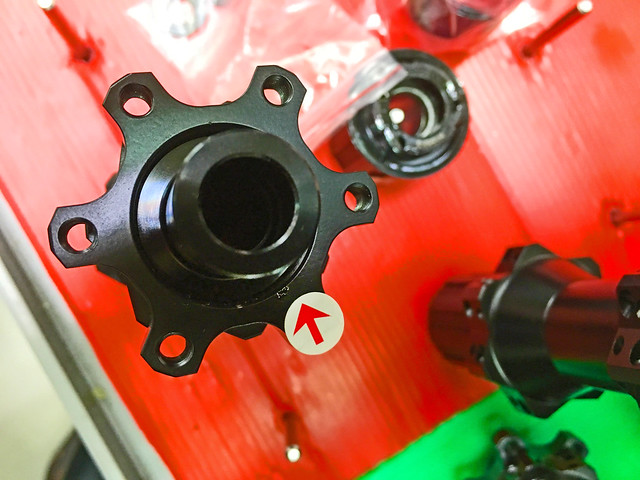
Those storied front and rear hubs come into the Taichung facility from a regional supply chain that allows DT Swiss to better leverage its volume against the higher quality and cost of each component. This gives the company space to offer higher performance at lower price points; a factor many smaller companies do not have the clout by volume to attain and thus rely on lower quality internals to compete at a certain price point. Some may complain that DT hubs are not the cheapest, but there seems to be more of a companywide inclination toward the quality end of the spectrum. 
Untitled
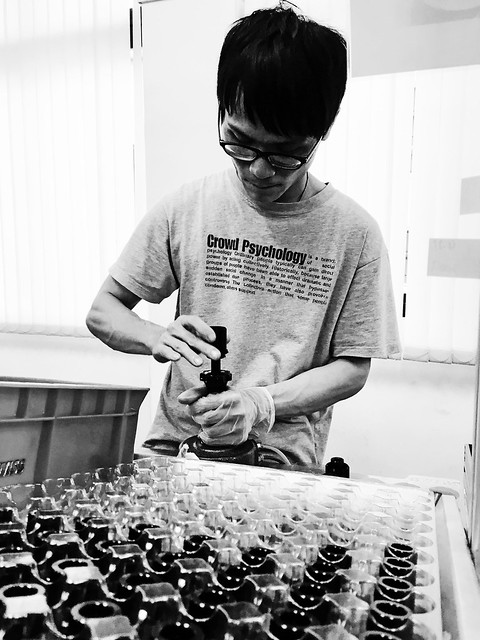
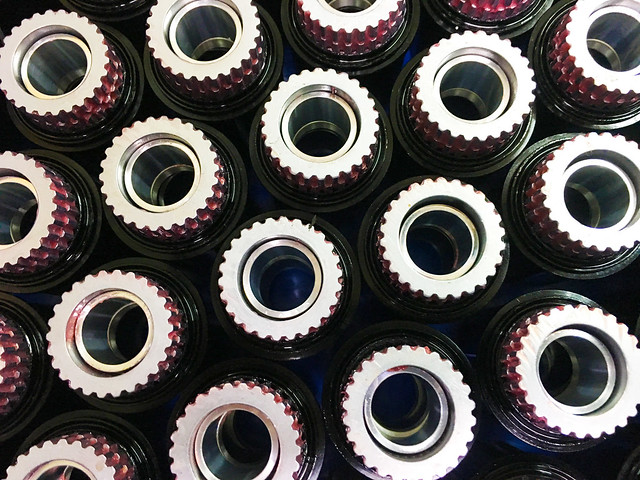
The bearing seats, ring nuts and inner hub shells are lightly greased and then packed into place. The axle and bearing are then slid into place, followed by the second bearing. The ring nut and shims are then prepped and installed. Rear hubs have the ratchet greased followed by the spring to hold it firm and then the assembly is capped by the rotor. Adapters are pushed together from either end before the finished hub is sent out for labelling.
Untitled

Untitled

Untitled
Aside from the individual parts, bearings, springs, caps et al, the hubs are completely assembled in-house, where the process and integrity can be tightly managed.
Untitled
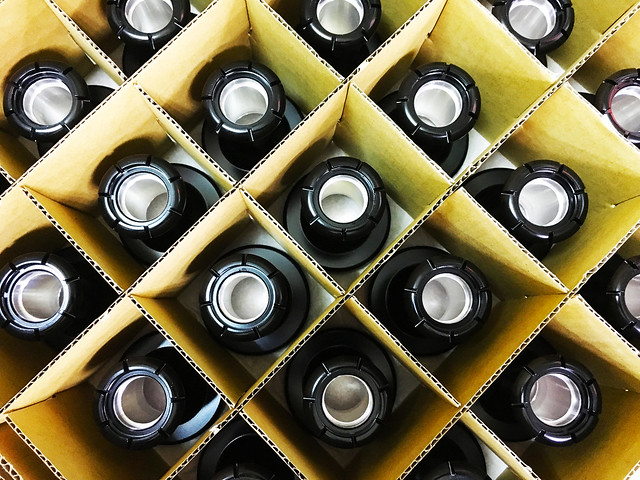
Hub Shells

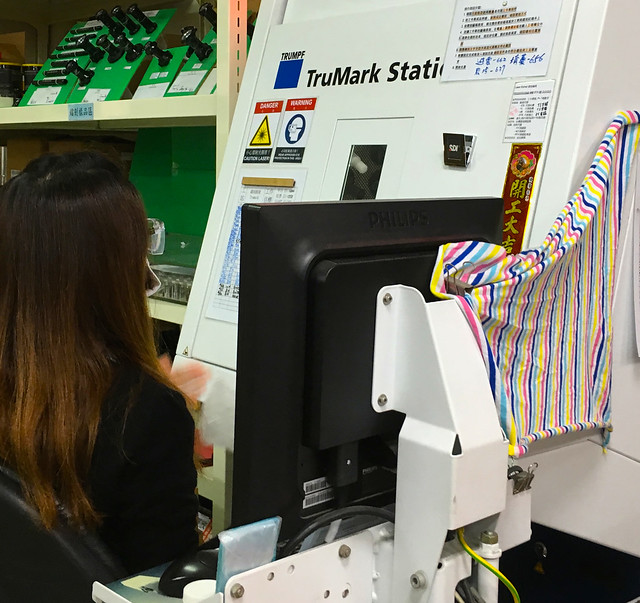
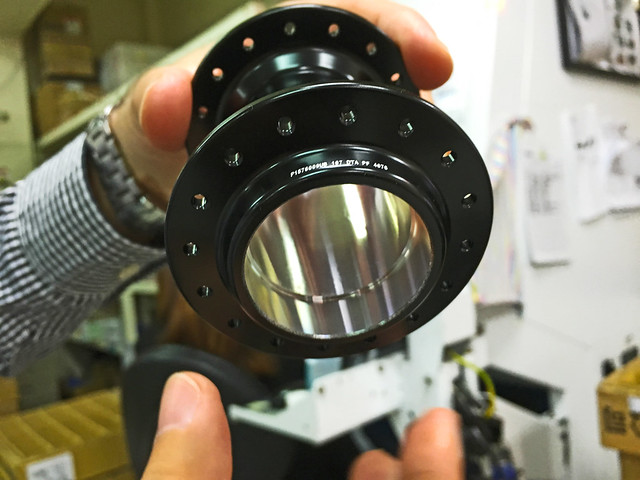
In some cases, hub shells are laser etched with logos or design details per customer request. Giant specs a large number of laser etched hubs from DT Swiss.
Untitled

Untitled
Quality Control

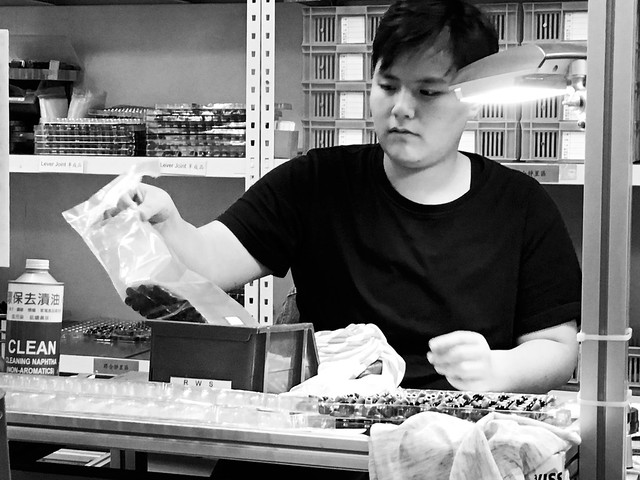
One thing I was trying to quietly keep an eye on, was the extent of the quality control systems in place at DT Swiss. When customers find their components were manufactured in Asia, there often seems to be an unfounded fear that the quality will somehow suffer. I think anywhere in the world there are cases where suppliers attempt to move the goalposts and get away with skipping procedures and of skimping on QC in an effort to shave a few more pennies off production. At DT Swiss, I saw similar controls as you would expect to find in any light industrial environment.

I once worked in a factory cutting Carl Zeiss lenses--arguably one of the most celebrated lenses for precision and quality. The quality controls and factory environment were, in a broader sense, nearly identical to DT Swiss.

Each hub is inspected along the way for flaws (these don't even have to be functional flaws) before it reaches the next stage in assembly. The hub pictured above has a slight inclusion in the coating and was duly marked and removed from production, and the cause traced and remedied.

Hubs are all marked with an individual serial number so that any anomaly can be traced, addressed and corrected.
Untitled
Serial Numbers
Untitled
Greasing

Untitled
Production Management

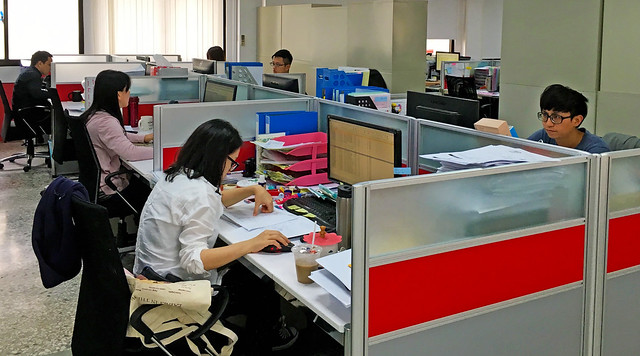
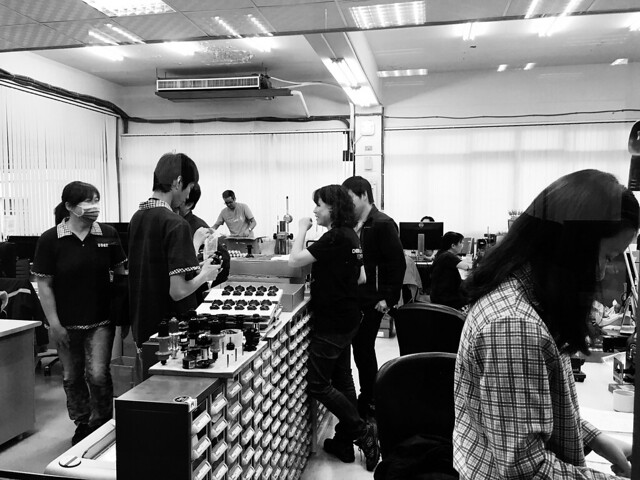
I was also surprised to see how the production management monitored quality, output and customer orders. The atmosphere in the production office seemed collaborative and low pressure. This is very important in maintaining quality. Sometimes high pressure or the threat of instability in production can lead to an environment that reduces both quality and efficiency.

I know what an adversarial work environment looks like, and how little it accomplishes. This seemed like a healthy work environment filled with young professionals. I asked about employee compensation, and while I couldn't nail down specific numbers, I was assured that employees were both well trained and well compensated compared to similar occupations in the local economy.

UntitledUntitled
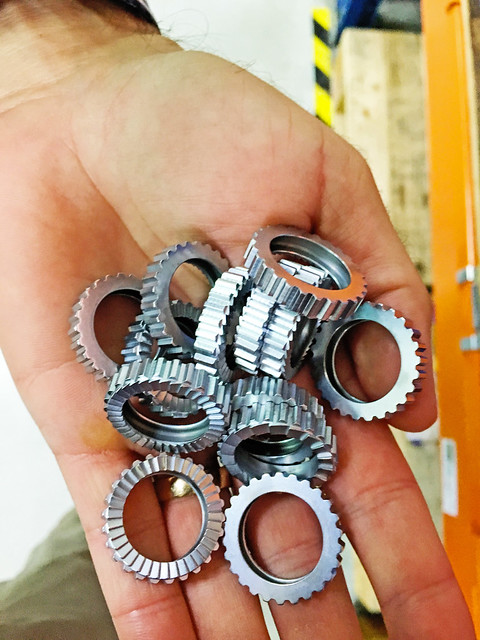
DT Swiss Ratchets

My overall impression of DT Swiss hub production is that they run a very tight, professional facility with adequate quality control systems within an amicable environment that, from my brief tour, seemed conducive to maintaining a healthy exchange of vital information that could have some bearing on the final product. The employees worked with the speed of experience, but nothing slapdash and definitely not the lazy "差不多了" (whatever/good enough!) sentiments I have heard about from the work culture of some... neighboring countries... ahem!

The DT Swiss 240 series of hub is probably one of the best and most reliable hubs on the mass market and may even be comparable to some of the big names in smaller production houses. For years I have considered the 240 to be in the same elite category as Chris King, Phil Wood, Hope, and White Industries. I had actually been thinking about 240s the last time around if I hadn't bought a complete wheelset. True! DT Swiss uses their patented, "Star Ratchet" system in the freewheel to provide instant acceleration in an easily maintained package. One of my few complaints with using Chris King hubs was that they were finicky to the extreme. A couple hundred miles in the saddle and I would be adjusting the tension of the free hub. DT 240s have a reputation for being tight, light, durable and easy. They may not have the same bling factor as Kings, but for a rider who just wants to go fast and go now, the eye candy can come later. 

For me, I really like easy. Living in Taiwan, space is a premium. You can't be spending every weekend with your bike, its components and internals, strewn all over the coffee table. You also can't be running back the have your hubs dissected after each surprise rain squall on an April afternoon. The less I need to remember about maintenance, the more I like it.    
Untitled
Ratchets

Untitled
Spoke Coil

From the world of hubs, I was taken into the other world of DT Swiss, Taichung-- the world of spokes.

Spokes really give life to any wheel. Count, gauge, weight, stress, length, lacing, material and nipple quality all play a factor for giving any wheel its seemingly magical properties to transform the quality of any ride and provide the longevity that makes a wheel safe for thousands of kilometers of riding. At any given time the entire weight of a rider is balanced upon the tight matrix of tiny wires that keep our wheels from collapsing into a mess of tattered and bent material on the side of the road.

One of my Tuesday night rides involves cresting an unlit section of hill over the outstretched starry lights that clutter the void above western Taichung between Dadu and Shalu. The route takes me up and down 4 miles of gradients averaging over 7%, where I have hit 70kph on some sections of the descent, while keeping ahead of any vehicle traffic. Every drainage grate I hit, I feel a little bite of fear. It always scares the hell out of me that one of these nights a grate will reach up and grab my wheel or the impact will harm the wheel's integrity and in an instant. It is a sobering fear and a very human fear. Vigilance. Nobody wants to die on the road. It scares the hell out of me.

It also reminds me that I need to trust my equipment. If I feel I have made a good choice in my wheelset, I feel less fear and stay off the brakes (braking is a great way to slip). In cycling there is a psychological necessity to trust your equipment. If you are constantly in fear of some terminal failure, you will always hold back and never risk taking things too far. If a product has threatened to fail on you before, do you want to roll the dice a second time? I reach the crest of that hill, take a breath, look behind me, then jump on the pedals into the abyss. I know my bike will take care of me. The trust is there. 

A well built, reliable, strong and true wheelset is essential for building that trust with your equipment and it really starts with the spokes. A spoke may be, individually, less than 2.0mm in diameter, but together in a wheel, they hold, not only the weight of the bike and rider, but they also must hold up to the stresses of velocity during heroic descents, track precisely under the forces digging into banked curves, and push against gravity wrestling up thigh snapping climbs.

Take your bike down and just spend a few minutes looking at the design of the wheel, and then appreciate how the evenly measures stresses pulling on that skinny hoop are what keep you from burying your face into the pavement on your next outing. The inside of a wheel is mostly air.   

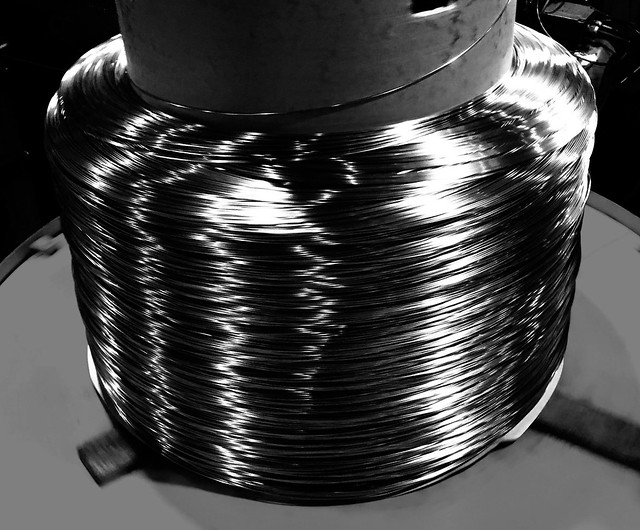
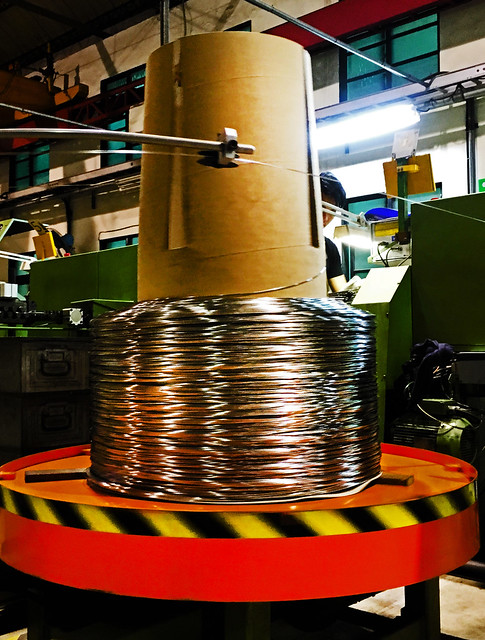
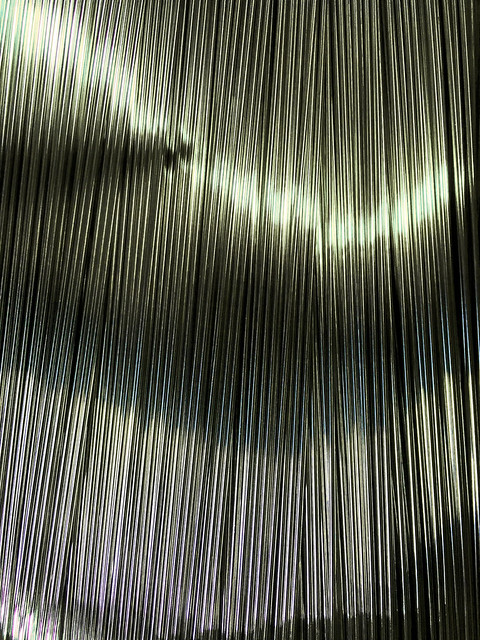
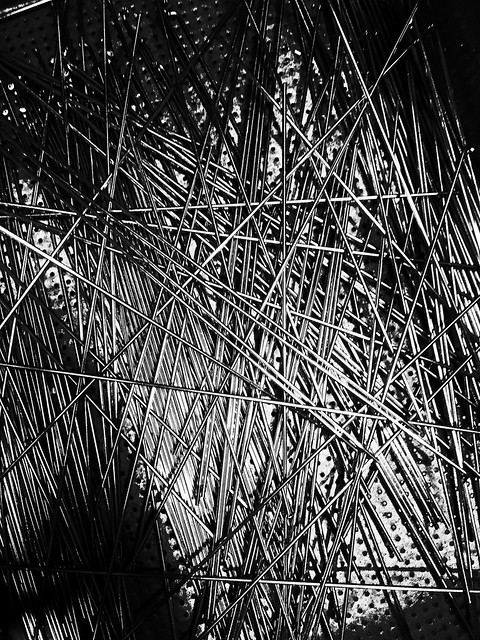
To make high quality spokes, DT Swiss spokes start their lives of drudgery as a massive 700kg wire coil. Each coil can produce approximately 100,000 spokes with DT Swiss turning out around 200 million spokes annually.
   
Untitled


The wire is unspooled and slowly fed through the machinery that straightens the wire while avoiding any stress on the spoke that could compromise its structural integrity.

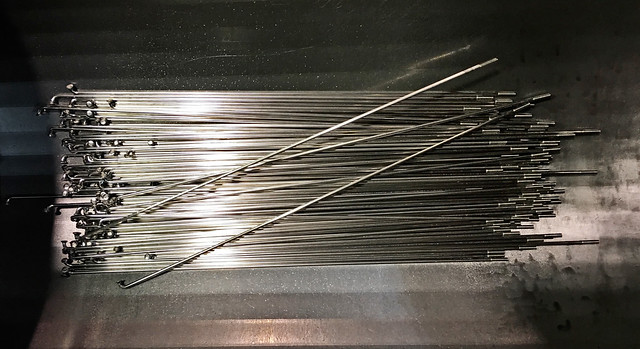
The spokes are cut to length, receive their threads, and J-bend before they are collected in the hopper.
Untitled
Newly Minted Spokes
Untitled

Untitled
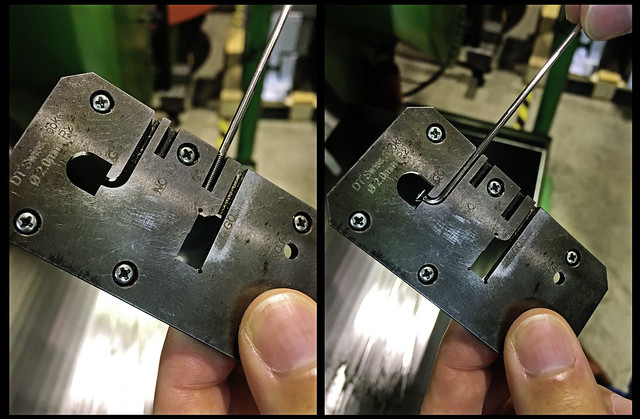
Spoke Integrity Check

The spokes are inspected for quality in their thread length and in the J-bend with the flange sitting flush. Spokes that do not meet DT Swiss standards are collected and rejected.

Untitled
Rejects

Some DT Swiss butted and bladed spokes, spokes like the Aeorlite, undergo a cold forging process that subjects the spokes to a type of ultrasonic treatment for strength and lightness.

Another highly secretive process that remained hidden from view, behind imposing steel doors-- doors too technologically sensitive to be photographed-- was the process used to "blacken" spokes with a deep coloring process, which, unlike paint, prevents the spoke from discoloring from wear or from contact vibration in cross-spoke patterns.    
Untitled
Overstock

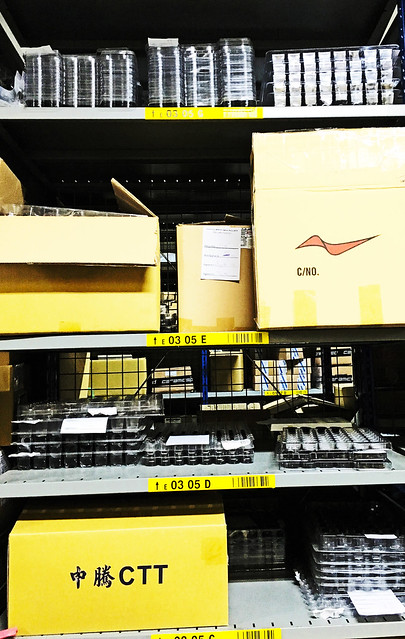
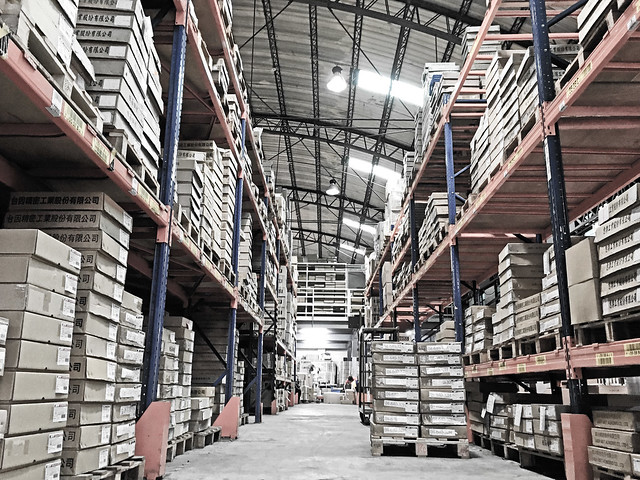
With custom orders, DT Swiss keeps a ready supply in overstock, so that customers can quickly respond to a rush order without having to wait for the machinery to be scheduled for another run. This adds flexibility and keeps production costs down. It is far cheaper to run a few extra units for overstock, than to set up for an entirely new production run.

DT Swiss keeps materials and supplies warehoused on site for immediate access. The entire facility seemed compliant with international regulations and guidelines. I recall having to jump through the ISO hoops several years ago to gain certification. Not long after the ISO evaluation succeeded, the procedures and guidelines were replaced with business as usual. I did not see anything at DT Swiss that remotely looked like business as usual.

I left feeling satisfied with the integrity and quality of DT  Swiss products and production methods, and I felt my questions had all been answered in a satisfactory manner. It is only with this in mind that I felt I could, in good conscience, write an extensive, fair and thoughtful review of a wheelset offered by DT Swiss. Once the test period has concluded, Taiwan in Cycles will publish the review in full.

Now I have an excuse to ride the hell out of a set of wheels...like my life depends on it.

Stay tuned for a review of the DT Swiss Dicut RR21 Wheelset.

Many DT Swiss components may get their uncelebrated start within the walls of the nondescript Taichung production facility, but many of these nearly identical parts may lead the most extraordinary of mechanical lives, limited only by a rider's own sense of adventure.     
Untitled
Warehouse